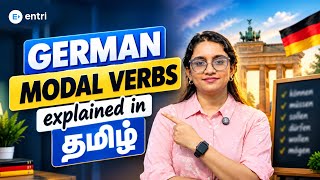
How do you say “I can speak German”, “I must work today” or “I would like a coffee” in German? All of these need modal verbs, one of the most used grammar topics in everyday German. The Learn German Modal Verbs in Tamil course explains the six key modal verbs (können, müssen, dürfen, wollen, sollen and möchten/mögen) in simple Tamil. You’ll learn what each verb means, how to conjugate it, and the important rule that sends the main verb to the end of the sentence. This free course is ideal for Tamil-speaking beginners, students preparing for Goethe A1 or A2, and anyone planning to study or work in Germany. By the end, you’ll be able to form clear, natural sentences to express ability, permission, wishes and obligations.
Speak German Confidently – Let Our Experts Guide You!
Learn from expert instructors, immerse yourself in real-world conversations, and master German with confidence. Secure your spot today and start your journey to fluency! 🌍
Basic German knowledge helps: Knowing simple greetings and present-tense verbs like “sein” and “haben” will make lessons easier, but it isn’t mandatory.
A device with internet: A smartphone, tablet or laptop is all you need to watch the lessons anytime.
A notebook for practice: Writing out conjugation tables and sample sentences helps you remember them faster.
Basic Tamil understanding: All explanations are in Tamil, so every rule is easy to follow.
Willingness to practise aloud: Saying sentences out loud builds speaking confidence along with grammar.
German Modal Verbs
German Modal Verbs in Tamil
Video
German Modal Verb ‘Wollen’
Video
Placement Oriented Programs by Entri
German Language Course A1 to B2
Effortlessly excel in German A1 to B2 with the guidance of skilled mentors on Entri. Your path to acquiring vital...
German A1 Course
Effortlessly master German A1 with expert guidance from skilled mentors on Entri. This course is your gateway to acquiring essential...
German A2 Course
Effortlessly master German A2 with expert guidance from skilled mentors on Entri. This course is your pathway to gaining essential...
German B1 Course
Effortlessly master German at the B1 level with expert guidance from skilled mentors on Entri. This course is your pathway...
German B2 Course
Effortlessly master German at the B2 level with the guidance of skilled mentors on Entri. This course is your pathway...
Generative AI for Professionals Course in Kerala
The first comprehensive Generative AI course designed for professionals in Kerala. Learn how to automate up to 40% of your...
Airport Management Course in Kerala
Entri’s latest course addition – Airport Management Course in Kerala – in association with SpeedWings Aviation Academy, is one of...
Robotics Course For Beginners in Malayalam
Ever wondered how robots think, move, and sense the world around them? Now you can find out – and build...
HR Management Course
Transform your career with our HR Management direction. Gain crucial talents and know-how to excel inside the ever-evolving HR panorama....
Certification in Advanced Video Editing
This Video Editing Course equips learners with industry-ready skills in storytelling, professional editing, color grading, motion graphics, and ad creation...
UI/UX Design with AI
Learn to design intuitive user interfaces and seamless user experiences using AI tools. This course blends UI/UX fundamentals with AI-powered...
Executive Certificate Program – Digital Marketing
Entri Elevate’s Digital Marketing Executive Certification Program is meticulously crafted to empower you as a digital expert, offering comprehensive knowledge...
Stock Market Course
Begin your investment journey and potentially multiply your income with expert guidance from seasoned traders.
AI Tools Mastery
This course gives a simple introduction to Artificial Intelligence and its real-world uses. Learn about GenAI tools, content creation, automation,...
Know more about placement oriented programs at Entri
FAQs
Are German modal verbs difficult to learn?
Not really. There are only six main modal verbs, and they follow a clear pattern. Once you understand the “verb at the end” rule, you can build many useful sentences quickly. This course explains everything step by step in Tamil.
Who is this course to learn German modal verbs in Tamil for?
It’s for Tamil-speaking beginners, students preparing for Goethe A1 or A2, and nurses, job seekers or anyone planning to move to Germany who wants a strong grammar foundation.
What do I need to use for this course?
Just a smartphone or laptop with internet, and a notebook for practising sentences. No special software is required.
How long does it take to complete this course
The course can be completed in a few hours. With 20–30 minutes of daily practice, most learners can use modal verbs comfortably in speaking and writing within one to two weeks.
Why Choose Our Free Course to Learn German Modal Verbs in Tamil?
Used in daily conversation: Modal verbs appear constantly when asking for things, making plans or explaining what you need.
Key for Goethe exams: Modal verbs are tested across A1 and A2 Lesen, Schreiben and Sprechen tasks.
Sound polite and natural: Phrases with “möchten” and “können” help you make polite requests at work, shops and offices.
Foundation for advanced grammar: Understanding modal verbs makes past tense, subordinate clauses and higher levels much easier.
Taught in Tamil: Every meaning, rule and example is explained in clear, simple Tamil.
Real-life examples: Lessons use sentences from everyday situations like travel, work, shopping and appointments.
Easy conjugation tables: Get simple charts to quickly revise all six modal verbs.
Expert mentors: Learn from experienced German trainers who know where Tamil-speaking learners usually get stuck.
Meanings of all six modal verbs: What können, müssen, dürfen, wollen, sollen and möchten/mögen express and when to use each.
Conjugation patterns: How modal verbs change with ich, du, er/sie/es, wir, ihr and sie/Sie.
Sentence word order: Why the modal verb takes second position and the main verb moves to the end.
Questions and negation: How to ask questions and say “can’t”, “don’t have to” and “must not” correctly.
Polite requests: How to use “möchten” and “können” to sound courteous in German.
Avoiding common errors: Typical mix-ups like “müssen nicht” vs “dürfen nicht” and how to avoid them.<ul dir=”ltr”>
<li><strong>Basic German knowledge helps:</strong> Knowing simple greetings and present-tense verbs like “sein” and “haben” will make lessons easier, but it isn’t mandatory.</li>
<li><strong>A device with internet:</strong> A smartphone, tablet or laptop is all you need to watch the lessons anytime.</li>
<li><strong>A notebook for practice:</strong> Writing out conjugation tables and sample sentences helps you remember them faster.</li>
<li><strong>Basic Tamil understanding:</strong> All explanations are in Tamil, so every rule is easy to follow.</li>
<li><strong>Willingness to practise aloud:</strong> Saying sentences out loud builds speaking confidence along with grammar.</li>
</ul>
Register now and get instant access to our Free Course!
Registration Successful!
You now have access to the Free Course. Let’s begin your journey to success!