

What Is Sahyog Portal?
The Sahyog portal is India’s – pretty ambitious – attempt at getting all the internet middlemen – that’s social media, messaging apps, and online shops – into one central online spot to take down any dodgy content that breaches Indian law. It’s meant to make things easier for the government agencies that have to chase all this around.
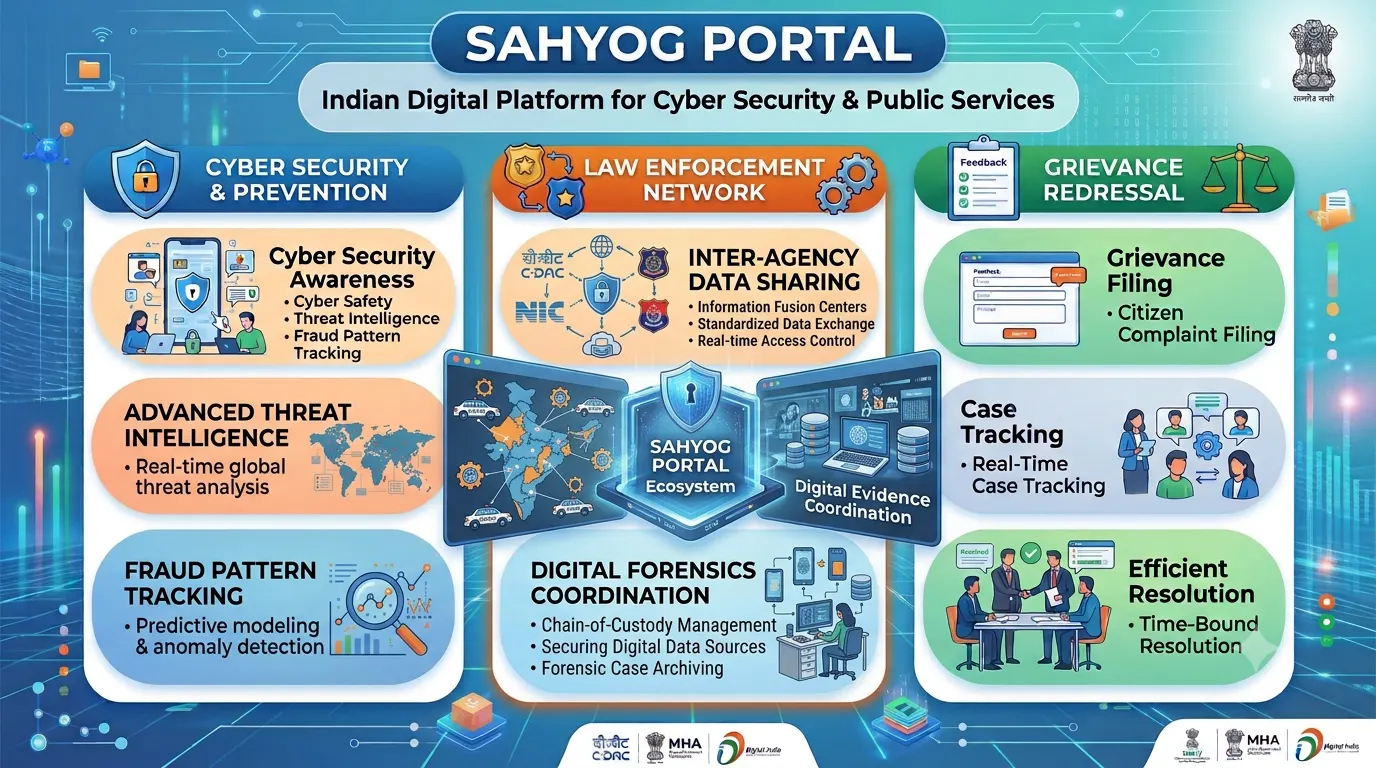
sahyog portal
Its Run by I4C under the Ministry of Home Affairs
The Sahyog portal is basically a project of the Indian Cyber Crime Coordination Centre (I4C), which falls under the Ministry of Home Affairs (MHA) . If that sounds complicated, think of the I4C as the person in charge of dealing with cybercrime in the Indian government – and Sahyog is one of the tools they are using to make internet platforms behave.
When it launched
It actually started in October 2024, and by early 2025, the government said that 38 different online platforms (including big names like Microsoft and Google) had signed up, as well as law enforcement and six central ministries from all around the country.
What’s the Point of this Sahyog Portal?
The Indian government wants to make a few things happen with this portal:
- We want to be able to take down dodgy content a lot faster.
- Get a central way for all the different agencies and platforms to talk to each other so we don’t have to deal with a load of separate emails and letters
- Use the Sahyog portal to combat online nastiness like bank fraud, child abuse and hate speech
- Get all the states working together so they don’t all have to build their own systems
Legal Trouble: Which Laws Apply
The government is fighting with itself over which bit of the Information Technology Act, 2000 actually lets them order online content to be taken down – and what protections are in place to make sure that doesn’t get abused.
| Provision | Who can issue | Safeguards | Consequence of non-compliance |
| Section 69A | Central government (through a designated committee) | Reasoned written orders; grounds limited to national security, public order, etc.; review committee; procedural rules under 2009 Blocking Rules | Blocking order enforceable; non-compliance can lead to prosecution |
| Section 79(3)(b) | “Appropriate government or its agency” (broadly interpreted by government to include police and ministries) | No statutory hearing requirement; no mandatory reasoned order under the provision itself; due-diligence obligation under Rule 3(1)(d) of 2021 IT Rules | Intermediary loses safe harbour—exposed to liability for user content |
What Safe Harbour Means for Intermediaries
Safe harbour is the legal protection that keeps platforms from being held accountable for the content that users post on them. Under section 79 of the IT Act, an intermediary isn’t considered the publisher of user-generated content – as long as they exercise some level of due care. But section 79(3)(b) makes it clear that this protection vanishes if the intermediary is informed of unlawful content via a court order or government notification and they still fail to do anything about it.
The Shreya Singhal (2015) Connection
When the Supreme Court looked at the Shreya Singhal v. Union of India case, they wiped out Section 66A of the IT Act, but left Section 69A and the 2009 Blocking Rules in place – mainly because they have safeguards in place to prevent abuse – things like orders being properly justified, a way to review decisions, and strict rules on what you can take down. Crucially, the Court also interpreted Section 79(3)(b) to mean that intermediaries only have to act when a court order or a government notification is properly processed, and not just when someone (informal or not) comes along and demands removal of content. X Corp are making a strong point that Sahyog brings back the kind of informal removal process that Shreya Singhal was actually trying to stop.
How the Sahyog Portal Actually Works
According to what the government said in the Karnataka High Court, the process goes like this:
- An agency flags content: Someone in a central ministry, state police, or some other approved body gets in touch with the Sahyog system and flags some content as unlawful. They choose the law that they think has been broken.
- The notice is sent through the portal: The platform gets the notice, which shows up on their Sahyog dashboard – it includes the URL of the content in question and the law they think has been broken.
- The intermediary acts or responds: The platform can take down the content, ask for more information, or explain why they can’t comply. If the agency doesn’t accept their reasons, they get a notice to explain themselves – and if they continue to ignore that notice, they might start to lose their safe harbour protection under Rule 7 of the 2021 IT Rules – which could be a real problem.
- You can see where you are: Not only can the agency see where things stand, but so can the platform – the status is tracked on the Sahyog dashboard.
Who Is Connected to Sahyog?
The people who are able to use Sahyog come from all over – both the government and the private sector:
- Central agencies: Government departments like the Ministry of Railways have already started using the portal.
- State police and agencies: 28 states and 5 Union Territories have appointed officers who can use the platform.
- Social media platforms: Major players like Google, Meta, Microsoft, ShareChat, and LinkedIn have joined up.
- Messaging apps and e-commerce sites: The portal is open to any intermediary, not just big social media sites.
Sahyog Portal – Some Key Facts (2026)
| Fact | Detail |
| Ministry | Ministry of Home Affairs (MHA) |
| Operator | Indian Cyber Crime Coordination Centre (I4C) |
| Legal provision invoked | Section 79(3)(b) of the IT Act, read with Rule 3(1)(d) of the 2021 IT Rules |
| Intermediaries onboarded | 38 (as of early 2025), including Google, Meta, Microsoft |
| Legal status (as of 2026) | Upheld by Karnataka HC single bench (Sept 2025); on appeal; Supreme Court has stayed High Court proceedings and is considering transfer of all challenges to itself |
The Sahyog Portal Debate: X Corp Case and Court Rulings
Government’s position
The government defends Sahyog as a facilitative tool, not a censorship mechanism. Its arguments, accepted in broad outline by the Karnataka High Court’s single bench, include:
- The portal merely streamlines compliance with an existing legal obligation under Section 79(3)(b): intermediaries must remove content that is already unlawful under Indian law.
- Rule 3(1)(d) is a due-diligence requirement, not an independent blocking power; nodal officers can only flag content that is prohibited by some other law.
- The portal is an instrument of “public good” for combating cybercrime, in the words of Justice M. Nagaprasanna.
- X Corp, as a foreign company, cannot invoke Article 19’s free-speech protections, which are citizen-centric.
Challengers’ arguments
X Corp and later petitioners (including Kunal Kamra and Haresh Jagtiani) argue that Sahyog creates an unconstitutional parallel regime:
- Bypasses Section 69A safeguards: The portal allows thousands of police officers and officials to issue takedowns without the reasoned orders, review committee, and narrow grounds that Shreya Singhal held essential.
- Lacks reasons or a hearing: Notices can be issued on vague allegations of “illegality” without prior notice to the speaker or a meaningful opportunity to contest.
- Contradicts the Bombay HC fact-check ruling: X Corp points to the Bombay High Court’s decision striking down the government’s Fact Check Unit as evidence that similar bypass mechanisms are constitutionally suspect.
Case timeline
- September 24, 2025: Karnataka High Court single bench (Justice Nagaprasanna) upholds Sahyog and Rule 3(1)(d); dismisses X Corp’s petition.
- November 2025: X Corp files a writ appeal before a division bench, arguing the single judge misread Shreya Singhal and ignored its 91% compliance record.
- February 2026: Kunal Kamra and Haresh Jagtiani file separate writ petitions in the Bombay High Court challenging Sahyog and the 2025 amendment to Rule 3(1)(d).
- July–August 2026: The Supreme Court stays all High Court proceedings and considers the Union government’s transfer petitions to consolidate the challenges before itself.
Sahyog vs Other MHA/DoT Cyber Portals
| Portal | Purpose | Users |
| NCRP (cybercrime.gov.in) | Citizen-facing reporting of cybercrime; complaints routed to police | General public, law enforcement |
| CEIR / Sanchar Saathi | Track and block stolen mobile phones; verify device authenticity | Mobile users, DoT |
| Pratibimb | Madhya Pradesh resident identity authentication and welfare delivery (state-level, not a content-takedown tool) | MP state government, residents |
| Sahyog | Government-to-platform content takedown notices and tracking | Authorized agencies, intermediaries |
Sahyog Portal for Competitive Exams: Revision Highlights
- What is it: A one-stop-shop portal for online content takedown requests that the government can send to any platform.
- Who’s behind it: I4C – the people who work for the Ministry of Home Affairs.
- When was it launched: October 2024. That’s when all this got underway.
- The government claims it’s allowed by: Section 79(3)(b) + Rule 3(1)(d) of the 2021 IT Rules – bit of a mouthful, huh?
- Trouble’s brewing: They’re accused of dodging safeguards that were set up in a 2015 case, Shreya Singhal.
- This is the key case: X Corp vs Union of India. The Karnataka High Court said the portal is okay (September 2025), but the Supreme Court is still looking at it (2026).
- Some numbers to know: 38 platforms have joined the Sahyog scheme so far, and it’s now working with 28 states and 5 Union Territories.
Conclusion
The Sahyog portal is right in the middle of a really big argument in India about how the government can control what people see on the internet, and how far they can push online platforms to do their bidding. With the Supreme Court now looking at all the different case bits and bobs, the outcome is going to shape how all of us interact with the internet for the next little while, at least. For people taking exams, Sahyog is a great example of the complicated relationship between fighting cybercrime and keeping the internet free – and this is definitely not the end of this story.
