

Introduction
Have you ever wondered how a government subsidy reaches your bank account? That is DBT at work.
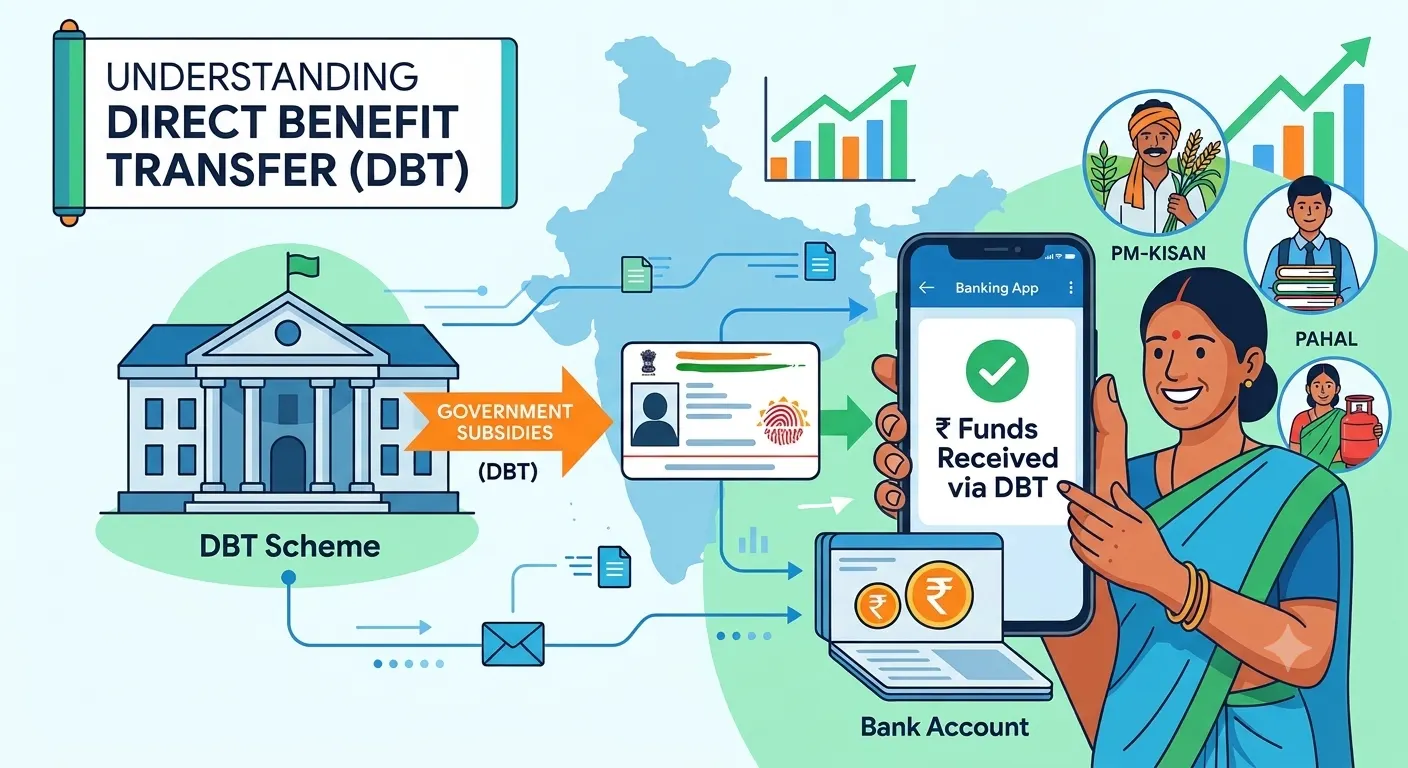
Direct Benefit Transfer (DBT) sends government money straight to your bank account. It started on 1 January 2013. The DBT Mission under the Cabinet Secretariat runs it. The money moves through Aadhaar-linked bank accounts. No middlemen are involved.
direct benefit transfer dbt
What Is Direct Benefit Transfer (DBT)?
DBT is a way of paying government benefits. The amount is sent directly to the beneficiary’s bank account. It can be a subsidy, a scholarship, a pension or a wage.
Earlier, many people handled the money before it reached you. Some money may not reach the person as expected. Payments are digital, so they are easy to track.
Think of DBT as a direct pipe from the government to your account.
DBT is not a scheme. It is just a payment method, and each scheme follows its own rules.
Launch date and the DBT Mission
DBT started on 1 January 2013. It began with scholarships and a few other schemes in selected districts. Then it spread across the country.
The DBT Mission now works under the Cabinet Secretariat. It guides ministries and states. The official portal is dbtbharat.gov.in.
Data point: The number of beneficiaries grew from about 11 crore to 176 crore.
The JAM Trinity: Jan Dhan, Aadhaar, Mobile
DBT works because of three things. Together, they are called JAM.
- Jan Dhan: A bank account for every person.
- Aadhaar: One unique ID to prove who you are.
- Mobile: A phone number to get payment alerts.
Objectives of DBT
The government had clear goals behind DBT.
- Cut leakages and middlemen: Money reaches people without cuts on the way.
- Remove ghost and duplicate beneficiaries: Fake and repeat names are dropped.
- Pay on time: Digital payments are faster than paper-based ones.
- Target correctly: Only real, eligible people get the benefit.
- Promote financial inclusion: More people start using bank accounts.
How Does DBT Work?
The process is simple. Here is how a payment moves.
- Beneficiary identification: The scheme picks eligible people.
- Aadhaar seeding: The person’s Aadhaar number is linked to their bank account.
- PFMS: The government creates the payment order here.
- NPCI Aadhaar Payment Bridge: The payment is routed using the Aadhaar number.
- Bank account: The money lands in the beneficiary’s account.
Sometimes, payment is also made through normal bank transfer like NEFT.
Role of PFMS and NPCI
PFMS is the Public Financial Management System. It tracks money from the government to the beneficiary.
NPCI is the National Payments Corporation of India. Its Aadhaar Payment Bridge sends the money to the right bank account.
Who Is Eligible to Receive DBT Benefits?
You do not apply for DBT alone. You apply for a scheme. DBT only delivers the payment.
Eligibility depends on the underlying scheme
Every scheme sets its own rules. These can be about income, age, land or occupation. A farmer scheme has farmer rules. A scholarship has student rules. Always read the scheme’s official guidelines.
Basic requirements to receive DBT payments
Most schemes need these four things.
- A bank account in your own name
- Aadhaar seeded to that account
- Account mapped with NPCI
- An active mobile number
How to check Aadhaar seeding and DBT status
Follow these easy steps.
- Open the official UIDAI website or the myAadhaar portal.
- Choose the option to check Aadhaar and bank account linking status.
- Enter your Aadhaar number and the security code.
- Enter the OTP sent to your mobile. An OTP is a one-time code.
- See which bank account is linked and what the status is.
You can also visit your bank branch for help.
Types of DBT: Cash vs In-Kind Transfers
DBT has two types. In a cash transfer, money goes to your account. In an in-kind transfer, you get goods, like food grains.
| Type | Example scheme |
| Cash transfer | PM-KISAN, scholarships, pensions |
| In-kind transfer | Food grains under PDS |
Major Schemes Covered Under DBT
Over 300 schemes use DBT. They come from many ministries. Here are some well-known ones.
| Scheme | Benefit | Ministry |
| PM-KISAN | ₹6,000 a year to farmers | Agriculture and Farmers Welfare |
| PAHAL (LPG) | Cooking gas subsidy | Petroleum and Natural Gas |
| MGNREGS | Wages for rural work | Rural Development |
| PM-Ujjwala | Support for free LPG connections | Petroleum and Natural Gas |
| Scholarships | Money for students’ studies | Education and other ministries |
| PDS / food subsidy | Subsidised food grains | Consumer Affairs, Food and Public Distribution |
| Pensions (NSAP) | Monthly pension for older and needy people | Rural Development |
Benefits of DBT
DBT helps both the government and the people.
- Less leakage: Money reaches the real beneficiary.
- Faster payment: No long waits at offices.
- More transparency: Every payment can be tracked.
- Fewer fake names: Duplicate and ghost entries are removed.
- Better use of public money: Savings can go to other needs.
- More bank users: Many people opened accounts for the first time.
Data point: DBT has saved about ₹3.48 lakh crore in total. Food subsidy alone accounts for ₹1.85 lakh crore, which is 53% of the savings. Under MGNREGS, 98% of wages were paid on time.
Challenges and Criticism of DBT
DBT is not perfect. Some people still face problems.
- Aadhaar authentication failures: Fingerprints or OTPs sometimes fail.
- Exclusion errors: Some real beneficiaries get left out.
- Last-mile banking access: Many villages are far from banks.
- Payment failures: Money fails to arrive if the account is inactive or not mapped.
DBT Key Facts and Latest Figures (2026)
| Fact | Figure |
| Launch year | 2013 (1 January) |
| Nodal agency | DBT Mission, Cabinet Secretariat |
| Schemes covered | About 320 (as of September 2026) |
| Total transferred | Over ₹43 lakh crore by April 2025 |
| Transferred this fiscal | ₹2.08 lakh crore by mid-September 2026 |
| Cumulative savings | About ₹3.48 lakh crore |
| Beneficiary growth | About 11 crore to 176 crore |
These figures come from reports at specific times. They keep changing. Check dbtbharat.gov.in for the latest numbers.
DBT for Competitive Exams: Quick Revision Points
- DBT began on 1 January 2013.
- The DBT Mission works under the Cabinet Secretariat.
- JAM means Jan Dhan, Aadhaar and Mobile.
- PFMS tracks payments. NPCI’s Aadhaar Payment Bridge sends them.
- DBT has two types: cash and in-kind.
- Subsidy share in total spending fell from 16% to 9%.
- DBT is a payment method, not a scheme.
Conclusion
DBT sends welfare money straight to your bank account. It cuts leakages and saves time. Keep your bank account, Aadhaar and mobile number linked. Always check your scheme’s rules on official websites.
