

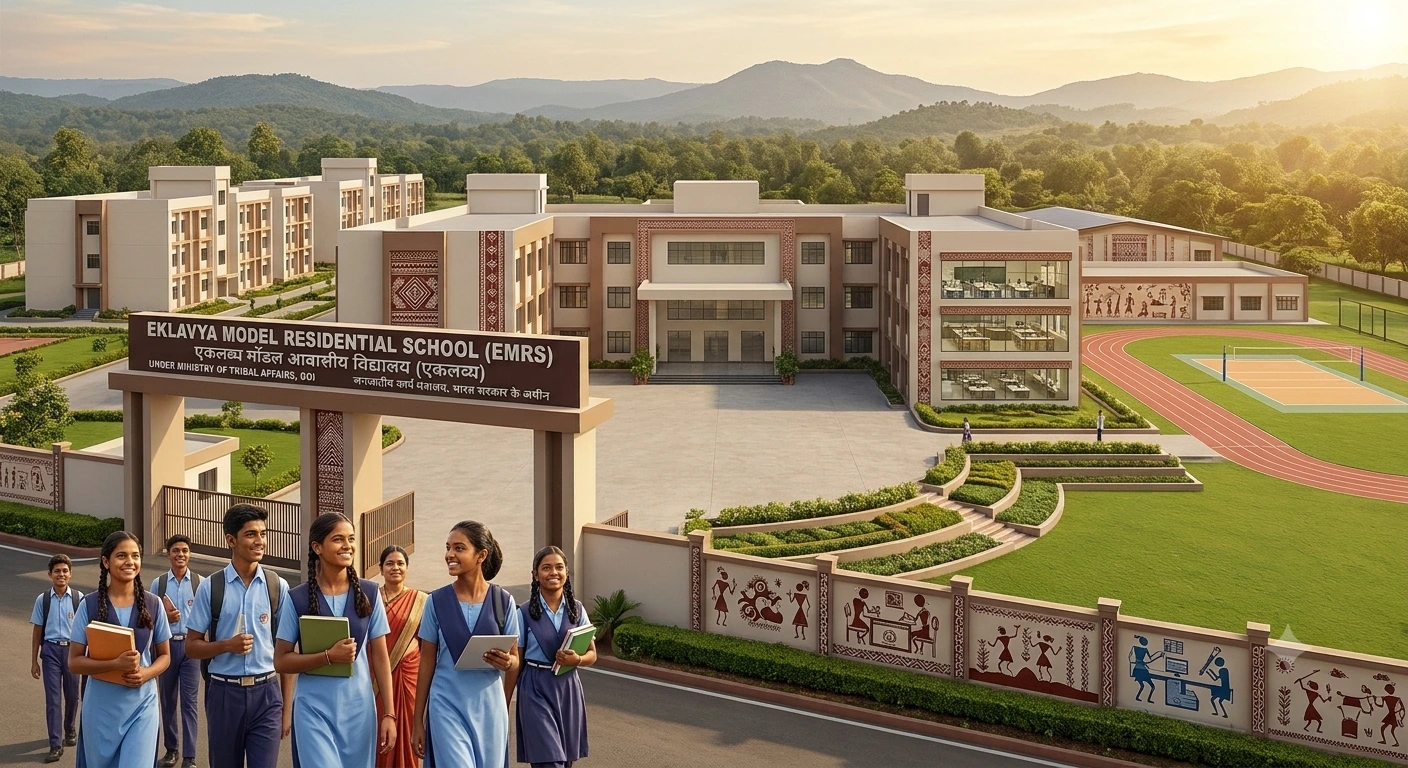
Eklavya Model Residential Schools (EMRS) are residential schools established by the Government of India to provide quality education to Scheduled Tribe (ST) students, particularly those living in remote and tribal areas. They are managed by the Ministry of Tribal Affairs through the National Education Society for Tribal Students (NESTS). Education and residential facilities are provided to eligible students, generally without charge.
EMRS
What Are Eklavya Model Residential Schools?
Eklavya Model Residential Schools (EMRS) are government-aided residential schools which offer quality education to Scheduled Tribe (ST) pupils mainly in remote and tribal locations. These institutions provide education from class VI to class XII with emphasis on academic excellence, cultural awareness and overall growth. The plan is being implemented by Ministry of Tribal Affairs through National Education Society for Tribal Students (NESTS).
| Key Fact | Details |
| Launch Year | 1997-98 |
| Ministry | Ministry of Tribal Affairs, Government of India |
| Classes offered | Class VI to Class XII |
| Eligible students | Primarily Scheduled Tribe(ST) students |
| Cost to students | Education and residential facilities are generally free for eligible students. |
Launch Year (1997–98) and the Ministry of Tribal Affairs
The EMRS scheme was introduced in 1997-98 by the Government of India with a view of improving access to excellent education to tribal children. It comes under the Ministry of Tribal Affairs and aims to improve educational opportunities for ST students across the country.
Funded Under Article 275(1) of the Constitution
Initially, the EMRS was funded through Grants under Article 275(1) of the Indian Constitution. These grants are used for state development efforts, such as educational facilities for native people. Later, EMRS was designed as a separate Central Sector Scheme for expansion and strengthening of the program.
Revamp in 2018–19 and Merger of EMDBS in 2022
In 2018-19, the government modified EMRS initiative to increase access to quality residential education in tribal-dominated areas. The plan was modified to create schools in blocks having more than 50 % ST population and a minimum of 20,000 tribal people based on Census 2011 data. The Eklavya Model Day Boarding Schools (EMDBS) were amalgamated into EMRS system on 29th April, 2022.
Objectives of Eklavya Model Residential Schools (EMRS)
To give Scheduled Tribe (ST) students, particularly those who reside in remote and tribal areas, equal opportunity and a high-quality education is the primary goal of Eklavya Model Residential Schools (EMRS), which are operated by the Indian government. The following are the primary goals:
- Children from tribal communities should be provided with a proper education, and their academic performance should be improved.
- Equal treatment with Jawahar Navodaya Vidyalayas (JNVs): Provide educational facilities that are on par with those that are offered at JNVs.
- Enhance students’ intellectual, physical, social, creative, and leadership abilities through holistic development by encouraging them to develop these qualities.
- Encourage the preservation of tribal customs, dialects, traditions, and cultural heritage in order to preserve tribal culture.
- Preparing pupils for higher education, competitive examinations, and professional courses is one of the opportunities available to them.
- Career development is the process of providing students with the information and abilities they need to become self-sufficient and engage in employment prospects.
EMRS Eligibility
The Eklavya Model Residential Schools (EMRS) are primarily responsible for providing residential education to pupils who are classified as Scheduled Tribes (ST). The student’s eligibility, the number of seats that are available, and the official admission requirements for the academic year are all factors that determine admittance.
Which Blocks Get an EMRS?
According to the information obtained from the Census of 2011, the current standards for the system demand the development of EMRS schools in regions that have a population that is comprised of more than fifty percent of STs and at least twenty thousand tribal people. Using this criterion, it is feasible to identify the areas in which indigenous communities have a greater need for enhanced access to education of a higher quality.
Student Eligibility: ST Students, Classes 6–12
Students who are interested in enrolling must fulfilll the prerequisites that are outlined in the admission notification that is applicable to them.
- To fulfilll the requirements of the rules, you must belong to a Scheduled Tribe group that is eligible.
- You should submit your application for the proper class, which is often Class VI.
- Maintain the required age as well as any other prerequisites for admission.
- In cases where it is applicable, you must qualify through the announced selection process.
- Please provide the necessary copies of your academic records and certificates.
Seat Reservations and Priority Groups
There are specific groups that are given particular consideration in accordance with the EMRS entrance guidelines:
- Particularly Vulnerable Tribal Groups (PVTGs) are given a total of five percent of the available seats.
- In accordance with the standards, five percent of the available seats are set aside for communities that are classified as Semi-Nomadic, Denotified, or Nomadic for the Nomadic Tribe.
- In terms of the number of seats available, there are equal numbers of boys and girls.
- Candidates who are not members of the Scheduled Tribes: According to the guidelines that have been established, up to ten percent of the seats can be filled by non-ST candidates who are eligible. With priority given to certain vulnerable groups, such as children who have been impacted by Left Wing Extremism and children whose parents are disabled or widowed.
EMRS Admission Process
It is the responsibility of the National Education Society for Tribal Students (NESTS) and the relevant state authorities to ensure that admission to Eklavya Model Residential Schools (EMRS) is carried out in accordance with the guidelines that have been released. Official admission guidelines have been released by NESTS for the academic year 2026–2027.
Steps to Apply for EMRS Admission
- Check notification: Check admission dates and eligibility on the NESTS website or state EMRS portal.
- Submit application: Follow the state’s procedures to apply online or offline.
- Take the entrance exam. According to the rules, Class VI admission requires the Eklavya Model Residential School Selection Test (EMRSST).
- See the merits: Read the selection list and follow the document verification instructions.
- Complete admission: Complete the admission process and submit the relevant documents on time.
Documents Required for EMRS Admission
According to the official announcement, have the following documents ready:
- Scheduled Caste (SC) certificate, if relevant
- Birth certificate or other valid proof of age
- Previous school records or class mark sheets
- Certificate of residence, if needed
- Passport size photograph
- Other documents required by the admissions authority.
Benefits and Facilities for Students
The Eklavya Model Residential Schools (EMRS) are intended to provide a variety of educational and residential amenities to enable academic and personal growth of Scheduled Tribe (ST) children. The project focuses at providing quality education to the indigenous children especially those in remote places.
Free Education, Hostel and Meals
Eligible students generally receive education and residential facilities without charge. Key benefits include:
- Free schooling and academic support.
- Separate hostel facilities for boys and girls.
- Meals and dining facilities.
- Essential learning materials and student welfare support.
CBSE Curriculum, Smart Classes and Labs
The EMRS is intended to give facilities for modern education at par with Jawahar Navodaya Vidyalayas (JNVs). They include:
- Curriculum compatible with CBSE Learning based on NCERT.
- Laboratories of science and computer.
- Classrooms equipped with technology and digital learning resources.
- Libraries and other academic facilities
Sports, Skill and Vocational Training
The following are some of the ways in which students are encouraged to participate in extracurricular activities and learn important practical skills:
- The facilities for both indoor and outdoor sports.
- Activities and events of a cultural nature that help to maintain Indian heritage.
- programs that focus on the development of skills and occupational competence.
- Training in specialized sports through particular centers of excellence that have been authorized.
Free JEE/NEET Coaching and Scholarships
EMRS students may receive academic support for competitive exams like JEE and NEET, depending on school activities. Other government scholarships are available to eligible students. However, not all schools offer these incentives, so students should check.
Per-Student Recurring Grant
From 2025-26, the government increased the annual EMRS payment from ₹109,000 to ₹147,062 per student. Medical expenditures, CBSE fees, stationery, school bags, and sanitary napkins are covered by this subsidy. The funding supports educational expenses, not individual student payments.
Who Manages EMRS? NESTS and State Societies
Eklavya Model Residential Schools (EMRS) are managed by the Ministry of Tribal Affairs, the National Education and Training Services (NESTS), state-level groups, and district governments. It is the responsibility of each committee to ensure that the administration, education, and welfare of the students are of a high standard.
| Body | Role |
| Ministry of Tribal Affairs | The management of the EMRS project and the provision of overall policy guidance are both the responsibilities of this organization. |
| State/UT EMRS Societies | Individually, they are accountable for the management of school administration, staff, and day-to-day operations within their particular areas of responsibility. |
| District-level committees | In addition to assisting in the resolution of any implementation difficulties, you should monitor the operation of the local area. |
| NESTS | Provides support for recruitment, establishes criteria, and assesses school performance in addition to coordinating implementation. |
EMRS Recruitment: Teaching and Non-Teaching Jobs
Eklavya Model Residential Schools (EMRS) hires teachers and non-teachers. To fill school openings in India, the National Education Society for Tribal Students (NESTS) uses the EMRS Staff Selection Examination (ESSE).
Major Posts in EMRS Recruitment
- The Principal shall be responsible for the administrative and academic functioning of the institution.
- A Post Graduate Teacher (PGT) is responsible for teaching subject at senior secondary level.
- Trained Graduate Teachers (TGT) are instructors in subjects taught at the secondary level.
- The Hostel Warden shall be responsible for the supervision of hostel facilities and the welfare of the students.
- The Accountant maintains the financial records and bookkeeping.
- JSA is the Junior Secretariat Assistant. This is a position that deals with administrative and clerical chores.
- Lab Attendant: Provides assistance with laboratory equipment and practical work.
EMRS Recruitment Exam Pattern
As per the ESSE-2025 notice, the selection process usually consists of Tier I and Tier II exams. Tier I is an objective screening test. Tier II tests the relevant knowledge in the specified examination format. Interviews for the posts of Principals; Skill Test for the posts of JSA. Candidates are advised to go through the official announcement for post wise eligibility and selection norms.
EMRS Key Facts and Latest Figures (2026)
Eklavya Model Residential Schools (EMRS) continue to expand educational opportunities for tribal students across India. According to the official NESTS dashboard, updated in October 2026, the scheme has approved 728 schools, with 525 functional schools and 172,043 students enrolled.
| Fact | Figure |
| Target number of schools | 728 approved EMRSs |
| Functional schools | 525, as of October 2026 |
| Students enrolled | 172,043, according to the NESTS dashboard |
| Recurring grant per student | ₹147,062 annually from FY 2025–26 |
| NESTS formation year | 2019 |
The grant amount is as revised and stated for FY 2025-26. Figures may fluctuate with the addition of new schools and updated enrollment.
EMRS for Competitive Exams: Quick Revision Points
- Full form: Eklavya Model Residential Schools.
- Launch: 1997–98.
- Ministry: Tribal Affairs Ministry.
- Management: National Education Society for Tribal Students manages.
- Focus: ST kids
- Funding: The original financing source was Article 275(1) of the Indian Constitution.
- Goal: Quality education and overall development for tribal students.
Challenges Facing EMRS
EMRS faces various problems that could impair education quality and student welfare, notwithstanding its success.
- Some approved schools are still closed, limiting tribal students’ access.
- Shortages of trained teachers might impair classroom teaching and academic support.
- Temporary campuses: Building delays may limit access to labs, dorms, and other amenities.
- Student retention: Language, residence, and family issues may affect attendance and schooling. Check national data of a rising dropout rate before making such assumption.
- To guarantee all schools have suitable facilities, funding, construction, and maintenance must be timely.
CONCLUSION
The Eklavya Model Residential Schools (EMRS) are playing a key role in providing quality education and residential amenities to the children belonging to Scheduled Tribes all over the country. The initiative aims at creating better opportunities for tribal communities with concentration on academic excellence, preservation of culture and holistic development. For latest admission updates, recruitment notifications and scheme details kindly visit official NESTS website.
