

Introduction
Have you seen a new school building or village road with an “MP fund” board? That money comes from MPLADS.
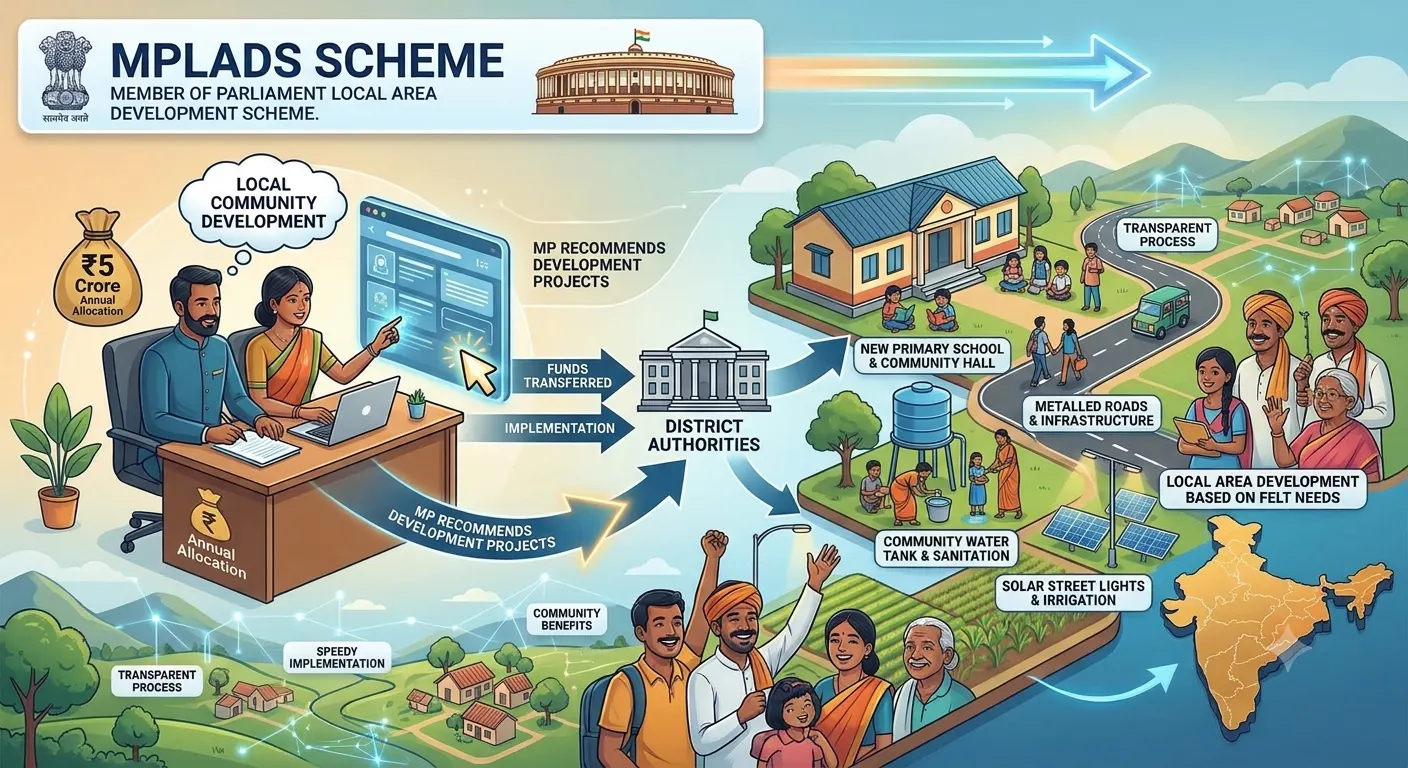
MPLADS lets every Member of Parliament suggest development works in their area. It started in 1993-94. Each MP gets ₹5 crore a year. The district authority and implementing agencies carry out the works.
mplads scheme
What Is the MPLADS Scheme?
MPLADS stands for Members of Parliament Local Area Development Scheme. It is a government scheme for local development.
Every MP gets a yearly fund. The MP suggests works that people in the area need most. These can be roads, school buildings, drinking water or health centres.
The MP does not spend the money directly. The MP only recommends the work. Officials check it and get it done. So, think of the MP as the one who picks the work, and the officials as the ones who make it happen.
Launch year and nodal ministry (MoSPI)
The scheme started in 1993-94. The Ministry of Statistics and Programme Implementation (MoSPI) looks after it. It makes the rules and tracks the work.
Data point: Each MP gets ₹5 crore every year.
Central Sector Scheme with non-lapsable funds
MPLADS is a Central Sector Scheme. This means the Central Government pays for it fully. States do not share the cost.
The funds are non-lapsable. Unspent money does not vanish at the end of the year. It carries forward to the next year.
Objectives of MPLADS
The scheme has some clear goals. Here are the main ones.
- Durable community assets: Build things that last for years, like roads and school buildings.
- Locally felt needs: Works should match what people in the area really need.
- MP-led local development: MPs get a direct say in how their area grows.
- Disaster relief support: Funds can help areas hit by severe calamities, like floods.
In short, the scheme aims to bring small but useful change to local areas.
How MPLADS Works: Fund Flow and Implementation
Here is how a work moves from an idea to a finished project.
- MP recommends: The MP suggests a work to the district authority.
- District authority checks and sanctions: Officials check if the work fits the rules. If it does, they approve it.
- Implementing agency executes: A government agency builds the work.
- Monitoring on eSAKSHI: Every step is tracked on the eSAKSHI portal.
The Government of India sends the money to the district authority of the MP’s nodal district. It comes in two instalments of ₹2.5 crore each. Since 1 April 2023, this whole process runs online through eSAKSHI.
The MP’s recommendatory role vs the district authority’s powers
| Point | MP | District authority |
| Suggests works | Yes | No |
| Checks if the work is allowed | No | Yes |
| Handles the funds | No | Yes |
| Handles the funds | No | Yes |
| Picks the implementing agency | No | Yes |
MPLADS Eligibility: Who Can Recommend Works?
Only sitting MPs can recommend works. Citizens cannot apply for the funds. But people can ask their MP to suggest a work.
Where an MP can suggest works depends on the type of MP.
Lok Sabha MPs, Rajya Sabha MPs and nominated MPs
| MP type | Where they can recommend works |
| Lok Sabha | MPIn their own constituency |
| Rajya Sabha | MPIn districts of the state they were elected from |
| Nominated | MPIn districts of any one state of their choice |
Works outside the constituency (₹50 lakh limit, ₹1 crore for severe calamity)
Data point: An MP can recommend works outside their area, up to ₹50 lakh in a financial year. In a severe calamity, this limit goes up to ₹1 crore.
Eligible Works Under MPLADS
Most works that meet local needs are allowed. The focus is on lasting assets. Here are some examples.
- Roads and bridges
- School buildings
- Drinking water facilities
- Health facilities
- Sanitation works
- Sports infrastructure
Other works that meet local needs can also be taken up. The scheme guidelines give the full list. A work must follow those rules to get approval.
Mandatory earmarking for SC/ST areas
Data point: Every year, MPs must recommend works worth at least 15% of their fund for areas with a large SC population. For ST areas, it is at least 7.5%.
Funding for trusts and societies
Data point: MPs can fund assets built by trusts and societies. The limit is ₹75 lakh a year, under the scheme’s conditions.
Works Not Allowed Under MPLADS
Some works are not allowed under the scheme.
- Private or commercial assets
- Religious buildings
- Land acquisition
- Repairs and maintenance
- Grants and loans
The scheme is for public assets that serve everyone. So, works that help only a person or a business do not qualify.
Benefits of MPLADS
MPLADS helps local areas in many ways.
- Quick local help: MPs can fund small works that people need fast.
- Lasting assets: Roads, buildings and water points stay useful for years.
- Support for weaker areas: SC and ST areas get a fixed share every year.
- Help in disasters: Funds can be used for calamity relief.
- Online tracking: People can see how works are going.
- Joint use with other schemes: MPLADS can join other government schemes for bigger impact.
Criticism and Challenges of MPLADS
The scheme is useful, but it faces some problems.
- Unspent balances: Many funds are not used on time.
- Delays: Many works stay pending for long.
- Misuse allegations: Some reports raise doubts about how funds are used.
- Separation-of-powers debate: Critics say MPs make laws. They should not run local works.
- 2020-21 COVID suspension: The scheme was stopped for a time during the pandemic.
MPLADS Key Facts and Latest Updates (2026)
| Fact | Detail |
| Launch year | 1993-94 |
| Nodal ministry | MoSPI |
| Type of scheme | Central Sector Scheme |
| Annual entitlement | ₹5 crore per MP |
| Instalments | Two of ₹2.5 crore each |
| eSAKSHI launch | 1 April 2023 |
| Dashboard revamp | 6 March 2026 |
| Guidelines | 2023 guidelines in force; revision in progress |
The revamped dashboard shows works recommended, sanctioned and completed in each constituency. The ministry is also working on new guidelines. The final changes are not yet known.
MPLADS for Competitive Exams: Quick Revision Points
- MPLADS began in 1993-94.
- MoSPI is the nodal ministry.
- It is a Central Sector Scheme.
- Each MP gets ₹5 crore a year.
- Funds are non-lapsable.
- MPs recommend. The district authority sanctions.
- 15% goes to SC areas and 7.5% to ST areas.
- eSAKSHI is the online portal.
Conclusion
MPLADS gives each MP ₹5 crore a year for local development. The MP recommends, and officials carry out the work. Funds do not lapse, and eSAKSHI helps people track works. Check your constituency’s works on the eSAKSHI dashboard. Then ask your MP for the works your area needs.
