

One hailstorm can wipe out months of work. PMFBY is the government’s answer to this.
It is India’s crop insurance scheme, and it started in 2016. Farmers pay just 2% of the insured amount for Kharif food crops and oilseeds, 1.5% for Rabi, and 5% for cash crops. Anyone growing a notified crop in a notified area can join.
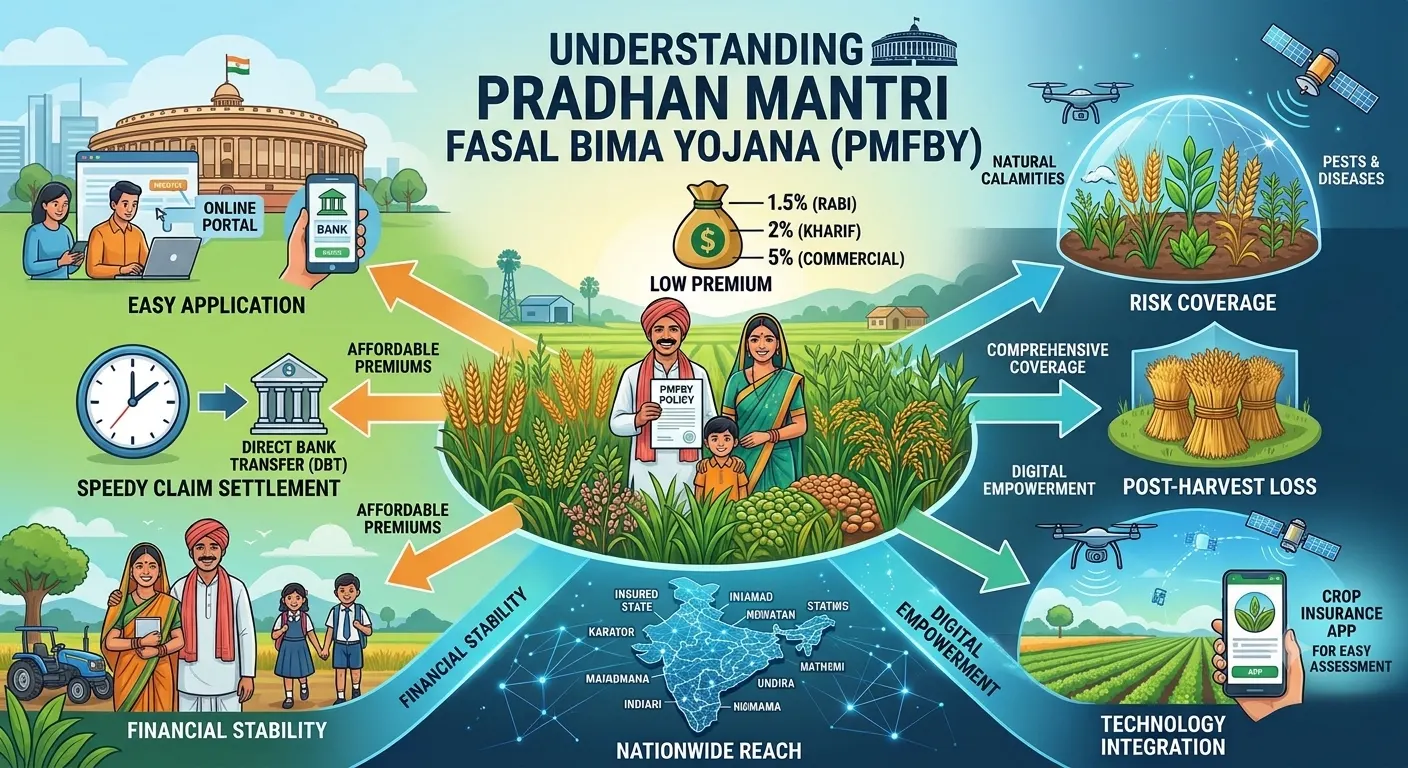
pmfby
What Is Pradhan Mantri Fasal Bima Yojana?
PMFBY pays a farmer when a crop fails because of natural causes. Floods, drought, pests, unseasonal rain. You pay a small premium, and if disaster hits, the insurance company pays your claim.
Who pays the rest of the premium? The Central and state governments do. That’s the reason farmers pay so little.
Here’s why it matters. Most small farmers borrow to farm. If the crop fails, the loan stays, and the family starts the next season in debt.
One thing to remember: the state government decides which crops and areas are covered in each season. Your village and your crop both have to be on that list.
Launch date, ministry and the schemes it replaced (NAIS, MNAIS)
The scheme was approved in January 2016 and began with the Kharif 2016 season.It is managed by the Ministry of Agriculture and Farmers Welfare. Before PMFBY, farmers had two older schemes: the National Agricultural Insurance Scheme (NAIS) and the Modified NAIS (MNAIS). PMFBY replaced both.
The numbers show how big it has grown. Since 2016, more than 92.46 crore farmer applications have been insured.
Voluntary for all farmers since Kharif 2020
In the early years, any farmer who took a seasonal crop loan was enrolled automatically. That changed in Kharif 2020. Now the scheme is voluntary for everyone, so each farmer chooses whether to join.
Objectives of PMFBY
The scheme was built around four goals:
- Give farmers money when crops fail
- Keep farm income steady from one year to the next
- Let farmers try new methods without fearing a total loss
- Crop insurance can help farmers get loans from banks more easily.
PMFBY Eligibility: Who Can Apply?
Small farmers, big farmers and tenant farmers can all apply, as long as the crop and the village are on the state’s notified list. Farmers must provide both. Otherwise, their application will not be accepted.
Loanee and non-loanee farmers
| Point | Loanee farmer | Non-loanee farmer |
| Who they are | Has a seasonal crop loan, like a KCC | Has no crop loan |
| Enrolment | Bank usually enrols them by default | Farmer enrols on their own |
| Choice | Can opt out before the cut-off date | Joins by choice |
Tenant farmers and sharecroppers
Many people farm land they don’t own. Good news: they can take cover too. You’ll need a lease or tenancy paper, and the exact rules change from state to state. Your bank or the local agriculture office can tell you what your state accepts.
Eligible crops
Three groups of crops are covered:
- Food crops like cereals, millets and pulses
- Oilseeds like mustard, groundnut and soybean
- Annual commercial and horticultural crops, such as cotton and some fruits and vegetables
Risks Covered Under PMFBY
The cover follows the crop through its life, from sowing to harvest and a little beyond.
- Prevented sowing: Heavy rain or drought stops you from sowing at all. You can get up to 25% of the sum insured.
- Standing crop: Floods, drought, pests or disease that cut your yield.
- Mid-season adversity: Crop damage caused by problems like a long period without rain.
- Post-harvest losses: Harvested crop left in the field to dry gets damaged. The crop must be cut and left in the field to dry.
- Localised calamities: Hailstorm, landslide, flooding in a small area and cloudburst.
Not everything is covered. War and theft are not, for example. The scheme rules carry the full list, so read them before you enrol.
PMFBY Premium Rates and Government Subsidy
The farmer’s share is a fixed percentage of the sum insured, and it is the same across India.
| Season / crop | Farmer share | Who pays the rest |
| Kharif food crops and oilseeds | 2% | Central and state governments |
| Rabi food crops and oilseeds | 1.5% | Central and state governments |
| Annual commercial and horticultural crops | 5% | Central and state governments |
Let’s do the maths with an example. Say a farmer insures a Rabi wheat crop for ₹50,000. At 1.5%, the farmer pays ₹750. The remaining premium amount is covered by the government. If the crop fails badly, the claim is calculated on that ₹50,000 sum insured.
How to Enrol in PMFBY
Start by checking that your village and crop are on the state list. Then note your state’s last date, because you can’t enrol after it. Pick a route, fill in your crop and land details, attach your documents and pay your share. Keep the receipt and your policy number safe. Keep both documents safe, as you may need them when asking for compensation.
One tip: look at the entry the bank or portal makes. If you sowed mustard but they noted wheat, your claim can be rejected later.
Enrolment routes
You can enrol through:
- Your bank branch
- A Common Service Centre (CSC)
- The NCIP portal at pmfby.gov.in
- The AIDE app
- An insurance company or its agent
Documents needed
Keep these ready: Aadhaar card, land record or tenancy proof, bank passbook, and a sowing certificate.
How to File a PMFBY Claim and Check Status
How you claim depends on the loss. If hail hits only your area, you have just 72 hours to report it. For wider losses, the claim comes from crop-cutting data collected across the area.
To report a loss:
- Tell the insurer as soon as the damage happens.
- Use the Crop Insurance app, helpline 14447, your bank or the insurance company.
- Give your policy number, the crop and what happened.
- Wait for the loss to be assessed.
- If your claim is accepted, the money will go to your bank account.
You can check your claim on the NCIP website, the Crop Insurance app, or by calling 14447.
Technology Behind PMFBY
- NCIP: The National Crop Insurance Portal. Enrolment, subsidies and claims run through it.
- Digiclaim: Calculates claims and pays them online.
- CCE-Agri app: Officials record crop-cutting experiment data on it.
- YES-TECH: Uses technology to estimate yield.
- WINDS: Collects local weather data from weather stations.
PMFBY Key Facts and Latest Figures (2026)
| Fact | Figure |
| Launch | Approved January 2016; began Kharif 2016 |
| Farmer applications insured | Over 92.46 crore (till Rabi 2025-26) |
| Claims paid | Over ₹2.06 lakh crore |
| Applications that got claims | Over 26.33 crore |
| Budget 2026-27 | ₹12,200 crore |
| States and UTs taking part | 25 (Kharif 2026) |
| Kharif 2026 coverage | Over 241.38 lakh farmers and 278.12 lakh hectares (as of 27 August 2026) |
Kharif 2026 enrolment has already passed the Kharif 2025 level. Also, West Bengal rejoined from Kharif 2026, and Bihar plans to return from Rabi 2026-27.
Benefits and Challenges of PMFBY
| Benefits | Challenges |
| Very low premium for farmers | Claims can take long |
| Wide range of risks covered | Some states left and rejoined |
| Tenant farmers can join | Farmers often dispute yield estimates |
| Claims paid online to the bank account | Many farmers don’t know the scheme |
| Voluntary for everyone | A wrong crop or area entry can sink a claim |
PMFBY for Competitive Exams: Quick Revision Points
- Started in 2016; replaced NAIS and MNAIS
- Run by the Ministry of Agriculture and Farmers Welfare
- Voluntary for all farmers since Kharif 2020
- Farmer premium: 2% Kharif, 1.5% Rabi, 5% for cash crops
- Prevented sowing: up to 25% of the sum insured
- Main digital platform: NCIP
- Helpline: 14447
Conclusion
PMFBY protects farmers from crop loss for a small premium, between 1.5% and 5% of the insured amount. Check your crop, your area and your state’s last date, then enrol early through your bank, a CSC or pmfby.gov.in.
