
 Rated 4.8 on Google Play
Advanced Program in Data Science Course in Malayalam
Kickstart your data science career in Kerala with our industry-aligned online course. Master programming, data analysis, visualization, MySQL, and machine learning. Designed for Kerala’s tech job market with hands-on projects and expert mentorship




Overview of Data Science Course in Malayalam
Kickstart your career in Data Science and Machine Learning with Entri’s expertly designed course, tailored for Kerala’s booming tech industry. Whether you’re a beginner or looking to advance your skills, this online program offers everything you need to excel. Learn Python, statistics, data analysis, machine learning, and data visualization through engaging video lessons, interactive discussions, and personalized mentoring

Inclusive & Immersive Hybrid Training Sessions

Industry Expert Sessions

80+ Live & Recorded Sessions

Soft Skill Sessions

Industry Networking

Placement Training

Illinois Tech Certification
Skills Covered
These are the most important skills to have if you want to succeed in the data science and machine learning fields.
Placement Stories
Here is our aspirants achievements to inspire you

Sreehari Ramesh
AL/ML Engineer

Jibin George
Data Analyst

Aswathi Mohan
Data Processing Analyst

Geethu Mol
Data Processing Analyst

Alvis John Varghese
Data Analyst Intern

Ananthu Subhash
Data Processing Analyst

Vimal Gopan
Data Analyst
Download Power BI Tutorial For Free 📥
Why Do Students Love Us?
Hear from Our Data Science Students!
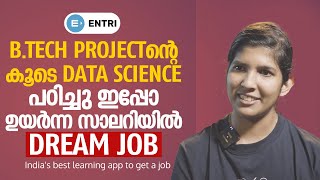

Ahini Abraham
Data Scientist Placed at
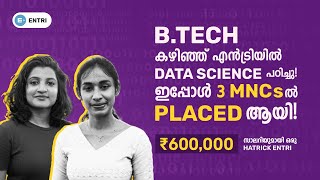
Anitta Mary Thomas
Data Scientist Placed at

Fahila K P
Data ScientistData Science Tools Covered
Illuminate the path to insights! Unlock the power of data science with these necessary tools!


Data Science Job Roles
What Exactly Does a Data Scientist Do? Lets Dive Deep into Roles!
Data Scientist
To find patterns and trends in massive data sets, a data scientist gathers, examines, and interprets the information. To glean insights and make data-driven decisions, they employ a range of instruments and methodologies. People may become qualified for this position by taking a course in data science and machine learning, which will teach them statistical analysis, computer languages, and data mining.
Machine Learning Engineer
The goal of machine learning engineers' work is to create models and algorithms that let computers learn from data and make precise predictions. These experts have a solid foundation in data science, programming, and mathematics. People who take courses in data science and machine learning can prepare for this position by gaining a strong foundation in these fields.
Data Analyst
Data analysts collect, arrange, and evaluate data to give firms valuable insight. They convey their results to important stakeholders after identifying trends and patterns using statistical tools and procedures. People who have taken a course in data science and machine learning and are proficient in analytics, visualization, and data manipulation are ideal candidates for this position.
Business Intelligence Analyst
Analysts of business intelligence are in charge of examining data to find patterns and trends that can help businesses make wise decisions. To gather information from several data sources and display it in a way that stakeholders can understand, they make use of a range of data analytics technologies. Strong analytical skills, business knowledge, and outstanding communication ability are required for this role.
Data Science Course Curriculum
Explore a comprehensive Data Science curriculum covering Python, MySQL, statistics, Power BI, and data analysis fundamentals. Gain practical knowledge through hands-on projects and preparatory sessions to build job-ready skills and explore career opportunities in Data Science.
- Program Orientation: Pre-learning
- Python Basics: Introduction to Data Science, what is Python, overview of Python libraries for Data Science, installing Anaconda and Jupyter Notebook, Google Colab walkthrough
- Python Syntax & Basics: Variables and data types, type casting, comments and indentation, input/output functions, operators
- Control Statements: Conditional statements (if, elif, else), loops (for, while, break, continue), functions, lambda functions, recursion
- Python Data Structures: Lists, tuples, sets, dictionaries, list comprehension, file handling, exception handling (try, except, else, finally)
- Modules and Packages: Importing modules, standard libraries (math, random, datetime), creating and using custom modules
- Object-Oriented Programming: Classes and objects, constructors and
__init__, instance vs class variables, inheritance and method overriding, encapsulation and polymorphism - Module Assessment: Python Module End Assessment
- NumPy: Arrays, array operations and functions
- Pandas Series: Slicing, indexing (index, boolean, loc, iloc), data manipulation (add, update, delete), attributes and methods
- Pandas DataFrame: Slicing, indexing, data manipulation, attributes and methods
- Data Analysis: Data ingestion, exploration (read_csv, head, tail, shape, columns, info, dtypes, describe, value_counts), wrangling (merge, concat, join, groupby)
- Data Visualization with Matplotlib: Scatter plot, line chart, bar chart, pie chart, histogram, box plot
- Data Visualization with Seaborn: Count plot, bar plot, scatter plot, line plot, box plot, histogram, density plot, violin plot, swarm plot, heatmap, pair plot
- Web Scraping: HTML basics, parsing with BeautifulSoup, Selenium for dynamic scraping
- Version Control: Git and GitHub basics, commands (clone, commit, push, pull, branch, merge), managing repositories, collaboration
- Module Assessment: Python Module End Assessment
- Mathematics for Data Science: Linear algebra (vectors, matrices, determinants, eigenvalues, eigenvectors), probability concepts, probability distributions, Bayes theorem, conditional probability
- Statistics Fundamentals: Descriptive statistics, measures of central tendency, dispersion (range, variance, standard deviation), symmetry (skewness, kurtosis)
- Data Analysis Concepts: Handling outliers (percentile, quartile, IQR, z-score), correlation (Pearson, Spearman), covariance
- Inferential Statistics: Bootstrapping, Central Limit Theorem, point and interval estimates, hypothesis testing, null and alternate hypothesis
- Statistical Tests: z-test, t-test, Chi-square test, F test, ANOVA, A/B testing
- Module Assessment: Statistics Module End Assessment
- AI & ML Foundations: Intro to AI and ML, history and evolution of AI, AI vs ML vs Deep Learning, types of ML, ML workflow
- AI Ethics: Bias and fairness, job displacement and automation, surveillance and privacy
- Data Preprocessing: Missing values (mean, median, mode, SimpleImputer), duplicates, outliers (boxplot, IQR, z-score), skewed data (square-root, log transformation)
- Feature Engineering: Label encoding, one-hot encoding, feature selection (SelectKBest, correlation), train-test split, feature scaling (standardization, normalization)
- Regression Models: Linear regression, evaluation measures, assumptions of linear regression
- Model Optimization: Bias-variance trade-off, overfitting and underfitting, regularization (Ridge, Lasso), polynomial regression
- Classification Algorithms: Logistic Regression, Decision Tree, KNN, Naive Bayes, SVM
- Ensemble Learning: Random Forest, Bagging, Boosting
- Model Evaluation: Classification evaluation measures, cross-validation, hyper-parameter tuning, model comparison and selection
- Clustering Algorithms: Unsupervised learning, KMeans, random initialization trap, elbow method, agglomerative hierarchical clustering, dendrograms, DBSCAN
- Dimensionality Reduction: PCA, t-SNE
- Association Rule Learning: Apriori algorithm
- Recommendation Systems: Introduction, types, building recommendation systems
- Time Series Analysis: Trend, seasonality, noise, ARIMA
- Model Deployment: Local deployment, APIs with Flask or FastAPI, serving models as REST APIs, containerization with Docker
- Mini Project: EDA, visualization, preprocessing, feature selection, model building using multiple models, project reviews, mock interviews
- Intermediate Assessment
- Deep Learning Fundamentals: Introduction, applications and real-world use cases, neural network architecture (input, hidden, output layers)
- Neural Network Basics: Perceptron, Multi-layer Perceptron (MLP), limitations of perceptron
- Activation Functions: Sigmoid, ReLU, Tanh, choosing the right one
- Artificial Neural Networks: Backpropagation, loss functions (Mean Squared Error, Cross-Entropy)
- Optimization Techniques: Gradient Descent, Stochastic Gradient Descent, hyperparameter tuning (learning rate, batch size, dropout)
- Deep Learning Frameworks: TensorFlow, Keras, PyTorch, tensors, AutoGrad, building a simple ANN in PyTorch, Keras Sequential API
- Neural Network Architectures: Sequential API vs Functional API
- Convolutional Neural Networks: CNN architecture, convolutional, ReLU, pooling and fully connected layers, image classification
- Recurrent Neural Networks: RNN architecture, vanishing gradient problem, time series prediction
- Long Short-Term Memory: LSTM architecture, LSTM vs RNN
- Natural Language Processing: Text preprocessing (tokenization, stopwords, stemming, lemmatization), Bag of Words, TF-IDF, text classification using deep learning
- Sentiment Analysis using LSTM
- Autoencoders: Types, applications, autoencoder vs PCA, building with Keras
- ChatGPT Concepts: Transformer architecture, tokens, context length, response generation, applications in education, business, productivity, code generation, analytics
- Transfer Learning: Advantages, pre-trained models (VGG16, ResNet, Inception), fine-tuning
- Hugging Face: Pre-trained models, pipelines for summarization, text generation, image generation
- Module Assessment: Deep Learning Module End Assessment
- Generative AI Fundamentals: Use cases, examples (GPT, DALL·E, MidJourney), principles, latent space, training and inference
- Generative Models: GANs, VAEs, diffusion models
- Future of Generative AI: Advancements, multimodal models, ethical boundaries, regulation, AI alignment
- Generative AI Essentials: Performance metrics and limitations
- Prompt Engineering: Role of prompts in LLMs, crafting effective prompts, zero-shot, few-shot and chain-of-thought prompting
- Module Assessment: AI & Generative AI Module End Assessment
Data Science Blogs
Explore Trending Topics of Data Science
A strong portfolio can set you apart in a competitive data science job market. Discover what to include, how to showcase your projects, and tips to build a portfolio that impresses recruiters. Let’s read more about this!
Data mining is the process of analyzing data and extracting helpful information, while data science involves obtaining valuable insights from structured and unstructured data using various tools and techniques. Let's read more about this!
Cyber security and data science offer incredible opportunities for individuals with technological skills and knowledge and those who want to get involved in exciting and active IT fields.
As a data scientist, you should have a professional portfolio that demonstrates your abilities and expertise. Possessing a portfolio facilitates the process of informing prospective employers about your experience and credentials. It also facilitates sharing your work and showcasing your accomplishments.
Eligibility / Pre-requisities for Data Science Course
Anyone with an interest in data science and machine learning can enroll in these courses. There is no specific educational background required. However, a basic understanding of mathematics, statistics, and programming can be beneficial.

Logical thinking
Having the ability to think critically and approach problems analytically by identifying their key components and understanding how they relate to each other.

Basic Programming Skills
Analyzing and interpreting complex datasets, developing machine learning models, and providing actionable insights to solve business problems.

Problem-Solving Skills
Formulate data-driven solutions, identify patterns and trends, and the ability to apply logical thinking to solve complex problems with strong problem-solving and analytical skills.

Basic Mathematical skills
Mastering fundamental mathematical concepts, like algebra, calculus, and probability, is essential. These concepts serve as building blocks in data science and are applicable in various fields.
See Where Our Students Are Working
To help companies reach their recruiting targets, provide them with access to a global network of recruitment partners.












Why Live Sessions?
Live sessions on data science and machine learning have several advantages that make them a valuable learning resource.
Increased Engagement
Engage participants directly, respond to inquiries promptly, and provide a more dynamic learning environment.
Real-time Q&A
This feature creates a lively learning atmosphere by allowing participants to ask questions and get prompt responses.
Clarification of doubts
Prompt answers from the teacher help clear up confusion and reinforce comprehension.
Flexible scheduling
Live and recorded session options accommodate a range of schedules and time zones.
Immediate feedback
Participants may provide instructors with comments immediately, enabling them to make changes and enhance the course in real-time.

Data Science Certifications
Courses Recognised by




Frequently Asked Questions
Illinois certification validates your proficiency and expertise across various industries. It can enhance your credibility and positively impact your career growth, earning potential, and professional fulfillment. Obtaining Illinois certification opens up opportunities for career advancement and high-paying jobs, bringing ample career opportunities and enhancing your professional success.
Illinois certification is best for IT freshers. This certification program provides comprehensive training and education on various aspects of IT, including programming languages, software development, database management, and more.
Illinois certification helps freshers build a strong foundation in IT. It equips them with the necessary skills to succeed in their careers and to get better job opportunities with higher salaries.
What Our Data Science Learners Say
Enrolled by Students
Google Play
(102K Ratings)

Alvis John Varghese
Placed at BZ AnalyticsEntri's Data Science course provided a valuable opportunity to gain foundational knowledge in data science and machine learning. It served as an excellent entry-level course, allowing me to familiarize myself with the key concepts and principles in the field. While the course fee was slightly high, I believe it was worth the investment considering the entry it provided into the world of data science.

Dejena
Placed at UC ProMy journey into data science and machine learning, guided by Entri and Fairoose Sir, was transformative, with their teaching style and support opening up incredible career opportunities. Thanks to Entri's placement department, I secured a prestigious support assistant position at Ucpro and I highly recommend their courses to anyone interested in this field.

Vishnu Roy
Fairoos sir has a deep understanding and experience in the concepts and his classes are engaging as well as concise. He simplified the content which made me easily understand the tools, libraries and algorithms and were really helpful to work with. The timely follow-up by Aswathy mam also helped to complete this Data science course

Farsana T V
I thought coding was complicated. I am not from a computer science background. So I had my doubts regarding the course completion. But, finally, I successfully completed data Science course with confidence for my new job.
Key Learning Outcomes Advanced Data Science Course
The following are the main points that were learned during the 'Entri's AI Powered Data Science course in Malayalam:
Data Wrangling & Cleaning
To prepare jumbled data for analysis, master data manipulation techniques.
Statistical Analysis
Comprehend fundamental statistical principles to analyze information and derive significant conclusions.
Data visualization
Produce eye-catching images to convey data insights clearly.
Problem-Solving Method
To tackle challenging issues, use a data-driven methodology.
Create an AI strategy
Create an AI strategy tailored to your sector and assess the different aspects of its execution.

Frequently Asked Questions
Find Your Program and Up-skill
Entri App in the News


The startup lab

startup blink
Advantages of Learning from Entri
Elevate Learning Experience

Student Support
Available all-day, using Entri Chat platform for urgent queries.
Q&A Forum
Timely doubt resolution from peers and mentors
Expert Feedback
Personalized feedback on assignments and projects
Industry Networking
Live doubt clearing sessions with Industry Experts
Career Support
Personalized Industry Mentorship
Get mentored by an experienced data science expert and receive personalized feedback for better career guidance
Resume Review
Obtain specific, personalized inputs on your resume structure and content
Live profile-building workshops
Be it your resume, GitHub, or Kaggle, build your profile with hands-on sessions
Data Science Course in Cities
Who Can Apply for this Data Science Course
- Students
- Professionals
- Career Switchers
- Job Seekers
- House Wife
- Unemployers
- Freelancers


Get Expert Advice for Free: Register for Your Free Consultation Now!
Interview Questions and Answers

Entri App is India's rapidly growing e-learning platform with 10M+ users. Entri offers courses for govt test prep, coding, digital marketing, spoken english, finance & more in 6 regional languages.
