

Introduction
The 7 Rs of logistics are seven principles that help businesses deliver the right product, to the right customer, in the right quantity and condition, at the right place and time, and at the right cost. Together, they form a practical checklist for reducing delivery errors, controlling expenses, and improving customer satisfaction.
Logistics is the process of planning, executing, and monitoring the movement and storage of goods from their point of origin to the final customer. A business may have an excellent product, but it still needs a reliable logistics system to ensure that product reaches the customer efficiently and safely.
Understanding Logistics, Its Types, Functions, and Supply Chain Role
Logistics is the process of planning, implementing, and controlling the movement and storage of goods from their point of origin to the final customer. It includes transportation, warehousing, inventory management, order processing, packaging, and shipment tracking. Its main goal is to deliver the right product to the right customer, in the right quantity and condition, at the right place, time, and cost.
Logistics has several types. Inbound logistics moves raw materials from suppliers to a business, while outbound logistics delivers finished products to customers or retailers. Reverse logistics manages returns, repairs, and recycling. Companies may also use 3PL providers for outsourced logistics services or 4PL providers to manage an entire logistics network.
The main functions of logistics include transporting goods, storing them in warehouses, managing inventory, processing orders, packaging products, and tracking shipments. Demand forecasting, material handling, information systems, and customer service also support smooth operations. Together, these functions help businesses avoid delays, stock shortages, and unnecessary costs.
Logistics is a key part of supply chain management, but supply chain management is broader. It covers the complete network of suppliers, manufacturers, warehouses, distributors, retailers, and customers. Logistics focuses on the physical movement and storage of goods within this network. Effective logistics helps businesses reduce delays, control costs, prevent stockouts, and improve customer satisfaction.
Also read: Logistics vs Supply Chain Management
What Are the 7 Rs of Logistics?
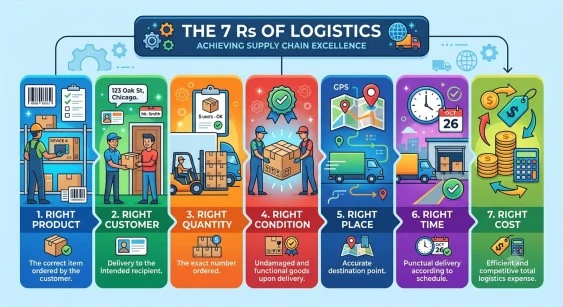
The 7 Rs are also called the 7 Rights of Logistics. They describe the key outcomes every logistics operation should achieve:
- Right Product
- Right Customer
- Right Quantity
- Right Condition
- Right Place
- Right Time
- Right Cost
These principles apply to inbound logistics, outbound logistics, warehousing, transportation, e-commerce fulfilment, and even reverse logistics.
Why the 7 Rs Matter
A single logistics mistake can affect several areas of a business. Shipping the wrong quantity increases storage costs, late delivery damages customer trust, and poor packaging can lead to damaged goods and costly returns.
The 7 Rs help teams make better decisions across the supply chain. They encourage businesses to align demand planning, inventory control, packaging, transport, delivery, and pricing so that goods reach customers without avoidable delays or losses.
1. Right Product
The right product means ensuring that the customer receives exactly the item they ordered, with the correct specifications, model, size, variant, and packaging requirements.
Before shipping, logistics teams should confirm product details such as weight, dimensions, fragility, storage needs, and handling instructions. This is especially important for products such as electronics, glassware, medicines, perishable food, and industrial equipment.
Example: A customer orders a black, 256 GB smartphone. Sending a white, 128 GB version is a product error, even if it reaches the customer on time. A barcode or SKU verification system at the packing stage can prevent this mistake.
2. Right Customer
The right customer means delivering an order to the correct person, address, or business location. It also includes identifying the appropriate target customers for a product through market research and demand analysis.
In B2C logistics, this usually means accurate address verification and identity confirmation. In B2B logistics, it may involve delivering materials to the correct factory, warehouse, retail store, or project site.
Example: A furniture company receives an order for a sofa to be delivered to a customer’s apartment. The delivery team must confirm the flat number, building name, contact person, and delivery slot before dispatch. Delivering it to a neighbouring building creates inconvenience, return costs, and a poor customer experience.
3. Right Quantity
The right quantity means supplying neither too little nor too much. Businesses must match stock levels with actual demand, seasonal trends, and customer orders.
Understocking can lead to lost sales and delayed fulfilment. Overstocking increases warehousing costs, ties up working capital, and raises the risk of product expiry or obsolescence.
Example: A bakery expects high demand for cakes during a festival weekend. If it prepares too few cakes, customers may switch to another bakery. If it prepares too many, unsold stock may go to waste. Demand forecasting helps the bakery choose the right production and delivery quantity.
4. Right Condition
The right condition means products must arrive undamaged, fresh, functional, and in the expected quality. Proper packaging, handling, storage, and transport conditions are essential to achieve this.
Different products need different care. Perishable goods may require cold-chain transport, fragile items need protective packaging, and electronic goods may need moisture-resistant packing and secure handling.
Example: A pharmaceutical distributor transporting vaccines must maintain the required temperature throughout storage and transit. If the cold chain breaks, the products may become unsafe or ineffective, even if they reach the destination on time.
5. Right Place
The right place means delivering goods to the exact location where the customer needs them. This could be a home address, retail outlet, warehouse, construction site, hospital, or distribution centre.
Location accuracy becomes more important when businesses operate across cities, states, or countries. Route planning, GPS tracking, proof of delivery, and clear address data help reduce failed deliveries.
Example: An online grocery platform delivering to a customer in Kochi must ensure the order reaches the correct apartment or house, not merely the correct street. Live tracking and delivery instructions can help the rider locate the address quickly.
6. Right Time
The right time means delivering goods when the customer expects them. Timely delivery is one of the strongest drivers of customer satisfaction, especially in e-commerce, healthcare, manufacturing, and retail.
Late deliveries can interrupt production schedules, cause stockouts, and push customers toward competitors. Businesses use delivery schedules, route optimisation, real-time tracking, and automated notifications to improve punctuality.
Example: A garment manufacturer needs fabric delivered before a production shift begins. If the supplier delivers two days late, the factory may halt production, miss an export deadline, and incur additional costs.
7. Right Cost
The right cost means providing logistics services at a price that protects profitability while remaining competitive for customers. It includes transportation, packaging, warehousing, labour, fuel, returns, insurance, and technology costs.
The goal is not simply to reduce costs at any price. A cheaper logistics option that causes frequent damage or delays may cost more in the long run. Businesses should balance cost efficiency with service quality.
Example: An e-commerce seller may choose consolidated shipping for low-value products to reduce delivery expenses. However, for urgent medical supplies, it may choose faster premium transport because reliability matters more than the lowest possible cost.
Quick Overview of the 7 Rs
| R | What It Means | Example |
|---|---|---|
| Right Product | Deliver the exact item ordered | Send the correct phone model and colour |
| Right Customer | Deliver to the correct recipient or business | Confirm the customer’s address before dispatch |
| Right Quantity | Supply the required amount | Send 100 units when 100 units are ordered |
| Right Condition | Keep goods safe and in good quality | Use cold-chain transport for vaccines |
| Right Place | Deliver to the correct destination | Deliver stock to the correct retail outlet |
| Right Time | Meet the promised delivery schedule | Deliver raw materials before production begins |
| Right Cost | Keep logistics affordable and profitable | Choose the most efficient transport route |
How Businesses Can Apply the 7 Rs
Companies can improve logistics performance by treating the 7 Rs as a daily operational checklist:
- Use SKU codes, barcodes, and order verification to prevent product errors.
- Maintain updated customer addresses and delivery instructions.
- Apply demand forecasting and inventory management to control stock levels.
- Use suitable packaging, handling procedures, and storage conditions.
- Track shipments with GPS, delivery updates, and proof-of-delivery tools.
- Optimise delivery routes and transport modes to meet deadlines.
- Review logistics costs regularly without compromising delivery quality.
Technology can support each of these areas. Warehouse management systems, transport management software, ERP tools, and automated notifications help businesses reduce manual errors and improve visibility across the supply chain.
Conclusion
The 7 Rs of logistics provide a simple but powerful framework for managing the movement of goods from suppliers to customers. When businesses get the product, customer, quantity, condition, place, time, and cost right, they can reduce waste, improve delivery reliability, and build stronger customer relationships.
