

Introduction
Logistics is the process of planning, moving, storing, and delivering goods, materials, and related information from their point of origin to the final destination. In simple terms, it ensures that the right product reaches the right customer, in the right quantity and condition, at the right time and cost.
Modern logistics is a core part of every business that sells physical products. Whether a company manufactures automobiles, runs a grocery store, exports textiles, or fulfils online orders, logistics connects suppliers, warehouses, transport providers, retailers, and customers into one coordinated system.
Logistics Meaning
The word logistics refers to the organised management of how goods are acquired, stored, transported, and delivered. It includes both the physical movement of products and the information needed to track, plan, and control that movement.
For example, when a customer orders a smartphone online, logistics begins before the order is placed. The manufacturer must source components, transport them to a factory, store finished phones in a warehouse, pack each order, select a delivery route, and ship the product to the customer. Logistics also covers returns, repairs, and recycling if the customer sends the product back.
Logistics Definition
A clear logistics definition is:
Logistics is the process of planning, implementing, and controlling the efficient movement and storage of goods, services, and information from the point of origin to the point of consumption.
The main objective of logistics is to meet customer requirements in a timely and cost-effective manner. It focuses on practical execution—such as transportation, warehousing, inventory handling, packaging, and order fulfilment—rather than only high-level supply-chain strategy.
Why Is Logistics Important?
Logistics is important because it directly affects cost, customer satisfaction, product availability, and business profitability. A product cannot create value for a customer if it is unavailable, damaged, delayed, or delivered to the wrong location.
Effective logistics helps businesses:
- Reduce transportation, storage, and inventory costs.
- Prevent stockouts and overstocking through better inventory control.
- Improve delivery speed and accuracy.
- Maintain smooth production by ensuring raw materials arrive on time.
- Support e-commerce growth through fast order fulfilment and tracking.
- Build customer trust through reliable delivery and easy returns.
For example, a fashion retailer with strong logistics can move unsold stock from one store to another where demand is higher. This reduces markdowns, prevents waste, and helps the business recover more value from its inventory.
Logistics vs Supply Chain Management
Logistics and supply chain management are closely related, but they are not the same. Logistics is one important function within the broader supply chain.
| Aspect | Logistics | Supply Chain Management |
|---|---|---|
| Meaning | Movement and storage of goods, services, and information | End-to-end coordination of the entire product journey |
| Main focus | Transportation, warehousing, inventory, packaging, and fulfilment | Sourcing, production, suppliers, distribution, demand planning, and customer delivery |
| Scope | Usually focused on a company’s operational activities | Covers multiple organisations, suppliers, manufacturers, distributors, and retailers |
| Goal | Deliver products efficiently and satisfy customer orders | Create a competitive, resilient, and profitable supply network |
| Example | Shipping a completed order from a warehouse to a customer | Coordinating raw-material suppliers, factories, logistics partners, retailers, and customers |
In short, supply chain management is the larger network, while logistics is the operational engine that keeps products moving within that network.
Read in detail: Logistics vs Supply Chain Management
Types of Logistics
Businesses use different types of logistics depending on where goods are in the supply chain and who manages the process.
Inbound Logistics
Inbound logistics manages the flow of raw materials, components, and purchased goods from suppliers to a company’s warehouse or manufacturing facility. It includes procurement, supplier coordination, receiving, quality checks, and storage.
Example: An automobile manufacturer receives steel, tyres, electronic parts, and batteries from different suppliers and stores them until production begins.
Outbound Logistics
Outbound logistics handles the movement of finished products from a company to distributors, retailers, or end customers. It includes order processing, picking, packing, shipping, and last-mile delivery.
Example: An online electronics store picks a laptop from its warehouse, packs it securely, generates a shipping label, and hands it to a courier for home delivery.
Reverse Logistics
Reverse logistics manages products moving backward from customers to sellers or manufacturers. This includes returns, exchanges, repairs, refurbishment, recycling, and disposal.
Example: A customer returns a defective mobile phone. The company collects it, inspects the fault, repairs or recycles the device, and updates its inventory records.
Third-Party Logistics (3PL)
Third-party logistics refers to outsourcing logistics activities to an external provider. A 3PL company may manage warehousing, transportation, order fulfilment, packaging, and returns on behalf of a business.
Example: A small e-commerce brand uses a 3PL provider to store inventory, pack orders, and deliver products, allowing the brand to focus on marketing and product development.
Fourth-Party Logistics (4PL)
Fourth-party logistics providers act as strategic managers of a company’s supply chain. Instead of only handling transport or warehousing, a 4PL coordinates multiple 3PLs, technology systems, carriers, and warehouses.
Example: A global apparel brand hires a 4PL provider to oversee regional warehouses, shipping partners, customs documentation, and delivery performance across several countries.
E-commerce Logistics
E-commerce logistics focuses on fulfilling individual online orders quickly and accurately. It commonly involves multichannel inventory management, real-time tracking, flexible delivery options, and efficient returns handling.
Example: An online grocery platform stores products in fulfilment centres close to customers, uses route optimisation for deliveries, and offers live tracking through its app.
Freight Logistics
Freight logistics manages the movement of large volumes of goods over long distances. It may use road, rail, air, and sea transport, often combining more than one mode in a single journey.
Example: A textile exporter ships garments from a factory to a port by truck, sends them overseas by sea, and arranges final delivery through a local transport partner.
Main Functions of Logistics
Logistics works through several connected functions. When these functions are managed well, products move smoothly from suppliers to customers.
Transportation
Transportation is the physical movement of goods between locations. Businesses choose transport modes based on cost, speed, distance, product type, and delivery deadlines. Common modes include road, rail, air, and sea transport.
Warehousing
Warehousing involves receiving, storing, organising, and protecting goods until they are needed. A well-planned warehouse keeps fast-moving products accessible, uses space efficiently, and reduces picking time.
Inventory Management
Inventory management ensures a business has enough stock to meet demand without holding too much unsold inventory. It includes tracking stock levels, monitoring product movement, forecasting demand, and deciding when to reorder.
Order Fulfilment
Order fulfilment covers everything that happens after a customer places an order: picking the correct item, packing it safely, labelling it, shipping it, and confirming delivery. Accuracy and speed at this stage strongly influence customer satisfaction.
Packaging
Packaging protects products during storage and transit. It also affects shipping costs, product presentation, sustainability, and the customer’s unboxing experience.
Demand Forecasting
Demand forecasting uses historical sales data, seasonal trends, and market signals to predict future product requirements. Accurate forecasts help businesses plan procurement, warehouse space, staffing, and transport capacity.
Material Sourcing
Material sourcing involves identifying suppliers and arranging the timely purchase of raw materials or finished goods. Strong sourcing decisions consider price, quality, reliability, lead time, and total logistics cost.
Technical Advancements in Logistics: AI and Automation
Technology is changing how businesses plan, track, and deliver goods. Artificial intelligence, automation, robotics, and connected devices are helping logistics teams reduce delays, improve accuracy, and respond quickly to disruptions.
Artificial Intelligence in Logistics
Artificial intelligence uses data to support faster and more accurate logistics decisions. It can analyse sales history, traffic conditions, weather, warehouse capacity, and shipment information to predict demand, estimate delivery times, and identify possible disruptions before they become serious problems.
AI is commonly used for:
- Demand forecasting: Predicting which products will sell in specific locations and time periods.
- Route optimisation: Selecting efficient delivery routes based on traffic, weather, delivery windows, and vehicle capacity.
- Inventory planning: Monitoring stock levels and recommending when and where to replenish products.
- Delivery-time prediction: Providing customers with more accurate estimated arrival times.
- Risk management: Identifying delayed or at-risk shipments and suggesting alternative routes or carriers.
For example, an AI-powered delivery system can change a driver’s route in real time if traffic increases or a customer changes the delivery slot. This can improve on-time delivery while reducing fuel consumption and unnecessary driving.
Automation in Warehousing
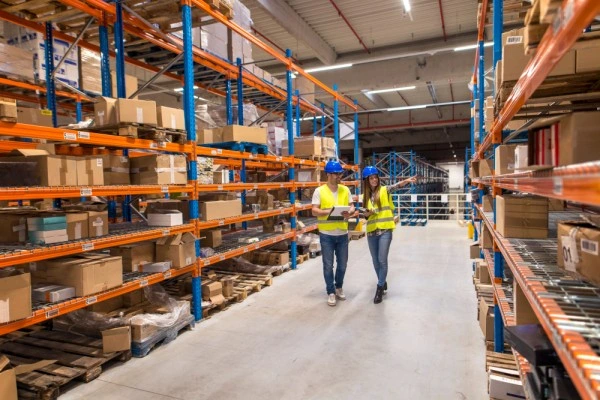
Warehouse automation uses machines, software, and robotics to perform repetitive tasks with greater speed and consistency. Automated systems can support receiving, sorting, picking, packing, labelling, and moving goods within a warehouse.
Common examples include:
- Automated storage and retrieval systems: Machines store and retrieve products from designated locations.
- Robotic picking systems: Robots assist with picking, sorting, and transporting items across the warehouse.
- Conveyor systems: Products move automatically between receiving, storage, packing, and dispatch areas.
- Automated packaging systems: Machines measure, pack, seal, and label parcels according to product size and order requirements.
- Barcode and RFID scanning: These technologies track inventory movement and reduce manual data-entry errors.
AI-powered warehouse tools can also recommend better product placement. By analysing order history, they can place fast-moving items closer to packing stations and group products that are frequently ordered together, reducing picking time.
Internet of Things and Real-Time Tracking
The Internet of Things, or IoT, connects vehicles, containers, pallets, sensors, and warehouse equipment through digital networks. These devices share real-time information about location, temperature, humidity, movement, and delivery progress.
This is especially valuable for perishable food, medicines, electronics, and other sensitive goods. For instance, temperature sensors can alert a logistics team if a refrigerated shipment moves outside the required range, allowing staff to take corrective action before the products are damaged.
Autonomous Vehicles and Drones
Autonomous technology is gradually being tested and adopted in logistics, particularly for long-haul transport, warehouse movement, and last-mile delivery. Self-driving trucks, autonomous forklifts, delivery robots, and drones can reduce manual effort in suitable environments, although regulations, safety requirements, and infrastructure still influence large-scale adoption.
Drones are mainly useful for lightweight, urgent, or hard-to-reach deliveries. Delivery robots and autonomous vehicles are more commonly used for short-distance deliveries, warehouse transport, and controlled campus environments.
Generative AI in Logistics Operations
Generative AI goes beyond prediction by helping teams create, summarise, and interpret information quickly. Logistics companies can use it to prepare shipping documents, answer customer queries, summarise shipment updates, and support dispatchers during delivery exceptions.
For example, a generative AI assistant can consolidate order details, identify missing documentation, and draft an update for a customer whose shipment has been delayed. This reduces manual work and helps teams respond faster.
Benefits of AI and Automation
AI and automation can improve logistics performance when they are implemented with clear goals, reliable data, and proper human oversight. Their main benefits include:
- Faster order processing and fulfilment.
- Fewer picking, packing, and documentation errors.
- Better delivery accuracy and real-time visibility.
- Lower fuel, labour, and inventory-carrying costs.
- Improved warehouse space utilisation.
- More sustainable operations through optimised routes and fuller vehicle loads.
- Better customer communication and delivery experiences.
However, technology does not replace the need for skilled logistics professionals. Businesses still need people to manage exceptions, maintain systems, ensure safety, negotiate with suppliers, and make judgement-based decisions when disruptions occur.
The 7 Rs of Logistics
The 7 Rs of logistics explain the goal of a well-managed logistics operation. They help businesses deliver value while controlling cost and maintaining service quality.
- Right product — Deliver the exact item the customer ordered.
- Right quantity — Provide the correct number of units.
- Right condition — Ensure goods arrive undamaged and usable.
- Right place — Deliver to the correct address or location.
- Right time — Meet the promised delivery date or time.
- Right customer — Ensure the order reaches the intended recipient.
- Right cost — Keep logistics efficient without reducing service quality.
Examples of Logistics in Real Life
E-commerce Delivery
When a customer buys clothes online, logistics includes checking stock, picking the garment, packing it, assigning a courier, tracking the parcel, and delivering it to the customer’s address. If the customer returns it, reverse logistics begins.
Manufacturing
A car manufacturer relies on inbound logistics to receive parts such as engines, tyres, glass, and wiring. Production logistics ensures these materials reach assembly lines on time. Outbound logistics then moves finished vehicles to dealerships.
Grocery Retail
A supermarket needs daily logistics to receive fresh produce, dairy, packaged foods, and household goods. Cold-chain logistics keeps perishable items at the correct temperature, while inventory management prevents shortages and spoilage.
Healthcare
Hospitals and pharmacies depend on logistics to receive medicines, surgical equipment, diagnostic kits, and protective supplies. Timely and secure delivery is especially important because delays can affect patient care.
International Trade
An exporter shipping spices from India to Europe must coordinate packaging, customs documents, freight booking, port handling, international shipping, and final delivery. This is an example of global logistics and trade compliance working together.
What Is Logistics Management?
Logistics management is the process of planning, organising, and controlling logistics activities to achieve efficient and reliable product flow. A logistics manager coordinates suppliers, transport partners, warehouse teams, inventory systems, and customer-service processes.
Key responsibilities include:
- Selecting transport modes and carriers.
- Planning delivery routes.
- Managing warehouse operations.
- Monitoring inventory levels.
- Handling order fulfilment.
- Controlling logistics costs.
- Managing returns and reverse logistics.
- Ensuring regulatory and customs compliance.
Many companies use logistics software, warehouse management systems, transportation management systems, and ERP platforms to improve visibility, automate routine tasks, and make better data-driven decisions.
Benefits of Effective Logistics Management
Strong logistics management creates value across the business. Its benefits go beyond faster delivery and influence financial performance, customer loyalty, and long-term growth.
- Lower operating costs: Better routing, consolidated shipments, and efficient inventory planning reduce freight and storage expenses.
- Better inventory control: Real-time visibility helps businesses avoid stockouts, excess stock, theft, and product damage.
- Faster fulfilment: Organised warehouses and automated processes shorten the time between order placement and delivery.
- Improved customer experience: Accurate delivery updates, flexible delivery options, and simple returns increase customer trust.
- Higher productivity: Smooth material flow prevents production delays and reduces bottlenecks.
- Business growth: Reliable logistics allows companies to enter new markets, handle higher order volumes, and scale operations.
Final Thoughts
Logistics is much more than shipping. It is the coordinated system that moves products, materials, and information from suppliers to customers while balancing speed, cost, quality, and reliability. As e-commerce, automation, and global trade continue to expand, efficient logistics management has become essential for businesses of every size.
