

TL;DR
- Logistics manages the physical movement and storage of goods, including transportation, warehousing, inventory, packaging, and order fulfilment.
- Supply chain management (SCM) is broader; it coordinates sourcing, procurement, production, suppliers, logistics, distribution, and customer delivery.
- Logistics is a key component of SCM, but SCM covers the entire journey of a product from raw material to final customer.
- Logistics focuses on efficient execution, while SCM focuses on strategic planning, cost control, supplier coordination, and risk management.
- Both functions are essential for reducing delays, controlling costs, improving customer satisfaction, and building a competitive business.
- Careers in logistics usually focus on warehousing, transport, and distribution; SCM careers often include procurement, demand planning, supplier management, and supply-chain analytics.
Introduction
Logistics and supply chain management are closely connected, but they are not the same. Logistics focuses on moving and storing goods efficiently, while supply chain management (SCM) coordinates the entire journey of a product—from sourcing raw materials to delivering it to the customer. In simple terms, logistics is a vital part of SCM, but SCM covers much more.
Many people use the two terms interchangeably because both deal with products, storage, transportation, and customer delivery. However, their scope, goals, and day-to-day responsibilities are different. Understanding this difference is important for students, job seekers, business owners, and professionals working in operations, procurement, warehousing, or distribution.
What Is Logistics?
Logistics is the process of planning, implementing, and controlling the movement and storage of goods, services, and related information from one point to another. Its main objective is to ensure that the right product reaches the right customer, at the right place, at the right time, in the right condition, and at a reasonable cost.
Logistics deals mainly with the practical execution of supply-chain activities. It coordinates warehouses, transport vehicles, delivery staff, packaging, inventory, and order fulfilment so that goods move smoothly through the supply chain.
Main activities in logistics
- Transportation management, including road, rail, air, and sea freight.
- Warehousing and storage of raw materials and finished goods.
- Inventory control to avoid both stock shortages and excess stock.
- Order processing, picking, packing, and dispatch.
- Material handling within warehouses and distribution centres.
- Packaging and unitisation to protect products during transit.
- Reverse logistics, including product returns and replacements.

Example of logistics
Imagine an online retailer selling smartphones. Logistics ensures that the phones are stored in the correct warehouse, packed securely, loaded onto delivery vehicles, tracked during transit, and delivered to customers on time. If a customer returns a damaged phone, reverse logistics manages the return, inspection, repair, or disposal process.
What Is Supply Chain Management?
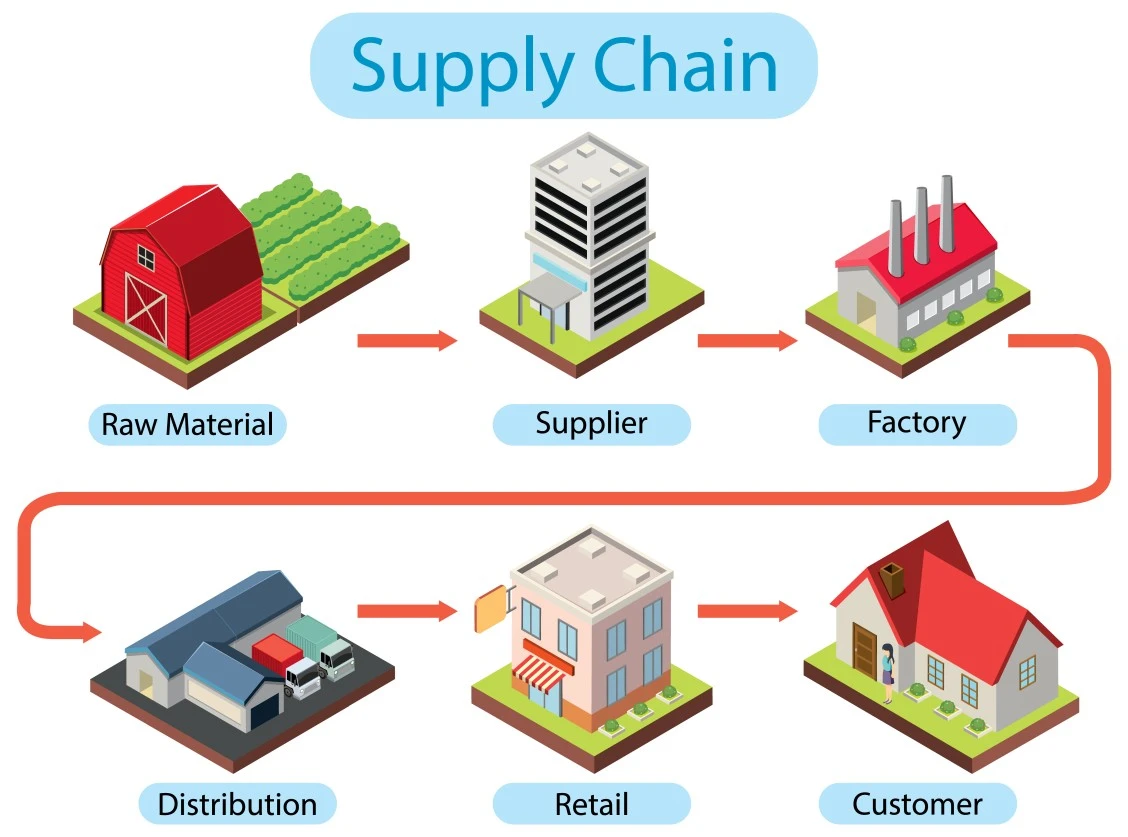
Supply chain management is a broader business function that plans and coordinates all activities involved in producing and delivering a product or service. It connects suppliers, manufacturers, warehouses, distributors, retailers, logistics providers, and customers into one efficient network.
SCM looks at the bigger picture. It decides how materials should be sourced, when production should happen, how much inventory is required, which suppliers should be used, and how finished products should reach the market. Logistics is one important function within this wider system.
Main activities in supply chain management
- Demand forecasting and sales planning.
- Sourcing and procurement of raw materials.
- Supplier selection, negotiation, and relationship management.
- Production planning and manufacturing coordination.
- Inventory planning across the supply network.
- Logistics, warehousing, and distribution.
- Quality control and compliance.
- Risk management and supply-chain visibility.
- Managing returns and product lifecycle processes.
Example of supply chain management
For the same smartphone retailer, SCM does not only handle delivery. It identifies reliable component suppliers, forecasts customer demand, plans production volumes, manages supplier contracts, coordinates manufacturing schedules, decides warehouse locations, and works with logistics teams to distribute products efficiently.
Logistics vs Supply Chain Management: Key Differences
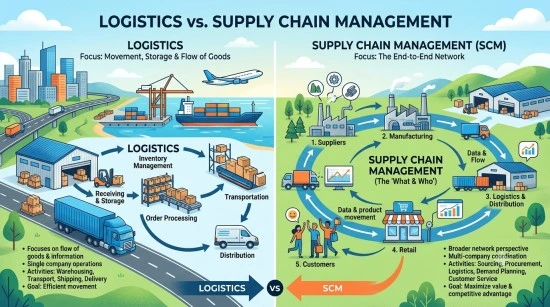
The clearest way to understand the difference is this: logistics executes the movement and storage of goods, while supply chain management strategically manages the entire flow of materials, information, and finances from origin to final consumption.
| Aspect | Logistics | Supply Chain Management |
|---|---|---|
| Definition | Movement, storage, and flow of goods, services, and information. | End-to-end coordination of sourcing, production, distribution, and delivery. |
| Scope | Narrower; mainly transportation, warehousing, inventory, and fulfilment. | Wider; includes procurement, manufacturing, suppliers, logistics, customers, and risk management. |
| Primary focus | Delivering goods efficiently and cost-effectively. | Creating an efficient, resilient, and competitive supply network. |
| Role | Operational execution. | Strategic planning and overall coordination. |
| Main goal | Right product, right place, right time, right cost. | Improve efficiency, reduce costs, manage risks, and gain competitive advantage. |
| Key activities | Transport, warehousing, packaging, inventory control, order fulfilment. | Sourcing, procurement, production planning, supplier management, distribution, and returns. |
| Relationship | A subset or component of SCM. | Includes and guides logistics activities. |
| Decision level | Often day-to-day and operational. | Often long-term, cross-functional, and strategic. |
How Logistics and SCM Are Similar
Although they differ in scope, logistics and supply chain management share several common goals. Both aim to ensure the smooth movement of goods from suppliers to customers while reducing delays, controlling costs, and improving customer satisfaction.
They also depend on accurate information. Tracking shipments, monitoring inventory levels, coordinating suppliers, and responding to disruptions all require reliable data across the supply network.
Shared objectives
- Move products efficiently from origin to destination.
- Maintain appropriate inventory levels.
- Reduce operational costs and wastage.
- Improve delivery accuracy and speed.
- Enhance customer experience.
- Support business profitability and growth.
The Role of Logistics in Supply Chain Management
Logistics is often described as the execution arm of supply chain management. SCM creates the strategy, while logistics carries out the physical and operational tasks needed to make that strategy work.
For example, SCM may decide that a company should source materials from a lower-cost supplier and distribute finished goods through regional warehouses. Logistics then determines how those materials and products will be transported, where they will be stored, how they will be packed, and how customer orders will be fulfilled.
Why logistics matters in SCM
- It keeps goods moving between suppliers, factories, warehouses, and customers.
- It prevents delivery delays and stockouts.
- It controls transportation and storage costs.
- It improves order accuracy and customer satisfaction.
- It provides real-time data that helps SCM teams make better decisions.
Logistical Components of the Supply Chain
Add this section after “The Role of Logistics in Supply Chain Management” and before “Inbound and Outbound Logistics.” It naturally expands on logistics’ role within SCM.
Logistics works through several connected components that help products move smoothly across the supply chain. Each component affects delivery speed, cost, product quality, and customer satisfaction. When these components are managed well, businesses can reduce delays, prevent stock shortages, and improve overall supply-chain performance.
Transportation
Transportation moves raw materials, components, and finished goods between suppliers, factories, warehouses, distributors, and customers. Businesses choose transport modes based on cost, speed, product type, distance, and delivery urgency.
Common transport modes include:
- Road transport for local and regional deliveries.
- Rail transport for bulk goods and long-distance domestic movement.
- Air freight for urgent, lightweight, or high-value shipments.
- Sea freight for international and bulk shipments.
- Multimodal transport, which combines two or more transport modes.
Warehousing
Warehousing provides secure storage for goods before they are needed for production, distribution, or sale. A well-organised warehouse helps businesses manage inventory, protect products, speed up order processing, and reduce handling costs.
Key warehousing activities include receiving goods, quality checks, storage, picking, packing, dispatch, and returns handling.
Inventory Management
Inventory management ensures that a business has enough stock to meet demand without holding excessive inventory. Too little stock can cause missed sales and production delays, while too much stock increases storage costs and the risk of obsolete products.
Effective inventory management depends on accurate demand forecasts, real-time stock visibility, reorder points, safety stock planning, and coordination between sales, procurement, and logistics teams.
Order Fulfilment
Order fulfilment covers every step involved in completing a customer order. It includes order receipt, stock allocation, picking, packing, labelling, shipping, tracking, and delivery confirmation.
Fast and accurate fulfilment is especially important in e-commerce, where customers expect quick delivery, real-time tracking, and easy returns.
Material Handling
Material handling involves moving, protecting, and controlling goods within warehouses, factories, and distribution centres. It includes the use of forklifts, conveyor systems, pallets, barcode scanners, automated storage systems, and warehouse management software.
Efficient material handling reduces product damage, improves worker safety, speeds up operations, and lowers labour costs.
Packaging and Labelling
Packaging protects products during storage and transport, while labelling provides essential information such as product details, batch numbers, handling instructions, and tracking data. Good packaging reduces damage and returns, while accurate labelling supports traceability and regulatory compliance.
Reverse Logistics
Reverse logistics manages the return flow of goods from customers back to businesses. It includes product returns, exchanges, repairs, recycling, refurbishment, and disposal.netsuite+1
A strong reverse-logistics process helps businesses recover value from returned products, reduce waste, and maintain customer trust.
Also read: Types of Logistics: Inbound, Outbound, Reverse, and Third-party
Inbound and Outbound Logistics
Logistics is commonly divided into inbound and outbound activities. Both are essential for maintaining a smooth supply chain.
| Type | Meaning | Examples |
|---|---|---|
| Inbound logistics | Managing the arrival, handling, and storage of materials or goods coming into a business. | Receiving raw materials, inspecting supplier deliveries, storing components, and moving materials to production. |
| Outbound logistics | Managing the storage, packing, and distribution of finished goods to customers. | Warehouse picking, packaging, shipping, last-mile delivery, and customer returns. |
How Both Logistics and Supply Chain Are Fundamental to Success
Logistics and supply chain management are fundamental to business success because they directly influence cost, speed, reliability, and customer experience. A strong supply chain helps companies source materials efficiently, produce goods at the right time, and deliver products when customers expect them.
Logistics makes this possible in practice. Even the best supply-chain strategy will fail if goods are delayed, stored incorrectly, damaged in transit, or delivered to the wrong location. Effective logistics ensures that products move reliably through every stage of the supply chain.
How they improve business performance
- Lower operating costs: Better transport planning, warehouse utilisation, and inventory control reduce unnecessary expenses.
- Faster delivery: Coordinated logistics helps businesses meet delivery deadlines and respond quickly to customer demand.
- Better customer satisfaction: Accurate orders, timely delivery, and easy returns improve customer trust and loyalty.
- Reduced waste: Proper inventory and demand planning minimise excess stock, expired goods, and obsolete inventory.
- Improved resilience: SCM identifies supplier risks, alternative sourcing options, and backup distribution routes before disruptions occur.
- Stronger competitiveness: Businesses that deliver the right product at the right time and cost can compete more effectively in the market.
For example, an e-commerce company with strong SCM can forecast festive-season demand, secure inventory in advance, and plan warehouse capacity. Its logistics team can then ensure that products are stored close to key customer locations and delivered quickly during peak sales periods.
Which Is Better: Logistics or Supply Chain Management?
Neither is “better” than the other because they serve different purposes. Logistics is essential for efficient execution, while SCM provides the strategic direction that makes logistics effective. A business cannot achieve strong supply-chain performance without reliable logistics, and logistics alone cannot solve problems caused by poor supplier planning, inaccurate demand forecasting, or weak production coordination.
For career purposes, logistics roles often focus on transport coordination, warehouse operations, fleet management, inventory control, and distribution. Supply chain roles are usually broader and may include procurement, demand planning, supplier management, production planning, and supply-chain analytics.
Common Career Roles
| Logistics careers | Supply chain management careers |
|---|---|
| Logistics coordinator | Supply chain analyst |
| Warehouse supervisor | Procurement officer |
| Transport coordinator | Demand planner |
| Fleet manager | Supplier relationship manager |
| Inventory controller | Production planner |
| Distribution manager | Supply chain manager |
| Shipping and documentation executive | Operations manager |
Future Trends in Supply Chain and Logistics
Technology, customer expectations, and global disruptions are changing how businesses manage logistics and supply chains. Companies are increasingly using digital tools to improve visibility, automate operations, predict demand, and respond quickly to disruptions.
Artificial intelligence and predictive analytics
Artificial intelligence helps businesses analyse large volumes of supply-chain data to forecast demand, identify delays, optimise routes, and improve inventory planning. Predictive analytics allows companies to act before problems occur rather than reacting after disruptions happen.
Automation and robotics
Warehouses are increasingly using automated storage systems, robotic picking, conveyor systems, autonomous vehicles, and smart sorting technology. These tools can improve speed, accuracy, and safety while reducing repetitive manual work.
Real-time supply-chain visibility
Businesses now expect real-time information about inventory, shipments, supplier performance, and delivery status. Supply-chain visibility tools help teams identify bottlenecks early, track goods across locations, and make faster decisions.
Sustainable logistics
Sustainability is becoming a major priority as businesses look for ways to reduce fuel consumption, packaging waste, carbon emissions, and returns. Companies are adopting electric vehicles, route optimisation, eco-friendly packaging, and greener warehouse practices.
E-commerce and last-mile delivery
The growth of online shopping has increased demand for fast, flexible, and cost-effective last-mile delivery. Businesses are using micro-fulfilment centres, local warehouses, delivery-route optimisation, and real-time tracking to meet rising customer expectations.
Digital twins and supply-chain simulation
A digital twin is a virtual model of a supply chain that allows businesses to test different scenarios before making real-world decisions. Companies can simulate supplier delays, demand spikes, transport disruptions, or warehouse capacity issues to identify the best response.
Blockchain for traceability
Blockchain technology can create secure, transparent records of product movement across the supply chain. This can improve traceability, reduce fraud, verify product authenticity, and support compliance in industries such as pharmaceuticals, food, and luxury goods.
Final Thoughts
Logistics and supply chain management work together to keep modern businesses running. Logistics ensures that products are stored, transported, and delivered effectively, while SCM oversees the complete network that makes production and delivery possible.
If you are choosing between the two fields, think about your interests: choose logistics if you enjoy hands-on operations, transportation, warehousing, and fulfilment. Choose supply chain management if you prefer broader planning, procurement, supplier coordination, analytics, and strategic decision-making. Both fields are essential, and professionals who understand how they connect will have a strong advantage.
