

This guide helps marketers use ChatGPT effectively. It covers campaigns, ads, emails, social media, positioning, and research. Every prompt follows a practical marketing need. The prompts are tested for usefulness, not randomly created.
Good marketing prompts need clear brand details. They should define the audience and marketing channel. They should also explain the main marketing goal.
What Makes a Good ChatGPT Prompt for Marketing
Marketing prompts need three important details. These are brand voice, target audience, and channel. You should also mention your marketing goal clearly. These details help ChatGPT avoid generic marketing content. They also make the final response more useful.
Useful details include:
- Brand voice and personality.
- Target audience and customer type.
- Marketing goal.
- Marketing channel.
- Product or service.
- Customer problem.
- Main customer benefit.
- Desired customer action.
- Content format.
- Campaign stage.
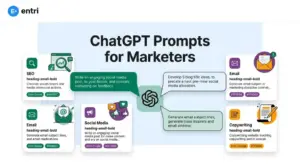
40+ ChatGPT Prompts for Marketers
These prompts cover common marketing activities. You can customize each prompt easily. Replace bracketed details with your information. Add more context when your campaign needs it.
Campaign Strategy Prompts
Campaign strategy starts with clear goals. It also requires a clear target audience. These prompts help marketers plan campaigns more easily.
1. Campaign Strategy
Act as a marketing expert. Create a campaign for [product]. Target [audience]. Focus on [goal]. Include channels, content, messages, and metrics.
Why this works: This prompt connects goals with actions. It also gives ChatGPT clear campaign boundaries.
2. Campaign Ideas
Create 10 campaign ideas for [product]. Target [audience]. Focus on [goal]. Make every idea different.
You can request different campaign types, including:
- Brand awareness campaigns.
- Product launch campaigns.
- Lead generation campaigns.
- Customer engagement campaigns.
- Customer retention campaigns.
3. Campaign Calendar
Create a 30-day campaign calendar for [product]. Target [audience]. Include topics, channels, formats, and goals.
A useful calendar can include:
- Publishing dates.
- Content topics.
- Marketing channels.
- Content formats.
- Campaign goals.
4. Audience Research
Analyze the audience for [product]. Identify their needs, problems, goals, concerns, and buying triggers.
This prompt helps marketers understand customers better. It can also reveal useful campaign opportunities. Use the findings when creating future marketing messages.
5. Campaign Messaging
Create five messages for [product]. Target [audience]. Use a [brand voice] tone. Focus on [benefit].
Ask for different message styles, such as:
- Emotional messaging.
- Practical messaging.
- Educational messaging.
- Benefit-focused messaging.
- Problem-focused messaging.
6. Marketing Funnel
Create a marketing funnel for [product]. Cover awareness, consideration, conversion, and retention. Suggest content for each stage.
The funnel should match customer intent. It should also suggest suitable marketing channels. This makes campaign planning more organized.
7. Campaign Review
Review this campaign for [product]. Identify strengths, weaknesses, gaps, and improvement opportunities.
Ask ChatGPT to review these areas:
- Audience fit.
- Message clarity.
- Channel choice.
- Offer strength.
- Call to action.
Ad Copy Prompts
Good advertisements need clear messages. They also need strong audience relevance. These prompts help create different ad versions.
8. Ad Variations
Write five ads for [product]. Target [audience]. Highlight [benefit]. Use a [brand voice] tone.
Why this works: This prompt gives clear creative limits. It also creates several options for testing.
9. Ad Headlines
Write 15 headlines for [product]. Keep each headline short. Focus on different customer benefits.
Try different headline approaches:
- Benefit-based.
- Problem-based.
- Question-based.
- Curiosity-based.
- Action-based.
10. Benefit-Focused Ads
Create five ads for [product]. Focus on customer benefits. Keep the language natural. Avoid unsupported claims.
This prompt keeps the customer at the center. It also reduces unnecessary product descriptions.
11. Problem-Solution Ad
Write an ad for [product]. Show how it solves [problem]. Target [audience]. Keep the message simple.
A problem-solution structure makes ads easier to follow. It also connects customer problems with product benefits.
12. Call-To-Action Ideas
Create 15 calls to action for [product]. Focus on [desired action]. Avoid generic phrases.
Possible actions include:
- Learn more.
- Start now.
- Book a call.
- Request details.
- Download the guide.
13. A/B Ad Testing
Create two ads for [product]. Target the same audience. Use different messages. Focus one on benefits. Focus another on problems.
Why this works: This creates two distinct approaches. Marketers can then compare their messaging.
14. Ad Review
Review this advertisement for clarity and relevance. Check brand voice and message. Suggest practical improvements.
Review these parts:
- Headline.
- Main benefit.
- Supporting message.
- Call to action.
- Brand voice.
Email Marketing Prompts
Email marketing needs clear customer-focused messaging. These prompts support different email campaign stages.
15. Promotional Email
Write a promotional email for [product]. Target [audience]. Highlight [offer]. Use a friendly professional tone.
Ask ChatGPT to include:
- A strong subject line.
- A clear customer benefit.
- Short supporting details.
- One clear call to action.
16. Welcome Email
Write a welcome email for new customers. Introduce [brand]. Explain its main benefit. Include one clear next step.
Why this works: This prompt focuses on new customers. It also gives them one clear action.
17. Product Launch Email
Write a launch email for [product]. Target [audience]. Explain its main benefits. Create interest without exaggeration.
The email should explain why the product matters. It should also guide readers toward action.
18. Follow-Up Email
Write a follow-up email for [product]. Target interested customers. Keep the tone helpful. Avoid sounding pushy.
This prompt works well after earlier contact. It keeps the message useful and respectful.
19. Reminder Email
Write a reminder email for [action]. Target users who stopped midway. Keep the message short and helpful.
The reminder should explain the next step clearly. It should avoid creating unnecessary pressure.
20. Customer Retention Email
Write an email for existing customers. Thank them for choosing [product]. Encourage continued use. Use a friendly tone.
Retention emails should strengthen customer relationships. They should also provide a useful reason for returning.
21. Email Subject Lines
Create 15 subject lines for [topic]. Use benefits, curiosity, and urgency. Keep every subject line short.
Different subject lines can support testing. They can also reveal which message angle works best.
Social Media Prompts
Social media content needs platform-specific planning. Different platforms have different audience expectations. These prompts help marketers create suitable content.
22. Social Media Ideas
Create 20 social media ideas for [brand]. Target [audience]. Focus on [goal]. Use a [brand voice] tone.
Ideas can include:
- Educational posts.
- Product posts.
- Customer stories.
- Industry tips.
- Engagement posts.
23. Social Media Captions
Write 10 captions about [topic]. Keep them short and engaging. Match the [brand voice] tone.
24. Educational Posts
Create 10 educational posts about [topic]. Make each post useful and different. Avoid repeating information.
25. Engagement Posts
Create 10 engagement posts for [audience]. Use questions, polls, or discussion prompts. Keep each idea simple.
26. Social Media Calendar
Create a weekly social media calendar for [brand]. Target [audience]. Include topics, formats, and goals.
27. Platform Adaptation
Adapt this message for [platform]. Keep the main idea unchanged. Adjust length, tone, structure, and call to action.
28. Social Media Review
Review these social posts for clarity and relevance. Check brand voice consistency. Suggest simple improvements.
The same message should not fit every platform. Each channel has different content expectations. Adapt the message before publishing it.
Positioning & Messaging Prompts
Strong positioning helps brands stand apart. Clear messaging also makes brands easier to understand. These prompts help marketers build stronger brand messages.
29. Brand Positioning
Create a positioning statement for [brand]. Target [audience]. Highlight [main benefit]. Show how the brand differs.
A strong positioning statement should explain the brand clearly. It should also focus on customer value.
Why this works: This prompt connects audience and differentiation. It also keeps the brand message focused.
30. Value Proposition
Create five value propositions for [brand]. Target [audience]. Focus on [main customer problem]. Keep each option clear.
Useful value propositions should explain three things:
- The customer problem.
- The offered solution.
- The main customer benefit.
31. Brand Messaging
Create a messaging framework for [brand]. Target [audience]. Include the main message and supporting messages.
The framework can include:
- Main brand message.
- Customer problem.
- Main benefit.
- Supporting benefits.
- Proof points.
- Call to action.
32. Brand Voice
Define a brand voice for [brand]. Target [audience]. Describe suitable words, tone, and writing style.
Ask ChatGPT to include:
- Words to use.
- Words to avoid.
- Tone examples.
- Sentence style.
- Communication principles.
Why this works: It creates clearer writing rules. Those rules improve consistency across content.
33. Messaging Pillars
Create four messaging pillars for [brand]. Target [audience]. Explain each pillar briefly.
Possible pillars can include:
- Product benefits.
- Customer needs.
- Brand values.
- Industry expertise.
34. Brand Differentiation
Identify five ways [brand] can stand out. Consider audience needs and competitors. Avoid unrealistic claims.
This prompt helps identify useful differences. It can also reveal weak positioning areas.
35. Tagline Ideas
Create 20 tagline ideas for [brand]. Target [audience]. Highlight [main benefit]. Keep them short.
Try different tagline styles:
- Benefit-focused.
- Emotional.
- Direct.
- Memorable.
- Problem-focused.
36. Message Simplification
Simplify this marketing message for [audience]. Keep the main meaning unchanged. Remove complex words and unnecessary details.
This prompt works well for complex products. It also helps improve customer understanding.
Competitor Research Prompts
Competitor research can reveal useful market insights. These prompts help organize competitor information clearly.
37. Competitor Comparison
Compare [competitors] with [brand]. Analyze their strengths, weaknesses, pricing, audience, and messaging.
Use a simple comparison table with these areas:
- Target audience.
- Main offer.
- Key benefits.
- Pricing approach.
- Brand message.
- Marketing channels.
38. Competitor Strengths
Analyze the strengths of [competitor]. Explain what attracts its target audience. Identify useful lessons for [brand].
This prompt focuses on learning from competitors. It does not require copying their approach.
39. Competitor Weaknesses
Analyze weaknesses in [competitor]’s marketing. Identify gaps in messaging, content, offers, and customer experience.
Use these findings to identify opportunities. Avoid making unsupported claims about competitors.
40. Competitor Messaging
Compare the messaging used by [competitors]. Identify common themes and differences. Suggest gaps for [brand].
This prompt can reveal crowded messaging areas. It can also identify opportunities for differentiation.
41. Competitor Content Ideas
Analyze content themes used by [competitors]. Identify common topics and missing topics. Suggest new ideas for [brand].
Possible areas include:
- Educational content.
- Product content.
- Customer stories.
- Industry content.
- Problem-solving content.
42. Competitor Audience Analysis
Compare the audiences targeted by [competitors]. Identify their needs, problems, and interests. Suggest opportunities for [brand].
This can help identify underserved audiences. It can also improve future campaign planning.
43. Competitor SWOT Analysis
Create a SWOT analysis for [competitor]. Focus on marketing and positioning. Keep the findings practical and evidence-based.
Why this works: It organizes competitor research into useful categories. It also helps marketers identify strategic opportunities.
How to Improve These Marketing Prompts
The prompts work best with specific information. Generic inputs can produce generic marketing content. Add useful details before sending each prompt.
Add Your Brand Voice
Tell ChatGPT how your brand sounds. This helps keep marketing content consistent.
For example, describe your voice as:
- Friendly.
- Professional.
- Helpful.
- Bold.
- Simple.
- Expert.
- Conversational.
You can also provide sample content. Ask ChatGPT to follow that style.
Define Your Audience
Always identify your target customer. Include details that affect marketing decisions.
Useful audience details include:
- Age group.
- Experience level.
- Main needs.
- Common problems.
- Buying concerns.
- Customer goals.
Avoid describing your audience too broadly. A focused audience produces stronger messaging.
Name the Marketing Channel
Different channels need different content. A social post needs different formatting. An email also needs different messaging.
Specify the channel, such as:
- Instagram.
- LinkedIn.
- Email.
- Search ads.
- Display ads.
- Landing pages.
- Blogs.
You can also specify the content format. This helps ChatGPT match platform requirements.
State the Marketing Goal
Tell ChatGPT what success means. Different goals need different strategies.
Common goals include:
- Increase awareness.
- Generate leads.
- Increase sales.
- Improve engagement.
- Build trust.
- Retain customers.
- Increase website visits.
A clear goal keeps the response focused.
Give the Main Customer Benefit
Tell ChatGPT what customers gain. Avoid focusing only on product features.
For example, provide:
- Time savings.
- Lower costs.
- Better convenience.
- Improved performance.
- Easier processes.
- Greater confidence.
Benefits help create customer-focused marketing content.
Common Mistakes Marketers Make with ChatGPT
- Not specifying brand voice or tone: This often creates generic content.
- Not specifying the target audience: The message may feel too broad.
- Treating the first output as final: Better results usually need iteration.
- Using one prompt everywhere: Each channel needs different instructions.
Build Better Marketing Prompts
A strong prompt starts with clear information. It should explain the marketing task first. Then provide the context ChatGPT needs.
A useful structure looks like this:
Act as [marketing role]. Create [content].
Target [audience]. Use [brand voice].
Publish it on [channel]. Focus on [goal].
Include [requirements]. Avoid [restrictions].
This structure works across marketing tasks. You can adapt it for different channels.
Example Marketing Prompt
Act as a marketing strategist. Create social posts for [brand]. Target [audience]. Use a friendly tone. Focus on [goal]. Provide ten unique ideas.
This prompt includes the main marketing details. It also gives ChatGPT a clear output requirement.
Always Review the First Output
ChatGPT should support marketing decisions. It should not replace marketer judgment. Always review important marketing content.
Check these areas:
- Brand accuracy.
- Audience relevance.
- Message clarity.
- Factual accuracy.
- Marketing claims.
- Tone consistency.
- Channel suitability.
- Call-to-action clarity.
You can then ask ChatGPT for improvements. This creates a simple improvement cycle.
A Useful Iteration Process
Start with your basic prompt. Review the first response carefully. Identify what feels weak or unclear. Then provide specific improvement instructions.
For example:
Make these captions more conversational.
Keep the same main message.
Remove repeated ideas.
Make the calls to action clearer.
This approach often produces better results. It also gives marketers more control.
Final Takeaway
ChatGPT works best with clear marketing instructions. Always provide your brand voice and audience. You should also name the marketing channel. Add the goal and desired customer action. Then review and improve the first response.
These prompts can save valuable marketing time. They can support strategy, content, ads, and research. However, marketers should still apply human judgment. The best results come from thoughtful prompt iteration.


