

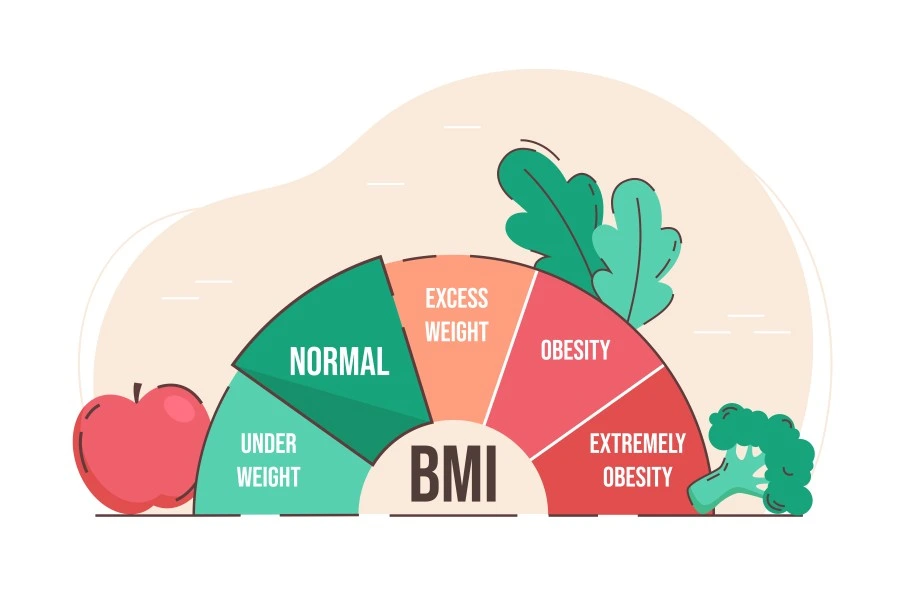
Body Mass Index is a simple measure that takes the height and weight of the patient into account. It provides an estimate of how much fat is present in the body and whether the patient is within a healthy weight range. To calculate BMI, the patient’s weight in kilograms must be divided by the height in meters squared (kg/m2). The healthy BMI ranges from 18.5 up to 24.9; a score of less than 18.5 indicates that they are underweight; 25-29.9 indicates that they are overweight; and a BMI of 30 or more means they are obese. The above formula applies to males and females; the healthy range may vary slightly based on age and population being studied.
KEY TAKEAWAYS
- One of the good things about BMI is that it is quick and easy to do – just divide your weight by your height squared.
- A BMI of 18.5–24.9 is what we generally consider “normal weight” for grown-ups.
- The categories work for both men and women – but the health risks can start kicking in at lower BMIs for Asian people.
- One of the downsides to BMI is that it can’t tell the difference between muscle and fat – so if you are into sport or you are older, it might get your classification a bit wrong.
- It is useful to use BMI as a starting point for looking at your health – but you should not rely on it – look at other things like waist circumference, what your lifestyle is like and other risk factors too .
- If you are under 20, BMI is calculated using percentiles that take into account your age and sex – rather than the adult categories.
INTRODUCTION
You may have seen or heard the term Body Mass Index floating around – maybe at the doctor’s surgery or on health websites – and even used an online calculator to work out your own – but do you really know what it means – or what it does not mean?
The Body Mass Index thing has become one of the most widely used health screening tools out there – doctors use it to get a quick idea if you are in a healthy weight range, public health researchers use it to track obesity across populations – it is simple, it is cheap, and it gives you a decent starting point for looking at weight-related health risks.
But to be honest, while BMI is a useful tool, it has some pretty big limitations – it does not tell the whole story of your health. This guide is going to help you get a handle on BMI – how to calculate it, what it means, and what to do with it.
WHAT IS BODY MASS INDEX (BMI)?
Body Mass Index is a number that compares your weight to your height – basically, it gives a rough idea of how much body fat you are carrying and whether you are likely to be in a healthy weight bracket for your height.
The idea behind BMI is pretty straightforward – your weight should be roughly in proportion to your height. A taller person naturally weighs more than a shorter one, so BMI takes that into account. It is not a direct measure of body fat – it does not measure fat percentage or distribution – it’s a screening tool to help doctors spot potential weight-related health risks. Someone with a high BMI is more likely to have excess body fat but not always – especially for athletes or people who are naturally pretty muscular.
Calculating Your BMI
The BMI formula is pretty straightforward – just plug in your weight and height and you’re done.
The Metric Formula
BMI = Weight (kg) ÷ Your Height Squared
For example, if you weigh 70 kg and are 1.75 meters tall:
- Multiply your height by itself – that’s just 1.75 x 1.75 = 3.0625
- Now divide your weight by that number: so 70 divided by 3.0625 is 22.9. Easy enough.
Your BMI is 22.9 – which is right in the healthy zone, by the way
The Imperial Formula
If you’re using pounds and inches, the formula is slightly different:
BMI = (Weight in pounds ÷ Your Height Squared) x 703
For example, if you weigh 160 pounds and are 66 inches tall:
- So, multiply your height by itself: that’s 66 x 66 = 4,356
- Next, divide your weight by that number: 160 divided by 4,356 is just 0.0367
- And finally multiply by 703: that gives you 25.8
Using The BMI Formula For Men And Women
The beauty of the BMI formula is it’s the same for men and women – the same height and weight will give you the same BMI number, regardless of gender.
The only thing to keep in mind is that women tend to have a bit more body fat than men – yet the same BMI categories are used for both. That’s one of the criticisms of BMI, by the way – it doesn’t take this sort of difference into account.
For adults over 20, the BMI is interpreted using the same standard weight chart for both men and women. For people under 20, however, BMI is compared to age- and sex-specific percentiles because body composition changes as we grow up.
Your BMI By Age And Gender
For adults over 20, the BMI categories are all the same, no matter your age. A BMI of 22 is the same thing at 25 or 65, for example.
But for most people, BMI does change as we get older. In the US, for example, median BMI for men in their 20s is 27.0, while for men in their 50s it’s 29.0. This is because people tend to put on a bit of weight as they get older.
For people under 20, it’s a different story. Instead of fixed categories, BMI is compared to age- and sex-specific growth charts. A kid or teenager’s BMI is expressed as a percentile, showing how it compares to others of the same age and gender.
The BMI Chart For Adults
Here is the standard BMI classification for adults over 20 :
| Weight Category | BMI Range (kg/m²) |
| Underweight | Below 18.5 |
| Normal weight | 18.5 – 24.9 |
| Overweight | 25.0 – 29.9 |
| Obese | 30.0 – 34.9 |
| Obese (Class II) | 35.0 – 39.9 |
| Extreme obesity | 40.0 and above |
Note: For East Asian populations, lower thresholds are used. Overweight is considered BMI ≥23, and obese is BMI ≥27.5 in some Asian guidelines.
HOW TO MAKE SENSE OF YOUR BMI RESULTS
Your BMI category is just a rough guide to whether your weight is putting you at risk of any health problems.
Underweight (BMI < 18.5): Being underweight is a bit of a worry, because it might be a sign of not getting enough to eat, losing muscle mass or having an underlying health issue. If that sounds like you, its worth chatting to a doctor to get some answers.
Normal weight (BMI 18.5-24.9): Most people are going to fall into this healthy weight range, and that’s good news – it means your risk of having any weight-related health problems is lower than it would be otherwise.
Overweight (BMI 25-29.9): Unfortunately, being in this category means you might be building up a few health risks – like high blood pressure, heart disease and type 2 diabetes. On the bright side, losing some weight could really help.
Obese (BMI 30 and above): This is when things start to get pretty serious. Being in this category means you’re at a higher risk of all sorts of nasty health conditions – heart disease, stroke, diabetes and joint problems, among them.
The Flaws of BMI – It’s Not as Simple as it Seems
BMI can be a useful tool, but let’s be honest, it’s far from perfect. Here are a few things to bear in mind when you get your BMI results.
For All Its Worth, BMI is Not a Muscle vs. Fat Test
The biggest problem with BMI – or rather, its biggest flaw – is that it can’t distinguish between fat, muscle, and bone. So if you’re an athlete who’s built up lots of muscle, you might find yourself in the overweight or obese range, even if you’re not carrying a lot of body fat. At the other end of the scale, someone who’s getting on in years and has a lot of body fat but not much in the way of muscle mass might end up with a ‘normal’ BMI.
BMI Doesn’t Give You a Clue About Where Your Fat is Stored
The thing is, BMI just gives you a single number. It has no idea where the fat is on your body. Visceral fat – the stuff that settles around your organs – is a lot more of a problem than the kind you can see just under the skin. If you want to get a better handle on that risk, waist circumference is probably a better bet.
For Certain Groups, BMI’s Just Not That Accurate
For older people, BMI is less reliable. As we get older, we tend to lose muscle and put on fat, so a normal BMI might actually be hiding all sorts of unhealthy fat. And for Asian populations, the standard BMI cut-off points aren’t always accurate.
BMI is Just One Piece of the Puzzle – Not the Whole Story
Your BMI is just a rough guide – it can’t tell you the whole story about your health. Other factors like how much you exercise, what you eat, how much you drink, whether you smoke, and your genetic makeup all play a part too.

Conclusion
BMI is a relatively easy and commonly used index that estimates the approximate probability of being within a normal weight category relative to one’s height. This is helpful information, but it is essential to remember that it is a good starting point but not the only factor to consider when evaluating one’s risk of obesity-related diseases.
But there are some problems with using this index. First of all, BMI cannot differentiate between muscle and fat. Also, it does not take into account the distribution of fat and the age-related changes in the composition of the body. In addition, BMI is less accurate for some categories of people, such as athletes, older patients, and individuals of certain races.
BMI is an excellent tool to use, but you need to use other measures of your weight-related health as well. Do not forget to take other factors into account – waist circumference, physical activity, etc. Discuss your ideal weight with your physician.
