

NABARD is one of the most important financial institutions in rural India. It funds farmers, rural banks, self-help groups and village infrastructure. Questions on NABARD come up often in banking and government exams like IBPS, SBI, RBI Grade B and NABARD Grade A. This article covers NABARD’s full form, history, structure and functions. It also lists the key facts you need for your exam.
NABARD Full Form
The full form of NABARD is the National Bank for Agriculture and Rural Development. It is India’s apex development bank for agriculture and the rural economy.
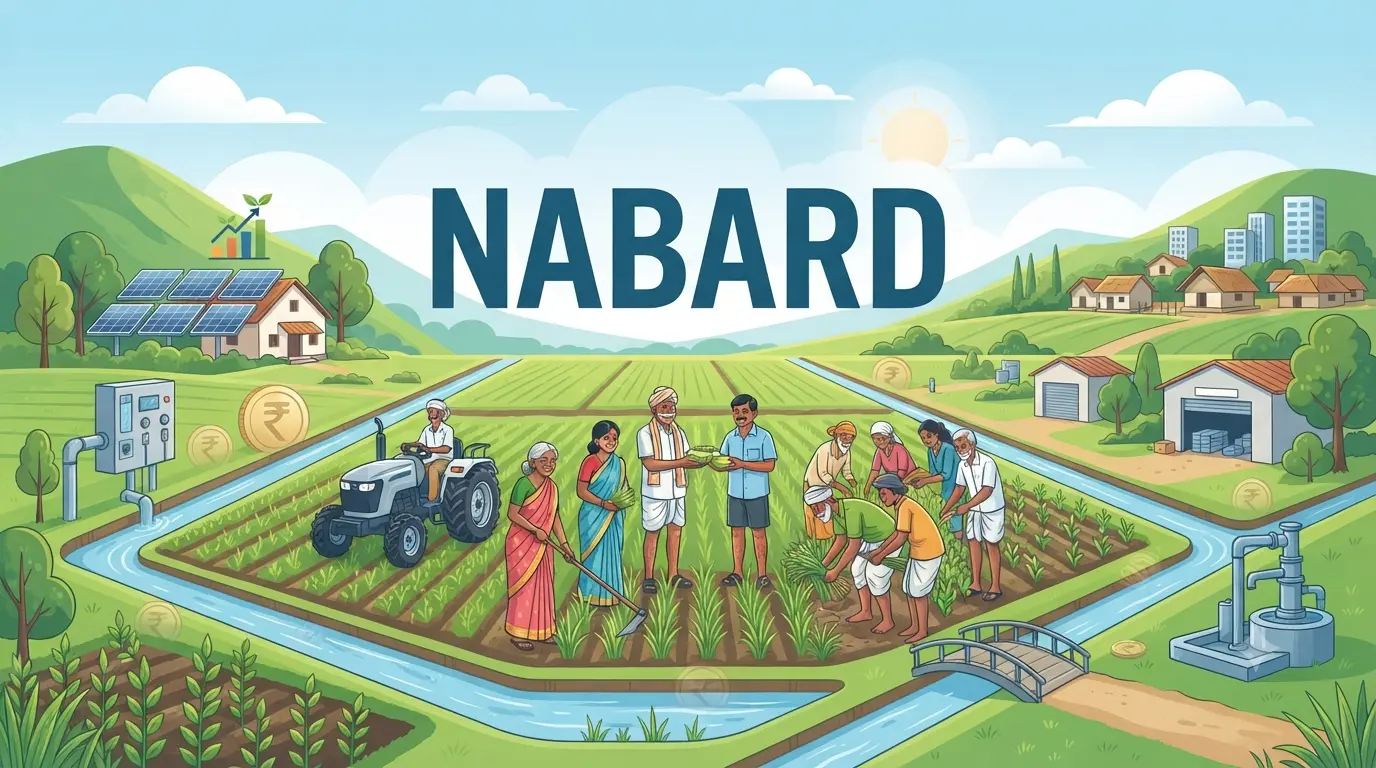
nabard
NABARD: Quick Facts
| Particulars | Details |
|---|---|
| Full Form | National Bank for Agriculture and Rural Development |
| Established | 12 July 1982 |
| Act | NABARD Act, 1981 (Act 61 of 1981) |
| Recommended by | CRAFICARD Committee (B. Sivaraman Committee) |
| Headquarters | Mumbai, Maharashtra |
| Chairman | Shaji K. V. (since December 2022) |
| Ownership | 100% Government of India |
| Initial Capital | ₹100 crore |
| Authorised Capital | ₹30,000 crore |
| Paid-up Capital | ₹17,080 crore |
| Tagline | Taking Rural India >> Forward |
| Foundation Day | 12 July |
History of NABARD
In 1979, the RBI set up a committee to review how credit reached rural India. This was the Committee to Review Arrangements for Institutional Credit for Agriculture and Rural Development (CRAFICARD), headed by B. Sivaraman. The committee recommended a single apex body for rural credit.
Parliament then passed the NABARD Act in 1981. NABARD started work on 12 July 1982 with an initial capital of ₹100 crore. The Government of India and the RBI shared this capital. Prime Minister Indira Gandhi dedicated NABARD to the nation on 5 November 1982.
NABARD took over two sets of functions:
- The agricultural credit functions of the RBI
- The refinance functions of the Agricultural Refinance and Development Corporation (ARDC)
Over time, the RBI’s stake moved to the Government of India. Since 2018, NABARD has been fully owned by the Government of India.
Objectives of NABARD

NABARD’s main aim is to promote agriculture and rural development across India. Its key objectives are:
- To provide credit for agriculture, small industries, cottage and village industries, and handicrafts
- To support integrated rural development and rural prosperity
- To strengthen rural financial institutions such as cooperative banks and Regional Rural Banks (RRBs)
- To build rural infrastructure through special funds
- To promote financial inclusion in villages
NABARD’s vision is to be the “Development Bank of the Nation for Fostering Rural Prosperity.”
Structure of NABARD
A Board of Directors manages NABARD. The Central Government appoints the board members under Section 6 of the NABARD Act, 1981. The board includes:
- The Chairman
- Experts in rural economics, rural development and cooperation
- Directors from the Reserve Bank of India
- Officials from the Government of India
- Officials from State Governments
NABARD also has Deputy Managing Directors who handle day-to-day operations. Its head office is in Mumbai. Regional offices in states and district development managers at the district level carry out its work on the ground.
Chairman of NABARD
Shaji K. V. is the current Chairman of NABARD. He took charge on 7 December 2022. Before this, he served as NABARD’s Deputy Managing Director.
Functions of NABARD

NABARD’s work falls into three broad areas: financial, developmental and supervisory.
1. Financial Functions
NABARD does not lend directly to most farmers. It works through other banks. Its main financial functions are:
- Refinance: NABARD gives short-term and long-term refinance to banks that lend to farmers and rural businesses. These include cooperative banks, RRBs and commercial banks.
- Rural infrastructure finance: It lends to state governments for rural roads, bridges, irrigation and other projects, mainly through the Rural Infrastructure Development Fund (RIDF).
- Direct lending: It lends directly to some institutions, like cooperatives, Farmer Producer Organisations (FPOs) and state-owned bodies.
2. Developmental Functions
NABARD helps build the rural credit system. Its key development roles are:
- It started the SHG–Bank Linkage Programme in 1992. This programme connects self-help groups with banks.
- It helped design the Kisan Credit Card (KCC) scheme, launched in 1998.
- It supports Farmer Producer Organisations (FPOs).
- It trains staff of rural banks and cooperatives.
- It funds watershed development, tribal development and farm innovation programmes.
- It prepares district-level credit plans that estimate how much credit each area needs.
3. Supervisory Functions
NABARD inspects and supervises rural financial institutions:
- Regional Rural Banks (RRBs)
- State Cooperative Banks (StCBs)
- District Central Cooperative Banks (DCCBs)
It checks their financial health and guides them on better practices. NABARD itself is an All India Financial Institution (AIFI), and the RBI regulates it.
Important Funds Managed by NABARD

NABARD manages several special funds for rural development. The key ones are:
- Rural Infrastructure Development Fund (RIDF): Set up in 1995–96 to fund rural infrastructure projects.
- Long Term Irrigation Fund (LTIF): Funds pending irrigation projects.
- Micro Irrigation Fund: Promotes drip and sprinkler irrigation.
- Dairy Processing and Infrastructure Development Fund (DIDF): Supports dairy cooperatives.
- Fisheries and Aquaculture Infrastructure Development Fund (FIDF): Builds fisheries infrastructure.
- Food Processing Fund: Funds food parks and processing units.
- Watershed Development Fund and Tribal Development Fund
Subsidiaries of NABARD
NABARD has seven subsidiaries:
| Subsidiary | Main Role |
|---|---|
| NABKISAN Finance Ltd | Lending to FPOs and agri businesses |
| NABSAMRUDDHI Finance Ltd | Finance for off-farm and non-farm activities |
| NABFINS Ltd | Microfinance |
| NABCONS | Consultancy services |
| NABVENTURES Ltd | Venture capital for agri and rural start-ups |
| NABSANRAKSHAN Trustee Pvt Ltd | Credit guarantee funds |
| NABFOUNDATION | Rural development projects (not-for-profit) |
Key Facts About NABARD for Exams
- NABARD was set up on the recommendation of the CRAFICARD Committee (B. Sivaraman Committee).
- It was set up under the NABARD Act, 1981.
- It started operations on 12 July 1982, which is now celebrated as its Foundation Day.
- Its headquarters is in Mumbai.
- It is 100% owned by the Government of India.
- Its authorised capital is ₹30,000 crore.
- Its paid-up capital is ₹17,080 crore.
- It is an apex development financial institution regulated by the RBI.
- It manages the Rural Infrastructure Development Fund (RIDF).
- It started the SHG–Bank Linkage Programme in 1992.
- It supervises RRBs, State Cooperative Banks and District Central Cooperative Banks.
- Its balance sheet is over ₹9 lakh crore.
Conclusion
NABARD is the backbone of rural finance in India. It refinances banks, builds rural infrastructure and supervises rural banks. It also leads major programmes like the SHG–Bank Linkage Programme and the Kisan Credit Card. For banking and government exam aspirants, NABARD is a must-know topic. Revise the key facts above before your exam. For the latest updates, visit the official NABARD website.
Our Offerings
Preparing for a government job? Explore Entri’s exam coaching programmes in Malayalam:
| Exam Category | Our Offerings | Popular Exams |
|---|---|---|
| SSC Exams | SSC Coaching | SSC CGL, SSC CHSL, SSC GD, SSC MTS |
| Railway (RRB) Exams | RRB Coaching | RRB NTPC, RRB Group D, RRB Station Master |
| Bank Exams | Bank Exam Coaching | IBPS PO, SBI PO, IBPS Clerk, SBI Clerk |
| Kerala PSC Exams | Kerala PSC Coaching | LDC, LGS, 10th Level, Degree Level |
| Kerala Teaching Exams | Kerala Teaching Exam Coaching | KTET, SET, HSST, HSA, LP/UP Assistant |
| Kerala Technical Exams | KPSC Technical Exam Coaching | Civil, Mechanical, Electrical, Electronics, Overseer |
