

Looking to build long-term wealth through blue-chip Indian stocks? Or are you trying your hand at short-term trading on the NSE and BSE?
Whatever be your plan, mastering technical and fundamental analysis is quite important to making informed financial decisions.
The aim of technical and fundamental analysis is to help you make profits in the stock market.
However, both the approaches use entirely different tools, data points, and time horizons.
Fundamental Analysis
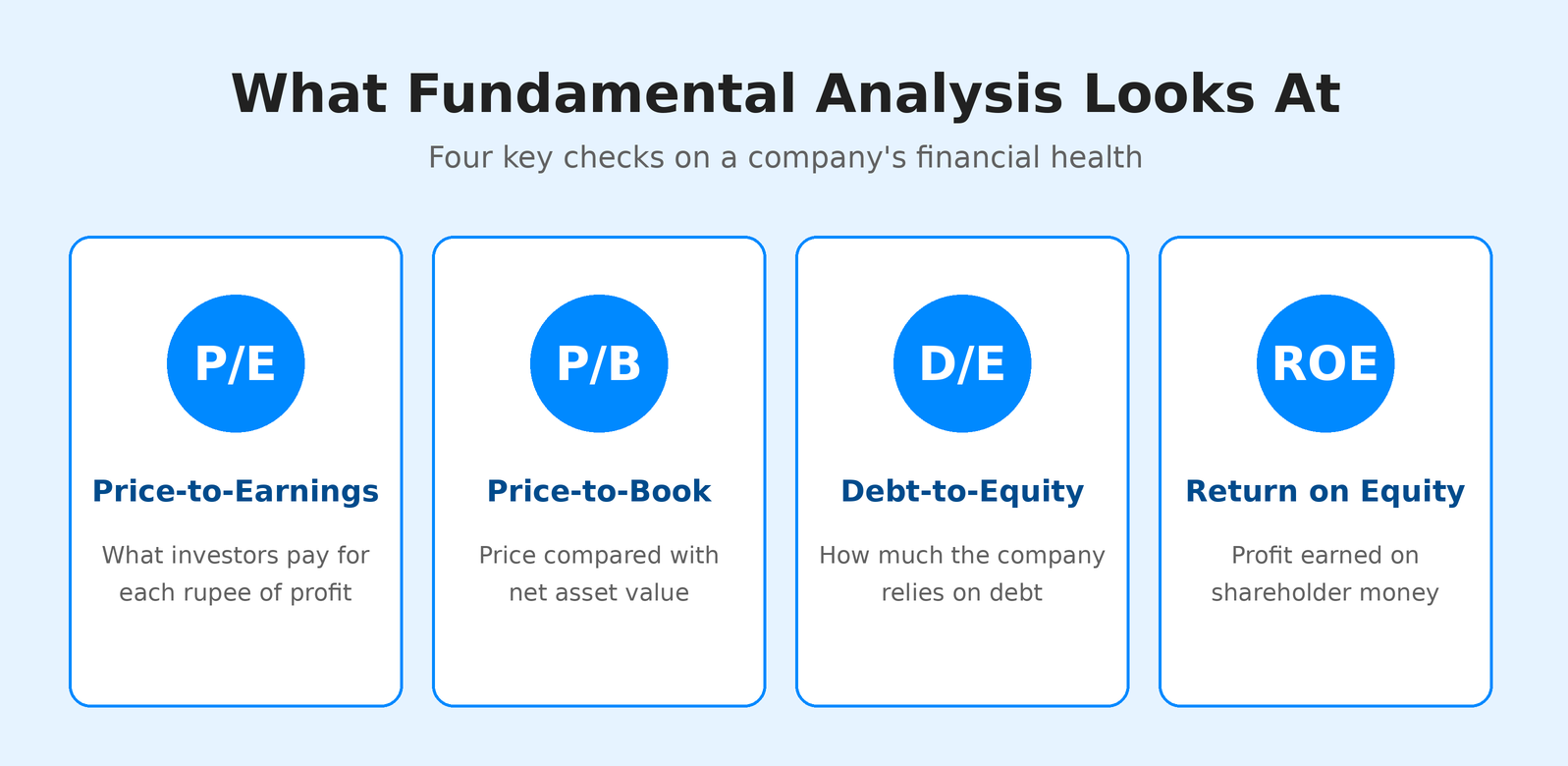
When it comes to Fundamental analysis, the focus is on evaluating the intrinsic value of a company.
Here analysts evaluate business financial health, industry prospects, and macro-economic factors. Thus they determine whether a stock is underpriced or overpriced.
Key Factors Evaluated:
| Financial Statements | Analyzing balance sheets, profit & loss (P&L) statements, and quarterly earnings reports published by listed companies |
| Valuation Ratios | Metrics like Price-to-Earnings (P/E), Price-to-Book (P/B), Debt-to-Equity, and Return on Equity (ROE) |
| Qualitative Aspects | Management quality, corporate governance, brand value, and competitive edge in the Indian market |
| Goal | Buy stocks that are trading at a discount compared to their actual business value and hold them over a long period |
Technical Analysis
Technical analysis ignores the underlying business model of the company. It focuses purely on price movements and market statistics.
Traders believe that all public information is already reflected in the stock price.
Key Factors Evaluated:
| Price Charts | Candlestick patterns, line charts, and volume charts over various timeframes such as minutes, hours, days |
| Technical Indicators | Moving Averages (EMA/SMA), Relative Strength Index (RSI), Moving Average Convergence Divergence (MACD), and Bollinger Bands |
| Chart Patterns | Support and resistance levels, head and shoulders patterns, double bottoms, and breakouts |
| Goal | Identify short-term price trends and market sentiment to enter and exit trades at optimal price points |
Comparison of Key Differences
A major benefit of understanding the differences between technical and fundamental analysis is that it will help you align your strategy with your investment goals.
| Feature | Fundamental Analysis | Technical Analysis |
| Primary Focus | Business performance & financial metrics | Stock price movement & trading volume |
| Main Objective | Find intrinsic (true) value of a company | Time market entry and exit points |
| Time Horizon | Long-term (Years to decades) | Short-term (Intraday, days, or weeks) |
| Primary Data Source | Earnings reports, balance sheets, GDP growth | Candlestick price charts, technical indicators |
| Investor Profile | Long-term value investors | Day traders, swing traders, and positional traders |
Fundamental Analysis or Technical Analysis?
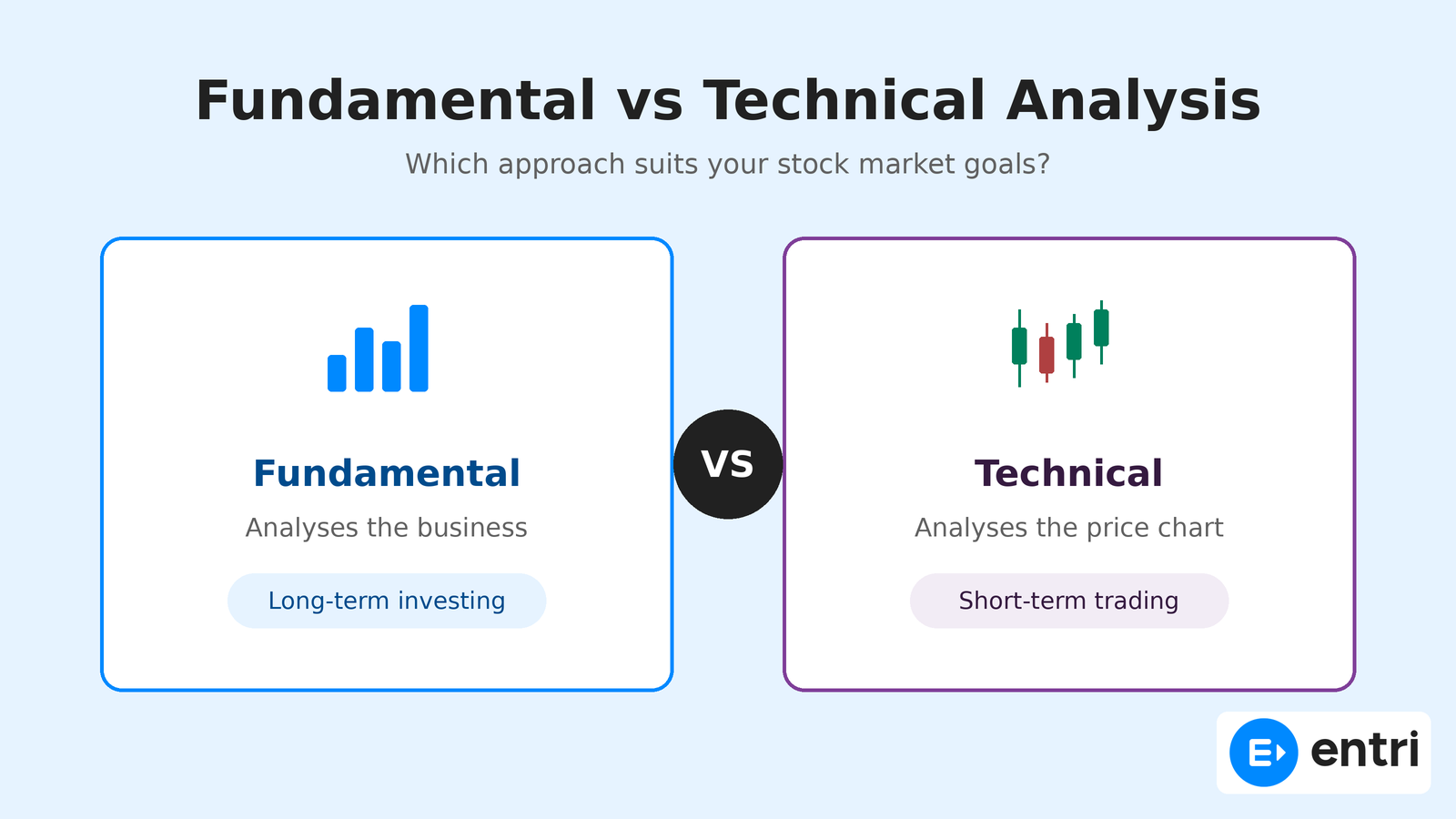
Now you might be thinking which method to choose between fundamental and technical analysis.
It depends heavily on your financial goals, risk appetite, and time commitment.
Choose Fundamental Analysis if you want to
- invest like a business owner
- build a multi-year portfolio (e.g., compounding wealth for retirement)
- do not want to monitor stock charts every day
Choose Technical Analysis if you
- enjoy active trading
- want to take advantage of short-term market fluctuations
- have time to track price actions during market hours
The Hybrid Approach
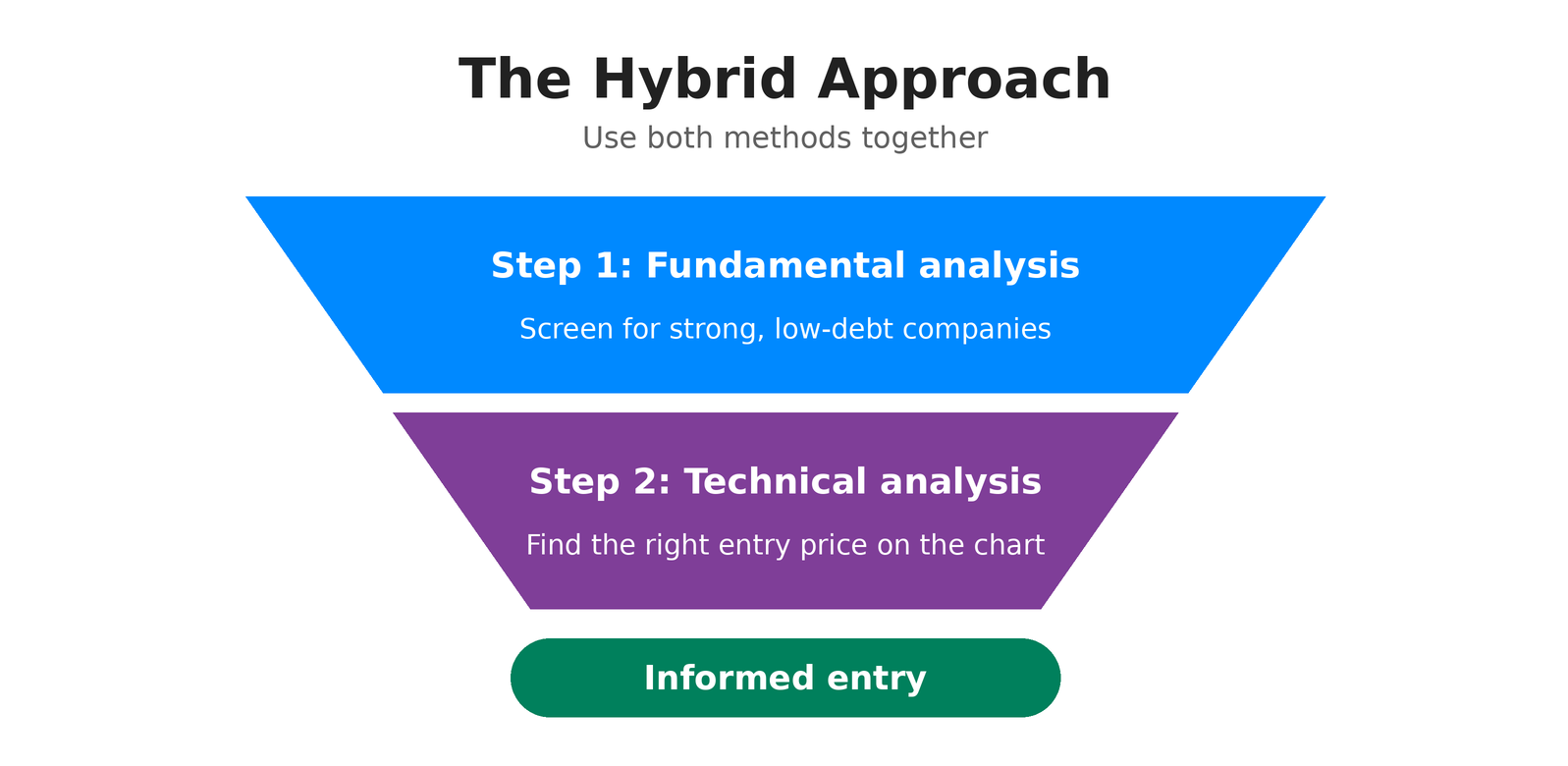
Many successful market participants combine both disciplines.
They use fundamental analysis to filter out high-quality, debt-free Indian companies. Then they use technical analysis to pinpoint an ideal entry price point on the stock chart.
This lesson is for education only and is not investment advice.
|
ALSO READ |
|
| Introduction to Indian Stock Market | |
| What is Leverage and Margin Trading? | |
| Introduction to Mutual Funds | Key Factors Before Investing in a Mutual Fund |
| How to Analyze Mutual Funds | |
