

A mutual fund is an investment scheme that pools money from many investors and invests it in stocks, bonds or other assets.
A professional fund manager runs it on everyone’s behalf. Each investor owns units of the fund.
Gains or losses are shared in proportion to the units they hold.
What is a Mutual Fund?
Imagine 1,000 people each invest ₹1,000. Together they create a fund of ₹10 lakh.
An expert invests that money across many companies or bonds.
If the investments grow, everyone’s share grows. If they fall, everyone’s share falls.
Each person gets a portion in proportion to what they paid.
Note:
You own units of the fund, not the shares inside it directly. So what happens to your money after you invest?
How do Mutual Funds Work?
Here is the journey your money takes:
- You invest money in a mutual fund scheme.
- Your money joins a common pool with other investors’ money.
- As per the scheme’s stated objective, the fund manager invests the pool in stocks, bonds or other assets.
- The value of those assets rises or falls every day.
- Gains or losses are shared among investors in proportion to the units they hold.
What does NAV mean?
NAV (Net Asset Value) is worked out as
(total value of the fund’s assets − expenses) ÷ number of units
Say you invest ₹10,000 when the NAV is ₹50. You get 200 units.
- If NAV rises to ₹55, your investment is worth 200 × ₹55 = ₹11,000.
- If NAV falls to ₹45, it is worth 200 × ₹45 = ₹9,000.
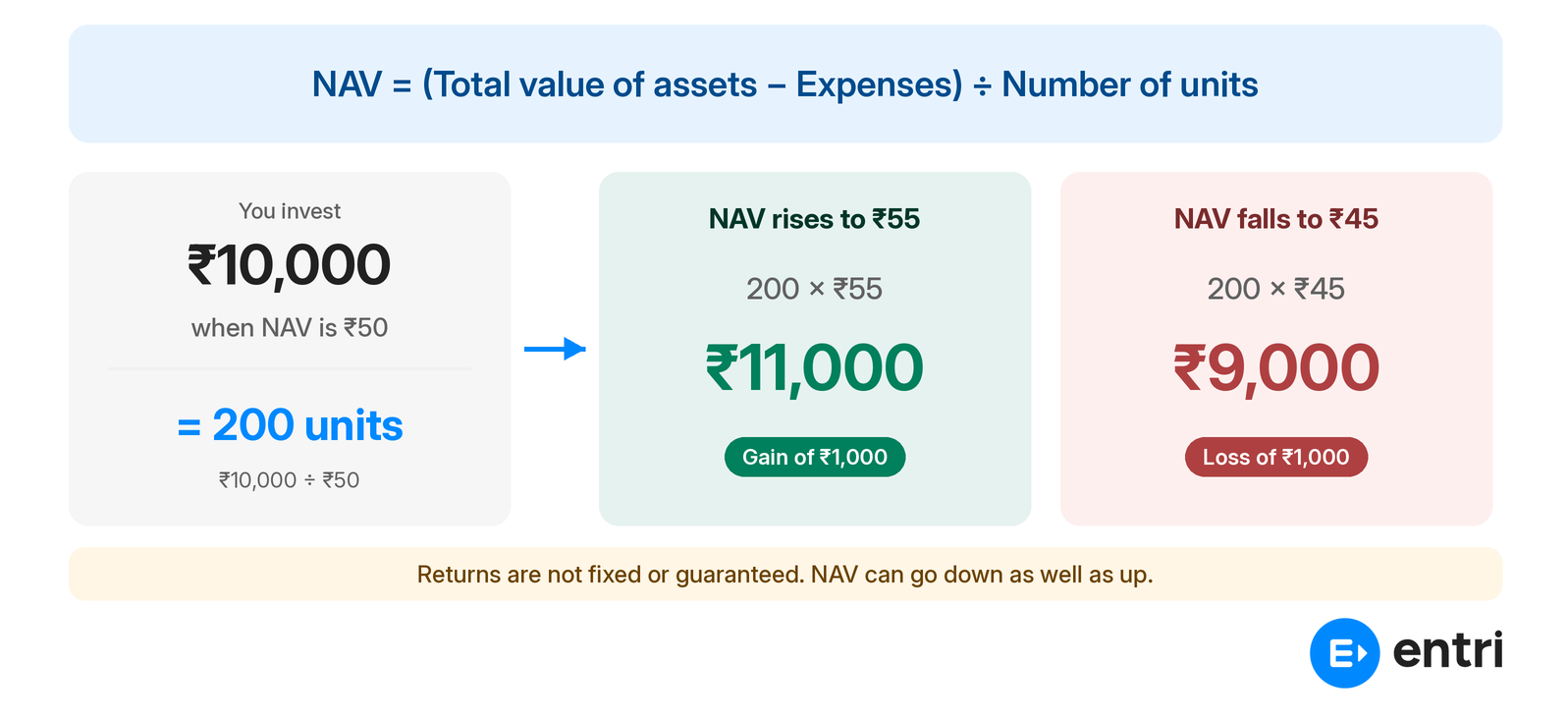
Important: mutual fund returns are not fixed or guaranteed. The NAV can go down as well as up.
Why do People Invest in Mutual Funds?
- Professional management:
Trained experts research and track investments for you.
- Diversification:
One fund may hold dozens of stocks or bonds. So one bad company hurts less.
- Affordability:
You can start a SIP with a small monthly amount.
- Liquidity:
Most open-ended funds can be redeemed on any business day.
Some charge an exit load if you leave early, and ELSS funds have a 3-year lock-in.
- Regulation:
SEBI rules, independent trustees, custodians that hold the assets, and daily NAV disclosure protect investors.
Regulation protects you from misuse of money, not from market falls. How risky a fund is depends on what it invests in.
What are the Types of Mutual Funds in India?
Funds are grouped by what they invest in. Here are the types beginners meet most often:
| Type | Invests in | Risk | Key Caution |
| Equity funds | Company shares | High | Can fall sharply in the short term |
| Debt funds | Bonds, government securities | Low–moderate | Interest-rate and credit risk |
| Hybrid funds | Mix of equity and debt | Moderate | Risk rises with equity share |
| Index funds | Same stocks as an index, e.g. Nifty 50 | High | Falls when the market falls |
| ELSS funds | Mainly equity | High | No withdrawal for 3 years |
| Liquid funds | Very short-term debt | Low | Modest returns, not guaranteed |
Mutual Fund vs Stock: Which Suits a Beginner?
| Factor | Mutual Fund | Direct Stocks |
| Who manages | Professional fund manager | You |
| Diversification | Built in | You must build it yourself |
| Research needed | Low to moderate | High |
| Minimum investment | Small SIP amounts | Price of at least one share |
| Control | Low; the manager decides | Full control |
| Volatility | Usually lower, as risk is spread | Often higher; single-company risk |
| May suit | Beginners, busy professionals | Experienced, hands-on investors |
It is not either/or. Many investors start with mutual funds and learn about direct stocks later.
SIP vs Lump Sum: Which should You Choose?
- SIP (Systematic Investment Plan): you invest a fixed amount at regular intervals, for example ₹5,000 every month.
- Lump sum: you invest a large amount at once.
Averaging smooths your purchase price. It does not guarantee profit.
A SIP may suit you if you
- earn a regular income
- are new to investing
- worry about investing at the wrong time
A lump sum may suit you if you
- have a bonus or windfall
- a long time horizon
- are investing in debt or liquid funds
What Mutual Fund Terms Should Every Beginner Know?
| NAV | Price of one unit of the fund |
| Expense ratio | Yearly fee charged as a % of your investment; deducted from the fund |
| AUM (Assets Under Management) | Total money the fund manages |
| AMC (Asset Management Company) | Company that runs the mutual fund |
| Fund Manager | Person who decides where the money is invested |
| Exit load | Fee for redeeming before a set period |
| Lock-in period | Time you cannot withdraw (3 years for ELSS) |
| CAGR | Average yearly growth rate over a period |
| Portfolio | List of stocks, bonds or other assets the fund holds |
| Benchmark | Index the fund’s performance is compared against |
| Direct vs regular plan | Direct: bought from the AMC, no commission, lower expense ratio.
Regular: bought via a distributor, includes commission |
How to Invest in Mutual Funds in India: Step by Step
You can start investing in mutual funds in India in nine steps. KYC and a first SIP can usually be done online in under an hour.
Before you start, keep ready:
- PAN card and Aadhaar
- A bank account in your name
- A clear goal and rough time frame
- An emergency fund covering a few months of expenses
1. Set a goal and time horizon
For example: an emergency fund, a bike in 3 years, or retirement in 25 years.
2. Assess your risk tolerance
Ask yourself: how would I feel if ₹10,000 became ₹8,000 for a few months?
3. Pick a category that fits
Match your time horizon to the fund type table above.
4. Compare schemes within that category
Look at expense ratio, performance against the benchmark over 5+ years, portfolio fit and the fund house’s track record of process.
5. Complete KYC
Submit PAN, Aadhaar and bank details once, online or through a registered intermediary.
6. Choose a direct or regular plan
Direct plans cost less; regular plans include advice from a distributor, for a commission.
7. Start a SIP or lump sum
Invest through the AMC’s website, a registrar platform, or a SEBI-registered app or adviser.
8. Review once or twice a year
Check whether the fund still fits your goal. Daily tracking is not needed.
9. Avoid frequent switching
Short periods of underperformance are normal.
Common Problems and Fixes:
- KYC on hold:
Usually a name or address mismatch between PAN and Aadhaar. Update the records, then reapply.
- SIP instalment failed:
Check the bank mandate and keep enough balance on the debit date.
- Bought a regular plan by mistake:
You can switch to the direct plan. But before that check exit load and tax first.
What are the Risks of Mutual Funds?
- Market Risk: equity fund values fall when stock markets fall.
- Interest-Rate Risk: debt fund NAVs can drop when interest rates rise.
- Credit Risk: a bond issuer may fail to repay.
- Liquidity and Exit-Load Costs: early withdrawal may cost a fee. ELSS money is locked for 3 years.
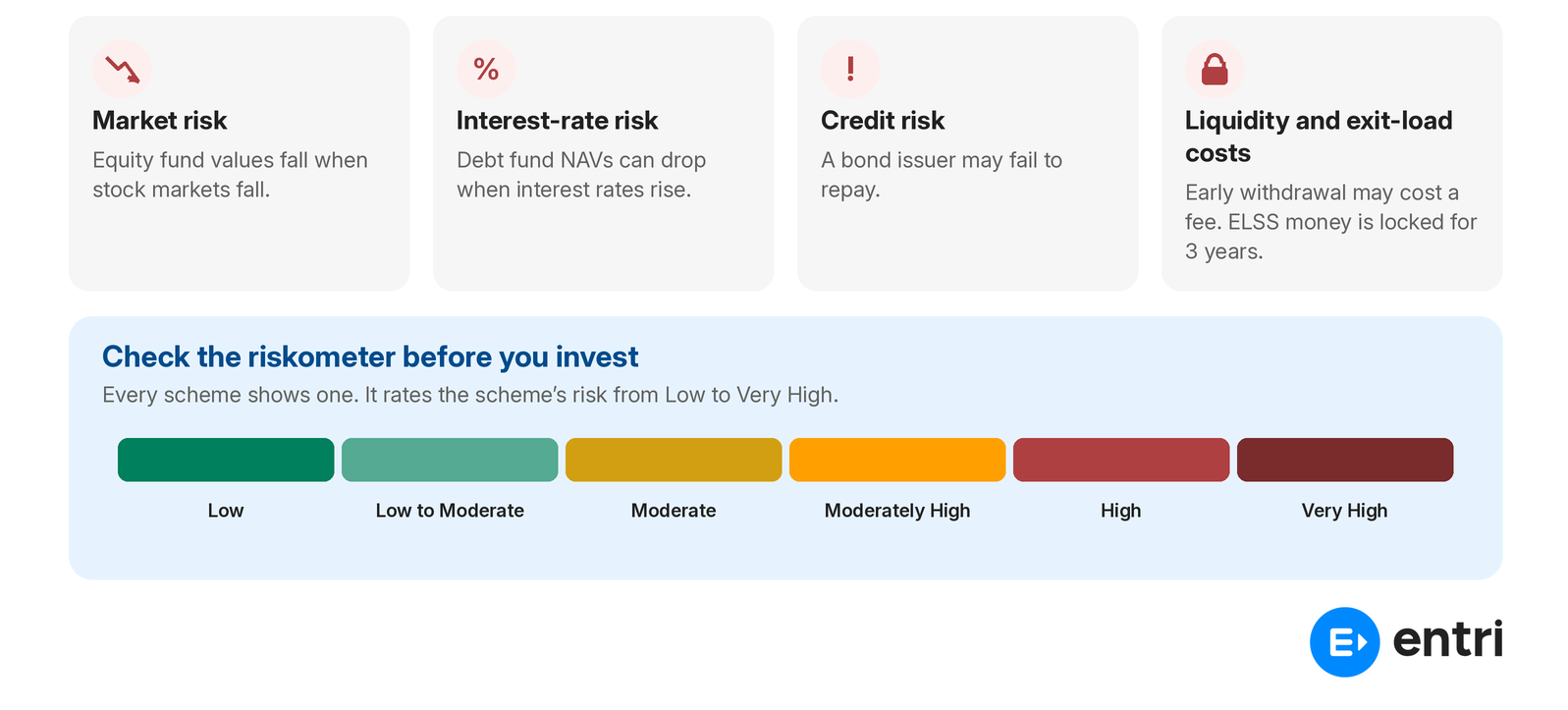
Every scheme shows a riskometer. It rates its risk from Low to Very High. Check it before you invest.
Common Beginner Mistakes to Avoid
- Chasing last year’s top returns – past performance may not repeat.
- Ignoring the expense ratio – a 1% higher fee eats into returns every year.
- Investing without a goal – you won’t know which fund or horizon fits.
- Stopping SIPs when markets fall – you miss buying units at lower prices.
- Mixing insurance and investment – products that combine both are often costly and hard to understand.
- Expecting guaranteed returns – no mutual fund can promise fixed returns.
|
ALSO READ |
|
| Introduction to Indian Stock Market | |
| How to Choose a Stock Broker | |
| What is Leverage and Margin Trading? | |
