

The Indian stock market is a marketplace where people go to buy and sell shares in different companies that have listed on the stock exchanges.
A share is a tiny bit of ownership in a company. Most of the day to day trading happens on two main exchanges in India: the BSE and the NSE.
The market as a whole is kept in check by SEBI – they are the ones making sure investors are protected.
Shares Mean Ownership
When you buy a share, you become a part-owner of that company. S
uppose a company has 1 crore shares and you buy 100. You now own a very small part of the company.
Buyers, Sellers and Price Movement
Every day, some people want to buy a company’s shares and others want to sell them. The share price changes based on this demand and supply.
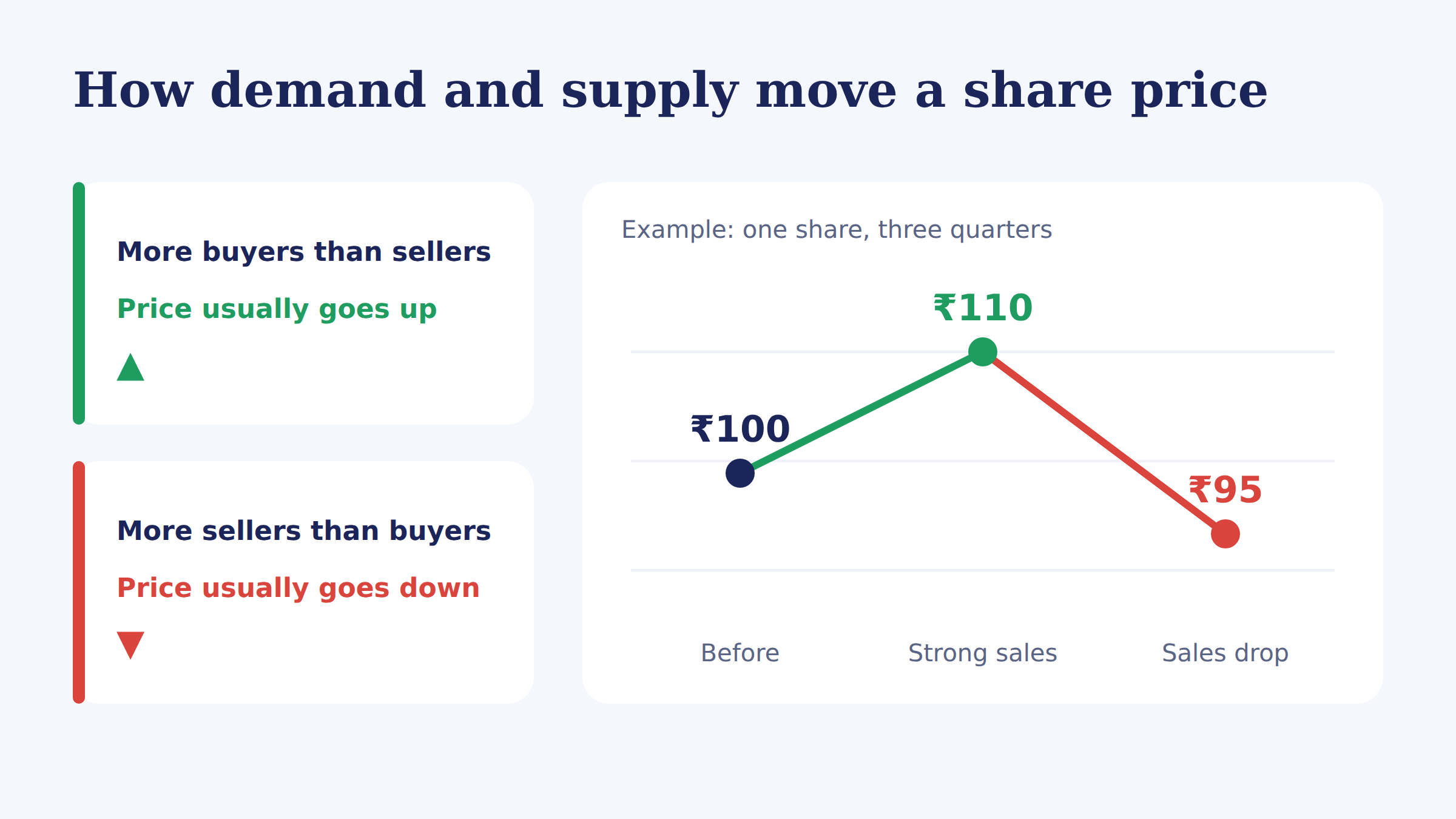
- If more people want to buy than sell, the price usually goes up.
- If more people want to sell than buy, the price usually goes down.
Example:
A company reports strong sales this quarter. More investors want its shares.
So the price moves from ₹100 to ₹110. If sales drop the next quarter, the price may fall back to ₹95.
How does the Stock Market Work in India?
You might be wondering how companies in India actually end up raising the cash they need to expand or do new projects. Well, most of the time it’s by selling shares to the public.
Those investors then sell and buy shares on the stock exchanges using brokers who are registered with SEBI.
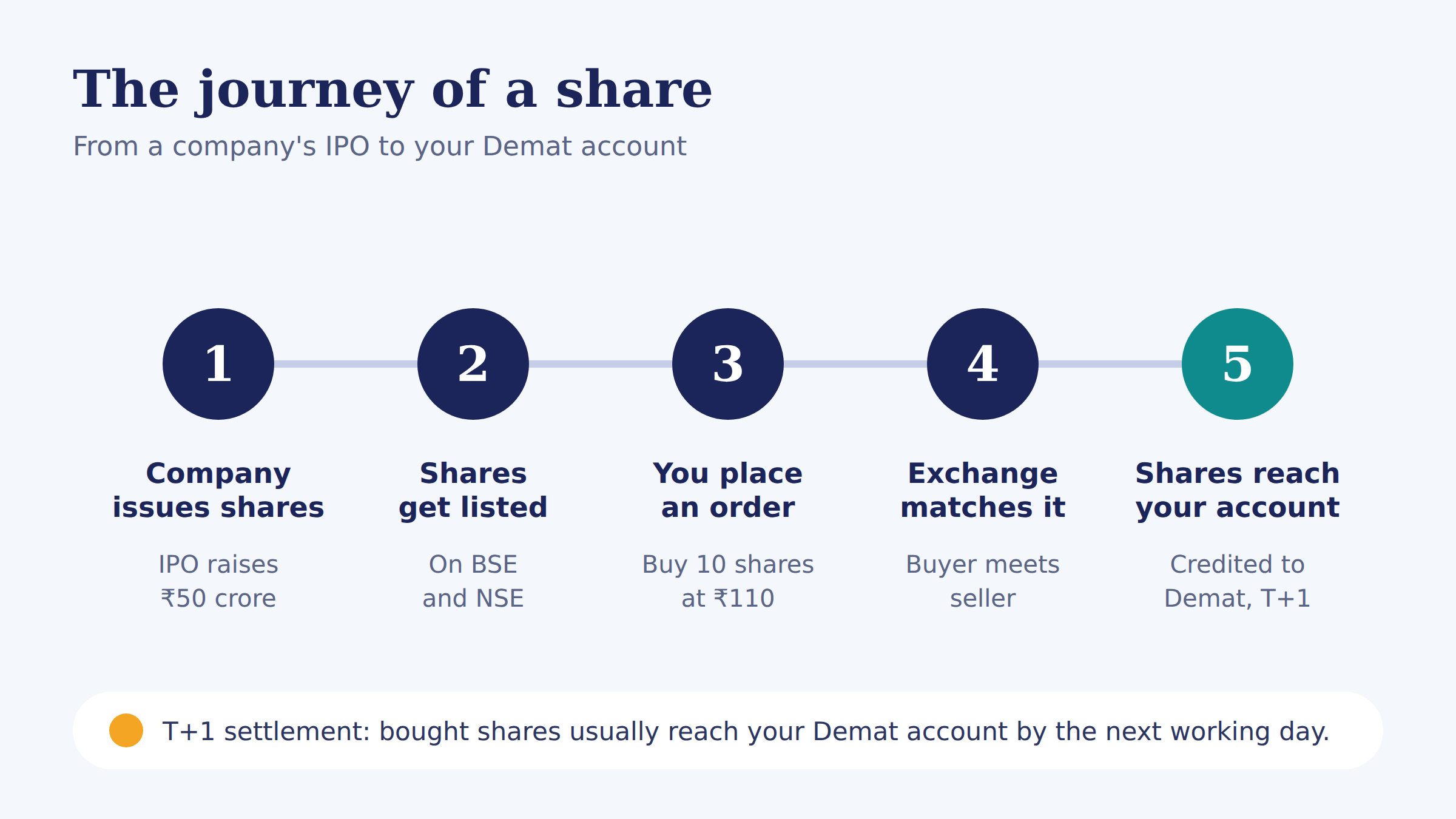
Here is the journey of a share, step by step:
1. The company issues shares
Imagine a company needs a whopping ₹50 crore to build a new factory.
Rather than taking out a loan, they sell shares to the public through a process called an IPO (‘Initial Public Offering’)
2. The shares get listed
After the IPO, the company’s shares are listed on BSE and NSE. Now anyone can trade them.
3. You place an order
You use your broker’s app to buy 10 shares at ₹110.
4. The exchange matches the order
The exchange’s computer system finds a seller who is ready to sell at that price and completes the trade.
5. Shares reach your account
The shares are credited to your Demat account, usually by the next working day. This is called T+1 settlement.
Primary Market vs Secondary Market
- Primary Market:
Where a company sells new shares directly to investors. For example, this happens during an IPO.
- Secondary Market:
Where investors buy and sell existing shares among themselves. Most daily stock market activity happens here.
What are BSE and NSE?
The BSE and the NSE are India’s two biggest stock exchanges where the shares of all sorts of listed companies are bought and sold.
The Sensex is what BSE uses to track its top companies, while the Nifty 50 is the measure NSE uses for the same thing.
- BSE (Bombay Stock Exchange):
It is Asia’s oldest stock exchange, which started in 1875. This is located on Dalal Street in Mumbai.
- NSE (National Stock Exchange):
It brought fully screen-based electronic trading to India in 1992. Today it is the country’s largest exchange by trading volume.
What are Sensex and Nifty 50?
An index is like a scorecard for the market. It tracks the share prices of a selected group of large companies.
- Sensex tracks 30 large, well-established companies listed on BSE.
- Nifty 50 tracks 50 large companies listed on NSE.
Example:
If the news says “Nifty rose 1% today”, it means the 50 companies in that index, when taken together, gained about 1% in value that particular day.
BSE vs NSE: Quick Comparison
| Feature | BSE | NSE |
| Started in | 1875 | 1992 |
| Location | Dalal Street, Mumbai | Bandra Kurla Complex, Mumbai |
| Main index | Sensex (30 companies) | Nifty 50 (50 companies) |
| Known for | Oldest exchange in Asia | Highest trading volume in India |
| Regulated by | SEBI | SEBI |
Note:
Most large companies are listed on both exchanges.
For a beginner, the choice of exchange makes very little difference. Your broker is the one who handles this for you.
What is the Role of SEBI?
SEBI are the ones that have the government’s back when it comes to regulating the stock market and keeping an eye on investors.
They became a real regulator back in 1992.Here is how SEBI keeps the market fair:
-
Registers and monitors market players:
Brokers, stock exchanges, mutual funds and investment advisers must be registered with SEBI.
-
Makes companies share honest information:
Listed companies must regularly publish their financial results and important updates.
-
Stops unfair practices:
SEBI acts against insider trading (trading using secret company information) and price manipulation.
-
Handles investor complaints:
Investors can file complaints online through SEBI’s SCORES portal.
-
Promotes investor education:
SEBI runs awareness programmes so that people can invest safely.
Stay Safe: Avoid Common Traps
- Always check that your broker or adviser is SEBI-registered on the official website, sebi.gov.in.
- Ignore WhatsApp, Telegram or social media groups offering “sure-shot tips”.
- Be careful of anyone who promises guaranteed or fixed returns from shares. No one can guarantee stock market returns.
- Never share your login details, OTP or password with anyone.
Important Stock Market Terms for Beginners
These 12 terms cover most of what you will hear when you start learning about the stock market.
| Term | Simple meaning | Example |
| Share | A small unit of ownership in a company | You own 100 shares of a company |
| Equity | Ownership in a company. Equity investing means investing in shares | Equity mutual funds invest mainly in shares |
| IPO | When a company sells its shares to the public for the first time | A company offers its shares to the public to fund a new factory |
| Demat Account | An online account that holds your shares in electronic form, like a bank account for shares | The shares you buy are stored here |
| Trading Account | The account you use to place buy and sell orders | You buy 10 shares using this account |
| Broker | A SEBI-registered firm that places your orders on the exchange | The company whose app you use to invest |
| Index | A measure that tracks a group of selected stocks | Sensex, Nifty 50 |
| Dividend | A part of company profit paid to shareholders | A company pays ₹2 per share from its profit |
| Bull Market | A period when share prices are generally rising | Prices go up for many months |
| Bear Market | A period when share prices are generally falling | Prices drop sharply for many months |
| Portfolio | All your investments taken together | Shares + mutual funds you own |
| Volatility | How much and how fast prices move up and down | A share moving 5% in a single day is volatile |
How to Invest in Stocks in India: 5 Simple Steps
To start investing in stocks in India, you need
- a Demat and trading account with a SEBI-registered broker
- completed KYC
- a basic understanding of what you are buying
Learn the basics first
Understand the terms in this guide before you invest any money. Knowing what you are buying is the first form of protection.
Open a Demat and trading account
Choose a SEBI-registered broker. Most brokers let you open both accounts online in one process.
Complete your KYC
KYC (Know Your Customer) verifies your identity. You will usually need your
- PAN card
- Aadhaar
- Bank account details
- A quick photo or video verification
Research before you invest
Take a good hard look at what the company actually does –
- Are they making money for themselves?
- Do they have a lot of debt hanging over their heads?
Don’t buy shares just because your mate or a dodgy social media post told you to.
Start small and think long term
Start off with an amount that feels like pocket change to you.
And whenever you invest in shares, be sure to only use money that you can afford to lose, not money you need to pay the bills or sort out any emergencies.
What does Investing Cost?
Buying and selling shares is not completely free. Common charges include:
- Brokerage:
The fee your broker charges for each order. Some charge a flat fee, others a percentage.
- DP charges:
A small fee charged when shares are taken out of your Demat account after you sell.
- Taxes and statutory charges:
Such as STT (Securities Transaction Tax), stamp duty and GST.
Charges differ from broker to broker. So check them before opening an account.
What are the Different Ways to Invest in the Stock Market?
You can Invest in the stock market by either buying shares directly or through a safer option i.e. mutual funds, index funds and SIPs which help spread your cash across many companies.
- Direct shares:
You choose and buy shares of individual companies yourself. This gives full control but needs time and research.
- Mutual funds:
These guys pool money from lots of different investors and then have a pro manage the whole thing, investing it in loads of companies.
- Index funds:
Think of these like a photocopy of an index like the Nifty 50 or Sensex. They stick to what the index does but often at a lower cost and with less brains needed to figure out what.
- SIP (Systematic Investment Plan):
This is basically a way to set up a regular investment in a mutual fund – just chuck in a fixed sum each month like 500 or 1000 rupees – it helps you get into the habit of saving.
The stock market does give you the possibility of long term growth but the prices of shares can also go down and there ain’t no guarantee on getting a return.
What are the Benefits and Risks of Investing in Stocks?
The stock market offers the potential for long-term growth. But share prices can also fall, and returns are never guaranteed.
BENEFITS
- Potential growth:
Over long periods, good companies can grow in value, and so can their shares.
- Dividends:
Some companies share part of their profits with shareholders.
- Ownership:
You become a part-owner of real businesses.
- Easy to start:
You can begin with small amounts.
RISKS
- Market risk:
Share prices can fall due to company problems, the economy or world events.
- Volatility:
Prices can rise and fall sharply in the short term.
- Loss of money:
You may get back less than you invested.
- Emotional decisions:
Panic selling or buying on hype can lead to losses.
Why Diversification Matters
Diversification is just another word for not putting all your eggs in one basket, which helps avoid one bad egg spoiling the whole basket.
If you put all your money in one company and say that company has a bad year, your whole investment is also down the drain.
But if you split your money across loads of different companies and sectors then if one of them does badly its impact is much less.
This lesson is for education only and is not investment advice.
