

Mutual funds have turned out to be one of the most popular investment options for Indians. This is because people are looking to grow their wealth over time.
However, before you invest your hard-earned money in a fund, it’s important to be aware of what you need to look for.
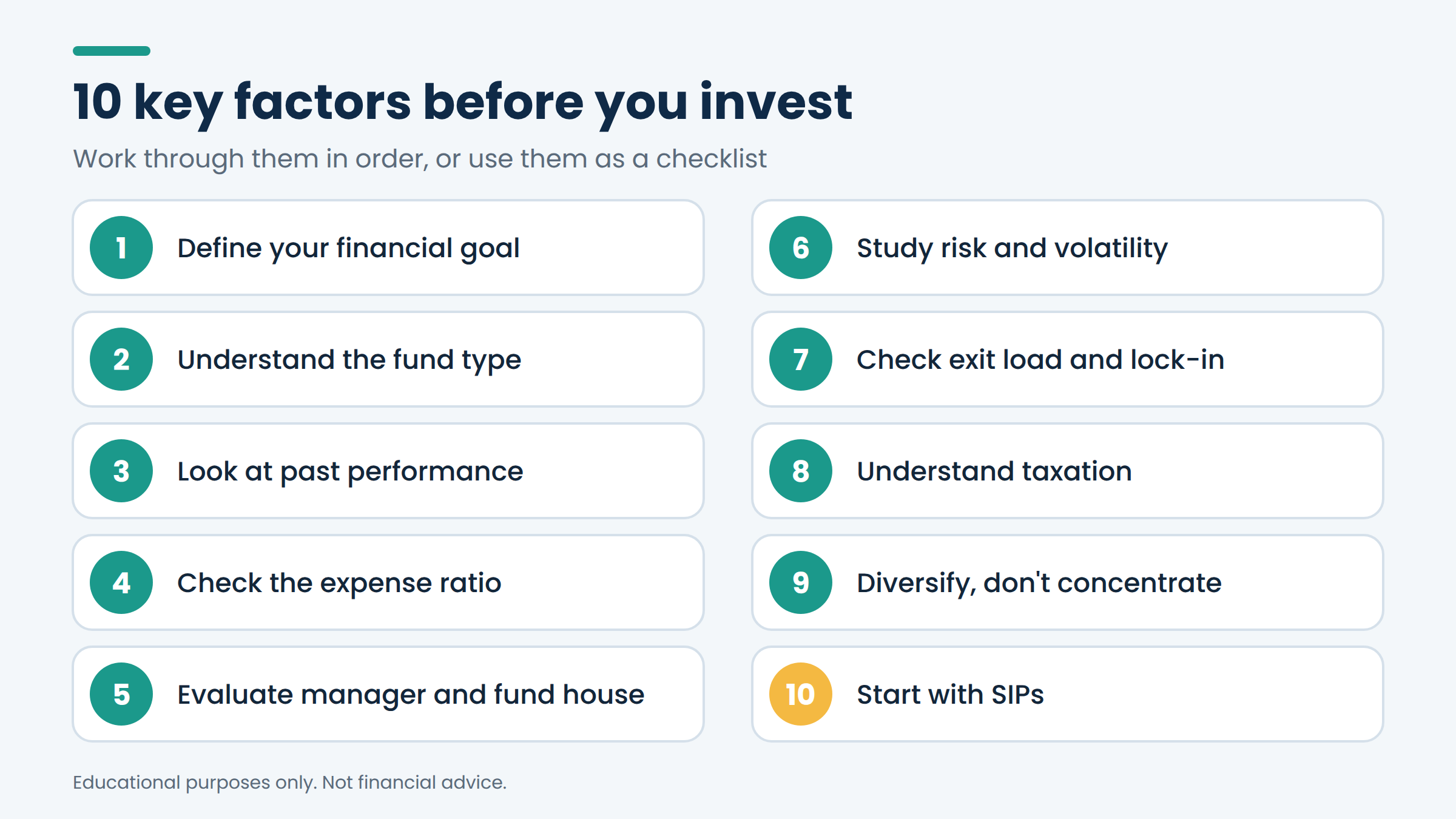
1. Define Your Financial Goal
Before starting any investment, there should be a clear purpose.
Start by asking yourself the following 3 questions:
- Am I investing for retirement, a house, or my child’s education?
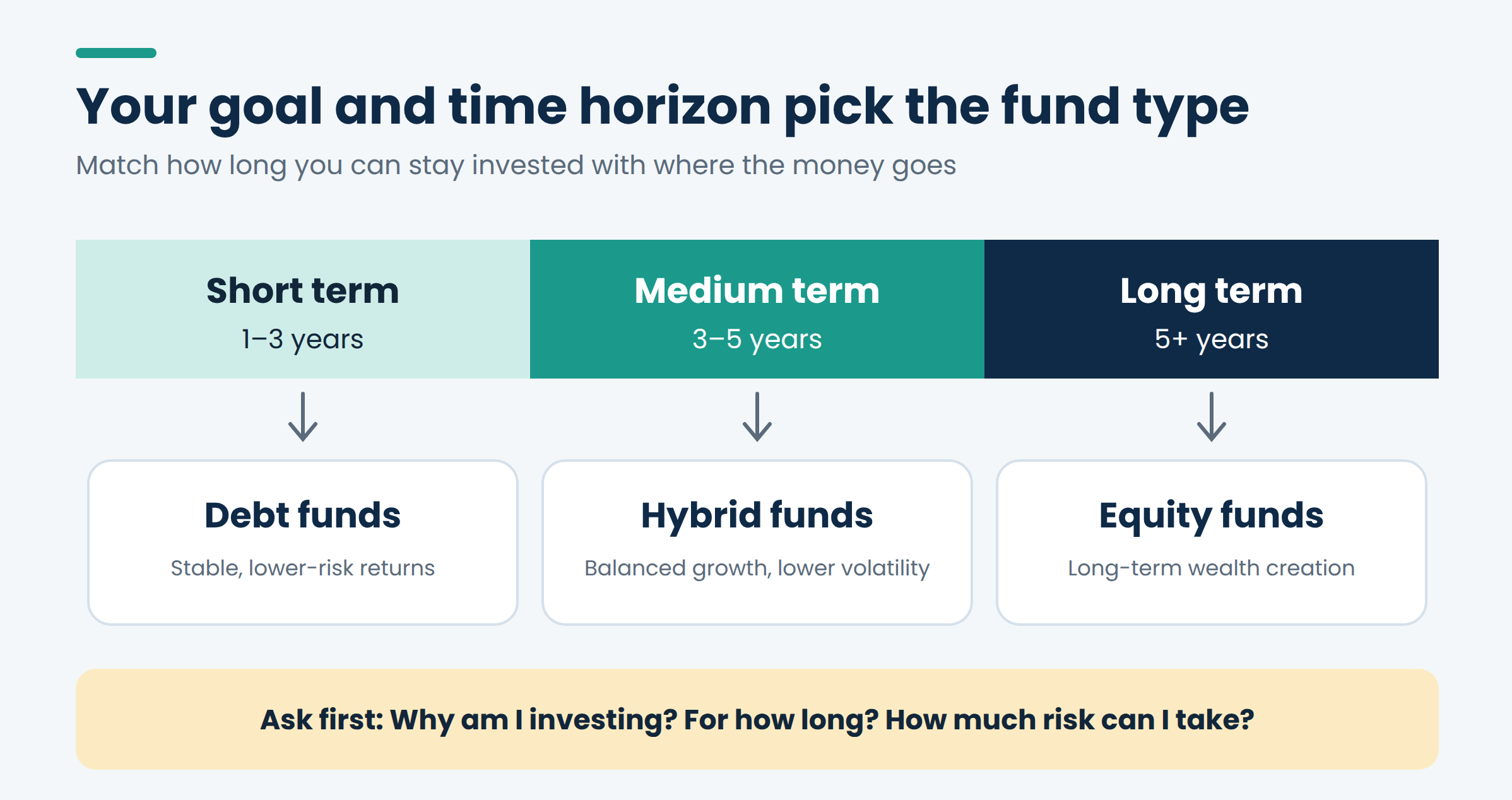
- What is my time horizon? Is it short term i.e. 1–3 years, medium term i.e. 3–5 years or long term i.e. 5+ years?
- How much risk am I comfortable taking?
It is based on your goal and time horizon that you will decide whether to pick equity, debt, or hybrid funds.
2. Understand the Fund Type
Mutual funds are broadly categorised based on the assets they invest.
A quick comparison is available right below.
| Fund Type | Invests Primarily In | Risk Level | Suitable For |
| Equity Funds | Company stocks | High | Long-term wealth creation |
| Debt Funds | Bonds, government securities | Low to Moderate | Short-term, stable returns |
| Hybrid Funds | Mix of equity and debt | Moderate | Balanced growth with lower volatility |
| ELSS | Equity (tax-saving) | High | Tax benefits under Section 80C |
3. Look For the Past Performance of the Fund
Though past performance doesn’t guarantee future returns, it helps you understand consistency.
Look at:
- Returns in the last 3, 5, and 10 years, not just the last one year
- How the fund performed during market downturns
- Comparison with its benchmark index and category average
Of the several options available, some of the best mutual funds to invest in are usually those that have shown steady, consistent performance across different market cycles rather than a single spike in returns.
4. Check the Expense Ratio
This is the annual fee charged by the fund house to manage your money.
A lower expense ratio means more of your returns stay with you.
- Actively managed funds usually come with higher expense ratios
- When it comes to Index funds and ETFs, they typically have lower expense ratios
- Even a difference of 1% can make a significant impact on long-term returns due to compounding
5. Evaluate the Fund Manager and Fund House
The person managing your money matters. Check:
- The fund manager’s experience and track record
- How long they have managed this particular fund
- The reputation and stability of the Asset Management Company or fund house
6. Study Risk and Volatility
Every fund carries some risk. Common risk indicators include:
- Standard Deviation – measures how much returns fluctuate
- Beta – shows sensitivity to market movements
- Sharpe Ratio – an indication of risk-adjusted returns
Go for a risk level that matches your personal comfort and financial situation.
7. Check the Exit Load and Lock-in Period
- Exit load is a fee charged if you withdraw before a specified period
- Lock-in period applies to certain funds like ELSS (3 years mandatory)
- Understand these terms so you’re not caught off guard when you need your money
8. Understand Taxation
Returns from mutual funds are taxed based on the fund type and holding period:
| Fund Type | Holding Period | Tax Treatment |
| Equity Funds | Less than 1 year | Short-term capital gains tax |
| Equity Funds | More than 1 year | Long-term capital gains tax |
| Debt Funds | Any period | Taxed as per your income slab |
9. Diversify Instead of Concentrating
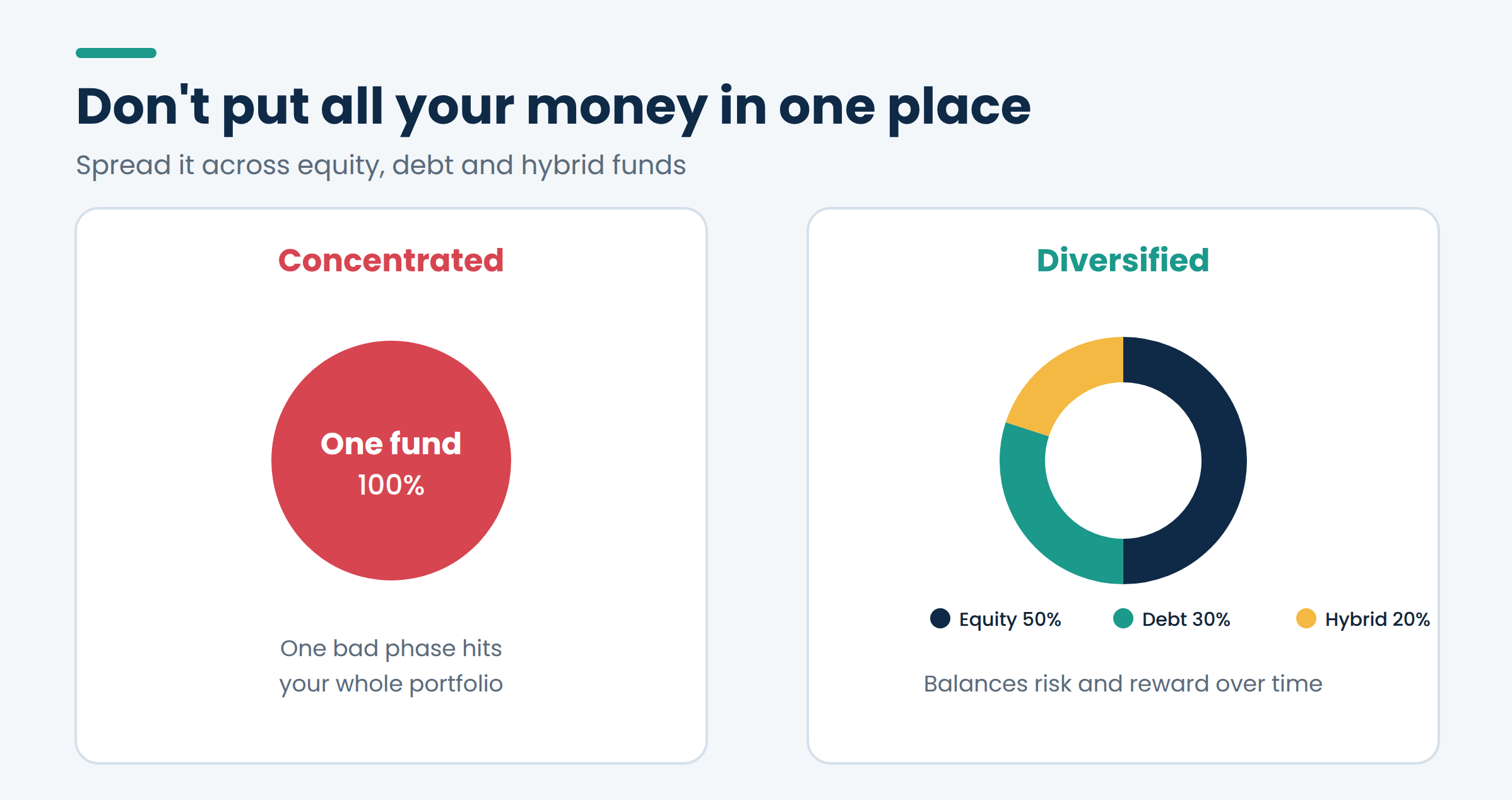
Never put all your money into one fund or one category.
Instead, go for a well-diversified portfolio across equity, debt, and hybrid funds so that it will help balance risk and reward over time.
10. Start with SIPs
For most beginners, starting a Systematic Investment Plan (SIP) is a practical way to build the habit of investing regularly.
This will help average out market volatility, and benefit from the power of compounding.
Instead of trying to time the market with a lump sum, it is better to opt for SIP.
Final Thoughts
Picking the right mutual fund is not about running behind the highest returns in the recent past. Instead, it’s about matching your investment with your goals, risk appetite, and time horizon.
When you are researching the best mutual funds to invest in, take time and compare fund types, costs, past consistency, and tax implications.
It’s quite important to do this exercise before making your final decision.
This tutorial is for educational purposes only. It should not be considered as financial advice. Please consult a certified financial advisor before making investment decisions.
|
ALSO READ |
|
| Introduction to Indian Stock Market | |
| How to Choose a Stock Broker | |
| What is Leverage and Margin Trading? | |
