

Picking the right stocks is the foundation of successful day trading.
Many beginners lose money not because their strategy is wrong, but because they choose the wrong intraday trading stocks to begin with.
What Makes a Stock Suitable for Intraday Trading?
Not every stock listed on the NSE or BSE is fit for day trading.
A good intraday stock should move enough to generate profit within hours, but not be so unpredictable that it wipes out your capital.
| Criteria | Why It Matters | Ideal Range |
| Liquidity | Easy entry/exit without price slippage | High daily traded volume |
| Volatility | Enough price movement to profit | Moderate to high (1–3% daily range |
| Volume | Confirms genuine interest, not manipulation | Above average 20-day volume |
| Price Band | Avoids frozen circuits | Stocks without frequent upper/lower circuits |
| Sector | Reacts to news, sector trends | Banking, IT, Auto, Pharma, FMCG |
Step-by-Step Selection Process
1st Step: Screen for Liquidity
- Shortlist stocks from the Nifty 50, Nifty Next 50, or Nifty Midcap indices
- Check average daily volume over the last 10–20 sessions
- Avoid thinly traded small-cap counters
2nd Step: Check Volatility and Range
- Look at the stock’s Average True Range (ATR)
- A stock moving less than 1% daily may not offer enough profit potential
- A stock moving more than 4–5% daily can be risky for beginners
3rd Step: Track News and Triggers
- Corporate results, RBI policy announcements, budget updates, and global cues often create short-term momentum
- Sector-specific news (for e.g. fuel price changes for auto stocks) can trigger intraday moves
4th Step: Use Technical Indicators
- Moving Averages (9 EMA, 21 EMA): Identify short-term trend direction
- RSI (Relative Strength Index): Spot overbought or oversold conditions
- VWAP (Volume Weighted Average Price): Popular benchmark for intraday entries and exits
- Support and Resistance Levels: Mark previous day’s high, low, and close
5th Step: Confirm with Pre-Market Data
- Check gap-up or gap-down opening trends
- Review pre-market volume spikes
- Compare with broader index movement (Nifty/Sensex direction)
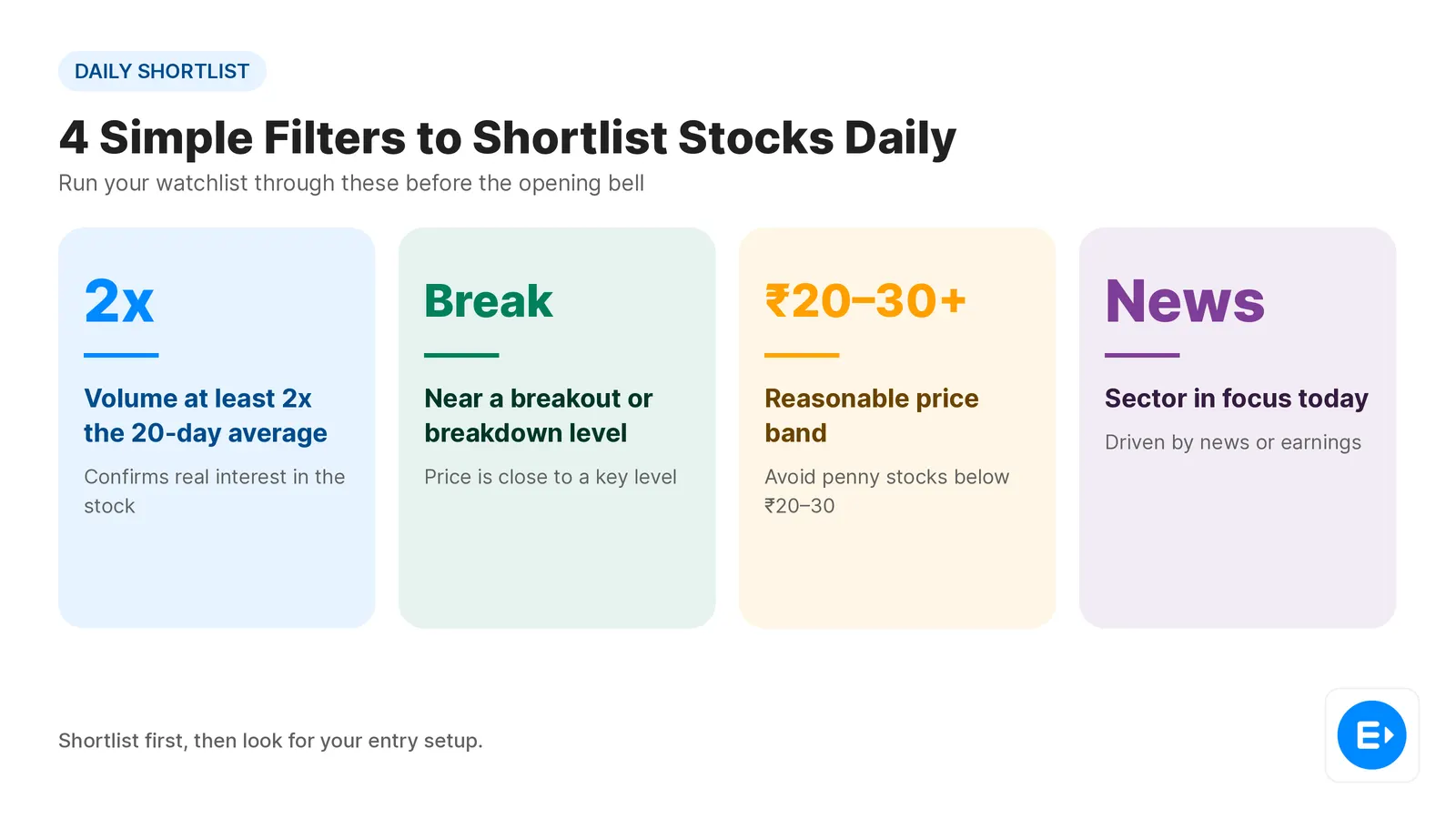
Simple Filters to Shortlist Stocks Daily
- Stocks with volume at least 2x their 20-day average
- Stocks near a breakout or breakdown level
- Stocks within a reasonable price band (avoid penny stocks below ₹20–30)
- Stocks from sectors currently in focus due to news or earnings
Risk Management While Selecting Stocks
Choosing the right stock is only half the job — protecting your capital matters equally.
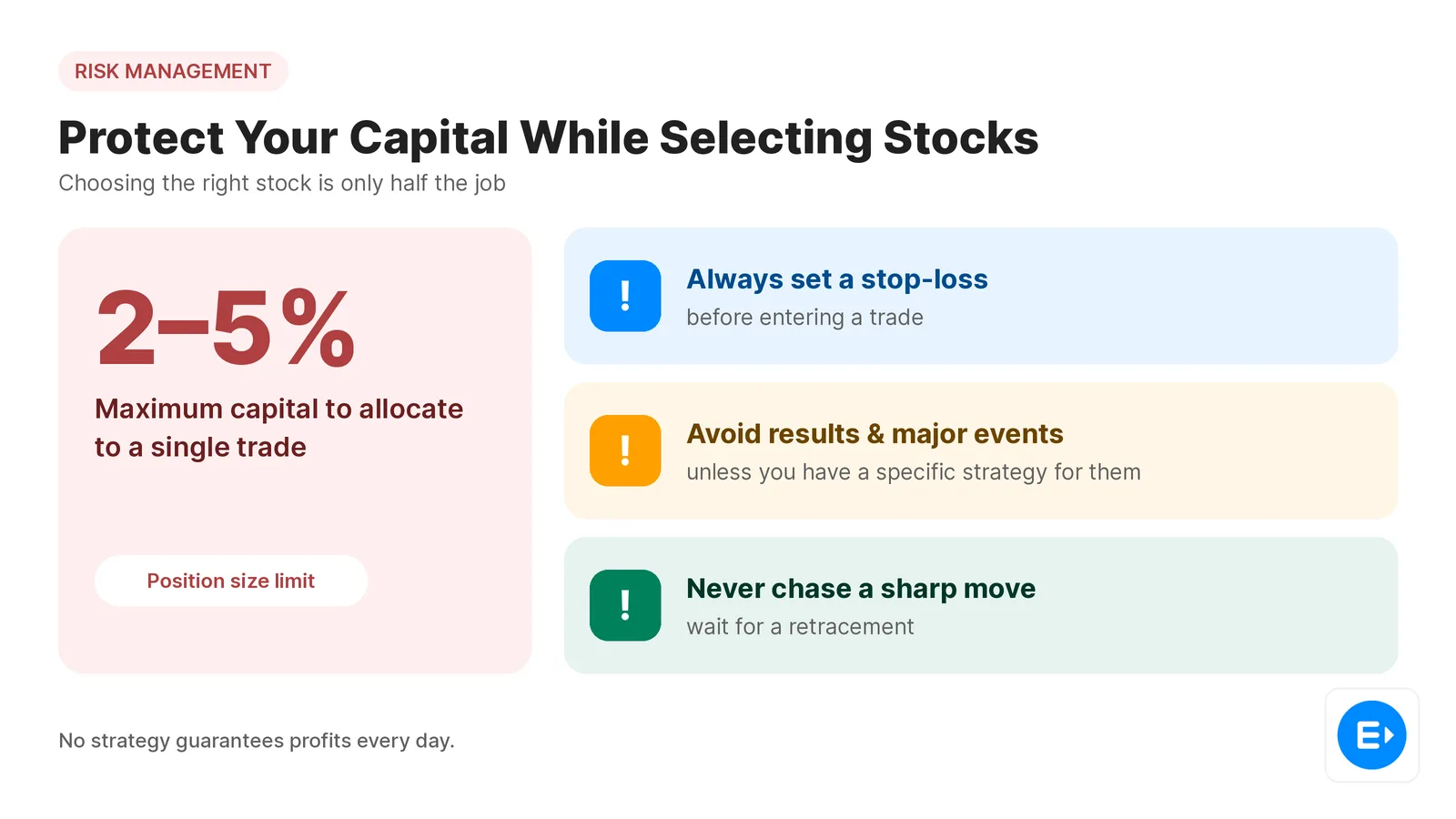
- Never allocate more than 2–5% of capital to a single trade
- Always set a stop-loss before entering a trade
- Stay away from trading in stocks with upcoming results or major events unless you have a specific strategy for it
- Never chase a stock after a sharp move; wait for a retracement
4 Common Mistakes Beginners Make
- Selecting stocks purely based on tips or social media hype
- Ignoring liquidity and getting stuck in a position
- Overtrading across too many stocks in one session
- Not adjusting strategy based on overall market trend (bullish/bearish/sideways)
Quick Checklist Before You Trade
| Check | Yes/No |
| Is the stock highly liquid? | |
| Is there a clear trend or trigger today? | |
| Have I checked the stop-loss level? | |
| Is my position size within risk limits? | |
| Does it align with the overall market trend? |
Conclusion
The key is a disciplined approach in selecting intraday trading stocks. This approach should be based on liquidity, volatility, technical setups, and proper risk management.
It can significantly improve consistency for traders in the Indian stock market. It is also to be noted that no strategy guarantees profits every day.
Hence, the goal should be to build a repeatable process, manage risk carefully, and continuously learn from each trading session.
|
Also Read |
|
| Types of Market Structure | |
| How to Analyze Mutual Funds | |
