

As a stock market enthusiast, one of the first things you need to understand is how stock exchanges work.
The next important aspect is when you can actually buy or sell shares. This tutorial explains everything about stock market timings in India.
What is a Stock Exchange?
A stock exchange is a regulated marketplace where shares of publicly listed companies are bought and sold. In India, there are two major stock exchanges:
- National Stock Exchange (NSE)
- Bombay Stock Exchange (BSE)
The Securities and Exchange Board of India (SEBI) is the regulator for both these stock exchanges. It is SEBI that ensures fair and transparent trading practices for all investors.
Why do Market Timings Matter?
Having proper awareness of the stock market timings India helps you plan your trades effectively. Assume that you place an order outside trading hours.
Note that the order won’t be executed until the market reopens. Thus when you time your actions correctly, it can save you from missed opportunities or unnecessary confusion.
Daily Trading Sessions
Indian stock markets operate in distinct sessions, each serving a specific purpose:
| Session | Timing | Purpose |
| Pre-Open Session | 9:00 AM – 9:15 AM | Determines the opening price based on early orders |
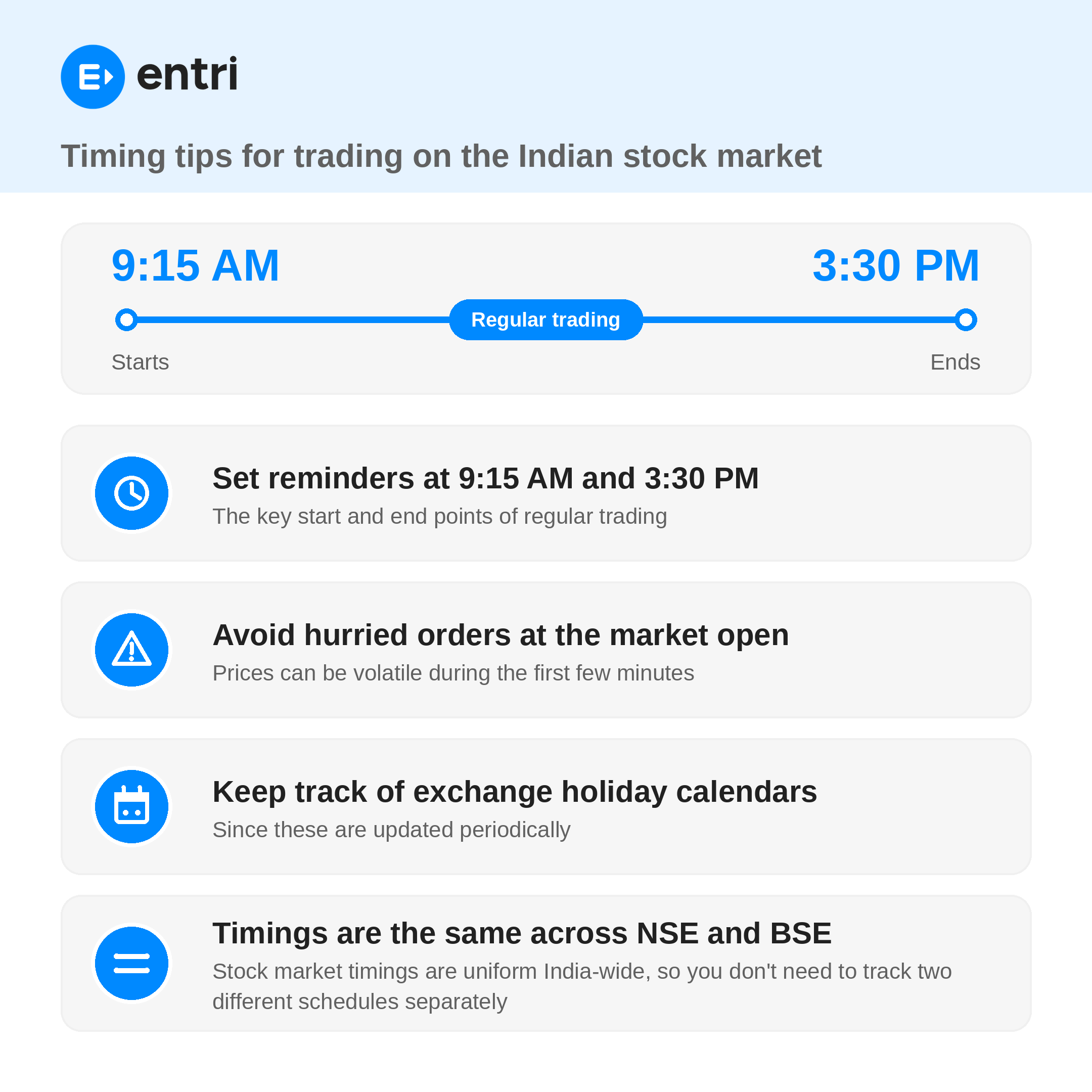
| Normal Trading Session | 9:15 AM – 3:30 PM | Regular buying and selling of shares |
| Closing Session | 3:30 PM – 3:40 PM | Calculates the official closing price |
| Post-Closing Session | 3:40 PM – 4:00 PM | Allows trading at the closing price |
Breaking Down the Pre-Open Session
The pre-open session itself is divided into smaller parts:
- 9:00 – 9:08 AM: Order collection (placing, modifying, or cancelling orders)
- 9:08 – 9:12 AM: Order matching and price discovery
- 9:12 – 9:15 AM: Buffer period to transition into normal trading
Weekly Schedule
Markets are open from Monday to Friday and closed on Saturdays, Sundays.
The markets remain closed also on official stock market holidays declared by the exchanges
What is Muhurat Trading?
Once a year i.e. during Diwali, exchanges hold a special one-hour session called Muhurat Trading. It’s because this time is considered auspicious for starting new investments.
This session usually takes place in the evening. However, the exact time is announced by NSE and BSE closer to the date.
Currency and Commodity Market Timings
Besides equities, other segments also follow their own schedules:
| Segment | Timing |
| Currency Derivatives | 9:00 AM – 5:00 PM |
| Commodity Derivatives | 9:00 AM – 11:30/11:55 PM (varies by product) |
Things to Keep in Mind for Beginners
This lesson is for education only and is not investment advice.
