

Trading in the stock market generally is about paying the full price of the shares you buy. However, brokers also let you trade with borrowed money.
Here the advantage is that you can take a bigger position than your own funds allow. This concept is built on two connected ideas: leverage and margin.
What is Leverage?
Leverage means using borrowed money to increase the size of your trade.
Instead of paying 100% of the trade value from your own pocket, you pay a small portion. The broker funds the rest of the amount.
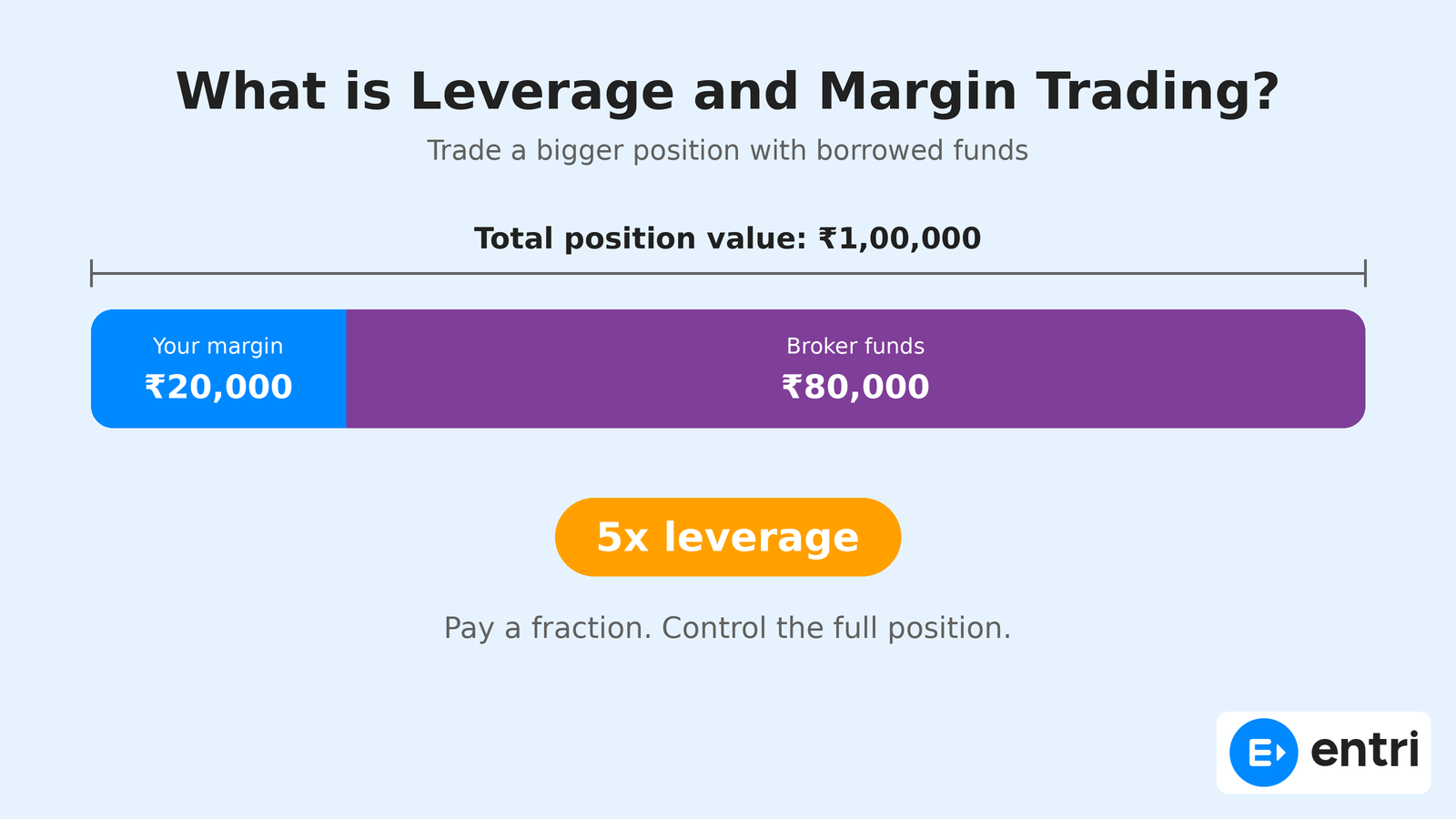
Example: Suppose a stock costs ₹1,00,000 and your broker offers 5x leverage.
In that case, you only need ₹20,000 of your own money. The remaining ₹80,000 is funded by the broker.
| Leverage Offered | Your Investment | Broker Funds | Total Position Value |
| 2x | ₹50,000 | ₹50,000 | ₹1,00,000 |
| 5x | ₹20,000 | ₹80,000 | ₹1,00,000 |
| 10x | ₹10,000 | ₹90,000 | ₹1,00,000 |
Leverage magnifies both gains and losses. A small price movement can lead to a large profit or a large loss, since you’re controlling a bigger position than your actual capital.
What is Margin?
Margin is the amount of money you must deposit with your broker to open a leveraged position.
Think of it as a security deposit that covers potential losses.
Margin is usually expressed as a percentage of the total trade value:
- Higher margin requirement → lower leverage, safer trade
- Lower margin requirement → higher leverage, riskier trade
In India, the amount of margin required for a trade depends on the exchange’s rules, the stock’s volatility, and the broker’s own risk policies.
How the Process Works
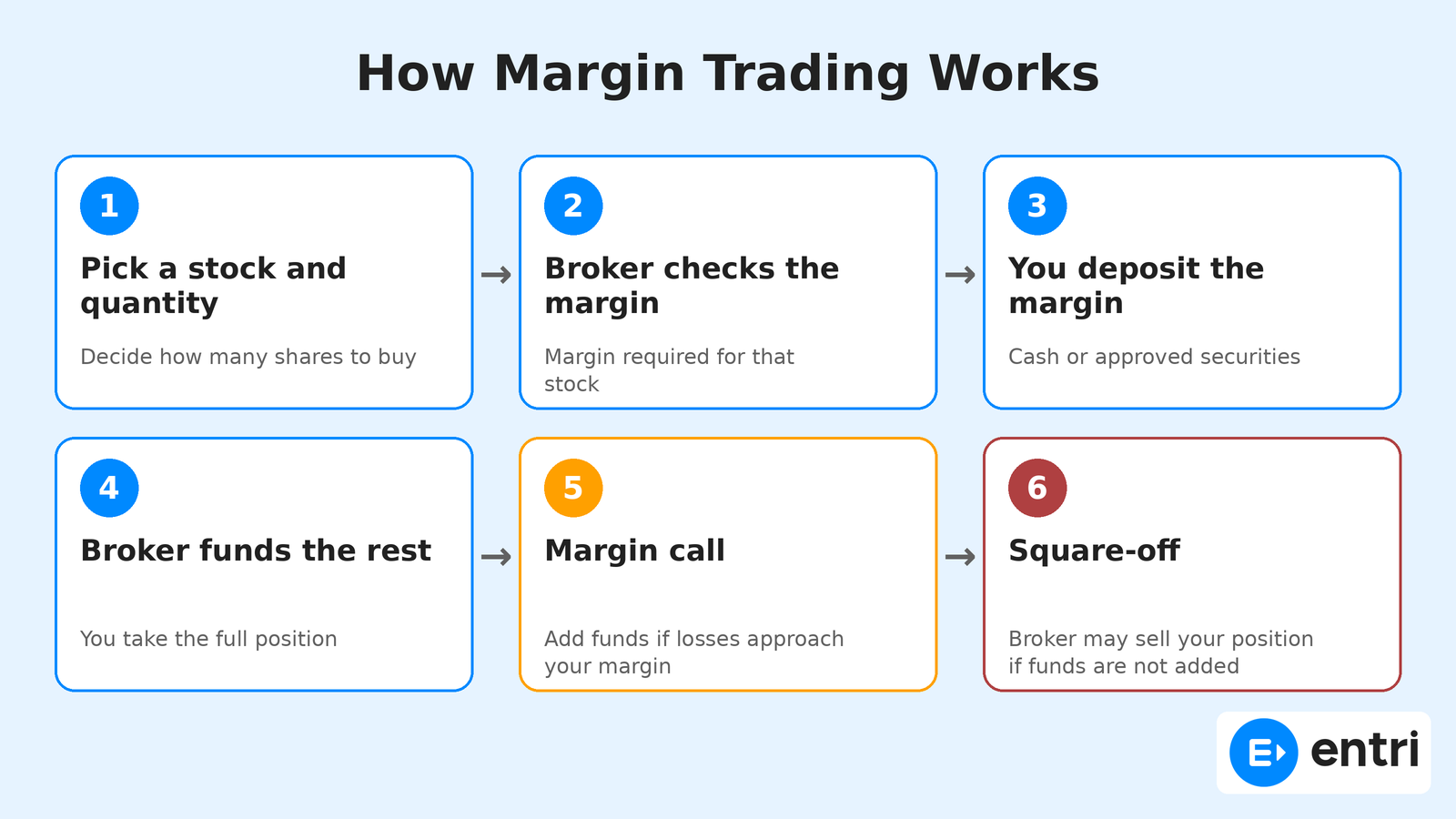
Here’s a simple breakdown of the steps involved:
- You select a stock and decide the quantity you want to buy
- Your broker checks the margin required for that stock
- You deposit the margin amount (cash or approved securities)
- The broker funds the remaining amount so you can take the full position
- If the stock moves against you and losses approach your deposited margin, the broker issues a “margin call” asking you to add more funds
- If you don’t add funds in time, the broker may square off (sell) your position to limit further loss
This Facility in the Indian Market
Margin trading is offered by Indian brokers under exchange-approved guidelines, allowing investors to buy shares by paying only a fraction of the total value upfront.
It is commonly used for intraday trades and for buying select stocks under a broker’s leveraged facility, where positions can even be carried overnight against pledged collateral.
Leverage-Based Trading vs Regular (Delivery) Trading
| Feature | Regular Delivery Trading | Leverage-Based Trading |
| Payment required | Full trade value | Only a percentage (margin) |
| Position size | Limited to your capital | Can be much larger |
| Risk level | Lower | Higher |
| Holding period | Can hold long-term | Often short-term or intraday |
| Interest/charges | None | Broker may charge interest on borrowed funds |
Key Risks to Keep in Mind
- Losses can exceed your original deposit in extreme cases
- Sudden price swings can trigger a margin call with very short notice
- Carrying leveraged positions overnight involves interest costs
- Not suitable for beginners without a clear risk management plan
- Regulatory margin requirements can change, affecting your position size
Tips for Safer Trading
- Start with lower leverage until you understand market behavior
- Always keep extra funds ready to meet margin calls
- Set a stop-loss on every leveraged trade
- Avoid using your entire capital as margin for a single trade
- Review your broker’s margin and interest policies before trading
Conclusion
Leverage lets you control a larger position with less money, while margin is the deposit that makes this possible.
This combination can boost your profits, but it can just as easily amplify losses.
Anyone considering this approach should first understand the mechanics, monitor positions closely, and use strict risk controls before committing real money.
This lesson is for education only and is not investment advice.
|
ALSO READ |
|
| Introduction to Indian Stock Market | |
| How to Choose a Stock Broker | |
| Introduction to Mutual Funds | Key Factors Before Investing in a Mutual Fund |
| How to Analyze Mutual Funds | |
