

Forex, short for foreign exchange, is the global market where currencies are bought and sold. It works almost non-stop on weekdays because trading moves from one financial centre to the next as the world’s business day rolls on.
A financial centre is simply a city where banks, companies and traders handle large amounts of money.
The forex market is generally closed over the weekend.
What are Forex Market Timings?
Forex market timings are the hours during which currencies can be actively traded. They are also called forex market hours. In simple words, they tell you when the market is open and when it is not.
You will often hear that forex runs “24 hours a day, five days a week.” That means trading continues round the clock from Monday to Friday, with a break over the weekend.
Here is the interesting part. No single exchange stays open for 24 hours. Instead, trading shifts between four major centres:
- Sydney
- Tokyo
- London
- New York.
The weekly window usually starts on Sunday evening in UTC and ends on Friday evening in UTC.
UTC (Coordinated Universal Time) is the world’s standard reference time. It does not change with the seasons.
In UTC, the forex week typically opens around 22:00 on Sunday and closes around 22:00 on Friday.
Exact timings can shift by an hour with daylight saving time, which we explain below.
Why Forex Trades Almost 24 Hours a Day
Think of a relay race – as one runner finishes, the next one picks up the baton. Forex works the same way.
When the Sydney market winds down, Tokyo is already busy. Tokyo slows when, London takes over. When London is halfway through its day, New York opens.
As the world has different time zones, there is always a financial centre awake somewhere on a weekday. This is what keeps currency trading active from Monday to Friday.
Major Forex Trading Sessions
A forex trading session is a period when one major financial centre is open and its banks and traders are active. There are four major sessions.
The table below shows standard timings.
UTC is the global reference time.
IST (India Standard Time) is the time used across India. IST is always 5 hours 30 minutes ahead of UTC.
| Session | Main Financial Centre | Usual UTC Timing | India Time (IST) | Key Characteristics |
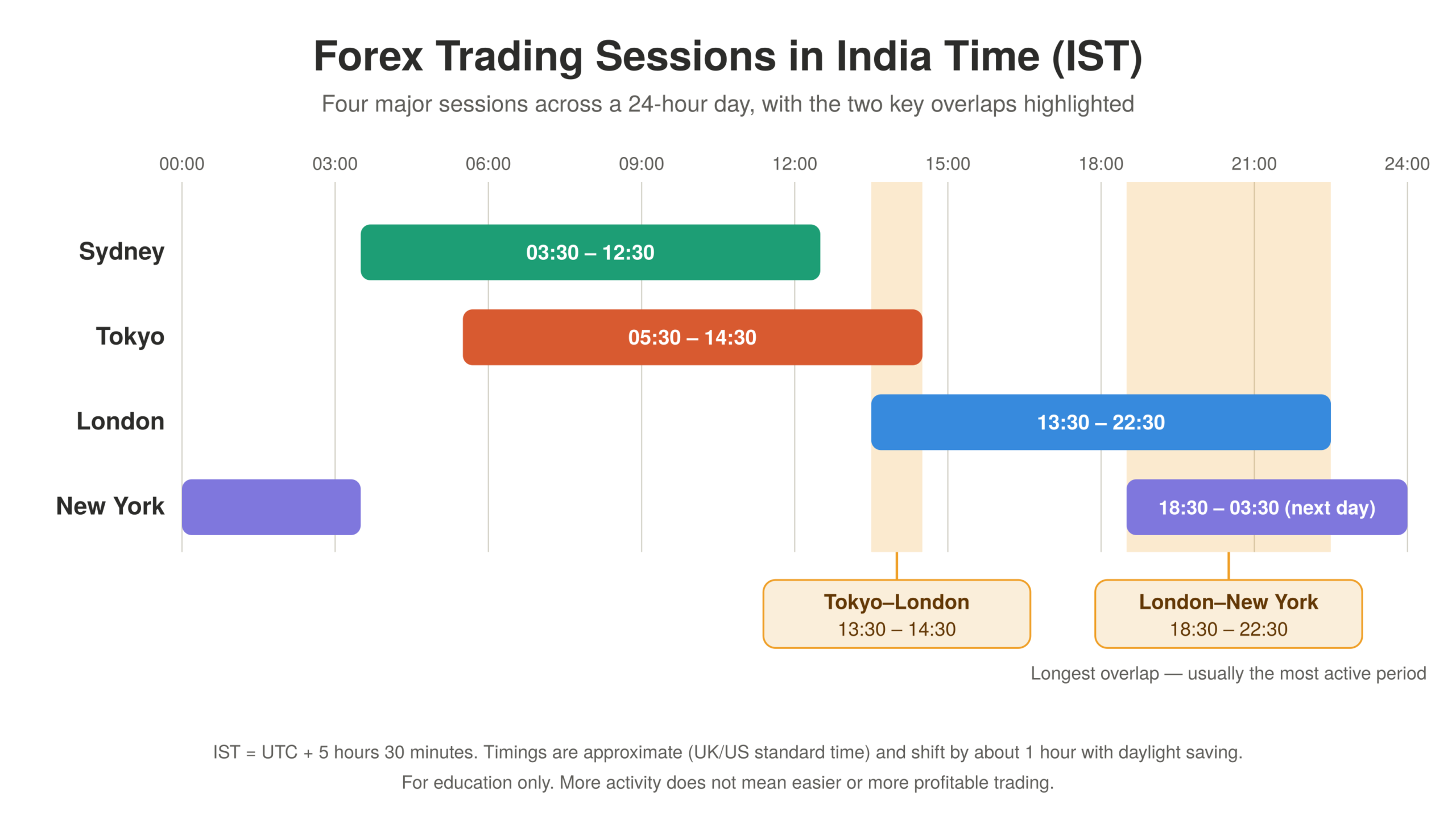
| Sydney | Sydney, Australia | 22:00 – 07:00 | 03:30 – 12:30 | Opens the trading week. Activity is usually lighter. Australian and New Zealand dollar pairs are commonly watched. |
| Tokyo (Asian) | Tokyo, Japan | 00:00 – 09:00 | 05:30 – 14:30 | Busiest Asian session. Pairs involving the Japanese yen are commonly associated with it. |
| London (European) | London, UK | 08:00 – 17:00 | 13:30 – 22:30 | Largest forex centre. Liquidity is usually high. Euro and British pound pairs are active. |
| New York (North American) | New York, USA | 13:00 – 22:00 | 18:30 – 03:30 (next day) | Very active, especially in the first half. US dollar pairs dominate. |
Note:
These are approximate timings. Sources differ slightly, and sessions shift by about one hour when daylight saving time (DST) starts or ends in Australia, the UK and the USA. Japan does not use daylight saving.
Sydney Session
The Sydney session opens the forex week. Trading volume is usually lower than in London or New York.
Pairs linked to the Australian and New Zealand dollars are the ones commonly associated with this session.
Tokyo (Asian) Session
Tokyo is the main centre of Asian trading. Activity is often moderate, and the Japanese yen features in many pairs.
Prices can move more calmly here than during the European and US hours, though this is not guaranteed.
London (European) Session
London is the world’s largest forex trading centre. Liquidity is typically high, and the euro and British pound are widely traded.
Many beginners notice faster price movement once London opens.
New York (North American) Session
The US dollar is the most traded currency in the world, so New York is a major hub.
The first few hours, when London is still open, are usually the busiest. Activity often cools as the day ends.
Always check the current timing on a live market-hours tool.
Forex Session Overlaps Explained
A session overlap is a window of time when two major sessions are open together.
With two centres active at once, more buyers and sellers are in the market.
Two overlaps matter most for beginners to know.
- Tokyo–London Overlap: a short window when Asian trading hands over to Europe.
- London–New York Overlap: the longest overlap, when the world’s two biggest centres are both open.
Overlaps often see higher trading activity as more participants are placing orders at the same time.
The London–New York overlap is widely described as the most active period of the day.
This does not mean it is easier or more profitable. It only means there is usually more activity.
| Overlap | UTC (standard time) | India Time (IST) |
| Tokyo–London | 08:00 – 09:00 | 13:30 – 14:30 |
| London–New York | 13:00 – 17:00 | 18:30 – 22:30 |
Forex Market Timings in India (IST)
If you are in India, this is roughly when each session begins and ends. Add 5 hours 30 minutes to the UTC time to get IST.
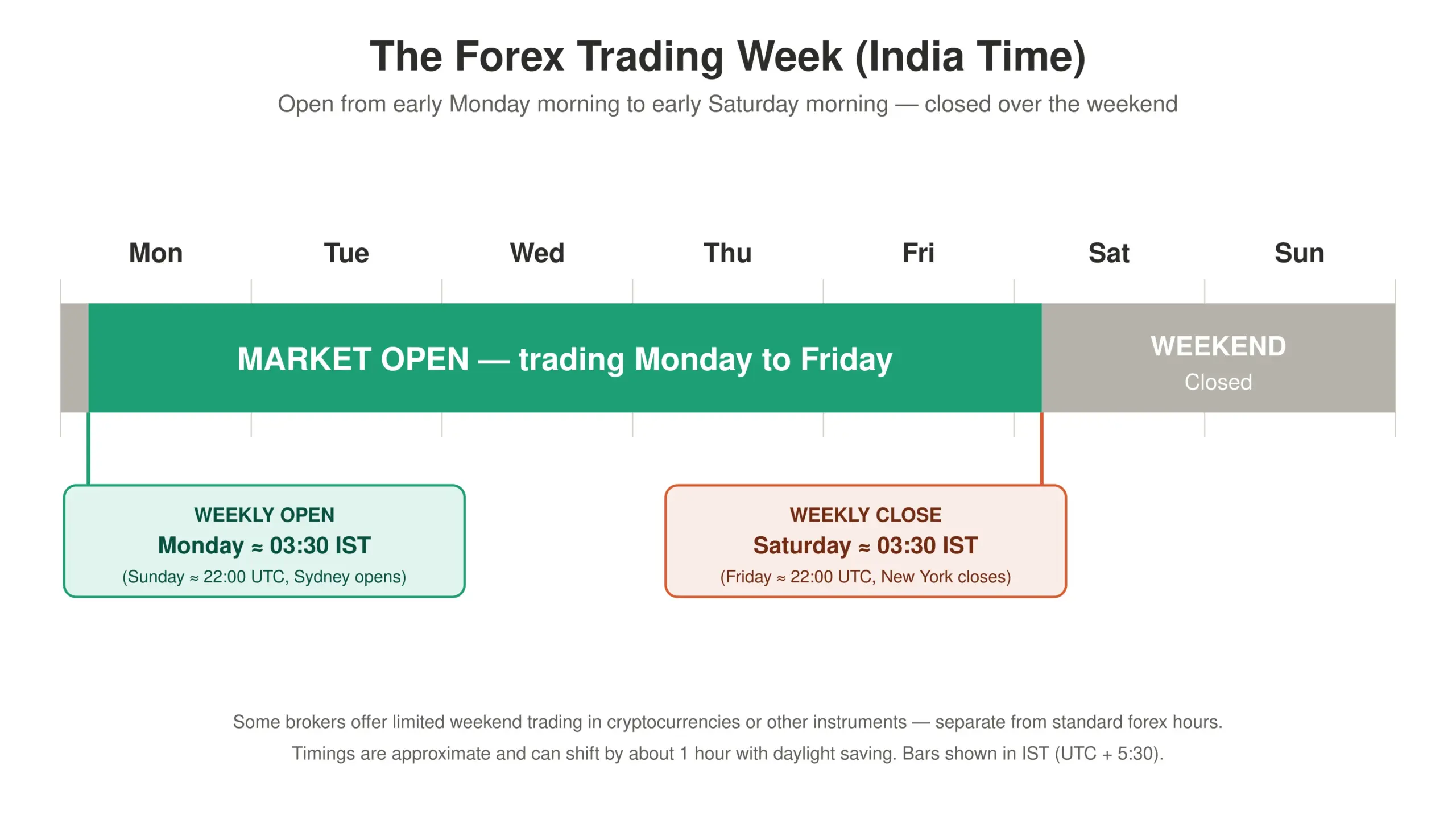
- Weekly open: early Monday morning, around 03:30 IST.
- Sydney: about 03:30 to 12:30 IST.
- Tokyo: about 05:30 to 14:30 IST.
- London: about 13:30 to 22:30 IST.
- New York: about 18:30 to 03:30 IST the next day.
- Weekly close: early Saturday morning, around 03:30 IST.
The table above uses standard (winter) timings for the UK and the USA. During their summer months, London and New York open one hour earlier in UTC.
That moves them to roughly 12:30 IST and 17:30 IST. The London–New York overlap then runs from about 17:30 to 21:30 IST.
Important Note:
IST does not change with daylight saving time. Overseas session timings can.
So the same session may start at a slightly different IST time in different months.
Is Forex Open on Weekends?
No. The standard forex market is generally closed on weekends.
It usually closes after the New York session ends on Friday evening.
In US Eastern Time, that is around 5:00 pm. It reopens on Sunday evening in UTC when the Sydney session begins.
For India, that means early Saturday morning for the close and early Monday morning for the reopening.
Some brokers may offer limited weekend trading in cryptocurrencies or other instruments. That is separate from standard forex market hours.
Note that the rules vary by provider.
Best Time to Trade Forex for Beginners
There is no single “best” time that guarantees profits. You should not trust anyone who promises that.
As a beginner, you will find session overlaps easier to observe. Market activity and price movement are usually higher, so you can see how prices behave.
The London–New York overlap is a popular time to watch. This is convenient as it falls in the evening in India.
Higher activity can also mean faster price movements. Fast moves can be confusing for new learners. So focus on learning first.
Practise on a demo account, which uses virtual money, and learn basic risk management before thinking about real trades.
This tutorial is intended for educational purposes only. It is not investment advice, a trading signal or a recommendation to trade.
