

The forex market is the global marketplace where currencies are bought and sold. It is also called the foreign exchange or FX market.
Banks, companies, governments and individual traders use it to swap one currency for another. Also, prices change every second based on supply and demand.
It is the largest financial market in the world. There is no single building or exchange for forex.
It runs as a decentralized network of banks, financial institutions, corporations, brokers, and traders who are connected electronically. This is called an over-the-counter (OTC) market.
How does Forex Trading Work?
Forex trading means buying one currency and selling another. The prime aim is to benefit from changes in their exchange rate. Prices move as the demand for each currency rises and falls.
Understand that you already touch this market in your daily life. When an Indian company pays a US supplier, or a student pays tuition abroad, one currency is exchanged for another.
What is a Currency Pair?
A currency pair shows the value of one currency in terms of another. Every pair has two parts:
- Base Currency:
The first currency in the pair. It is the one being priced.
- Quote currency:
The second currency. It shows how much you pay for one unit of the base.
Here are four examples:
- EUR/USD – US Dollars worth 1 Euro
- GBP/USD – US Dollars worth 1 British Pound
- USD/JPY – Japanese Yen worth 1 US Dollar
- USD/IND – Indian Rupee worth 1 US Dollar
Who Participates in the Forex Market?
-
Central Banks:
Manage a country’s money supply and interest rates. They sometimes step in to steady their currency.
-
Commercial Banks:
Trade huge volumes for clients and themselves. They form the core of the market.
-
Multinational Companies:
Exchange currencies to pay suppliers, receive revenue and protect against price swings.
-
Institutional Investors:
Funds and asset managers that trade currencies as part of larger portfolios.
-
Retail Traders:
Individuals who trade smaller amounts, usually through a broker.
-
Brokers:
Firms that connect traders to the market and earn from spreads or fees.
Key Forex Terms for Beginners
| Term | Simple meaning | Beginner example |
| Currency pair | Two currencies quoted together | EUR/USD |
| Base currency | First currency in the pair | In EUR/USD, it is the euro |
| Quote currency | Second currency in the pair | In EUR/USD, it is the US dollar |
| Exchange rate | Price of one currency in another | 1 EUR = 1.0800 USD |
| Pip | Smallest standard price move, usually the fourth decimal (0.0001).For yen pairs, the second (0.01) | 1.0800 to 1.0801 is 1 pip |
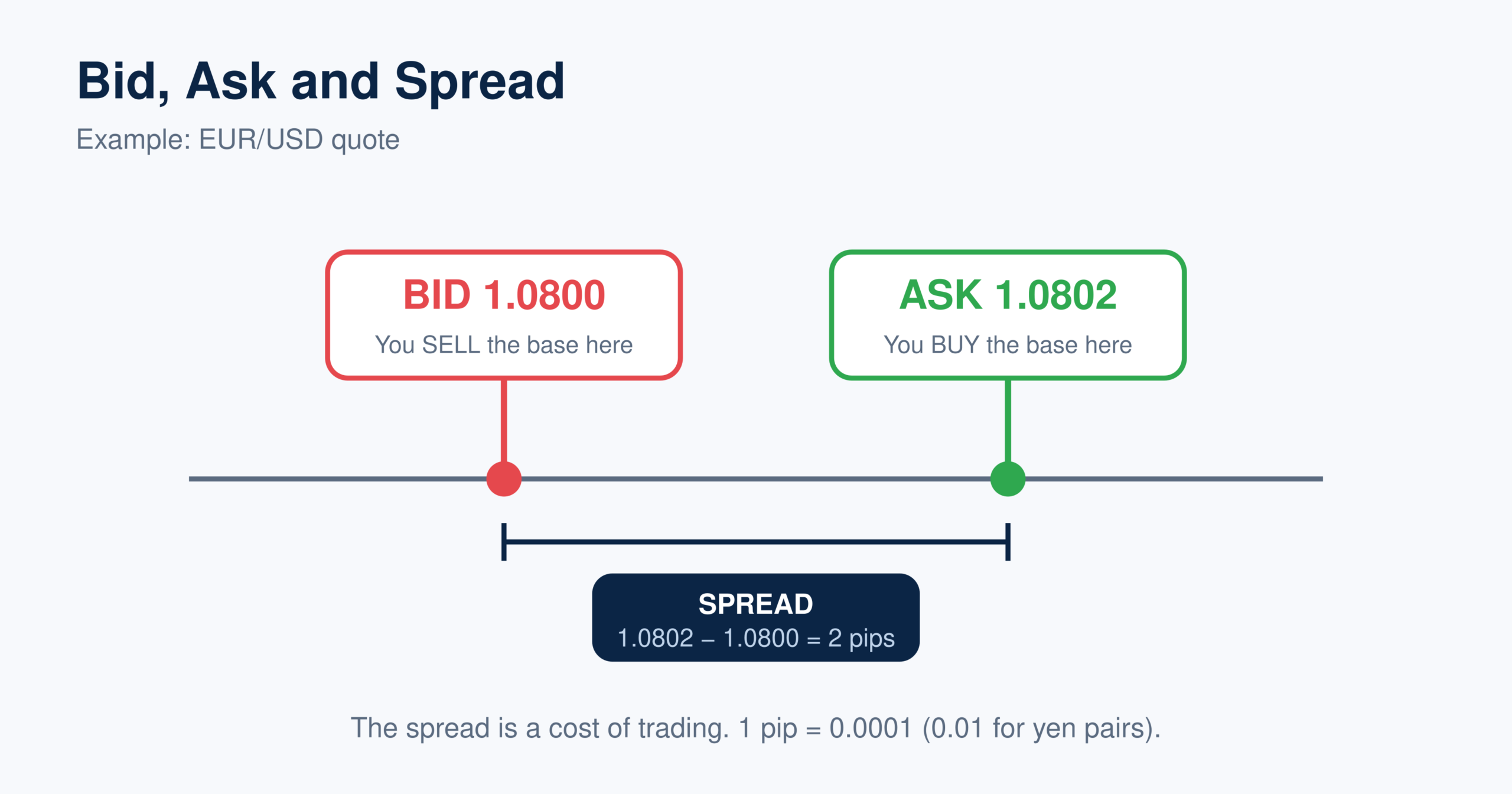
| Bid price | Price at which you can sell the base currency | Bid: 1.0800 |
| Ask price | Price at which you can buy the base currency | Ask: 1.0802 |
| Spread | Gap between bid and ask. It is a cost of trading | 1.0802 − 1.0800 = 2 pips |
| Lot size | Standard trade size units | Standard 100,000; mini 10,000; micro 1,000 |
| Leverage | Borrowed funds that let you control a larger position | 1:50 leverage controls US 50,000 with US 1,000 |
| Margin | Money set aside as security for a leveraged trade | The US$1,000 in the example above |
| Long position | Buying a pair, expecting the base to rise | Buy EUR/USD |
| Short position | Selling a pair, expecting the base to fall | Sell EUR/USD |
| Volatility | How fast and how far prices move | A pair jumping 100 pips after major news |
What is Leverage in Forex?
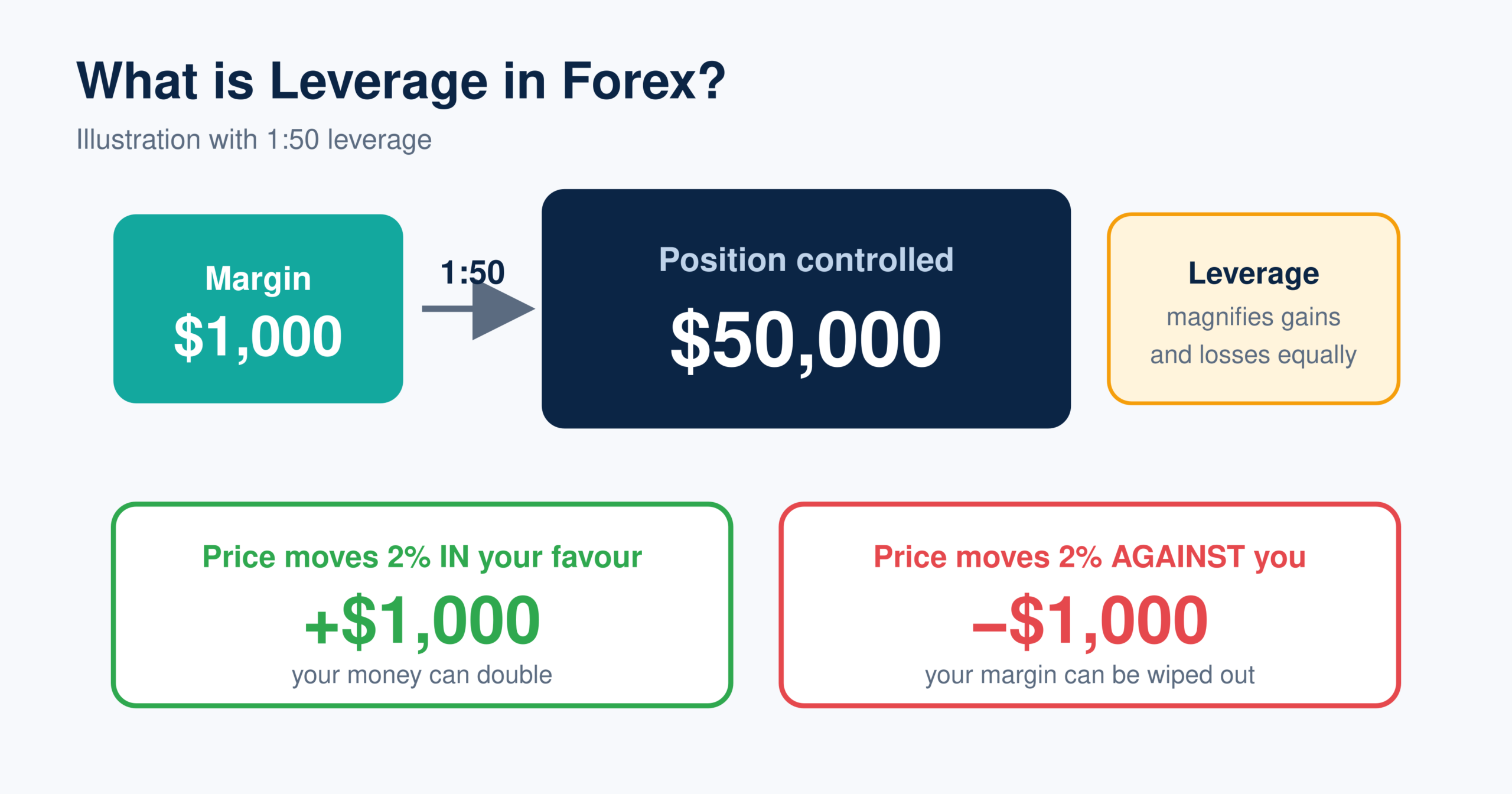
Leverage lets you control a bigger position than your own money would allow.
With 1:50 leverage, US 1,000 of margin controls US 50,000.
A 2% move in your favour could double your money. But a 2% move against you could wipe it out.
That is why leverage magnifies losses as much as gains.
Major, Minor and Exotic Currency Pairs
Pairs are grouped by how widely they are traded. The labels below are market conventions, and exact lists vary slightly by source.
| Category | What it includes | Examples | Typical features |
| Major pairs | The US dollar paired with another major currency | EUR/USD, GBP/USD, USD/JPY, USD/CHF, AUD/USD, USD/CAD, NZD/USD | Most liquid, usually the tightest spreads |
| Minor pairs (crosses) | Major currencies paired without the US dollar | EUR/GBP, EUR/JPY, GBP/JPY | Less liquid than majors, wider spreads |
| Exotic pairs | One major currency with an emerging-market currency | USD/INR, USD/TRY, USD/ZAR | Lower liquidity, higher costs, bigger price jumps |
Major pairs nearly always involve the US dollar and are generally more liquid. This means they are easier to buy and sell without big price changes.
In global classification, USD/INR works as an exotic pair.
What Moves Forex Prices?
No single factor decides a currency’s value. These forces work together:
-
Interest Rates:
Higher rates in a country can attract foreign money, which often supports its currency.
-
Inflation:
If prices rise faster in one country than another, its currency can lose buying power over time.
-
Economic Data:
Reports on jobs, growth and trade show how healthy an economy is.
-
Geopolitical Events:
Wars, elections and trade disputes can shift demand quickly.
-
Central-Bank Decisions:
Rate changes and policy statements often cause sharp moves.
-
Market Sentiment:
When investors feel nervous, they often move to currencies seen as safer, like the US dollar.
Benefits and Risks of Forex Trading
Potential Benefits
- High Liquidity:
Large trading volumes mean major pairs can be traded easily.
- 24-hour Access on Weekdays:
Trading moves through Sydney, Tokyo, London and New York sessions, and the market closes on weekends.
- Global Participation:
People, businesses and institutions from every region take part.
- Flexible Opportunities:
You can trade pairs in either direction, as rising or falling prices.
Risks You Must Understand
Forex trading does involve substantial risk. In fact, many retail traders lose money. The key risk factors are:
-
Leverage:
Can magnify losses and push your loss beyond what you expected.
-
Price Volatility:
News can move prices within seconds.
-
Margin Calls:
If losses grow, your broker may ask for more money or close your trades.
-
Emotional Decisions:
Fear and greed often lead to rushed trades.
-
Scams:
Fake signals, with “guaranteed profit” offers and social-media gurus are common.
-
Unregulated Brokers:
You may have little protection if the platform misbehaves or disappears.
How Can Beginners Start Learning Forex Safely?
Beginners can learn about forex. But trading without preparation is how most people lose money. Follow this path:
- Learn the Basics – Understand what moves currencies and the terms in the table above.
- Understand Currency Pairs – Practise reading pairs, bid and ask prices, and pip values.
- Study Risk Management – Learn why limiting the amount you risk matters more than finding perfect entries.
- Practise with a Demo Account – Use simulated money to build habits. But do this only through a provider that is legitimate under Indian rules.
- Choose only a Regulated, Trustworthy Broker – Verify authorization with the RBI and read the fee details. Always avoid anyone promising guaranteed profits.
Go slowly. Understanding the market first is the real advantage.
This guide is for education only. It is not investment, legal or tax advice.
