

Revenge trading is when a trader places impulsive trades right after a loss. This is done just with an intent to win the money back quickly.
The trade is driven by emotional impulses such as anger, frustration or ego instead of a trading plan. It usually means skipped stop-losses, bigger positions, and more losses.
In simple words, the market took money from you, and you want it back right now. This is a very human feeling. Almost every trader feels it at least once. So there is nothing to be ashamed of.
Revenge Trading in Simple Terms
A trade is one buy or sell of a share. A trading plan is a short set of rules you write before you trade:
- what you will buy
- when you will exit
- how much you are willing to lose
A normal trade follows that plan. A revenge trade ignores it. The only reason for entering is, “I need to recover my loss.”
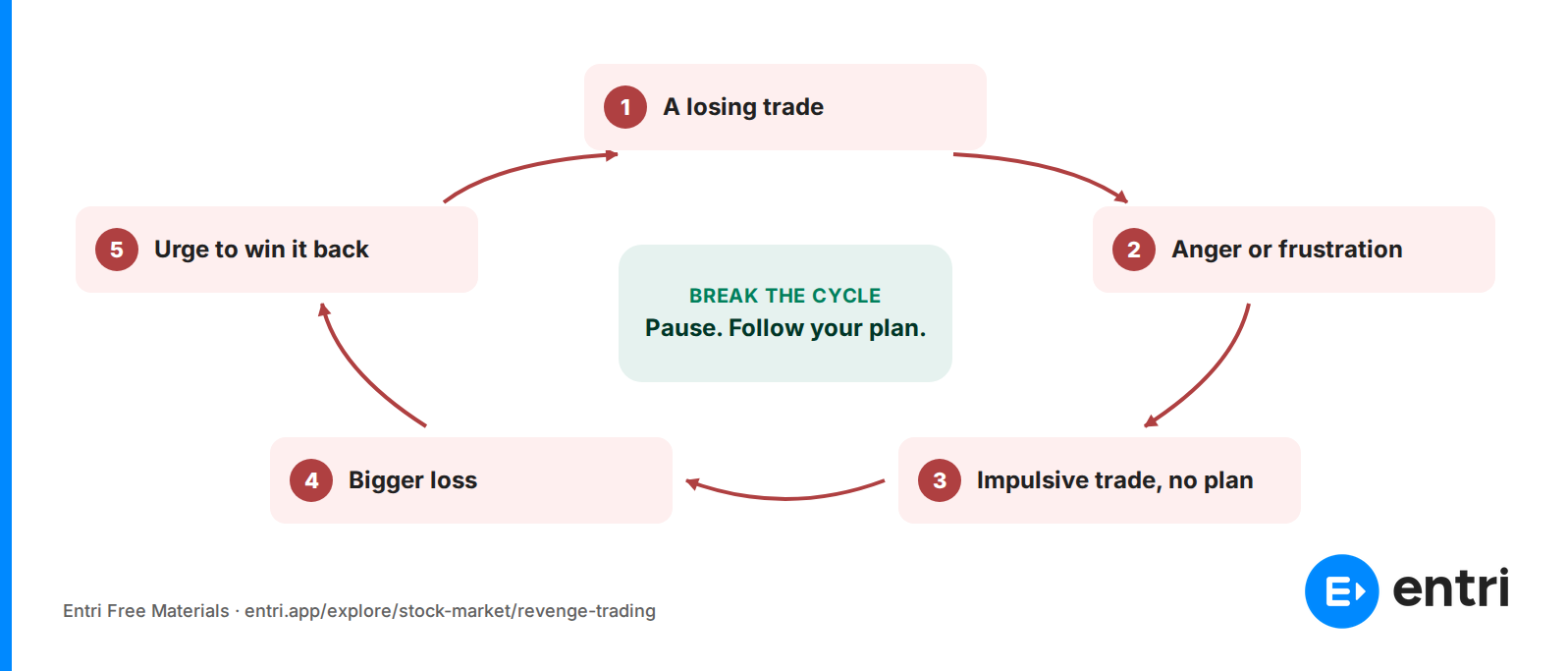
Revenge trading is one of the most common forms of emotional trading.
This means making decisions based on feelings like fear, anger or greed instead of logic.
Why does Revenge Trading Happen?
Revenge trading is a trading psychology problem, not an intelligence problem.
Smart people do it too. Here are the main reasons.
1. Fear of Loss
Humans hate losing more than they enjoy winning. After a loss, the mind panics and looks for the fastest way to make the pain go away.
A quick “recovery trade” feels like that way out.
2. Anger and Frustration
A stop-loss hit, or a share that reversed right after you sold, can make you angry. Anger pushes you to act fast and skip thinking.
3. Ego
Many beginners feel the market has “proved them wrong” and want to prove it wrong in return.
But the market does not know you exist. Trying to beat it out of pride only costs money.
4. Overconfidence
A few winning trades can make you feel unstoppable. Then one loss hits, and you take a bigger, riskier trade to “get back on track”.
This is only because you believe you cannot be wrong twice.
5. FOMO (Fear of Missing Out)
FOMO is the worry that everyone else is making money while you are sitting out.
After a loss, you may jump into any moving share just to avoid missing the next rally.
6. The Urge to “Win Back” Money
This is the biggest trigger. Your brain treats the lost amount as something that was taken from you and must be returned today.
In reality, the market owes you nothing, and the loss is already done.
A Simple Revenge Trading Example (in INR)
Let us look at a revenge trading example with an Indian trader.
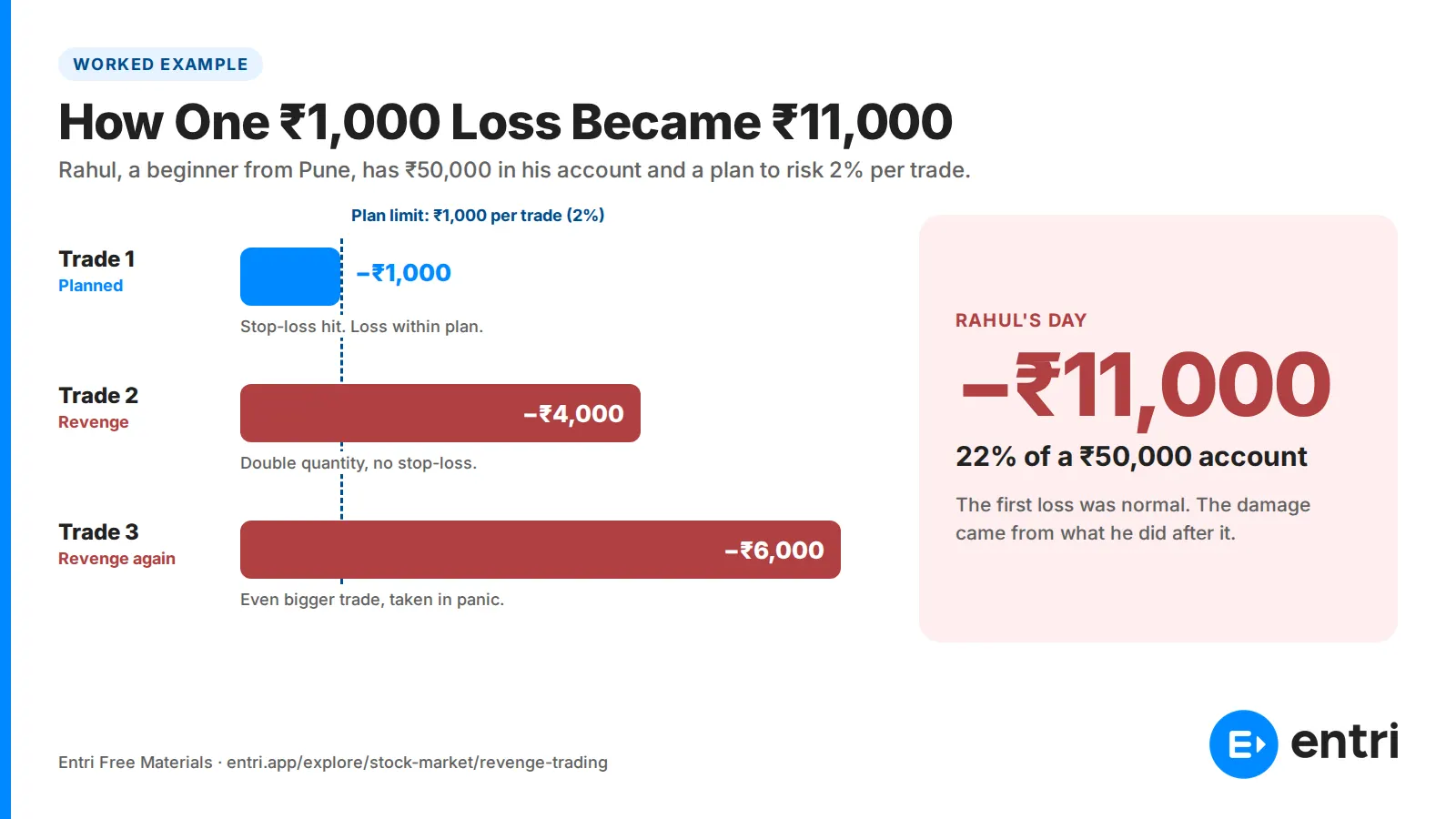
Meet Rahul, a beginner from Pune. He has ₹50,000 in his trading account. His plan says he will risk only 2% per trade, which is ₹1,000.
- Trade 1 (planned):
Rahul buys a share with a stop-loss (an order that automatically sells the share if the price falls to a set level).
The price hits his stop-loss. He loses ₹1,000. This is within his plan.
- Trade 2 (revenge):
Rahul feels angry. He buys a different share without any clear reason, and uses double the quantity to recover quickly.
He does not set a stop-loss. The share falls, and he loses ₹4,000.
- Trade 3 (revenge again):
Now he is down ₹5,000 and panicking. He takes an even bigger trade and loses ₹6,000.
By the end of the day, Rahul has lost ₹11,000, which is 22% of his account. A single planned ₹1,000 loss turned into a serious setback.
The first loss was normal. The damage came from what he did after it.
Risks of Revenge Trading
Revenge trading can hurt you in several ways:
- Larger losses:
Bigger positions and no stop-loss mean one bad trade can wipe out days or weeks of progress.
- Overtrading:
You place many trades in a short time, which also adds up in brokerage and other charges.
- Breaking stop-loss rules:
You move or remove your stop-loss, hoping the price will come back.
- Emotional burnout:
Constant stress and anger drain your energy and affect your sleep and daily life.
- Damage to trading confidence:
After repeated losses, you start doubting yourself and may quit or take even more reckless trades.
The good news is that all of these are avoidable with simple rules.
Planned Trade vs Revenge Trade
| Factor | Planned Trade | Revenge Trade |
| Entry reason | Setup matches your trading plan | Urge to recover a recent loss |
| Risk management | Position size fixed in advance | Larger quantity, often doubled |
| Emotions | Calm and focused | Angry, anxious or rushed |
| Stop-loss | Set before entering | Skipped, moved or ignored |
| Outcome | Small, controlled losses and gains | Bigger, unpredictable losses |
How to Avoid Revenge Trading: A Beginner Checklist
Here is a simple checklist to improve your trading discipline.
Trading discipline simply means following your own rules, even when emotions say otherwise.
- Accept the loss:
- Pause after a losing trade
- Set a daily loss limit
- Follow position sizing
- Always use a stop-loss
- Journal every trade
- Avoid trading when emotionally overwhelmed
- Focus on process, not profit
What to Do Immediately After a Loss
The first few minutes after a loss matter the most. Try these steps:
- Stop and close your trading screen. Do not place any new order right away.
- Take a few slow, deep breaths. Walk around, drink water or step outside for a short while.
- Write down what happened. Note the entry, the exit, and whether you followed your plan. Be honest but kind to yourself.
- Check your daily loss limit. If you have reached it, you are done for the day. If not, wait before you consider the next trade.
- Ask one question: “Is my next trade part of my plan, or am I trying to get my money back?” If it is the second, do not take it.
Conclusion
Revenge trading is not a sign that you are a bad trader. It is a signal that your emotions are in charge for a moment. The fix is to put rules between the loss and your next click.
Start small. Pause after a loss, set a daily loss limit, keep your position size steady and write down every trade.
Over time, these habits turn emotional reactions into calm, planned decisions. Remember that protecting your money is always a bigger win than chasing it.
