

Trading success does not merely depend on charts and strategies. Your mindset and emotional control are the main factors that decide whether a good plan actually works.
What is Overconfidence Bias in Trading?
Overconfidence bias, as the phrase suggests, is the habit of believing you know more, or can predict the market better, than you really can.
It usually shows up after a few wins. This is because thereafter, luck starts to feel like skill.
Example:
Imagine a beginner who risks ₹500 per trade and wins four trades in a row.
Feeling unstoppable, they suddenly risk ₹5,000 on the next trade. One bad move now wipes out all the earlier profit and more.
The market did not change. Only the trader’s confidence did.
What is Emotional Bias in Trading?
Emotional bias means making trading decisions based on feelings instead of your plan. Everyone feels emotions while trading.
The problem starts when emotions take over and decide your entry and exit.
Fear
Fear makes you exit a good trade too early or skip a valid setup. You are scared of losing, so you act before your plan says so.
Greed
Greed makes you hold a winning trade too long or take bigger positions than planned. You want “just a little more” and often lose the profit you already had.
Hope
Hope keeps you in a losing trade because you feel it will “come back”. Hope is not a strategy. A stop-loss is.
Revenge Trading
Revenge trading means jumping into a new trade right after a loss to win the money back quickly.
These trades are rushed, oversized and usually unplanned.
Loss Aversion
Loss aversion means feeling the pain of a loss more strongly than the joy of an equal gain.
So you hold losers (to avoid “booking” the loss) and sell winners too soon (to lock in the good feeling).
Quick Comparison: Biases at a Glance
| Bias | What it feels like | Common trading mistake | Simple way to manage it |
| Overconfidence | “I can’t go wrong now” | Increasing position size after wins | Fix your risk per trade and never change it after a streak |
| Fear | Panic, hesitation | Exiting winners too early, skipping valid setups | Write entry, stop-loss and target before you trade |
| Greed | Wanting more | Holding past your target, overtrading | Stick to your target and a daily trade limit |
| Hope | “It will bounce back” | Removing or widening the stop-loss | Treat the stop-loss as non-negotiable |
| Revenge trading | Anger, urgency | Quick, oversized trade after a loss | Take a break after a loss; stop for the day if needed |
| Loss aversion | Pain of booking a loss | Holding losers, selling winners early | Judge trades by your plan, not by the pain of the loss |
Why these Biases are Dangerous
These biases do not just hurt one trade. They create habits that slowly drain your account.
- Overtrading:
Taking too many trades out of excitement or boredom. More trades means more costs and more mistakes.
- Ignoring stop-losses:
A stop-loss is a pre-set exit price that limits your loss. Skipping it turns a small loss into a big one.
- Oversized positions:
Putting too much money in one trade. One wrong move can damage your whole capital.
- Holding losing trades too long:
Waiting and hoping instead of exiting as planned.
- Exiting profitable trades too early:
Fear cuts your winners short, while your losers keep running. Over time, this makes profits hard to build.
This matters most in leveraged products like intraday and F&O, where losses can grow fast.
How to Avoid Overconfidence and Emotional Bias in Trading
You cannot remove emotions, but you can stop them from running your trades. These simple habits help.
- Keep a trading journal
Note why you entered, how you felt, and what happened. Patterns in your behaviour become easy to see.
- Use a fixed risk per trade
Many beginners choose a small percentage of capital (for example, 1%) and keep it the same after wins and losses.
- Set stop-loss and target before entry
Decide your exit while you are calm, not while the price is moving.
- Avoid trading after an emotional loss
Step away for a while. Come back only when you feel neutral.
- Set a daily loss limit and trade limit
When you hit it, stop. This protects you from revenge trading and overtrading.
- Start small
Use small quantities or paper trading while you learn. Do not scale up just because of a short winning streak.
- Follow a written trading plan
A plan removes guesswork. If a trade is not in the plan, you skip it.
- Review your performance weekly
Look at your journal every weekend. Ask: “Did I follow my rules?” Rule-following matters more than profit on any single trade.
Realistic Indian-Market Example
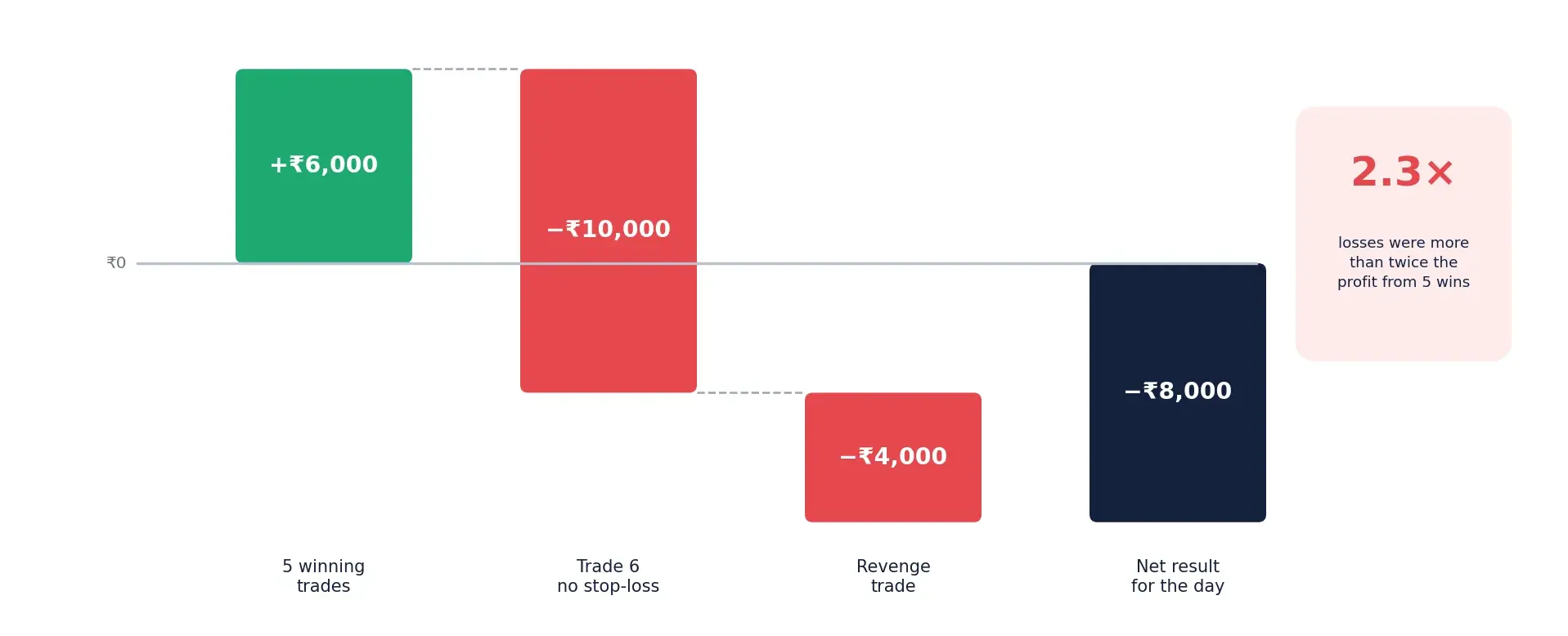
Asha has a ₹1,00,000 trading account. Her rule is to risk ₹1,000 per trade. She wins five intraday trades in a row on Nifty, making around ₹6,000.
Feeling confident, she buys a much larger quantity on the sixth trade, risking nearly ₹10,000.
She skips the stop-loss because “the trend is obviously with me”. The market reverses, and she loses about ₹10,000 in minutes.
Angry, she takes a rushed revenge trade and loses another ₹4,000. In one afternoon, she has lost more than twice her five-win profit.
What went wrong? She broke her own risk rule, skipped the stop-loss, and traded emotionally after a loss. Her strategy did not fail. Her discipline did.
Note: This is an illustrative example, not a real person or a recommendation.
