

Every forex trade starts with a currency pair. Money is never priced on its own in the forex market. It is always priced against another currency.
Once you understand currency pairs, the rest of forex becomes much easier to follow.
What is a Currency Pair?
A currency pair shows the value of one currency in terms of another. For example, EUR/USD compares the euro with the US dollar.
Forex trading always involves two currencies at the same time.
When you buy one, you are selling the other. That is why currencies are quoted in pairs.
Think of it like a price tag. A shop says “a bag of rice costs ₹60”. Forex says “one euro costs 1.10 US dollars”.
The only difference is that the “price” is another currency.
Base Currency and Quote Currency
Every pair has two parts, and the order matters.
- Base currency:
- The first currency in the pair.
- It is the one being priced.
- Quote currency:
- The second currency.
- It is the one used to measure the price.
In EUR/USD:
- EUR (euro) is the base currency.
- USD (US dollar) is the quote currency.
The number you see next to the pair is the exchange rate. It tells you how much of the quote currency you need to buy one unit of the base currency.
How to Read a Currency Pair
Let’s work through a simple example.
EUR/USD = 1.10
In plain English: 1 euro costs 1.10 US dollars.
So if you wanted 1,000 euros, you would need 1,100 US dollars at this rate.
Now suppose the rate moves to 1.12. One euro now costs 1.12 dollars. The euro has become stronger compared with the dollar.
If the rate falls to 1.08, the euro has become weaker compared with the dollar.
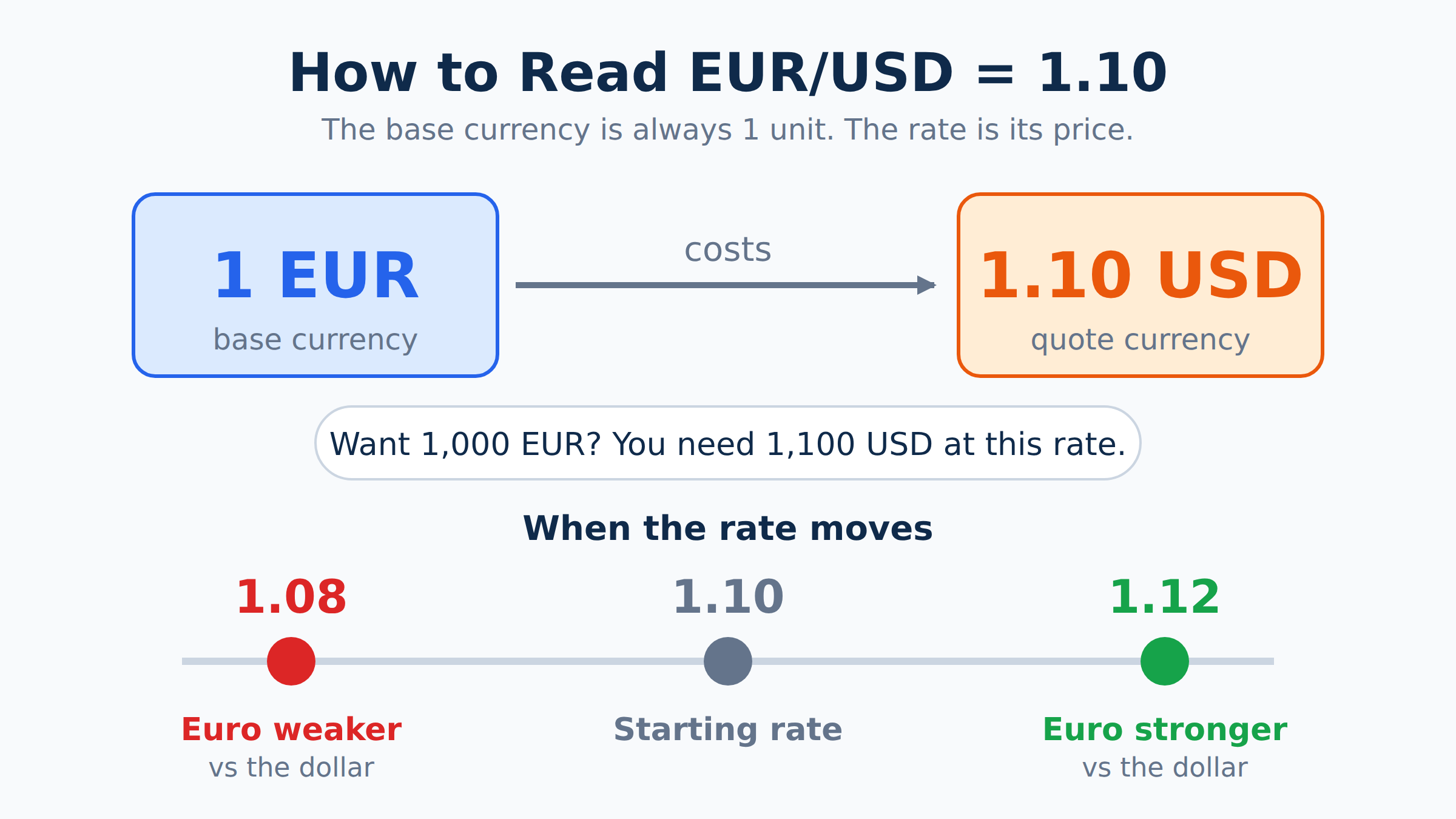
Here’s a quick way to remember it – The base currency is always “1 unit”. The rate tells you its price in the quote currency.
Types of Currency Pairs
Forex pairs are usually grouped into three types. Two terms will help here:
- Liquidity: how easily a pair can be bought or sold without big price jumps.
- Spread: the small gap between the buying price and the selling price. It is a cost of trading.
| Type | What it includes | Examples | Key characteristic |
| Major pairs | The US dollar paired with another major world currency | EUR/USD, GBP/USD, USD/JPY | Highest liquidity, usually the smallest spreads |
| Minor pairs (cross pairs) | Major currencies paired with each other, without the US dollar | EUR/GBP, EUR/JPY, GBP/JPY | Good liquidity, spreads usually wider than majors |
| Exotic pairs | One major currency paired with an emerging-market currency | USD/INR, USD/TRY, USD/ZAR | Lower liquidity, usually wider spreads |
Major Currency Pairs
Major pairs always include the US dollar. The dollar is the most traded currency in the world, so these pairs are the most active and the most followed.
Minor Currency Pairs
Minor pairs skip the dollar. They combine two other large currencies, like the euro and the British pound.
Exotic Currency Pairs
Exotic pairs include a currency from a smaller or emerging economy. USD/INR is usually grouped here.
These pairs trade less often, so prices can move more sharply and spreads are usually wider.
Examples of Common Currency Pairs
Here are some pairs you will see again and again:
- EUR/USD (euro / US dollar):
The most traded pair in the world. It reflects the Eurozone economy against the US economy.
- GBP/USD (British pound / US dollar):
Often called “Cable”. It compares the UK and US currencies.
- USD/JPY (US dollar / Japanese yen):
Here the dollar is the base currency. It shows how many yen one dollar buys.
- AUD/USD (Australian dollar / US dollar):
A popular pair linked closely to Australia’s commodity-driven economy.
- USD/INR (US dollar / Indian rupee):
The rate most Indians already know. If USD/INR is 90, one dollar costs ₹90.
Why Currency Pairs Matter for Beginners
A currency pair’s price moves because of the relative strength of its two currencies. It does not depend on one currency alone.
- The pair’s price rises if the base currency strengthens against the quote currency.
- The pair’s price falls, if the base currency weakens against the quote currency.
Say EUR/USD goes from 1.10 to 1.12. That could mean the euro got stronger, the dollar got weaker, or both.
Knowing this helps you read prices and news correctly. It also stops you from mixing up which currency is being priced and which is doing the pricing.
