Imagine you walking into an interview room at Accenture and asking how you can help big firms run their supply chains smoothly. As an Accenture SAP MM consultant, you can expect to work on projects of such scale that impact global companies. Many candidates are nervous about these questions, but if they are well prepared they can turn that nervousness into confidence. This comprehensive guide includes the most common Accenture SAP MM interview questions and clear, actionable answers. It draws from real-world experiences of applicants and addresses topics that come up frequently in Accenture interviews. By studying these, you become a qualified candidate with both technical knowledge and practical knowledge in SAP MM.
Join Entri’s SAP FICO Training Course today!!
What Is SAP MM and Why Does It Matter at Accenture?
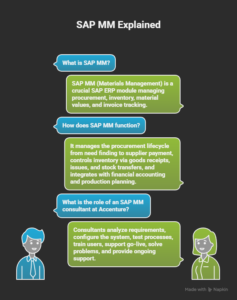
SAP MM stands for Materials Management and is one of the most important modules in SAP ERP. This module also serves companies in terms of procurement, inventory management, material values and invoice tracking. Accenture frequently develops SAP MM solutions for clients in manufacturing, retail, pharmaceuticals, and other industries where efficient supply chain operations can make a huge difference in profitability and customer satisfaction.
Accenture interviewers usually start with basic questions to verify your basic knowledge. For instance, this is a common question where you ask what SAP MM is and how it functions. SAP MM manages the entire procurement lifecycle from need finding to supplier payment. It also controls inventory via goods receipts, issues and stock transfers. It is also well integrated with financial accounting to ensure proper posting of costs and with production planning to meet manufacturers’ needs.
Another frequent question explores the role of an SAP MM consultant in Accenture projects. Consultants analyze client requirements, configure the system, test processes, train users, and support go-live activities. They solve problems during implementations and provide ongoing support to keep operations running without interruptions.
The Procurement Process in SAP MM
The procurement process is also one of the most tested areas of the Accenture SAP MM interviews in that it is the core of the module. Interviewers often ask candidates to walk through the procurement process from end-to-end. The process begins with a purchase request, which a department creates when it needs materials or services. The purchasing team reviews the requisition, selects a vendor and creates a purchase order. The goods are delivered by the vendor, and the receiving team posts a receipt for goods to update inventory. Next, the system matches the vendor invoice to the purchase order and receipt of the goods during invoice verification. Once everything matches, the finance team takes payment to the vendor.
A similar question asks what is the difference between a purchase requisition and a purchase order. Purchase requisition is a written document on the computer that asks for permission to buy something. It does not assign the firm to a supplier. But, a purchase order is a written promise to the vendor specifying price, quantity and delivery date.
Accenture interviewers also like to ask about source selection. When the requisition is converted to a purchase order, the system automatically suggests vendors based on information records, contracts or quota arrangements. It saves time and ensures that the company uses preferred suppliers.
Master Data in SAP MM
Master data provides the foundation for all transactions in SAP MM, and Accenture places strong emphasis on it during interviews. A common question asks candidates to describe the material master record. The material master contains all important information about a material, organized into different views. Basic data includes the material description, base unit of measure, and weight. Purchasing views cover details like purchasing group and order unit. Accounting views handle valuation class and price control. Plant-specific views extend the material to different locations.
Another key question focuses on material types. Material types classify items such as raw materials, finished goods, or services. Each type controls which views appear in the material master and how the system handles procurement or inventory for that material.
Interviewers may also ask about vendor master data. The vendor master stores information like address, payment terms, and reconciliation account. It links to company code and purchasing organization levels to support accurate transactions.
Inventory Management and Goods Movements
Inventory management questions appear often because Accenture clients rely on accurate stock tracking to avoid costly shortages or excess inventory. One typical question asks what goods receipt means. Goods receipt records the arrival of materials from a vendor. It increases stock quantity, updates inventory value, and often triggers quality inspection. People usually use transaction MIGO for this step.
Goods issue works in the opposite direction. It removes materials from stock for production, sales, or other uses. The system decreases inventory levels and posts costs to the appropriate accounts.
Physical inventory counts actual stock on hand and compares it to system records. Candidates often get asked how to handle differences found during physical inventory. After counting, post the differences to adjust the system records and investigate root causes to prevent future mismatches.
Stock transfers move materials between storage locations, plants, or company codes. These transfers help balance stock across locations and support efficient distribution.
Special Procurement Processes
Accenture interviews frequently include questions on special processes because they show deeper knowledge. Subcontracting is a popular topic. In subcontracting, the company provides components to a vendor who assembles or processes them into finished goods. The system tracks components issued and finished goods received using special purchase orders and movement types.
Consignment stock allows vendors to store materials at the client’s site without transferring ownership until consumption. The client pays only for what is used, which reduces upfront costs.
Split valuation lets the same material have different valuations based on factors like origin or quality. This approach helps companies track costs accurately for items sourced from different suppliers.
Integration with Other SAP Modules
Integration questions test whether candidates understand how SAP MM connects to the broader ERP system. A common question asks how SAP MM integrates with SAP FI. During goods receipt and invoice verification, the system automatically posts values to general ledger accounts based on configuration in OBYC. This setup ensures financial records stay accurate in real time.
Integration with production planning (PP) allows material requirements planning to generate purchase requisitions based on production needs. Sales and distribution (SD) integration supports stock checks during sales orders and updates inventory after deliveries.
Configuration and Customization
Accenture values consultants who can configure the system to fit client needs. Questions often cover enterprise structure, which includes company code, plant, storage location, and purchasing organization. These elements define the organizational framework for all MM activities.
Release strategy questions ask how to set up approval workflows for purchase orders. The system routes high-value documents through multiple approvers based on predefined criteria like value or material group.
Pricing procedure configuration determines how the system calculates prices, discounts, taxes, and freight in purchase orders. It uses condition types and access sequences to pull the right values automatically.
Scenario-Based and Practical Questions
Accenture interviewers love scenario-based questions to see how candidates apply knowledge. For example, they may ask how you handle a situation where a vendor delivers late. Check the purchase order terms, update delivery dates in the system, communicate with the vendor, and explore alternative sources if needed to avoid production delays.
Another scenario involves overstocked inventory. Analyze stock reports, classify items using ABC analysis, negotiate returns with vendors, or run promotions to clear slow-moving stock.
For invoice mismatches, block the invoice in the system, investigate quantity or price differences, coordinate with the vendor for corrections, and post credit or debit memos as required.
Advanced Topics and Best Practices
More experienced candidates are asked about advanced SAP MM concepts such as MRP types, quota arrangements, and vendor evaluation because these affect planning accuracy and procurement efficiency directly. Understanding how these components work together is a deep knowledge on both the system and business level which is not something that is expected of senior professionals.
MRP is a critical component in the planning of material needs based on demand. MRP runs, on demand, calculate the sales orders, forecasts, and production plans, determine the materials to be procured, produced, and when. Different types of MRP define the mode of planning—whether it’s automatic, manual or no planning. A well-designed MRP process minimizes stock shortages, inventory levels and smooth production flow.
Quota arrangements are used when a firm wants to split procurement between multiple suppliers. Purchases are arranged by a pre-determined percentage or quota rather than being sold to a single supplier. One vendor can receive 60% of the orders, while the other 40%. The system automatically selects vendors based on these quotas during procurement and thus ensures smooth sourcing, reduced risks, and improved supplier relationships. Quota arrangements are especially useful when purchasing valuable products or having high volumes of stock.
Vendor assessment is a system for organizations to track supplier performance. Suppliers are assessed for price competitiveness, materials quality and on-time delivery. These scores are kept in the system and are regularly updated to inform procurement decisions. Vendor evaluation in the long run promotes better negotiations and better supply chain reliability.
Best practices in these areas include clean and accurate master data, regular MRP jobs, and source lists to control which vendors can supply certain materials. Additionally, training end users is essential to reduce errors and ensure that planning and procurement processes run smoothly and consistently.
Join Entri’s SAP FICO Training Course today!!
Conclusion
An excellent basis for an Accenture SAP MM interview is a solid understanding of concepts associated with SAP MM, business scenarios, and key system integrations. Accenture interviewers typically evaluate theoretical knowledge as well as the ability to apply concepts in a real-world project setting. This includes clarity on the complete procurement cycle from purchase requisitions and purchase orders to receipt of goods, invoice verification, and vendor payment cycles. Understanding the integration of SAP MM with FI, SD and WM is also critical; real projects depend heavily on cross-functional collaboration.
The questions asked in this section are based on real interview experiences and span a wide range of difficulty. Expect everything from straightforward procurement flow questions to more complex topics like pricing procedures, release strategies, account determination and common configuration or troubleshooting scenarios. Interviewers like to ask you how you have handled issues in the past with your projects, so reading through your own outcomes on the project and understanding why each process decision was made will help you answer confidently and accurately.
Equally important, your ability to listen carefully to the question and respond in an organized, rational way. Accenture value consultants who can explain processes to clients and stakeholders more clearly than just design the system. Keeping up to date with SAP developments and developments around S/4HANA is also a major advantage. While Accenture tends to support legacy SAP systems, many projects are transitioning to or already running S/4HANA and awareness of these changes indicates readiness for future versions.
Focused preparation, good practice, and confident presentation will help you stand out in the interview. Success is not simply about knowing SAP MM; it is about showing the clients that you can bring value to their business through your expertise. Best wishes for your interview, and congratulations on taking this important step in your SAP career.
Master SAP with Expert-Led Courses
Unlock your potential with our comprehensive SAP courses! Learn essential modules like SAP MM (Materials Management), SAP SD (Sales and Distribution), and SAP FICO (Financial Accounting and Controlling) from industry experts.
Know MoreFrequently Asked Questions
As an SAP MM consultant at Accenture, can you describe the end-to-end procurement process in SAP and explain how it integrates with financial accounting?
As an SAP MM consultant at Accenture, you are not just a module expert; you are a business process integrator. The end-to-end procurement process, often called the “Procure-to-Pay” (P2P) cycle, is the lifeblood of a company’s operational and financial health. My role is to design, configure, and optimize this process to be seamless, transparent, and efficient for our global clients.
The process begins with Determination of Requirements. This can be a manual creation of a Purchase Requisition (PR) by a user, or, more efficiently, an automatic generation from a Material Requirements Planning (MRP) run based on production plans or from a direct material reservation. The PR is an internal document stating what is needed, when, and in what quantity, but it does not commit to a supplier.
The next critical phase is Source Determination. This is where Accenture’s value in designing intelligent systems shines. The system, based on configuration I would implement, automatically suggests sources using Source Lists (which specify approved vendors for a material), Quota Arrangements (for splitting requirements among multiple vendors), Contracts (long-term agreements with predefined conditions), or Purchase Info Records (historical data on material-vendor relationships). This automation ensures policy compliance, leverages negotiated rates, and optimizes the supply base.
Once a source is selected, the Purchase Order (PO) Creation occurs. The PO is a legally binding external document sent to the vendor. It contains precise details: material, quantity, price, delivery date, and payment terms. A key configuration point I handle is the Release Strategy, where POs over a certain value or for sensitive materials are routed through an automated workflow for managerial approvals, embedding control directly into the process.
Upon vendor delivery, the Goods Receipt (GR) is posted. Using transaction MIGO, the receiving personnel confirm the physical arrival. This step is crucial: it increases the warehouse stock in the system and, critically, generates an accounting document. The system automatically posts the GR to a GR/IR (Goods Receipt/Invoice Receipt) clearing account and the inventory account, based on the Valuation Price in the material master. This ensures inventory valuation is always current.
Following the GR, the vendor sends an Invoice. During Invoice Verification (MIRO), the three-way match—PO, GR, and Invoice—is performed. My configuration ensures tolerance limits are set so minor discrepancies (e.g., in price or quantity) are handled automatically or flagged for review. A successful match results in the system clearing the GR/IR account and creating a liability in the vendor’s account, ready for payment. This flawless matching prevents overpayments and ensures financial accuracy.
Finally, the Payment is executed by the Finance team via the Accounts Payable module, completing the cycle.
The integration with Financial Accounting (FI) is not an afterthought; it is the core of the design. Every material movement (GR, GI, transfer) and every invoice posting creates real-time accounting entries. This is governed by the Account Determination configuration (transaction OBYC), where I define which General Ledger accounts are posted to based on Transaction Keys (like BSX for inventory) and Valuation Modifiers (like different accounts for raw materials vs. trading goods). At Accenture, we ensure this integration is rock-solid, providing clients with a single source of truth where operational logistics and financial reporting are perfectly synchronized, enabling real-time cost visibility and compliance.
What is the significance of Master Data in SAP MM, and how do you approach its governance and maintenance for a large Accenture client?
In SAP MM, Master Data is the foundational bedrock upon which all transactional processes and reporting integrity are built. For a large global client at Accenture, poor master data quality isn’t just an IT issue; it’s a severe business risk leading to procurement errors, inventory inaccuracies, financial misstatements, and broken supply chains. As an Accenture consultant, my approach transcends simple configuration; it involves architecting a robust, sustainable Master Data Governance (MDG) framework.
The key master data objects include the Material Master, Vendor Master, and Purchasing Info Records. The Material Master is a single, unified record for each material, but its complexity lies in its segmentation. It contains dozens of views (Basic Data, Purchasing, Accounting, MRP, Storage) that are relevant to different organizational levels (Client, Plant, Storage Location). For a multinational manufacturer, one finished good might have a global description (Basic Data view), but plant-specific procurement sources (Purchasing view) and country-specific legal controls (Accounting view). Configuring the material type correctly (e.g., FERT for finished goods, ROH for raw materials) is crucial as it controls the fields and processes available.
The Vendor Master is equally stratified, with data organized at the general level (address, bank), company code level (payment terms, reconciliation account), and purchasing organization level (ordering data, pricing). A critical integration point here is the Reconciliation Account, which directly ties the vendor to the correct liability account in FI.
My approach for a large client is methodological:
-
Strategy & Blueprinting: I collaborate with business stakeholders to define data ownership, standards, and policies. Who creates a material? Who is responsible for maintaining vendor bank details? We define clear Data Domains and Stewardship roles.
-
Design & Configuration: I design the master data structure to support the business. This includes defining number ranges, setting up field selection groups to control which fields are required/hidden, and establishing classification systems for enhanced searchability. We implement Workflow-driven creation and change processes to enforce approvals and audits.
-
Data Migration & Cleansing: For implementations or mergers, I oversee the migration strategy. This involves extracting legacy data, running rigorous cleansing routines (deduplication, standardization), transforming it to SAP’s format, and validating it through mock loads. Tools like SAP’s LSMW or advanced solutions like SAP Information Steward are employed.
-
Governance & Maintenance: The go-live is just the beginning. I help establish the ongoing governance body—a cross-functional team that meets regularly to review data quality metrics, resolve issues, and approve changes to data standards. We implement periodic audits and use SAP’s standard reports or custom dashboards to monitor completeness, accuracy, and consistency.
-
Technology Enablement: For very large clients, we often recommend and implement SAP Master Data Governance (MDG) solutions. MDG provides a centralized, workflow-driven platform for mastering data, ensuring consistency across all systems (not just SAP) before it’s replicated to the transactional system.
At Accenture, we treat master data as a critical corporate asset. My role is to ensure it is accurate, consistent, and governed, thereby enabling reliable procurement, trustworthy financial reporting, and efficient global operations for our client.
Explain the concept of Inventory Management in SAP MM. How do Goods Receipt, Goods Issue, and Physical Inventory processes work, and what are their financial impacts?
Inventory Management (IM) is the real-time, quantitative and valuated tracking of all stock within an enterprise. In the context of Accenture’s work with asset-intensive clients like manufacturers or retailers, robust IM is directly tied to working capital optimization, production continuity, and customer satisfaction. My role is to configure processes that provide precise stock visibility and ensure every movement reflects both physical and financial reality.
The core transactions are Goods Receipt (GR), Goods Issue (GI), and Physical Inventory.
Goods Receipt (GR) is the posting of materials into stock. The most common GR is against a Purchase Order (MIGO, movement type 101). When posted, the system:
-
Quantitatively: Increases the unrestricted-use stock at the specified storage location.
-
Qualitatively: Can place stock in quality inspection (movement type 105) if required, blocking it from use until released.
-
Financially: This is the critical integration point. The system credits a GR/IR clearing account and debits the inventory account. The value is based on the price in the PO or the material’s standard price. This creates a provisional accounting entry, awaiting the invoice.
Other GR types include GR for a production order (receiving finished goods from the shop floor, movement type 101) and GR for a return from a customer.
Goods Issue (GI) is the posting of materials out of stock. Common examples include:
-
GI to a production order (movement type 261): Issuing raw materials to the shop floor. This decreases stock and debits a Work-in-Process (WIP) or consumption cost center account, moving value from inventory to production costs.
-
GI for a sales order delivery (movement type 601): Fulfilling a customer shipment. This decreases stock and, upon billing, triggers the Cost of Goods Sold (COGS) posting.
-
GI for a cost center (movement type 201): Issuing office supplies. This decreases stock and debits the cost center account, directly impacting departmental expenses.
Every GI, therefore, directly charges consumption to a profit center, cost center, or project, enabling precise cost accounting.
Physical Inventory is the process of reconciling system inventory with actual warehouse stock. The steps are:
-
Creating a Physical Inventory Document: This freezes the book inventory count for the selected materials/storage locations.
-
Counting: Physical count is performed by warehouse staff.
-
Entering Count Results: The counted quantities are entered into the system.
-
Posting Differences: If there’s a variance between the system count and physical count, a difference is posted. This automatically generates an accounting document.
-
If stock is higher physically, it’s a positive difference. The system debits inventory and credits a price difference or inventory gain account.
-
If stock is lower physically, it’s a negative difference. The system credits inventory and debits a loss account.
-
The financial impact here is direct P&L adjustment. My role includes configuring the appropriate GL accounts for these inventory differences (in OBYC) and helping clients analyze root causes (theft, damage, posting errors) to tighten controls.
For Accenture clients, I design these processes with controls like authorization groups for movement types and tolerances for negative stock, ensuring both operational efficiency and financial integrity.
Describe special procurement processes like Subcontracting, Consignment, and Third-Party Processing. What are their business use cases and how are they configured in SAP MM?
Standard procurement is straightforward, but complex global supply chains require specialized processes. Implementing these efficiently is where Accenture consultants deliver significant competitive advantage by optimizing working capital and streamlining operations.
1. Subcontracting
-
Business Use Case: A common scenario in discrete manufacturing. The client company provides raw materials or components (components) to an external vendor (the subcontractor), who performs a specific service (assembly, painting, heat treatment) and returns a finished item. This allows the client to leverage specialized external capacity without investing in machinery or skills.
-
SAP Process & Configuration:
-
A special Subcontracting Purchase Order is created for the finished item. The PO item contains the component materials as a “component list.”
-
The components are issued to the subcontractor using a special goods issue movement type (541). This transfers ownership and removes them from the client’s stock, posting them to a special “Subcontracting WIP” account.
-
Upon receipt of the finished goods (GR against the subcontracting PO, movement type 101), the system automatically reduces the subcontracting WIP account and increases the finished goods inventory.
-
The subcontractor’s invoice is for the processing fee only, as the component costs are already tracked.
-
Key configuration includes defining the material as “procurement type F” (external procurement with assembly), setting up a special stock indicator for subcontracting, and configuring the account determination for the WIP account.
-
2. Consignment
-
Business Use Case: The vendor places their materials in the client’s warehouse, but legal ownership remains with the vendor. The client only pays for the material upon consumption (withdrawal for production or sale). This is a powerful tool for reducing inventory carrying costs and ensuring material availability without tying up capital. Common in automotive and high-tech industries.
-
SAP Process & Configuration:
-
A Consignment Purchase Order or a Consignment Info Record is set up.
-
When the vendor replenishes stock, a goods receipt for consignment (movement type 101 K) is posted. This updates consignment stock quantities but creates no accounting entry, as ownership hasn’t changed.
-
When the client consumes the material (e.g., GI to production, movement type 201 K), this triggers the transfer of ownership. This is called a consumption posting. The system now creates an accounting document, debiting consumption and crediting the vendor’s liability. It also generates an outline agreement release document for billing.
-
Configuration involves setting up special stock types (‘K’), defining account determination for consumption, and establishing settlement procedures with vendors.
-
3. Third-Party Processing (Direct Shipment)
-
Business Use Case: A customer orders a product that the selling company does not stock. The seller creates a sales order, which triggers the automatic creation of a purchase order sent directly to their vendor/manufacturer. The vendor then ships the goods directly to the end customer. The seller never takes physical possession of the goods; they only handle the commercial transaction. This is a classic drop-ship model used in retail and trading.
-
SAP Process & Configuration:
-
The process integrates SD and MM tightly. A sales order is created.
-
The material must be configured with an item category group that allows third-party.
-
When the sales order is saved, the system automatically generates a purchase order (via output condition type EDI) to the specified vendor. This PO references the customer’s shipping address.
-
The vendor ships to the customer and sends the invoice to the selling company.
-
The seller posts a goods receipt (movement type 101) and a goods issue (movement type 641) in a single step, often automated. This keeps inventory neutral (no stock ever appears) but triggers the financial postings: the vendor liability is created, and the COGS and revenue accounts are updated upon billing the customer.
-
Key configuration is cross-module, involving material master settings, sales item categories, and purchase order types.
-
At Accenture, I analyze the client’s supply chain model to recommend and implement the right mix of these processes, configuring them for seamless integration and maximum business benefit.
How does SAP MM integrate with Production Planning (PP) and Sales & Distribution (SD) modules? Why is this cross-module understanding critical for an Accenture consultant?
In the real-world ERP landscape of an Accenture client, business processes do not operate in silos. A consultant with deep, cross-module integration knowledge is invaluable because they design solutions that reflect how the business actually runs—as a connected ecosystem. The integration between MM, PP, and SD is a prime example of this operational symphony.
Integration with Production Planning (PP):
This is a bi-directional, tightly coupled relationship centered on material availability for production.
-
MM to PP (Fulfillment): The PP module executes Material Requirements Planning (MRP). MRP runs analyze independent demand (from sales orders) and dependent demand (from production orders/BOMs) to calculate net requirements. The output of MRP is planned orders for in-house production and, crucially for MM, purchase requisitions (PRs) for externally procured materials. These PRs are automatically created in the MM module. As an MM consultant, I must understand the MRP types (e.g., PD – MRP, ND – no planning) and lot-sizing procedures configured in PP to anticipate the volume and timing of these PRs.
-
PP to MM (Execution): Once a planned order is converted into a production order, it requires components. The production order generates a reservation for the required raw materials. When the warehouse issues the materials to the order (Goods Issue 261), it is fulfilling this reservation. This GI also updates the order’s actual costs. Conversely, when finished goods are produced, a Goods Receipt (101) against the production order posts them into stock, crediting the production order and debiting inventory. My MM configuration of account determination for these movements directly impacts production costing accuracy.
Integration with Sales & Distribution (SD):
This integration ensures that promises made to customers can be kept based on actual stock.
-
Availability Check (ATP): When a sales order is entered in SD, the system can perform an availability check. This check consults the MM inventory data (unrestricted-use stock, plus planned receipts, minus reservations) to confirm if the product can be delivered on the requested date. My configuration of plant parameters and checking rules in MM directly influences the reliability of this promise to the customer.
-
Delivery Processing: When a sales order delivery is created, it triggers a picking request. The subsequent Goods Issue (601) for the delivery is an MM transaction. This GI reduces inventory and, upon billing, provides the value for the Cost of Goods Sold (COGS) posting. The linkage between the delivery document and the GI document must be flawless.
-
Third-Party and Stock Transfer Orders: As mentioned earlier, SD can trigger MM procurement (third-party) or inter-company stock transfers. Understanding the document flow (sales order -> purchase order / stock transfer order) is essential.
Why is this critical for an Accenture consultant?
-
Troubleshooting: An issue in production stoppage is rarely just a PP issue. Is it because MRP didn’t run? Or because a purchase requisition wasn’t converted? Or because a goods receipt was blocked? I can trace the problem across modules.
-
Solution Design: When a client wants to improve on-time delivery, the solution involves SD (availability check settings), PP (MRP frequency), and MM (safety stock levels, procurement times). I can architect a holistic solution.
-
Speaking the Client’s Language: Business users think in processes, not modules. A plant manager discusses “fulfilling the production schedule,” which involves PP and MM. My ability to engage in these conversations, understanding the entire flow, builds immense credibility and ensures my configured system matches business reality.
-
Project Success: Implementations and upgrades fail when integration points are missed. My cross-module knowledge ensures data flows correctly, preventing post-go-live disasters like missing stock, incorrect costing, or broken order fulfillment.
At Accenture, we value T-shaped professionals—deep in one area (MM) but broadly connected to others. This integration expertise is what transforms a technical consultant into a trusted business advisor.
Can you detail the configuration of the SAP MM organizational structure and account determination? How do these technical setups translate into business control for an Accenture client?
The configuration of the SAP MM organizational structure and account determination represents the foundational architecture upon which all procurement and inventory processes operate. For an Accenture consultant, this is not merely a technical exercise; it is the act of digitally mapping a client’s real-world operational and financial governance model into a system of record that enforces control, enables efficiency, and provides auditability at a global scale.
The Organizational Structure: Modeling Enterprise Reality
This structure defines the legal, logistical, and procurement hierarchy of the company. Each element serves a distinct control purpose:
-
Client: The highest level, representing the entire corporate group. Data at this level (like material descriptions) is universally shared.
-
Company Code: The smallest legal entity for which a complete, independent financial statement (Balance Sheet, P&L) can be created. This is a critical financial control point. Every financial posting from MM (inventory value change, GR/IR) is always assigned to a specific company code. A multinational might have hundreds of company codes (e.g., Accenture USA Inc., Accenture GmbH Germany).
-
Plant: An operational unit within a company code where materials are produced, stored, or services rendered. It can be a manufacturing facility, a regional distribution center, or a maintenance depot. Plants are valuation areas—meaning inventory is valued uniquely per plant. This allows for plant-specific costing and profitability analysis.
-
Storage Location: A subdivision within a plant designating a physical or logical storage area (e.g., raw material warehouse, finished goods bay, quarantine zone). All stock quantities are managed at the storage location level, enabling precise inventory tracking.
-
Purchasing Organization: The entity responsible for procuring materials and services. It can be configured at three levels, each offering different control models:
-
Central (Client-level): One purchasing org negotiates contracts for all company codes, achieving maximum leverage.
-
Company Code-specific: Each legal entity has its own purchasing team, allowing for local market adaptation.
-
Plant-specific: Maximum decentralization, used in very large, autonomous plants.
-
The genius of this structure lies in its assignment. A purchasing organization can serve multiple plants, and those plants can belong to different company codes. This allows Accenture to design a hybrid model—for instance, a central strategic purchasing org in Chicago negotiating global raw material contracts for plants in the US and Germany, while local purchasing orgs in each country handle tactical MRO items. This configuration directly enforces sourcing strategies and compliance.
Account Determination: The Automatic Financial Ledger
This is the configuration that breathes financial life into every logistical movement. It ensures that every goods receipt, issue, or invoice verification automatically posts to the correct General Ledger (GL) account without manual intervention. The configuration is rule-based and driven by transaction OBYC.
The process works through a deterministic key:
-
Transaction Key: A two-to-four-character code representing the accounting event (e.g., BSX = Inventory Posting, WRX = GR/IR Clearing Account, GBB = Offsetting Entry for Cost of Goods Issued).
-
Valuation Grouping Code: Usually the Valuation Area (Plant). This ensures the same material in different plants can be valued differently and post to different GL accounts.
-
Valuation Class: A field in the material master (Accounting 1 view) that classifies the material for accounting purposes (e.g., 3000 for raw materials, 7900 for trading goods). This is the crucial link between the material and the GL account.
-
Account Modifier: Used for GBB transactions to further specify the reason for the movement (e.g., VBR = Consumption for a sales order, VBO = Consumption for a production order, ZOF = Issue to a cost center).
The Business Translation: Control and Insight
For an Accenture client, this technical setup translates into tangible business control:
-
Financial Integrity & Compliance: The system, not people, determines the GL accounts. This eliminates manual posting errors and ensures strict adherence to accounting standards (IFRS, GAAP). Auditors can trace every kilogram of material to a precise financial value.
-
Cost Transparency: Because a goods issue to a production order (GBB+VBO) posts to a different account than an issue to a sales order (GBB+VBR) or a cost center (GBB+ZOF), management gains crystal-clear visibility into cost drivers. They can see exactly how much raw material cost is tied up in WIP, sold to customers, or consumed by administration.
-
Operational Governance: The organizational structure mandates process flows. A user in the German plant cannot create a purchase order using the US purchasing org’s contracts unless explicitly allowed. Stock cannot be transferred between company codes without a formal intercompany process. This hardwires corporate policies into daily operations.
-
Global Scalability: The model is inherently scalable. Adding a new acquisition involves creating a new company code, assigning plants, and linking it to existing or new purchasing orgs. The account determination rules automatically apply, ensuring the new entity operates under the same financial controls from day one.
As an Accenture consultant, my expertise is in interviewing business leaders to understand their control requirements, legal landscape, and operational model, and then translating that understanding into this precise, governing configuration. It is the bedrock of a successful, controllable SAP implementation.
What is the role of an SAP MM consultant in an S/4HANA transformation project at Accenture, and how does the functional scope evolve from SAP ECC?
The shift from SAP ECC to S/4HANA is not a simple upgrade; it is a paradigm shift towards a real-time, intelligent, and simplified enterprise suite. As an SAP MM consultant at Accenture, my role evolves from a functional configurator to a business process innovator and data simplifier. I am a key agent in helping clients navigate this transformation to unlock unprecedented operational visibility and agility.
The Evolving Role: From Technician to Strategic Guide
-
Process Simplification Advocate: S/4HANA comes with a strong opinion on “best practices.” My deep knowledge of legacy ECC complexities allows me to guide clients through necessary simplifications. For example, I lead workshops to retire obsolete custom enhancements (user exits, custom tables) that are no longer needed due to S/4HANA’s embedded analytics or new Fiori apps. I help them re-imagine processes in the context of a simplified data model.
-
Data Migration Architect: The migration to S/4HANA’s unified table structure (e.g., the single MATDOC table for all material documents) is a monumental task. I am responsible for the MM data domain. This involves cleansing decades of transactional and master data, mapping ECC structures to S/4HANA, and executing cut-over plans with zero tolerance for error, ensuring business continuity.
-
Innovation Catalyst: S/4HANA is a platform for innovation. I introduce clients to new capabilities like SAP Fiori for a role-based, consumer-grade user experience, moving users away from transaction codes. I explore embedded analytics like the Materials Management Analytics app suite, which provides real-time insights into procurement performance, supplier reliability, and inventory health directly from the operational database, eliminating the need for batch-based BW extracts.
-
Integration Specialist: In S/4HANA’s digital core, the lines between modules blur further. I collaborate closely with FI colleagues on the new Universal Journal (table ACDOCA), which captures all financial impacts from MM processes in real-time. I work with SD consultants on the advanced ATP capabilities and with Ariba specialists on embedding strategic sourcing into the operational procurement flow.
Functional Scope Evolution: Key Changes in MM
The functional scope undergoes significant, meaningful changes:
-
The End of Batch-Based MRP: One of the most dramatic shifts. In ECC, MRP (MRP Live) was often a nightly batch job that could strain systems. In S/4HANA, MRP on HANA can run in near real-time for a single material or plant, using the power of the in-memory database. This allows for a responsive, “always-on” planning process. My role is to redesign planning schedules and train planners to interact with a dynamic, real-time system.
-
Material Ledger & Actual Costing Becomes Standard: In ECC, Material Ledger (for actual costing and parallel valuation) was an add-on. In S/4HANA, it is mandatory and fully integrated. This provides instantaneous, multi-currency, multi-valuation (e.g., group vs. profit center) views of inventory. I must configure this complex but powerful functionality and explain its benefits to controlling departments.
-
Simplified Stock Valuation Tables: The cumbersome ECC valuation tables (MBEW, etc.) are consolidated. This simplifies configuration and improves reporting performance dramatically.
-
New Business Partner Concept: The separate Vendor Master (LFA1) and Customer Master (KNA1) are superseded by the unified Business Partner (BP). This is a major change for master data governance. I lead the redesign of vendor creation processes, working with SD and FI teams to ensure a single, golden record for any business entity.
-
Embeded Extended Warehouse Management (EWM) & Transportation Management (TM): While still separate licenses, the integration is seamless. For clients with complex logistics, I act as a conduit, defining the handshake points between MM (purchasing, inventory valuation) and EWM/TM (physical execution, transportation planning).
At Accenture, we don’t just lift and shift to S/4HANA; we transform. My role is to leverage these technical evolutions to drive business outcomes: reducing inventory days, improving procurement cycle times, enabling real-time decision-making, and creating a user experience that accelerates adoption. I am the bridge between the powerful new technical platform and the tangible business value it promises.
How do you approach key user training and change management as part of an SAP MM implementation or support project at Accenture?
For an Accenture SAP MM consultant, a technically flawless system is a failure if users reject it or cannot operate it effectively. My role extends far beyond configuration into the critical human dimensions of enablement and adoption. I approach training and change management as a structured, empathetic process designed to turn potential resistance into enthusiastic proficiency.
Phase 1: Early Engagement & Change Impact Analysis (Before Configuration)
Change management begins during the blueprint phase. I conduct workshops not just to gather requirements, but to listen for pain points and fears.
-
I identify key stakeholders and key users—the respected, influential individuals from procurement, warehouse, and planning teams.
-
Together, we analyze the “As-Is” and “To-Be” processes. I explicitly map out the change impact: “You currently approve POs on paper; in the new system, you will approve them in your workflow inbox with a click. You currently call the warehouse for stock; now you will check the system in real-time.”
-
This process builds buy-in early. The key users become my allies and co-designers, not passive recipients. They start to own the future process.
Phase 2: Designing Role-Based, Scenario-Driven Training
Generic SAP training is ineffective. My training is hyper-focused on the user’s specific daily tasks.
-
Develop Role-Based Curriculum: I create distinct training tracks. A Buyer needs deep training on purchase requisitions, source determination, PO creation, and vendor evaluation. A Warehouse Clerk needs intensive, hands-on practice with goods receipt (MIGO), goods issue, and physical inventory transactions. A Material Planner needs training on MRP evaluation, stock/requirements list, and purchase requisition management.
-
Leverage Real Client Data: Training uses the client’s own material numbers, vendors, and realistic scenarios. Instead of “Material 1000,” we use “Stainless Steel Coil – 304 Grade.” This creates immediate relevance.
-
Focus on “Why,” Not Just “How”: I explain the business rationale. “The three-way match isn’t a system quirk; it’s to prevent you from paying for goods you never received. This protects the company.” Understanding the purpose reduces frustration with new controls.
-
Utilize Multiple Formats: I develop a blend of:
-
Interactive Classroom Workshops: For key users and super-users.
-
Structured E-Learning Modules: For broader, scalable training on fundamentals.
-
Quick Reference Guides & “Cheat Sheets”: One-page job aids for the most common transactions, placed at the workstation.
-
Fiori Launchpad Sandboxes: For S/4HANA projects, I configure training sandboxes where users can safely explore their personalized Fiori apps.
-
Phase 3: Execution and Hyper-Care Support
-
Train-the-Trainer (TTT): I invest heavily in training the super-users (often the key users from Phase 1). They become the first line of support and the local champions of the system, speaking the business language of their peers.
-
Go-Live Support (“War Room”): During the critical go-live period, I am physically or virtually present in a command center. Super-users and I staff the support desks. This immediate, expert support is crucial for building confidence. We log every issue, distinguish between training gaps (solved immediately) and potential system bugs (escalated).
-
Post-Go-Live Reinforcement: Training is not a one-time event. After a few weeks, I conduct “refresher” sessions and roundtables to answer accumulated questions and share tips and tricks gathered from support logs.
The Accenture Difference: Managing the Human Transition
Accenture’s change management methodology provides the framework, but my functional expertise fills it with substance. I am seen as a trusted advisor, not just a tech expert. I empathize with the anxiety of a 20-year veteran buyer learning a new system. I celebrate their first successful PO. I translate their feedback into configuration tweaks, showing them they were heard.
Ultimately, my goal is to leave behind not just a working system, but a community of confident, capable users who understand how SAP MM helps them do their jobs better and contribute more strategically to the company. This is how we ensure the sustainability of the solution and deliver the full return on our client’s investment.
Describe common post-go-live issues in SAP MM and your structured approach to troubleshooting and resolving them as an Accenture consultant.
The go-live of an SAP MM system is a monumental achievement, but it is the beginning of the operational journey. The initial weeks are a period of stabilization where latent issues surface. As an Accenture consultant, my value is proven in this phase through a calm, systematic, and expert approach to troubleshooting that minimizes business disruption and builds enduring trust with the client.
Category 1: Master Data & Configuration Issues
These are the most common and often stem from legacy data errors or blueprint oversights.
-
Problem: “Goods receipt is failing with error ‘Material XXX is not extended to plant YYY’.”
-
Troubleshooting Approach:
-
Reproduce & Isolate: Have the user share the exact error message and transaction (MIGO). I attempt to reproduce the error in the system.
-
Root Cause Analysis: The error is clear: the material master lacks the necessary plant-specific views. I check MM01/MM02. The root cause could be:
-
Data Migration Error: The material was not extended to this plant during the migration load.
-
Process Gap: The procedure for creating a new material for this plant was not followed.
-
-
Resolution & Prevention: I immediately extend the material (MM01 -> Extend Plant). Then, I investigate: Was this a one-off mistake, or are there hundreds of materials like this? I run a report (e.g., list of materials with purchasing view missing for a plant) to identify a potential batch. I then work with the data governance team to correct the batch and reinforce the master data procedure with the users.
-
Category 2: Integration Issues
These occur when data does not flow correctly between modules.
-
Problem: “When we post a goods issue to a cost center, the finance team says the costs are hitting the wrong GL account.”
-
Troubleshooting Approach:
-
Trace the Document Flow: I start with the material document number (from MIGO). I use transaction MB03 to display it.
-
Analyze the Accounting Document: I navigate from the material document to the associated accounting document (via the document flow or directly view it). I check the GL accounts posted.
-
Diagnose Configuration: The wrong account points to an error in Account Determination (OBYC). I analyze the posting key: for a goods issue to a cost center, it’s GBB with account modifier ZOF. I check the valuation class of the material and the assignment in OBYC for GBB+Valuation Class+ZOF. I likely find a mis-mapping or a missing entry.
-
Correct and Test: After correcting OBYC (following proper change control), I perform a test transaction to verify the posting is now correct. I then inform the finance team of the correction and the affected period, so they can make any necessary manual adjustments.
-
Category 3: User Errors & Process Confusion
These are not system errors but reflect training gaps.
-
Problem: “We have a huge backlog of purchase requisitions that aren’t being converted to POs. The buyers say the system is slow.”
-
Troubleshooting Approach:
-
Observe and Inquire: I sit with a buyer (or connect via screenshare) and ask them to demonstrate. I quickly see they are manually searching for and converting each PR individually (ME54).
-
Identify the Gap: The issue is a lack of knowledge of mass processing tools. The system is not slow; the process is manual.
-
Educate and Empower: I show them transaction ME59 (Automatic PO creation) or how to use the mass processing functions in ME5A. I provide a quick refresher training session for the whole team. This resolves the “performance issue” instantly and dramatically improves productivity.
-
Update Training Materials: I ensure this knowledge gap is documented and added to the official training guides and job aids.
-
Category 4: Performance Issues
-
Problem: “MRP runs are taking 8 hours and timing out.”
-
Troubleshooting Approach: This requires a deeper technical partnership. I work with the Basis/technical team.
-
Functional Analysis: I review the MRP configuration: Are we planning the entire plant unnecessarily? Can we use planning horizons or planning file entries to reduce scope? Are there materials with unrealistic lot-sizing procedures creating infinite planning?
-
Data Analysis: I check for materials with enormous BOMs or rogue demand (e.g., a sales order for a million pieces entered incorrectly). I use reports like MD04 to analyze problematic materials.
-
Collaborative Solution: Based on my analysis, we might adjust MRP parameters, archive old planning data, or recommend technical optimizations (like HANA-specific MRP settings in S/4). The solution is always a blend of functional tuning and technical adjustment.
-
My Structured Methodology:
Regardless of the issue, I follow a disciplined protocol: Reproduce -> Isolate -> Diagnose -> Resolve -> Communicate -> Prevent. I maintain a detailed issues log, ensuring nothing falls through the cracks. Most importantly, I communicate proactively with the business and project leadership, setting realistic expectations and providing regular updates. This calm, competent approach during the stressful post-go-live period solidifies my role as a trusted problem-solver and ensures the long-term health of the SAP MM landscape.
Looking beyond core configuration, what are the emerging trends and future capabilities (AI, IoT, Blockchain) that will shape the role of SAP MM and the consultant in the "Intelligent Enterprise"?
The future of SAP MM is not merely about automating procurement and inventory tasks; it is evolving into the cognitive and connected core of the supply chain. As an Accenture consultant, my role is rapidly transitioning from a process implementer to a strategic integrator of intelligent technologies, helping clients harness innovation to build resilient, responsive, and self-optimizing supply networks. Several key trends are redefining the landscape.
1. Embedded Artificial Intelligence (AI) and Machine Learning (ML)
SAP is aggressively embedding AI/ML capabilities directly into its digital core under the umbrella of SAP Business AI. For MM, this is transformative:
-
Intelligent Forecasting & Replenishment: Moving beyond traditional MRP, AI algorithms can analyze vast datasets—internal sales history, external market signals (weather, commodity prices, social sentiment), and IoT sensor data—to predict demand with far greater accuracy. My role will involve configuring these AI models, defining the relevant data sources, and training planners to interpret AI-driven recommendations rather than static MRP results.
-
Smart Invoice Matching: Instead of rigid three-way matching, ML can learn from historical exceptions. It can automatically match invoices with slight discrepancies (e.g., a 2% price variance on a volatile commodity) if the pattern is approved historically, flagging only true anomalies. This dramatically reduces manual effort and speeds up payment cycles.
-
Conversational Procurement: Chatbots or co-pilots integrated with the MM system will allow users to perform tasks via natural language. “Hey SAP, create a purchase order for 100 units of bearing 5000 from our preferred vendor for delivery next Friday.” I will design the conversation flows and integrate these AI agents with the backend MM transactions and master data checks.
2. Integration with the Internet of Things (IoT)
The physical and digital worlds are merging. IoT sensors on bins, machines, and vehicles generate real-time data that MM can consume.
-
Predictive Maintenance & Automatic Replenishment: Sensors on a critical machine can predict a part failure next week. An IoT platform like SAP IoT Business Services can trigger the automatic creation of a purchase requisition for the replacement part in SAP MM, initiating the procurement process before the breakdown occurs, minimizing downtime.
-
Real-Time Inventory Visibility: Smart shelves with weight sensors or RFID-tagged pallets can provide perpetual, real-time inventory counts. This data feeds directly into SAP MM, eliminating the need for manual cycle counts and providing 100% accurate available-to-promise (ATP) data for sales. My role will involve defining the interface between the IoT middleware and SAP, mapping sensor events (e.g., “weight decreased by 10kg”) to MM movements (e.g., “Goods Issue 201 for cost center”).
-
Condition-Monitored Procurement: For temperature-sensitive goods (pharmaceuticals, food), IoT logs can be attached to the material document, providing an immutable record of the supply chain conditions, enabling quality-based acceptance or rejection upon goods receipt.
3. Blockchain for Provenance and Trust
While more nascent, blockchain offers revolutionary potential for complex, multi-tier supply chains.
-
Transparent Provenance: From conflict minerals to organic cotton, consumers and regulators demand proof of origin. Blockchain can create an immutable, shared ledger tracing a material from raw source through every processing step. SAP MM can be the system that records the commercial transaction (the PO, the GR), while blockchain records the physical and ethical attributes. I will design the integration where key data hashes from MM documents are written to the blockchain, creating an auditable link between the financial record and the physical journey.
-
Smart Contracts for Automated Settlement: A purchase order with defined terms (delivery by X date, quality = Y) can be encoded as a smart contract on a blockchain. When IoT data confirms on-time delivery and acceptable quality, the smart contract can automatically trigger the invoice creation and even the payment release in the financial system, removing intermediaries and disputes.
The Evolving Role of the Accenture Consultant
My expertise will expand in three key dimensions:
-
Architect of Intelligent Processes: I will design end-to-end processes that seamlessly blend core MM transactions with AI insights, IoT data, and blockchain verification.
-
Data Orchestrator: The value lies in connecting data silos. I will need a strong understanding of data models, APIs, and integration platforms (like SAP Integration Suite) to make MM the hub that consumes and acts upon intelligence from a network of connected systems.
-
Business Value Interpreter: I will translate the capabilities of AI, IoT, and blockchain into tangible business outcomes for the C-suite: reduced working capital, guaranteed compliance, perfect order fulfillment, and unprecedented supply chain resilience.
The future of SAP MM at Accenture is incredibly exciting. It moves us from managing materials to orchestrating an intelligent, interconnected supply ecosystem. My role is to be the trusted guide who brings this future into a practical, value-driven reality for our clients.