
Table of Contents
In German, the accusative case designates the individual or entity that is the subject of the action as the direct object of the phrase. To avoid redundancy, one may employ accusative pronouns as substitutes. Improved comprehension and fluency in German may be attained via dedicated learning.
Learn German from the best mentors in the field! Join the Entri online course!
What Are Accusative Pronouns in German?
In rare cases, a word can become an accusative pronoun when it is the direct object of a phrase. The items that get the action are called direct objects.
In the original text “Ich sehe Anna,” the accusative word “dich” substituted the word “Anna.” This means “I find myself with you.”
Using accusative pronouns makes phrases clearer and more fluid by getting rid of extra words that don’t change the meaning of the phrase.
Accusative Pronouns Chart (Singular & Plural)
1: How do you say "Good Morning" in German?
| Nominative | Accusative |
|---|---|
| ich | mich |
| du | dich |
| er | ihn |
| sie | sie |
| es | es |
| wir | uns |
| ihr | euch |
| sie / Sie | sie / Sie |
When to Use Accusative Pronouns
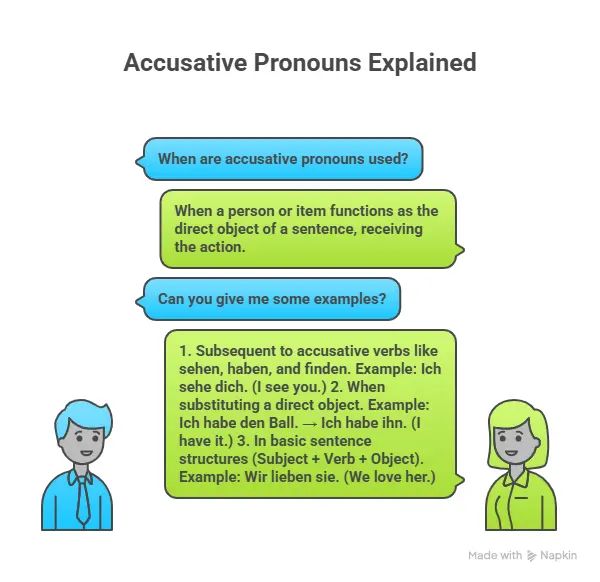
Accusative pronouns are employed when a person or item functions as the direct object of a sentence, receiving the action. Consider the following three salient points:
- Subsequent to Accusative Verbs
Certain German verbs consistently need the accusative case, including sehen (to see), haben (to have), and finden (to find).
Example: Ich sehe dich. (I see you.)
- When Substituting a Direct Object
Rather than reiterating a noun, one may substitute it with an accusative pronoun.
Example: Ich habe den Ball. → Ich habe ihn. (I have it.)
- In basic sentence structures (Subject + Verb + Object)
Utilize accusative pronouns to distinctly indicate the object in uncomplicated sentences.
Example: Wir lieben sie. (We love her.)
|
German A2 Exercises – Download Free PDF |
||
Free German A1 Mock Tests – Powered by AI!
Test your skills on our interactive platform. Get instant feedback from our AI to help you communicate better and track your progress. Start your free German mock test now.
Test Your German A1 for FreeAccusative Pronouns in Sentences (Examples)
Accusative pronouns are employed in everyday German to enhance the fluidity and naturalness of speech. They substitute nouns that are affected by the action of the verb — the direct object. To enhance fluency and conversational quality, utilize concise pronouns like as mich, dich, or ihn in place of redundant names or nouns.
Presented below are few examples:
- Ich sehe dich. (I see you.)
- Er liebt sie. (He loves her.)
- Wir haben es. (We have it.)
- Kannst du mich hören? (Can you hear me?)
- Ich lade euch ein. (I invite you — plural.)
|
Goethe 2026 Exam Dates: Multiple Test Centers |
|
| Trivandrum Goethe Exam Dates | Kochi Goethe Exam Dates |
| Chennai Goethe Exam Dates | Coimbatore Goethe Exam Dates |
Common Mistakes to Avoid
Beginners in German frequently make minor errors when they utilize accusative pronouns in their language vocabulary. Here are some common ones, along with the solutions to fixing them:
- Getting the Nominative and the Accusative confusedThe fact that the pronoun shifts into the object is something that many students fail to remember.
- Wrong: Ich sehe er.
- Correct: Ich sehe ihn.
- You should use “er” rather than “ihn.”It is important to keep in mind that “er” refers to the subject (he), while “ihn” refers to the object (him).Example: Er liebt sie. (He loves her.) — Here, er is the subject, and sie is the object.
- Using the Pronoun in an Incorrect PositionIt is common practice for the pronoun to follow the verb in German sentences, particularly in straightforward assertions.Example: Ich kenne dich. (I know you.) — not Ich dich kenne in normal word order.
Learn German from the best mentors in the field! Join the Entri online course!
Accusative Pronouns vs Nominative (Quick Comparison)
The nominative case indicates the agent or thing conducting the deed, or the topic of the statement.
As the subject of the sentence, the object of an accusative case verb is defined as the subject of the action.
| Nominative (Subject) | Accusative (Object) | Example Sentence |
|---|---|---|
| ich (I) | mich (me) | Ich liebe mich. (I love myself.) |
| du (you) | dich (you) | Ich sehe dich. (I see you.) |
| er (he) | ihn (him) | Sie kennt ihn. (She knows him.) |
| sie (she) | sie (her) | Er liebt sie. (He loves her.) |
| es (it) | es (it) | Ich habe es. (I have it.) |
Practice Exercises (With Answers)
A. Fill in the blanks:
- Ich liebe ___ (du).
- Kannst du ___ hören? (ich)
- Er sieht ___ (sie).
- Wir brauchen ___ (es).
- Ich lade ___ ein. (ihr)
B. Sentence Correction:
6. Ich sehe er. → ______
7. Du kennst ich. → ______
8. Wir haben sie (they). → ______
Answer Key:
- dich
- mich
- sie
- es
- euch
- Ich sehe ihn.
- Du kennst mich.
- Wir haben sie.
Final Thoughts
To sound natural and fluent in German, you must grasp the usage of accusative pronouns. They assist you prevent repetition, make your notion more cohesive, and improve the general flow of your ideas. First, compose tiny phrases and commit the pronoun chart to memory. Using these idioms in ordinary interactions will become second nature as your experience grows.
Free German A1 Mock Tests – Powered by AI!
Test your skills on our interactive platform. Get instant feedback from our AI to help you communicate better and track your progress. Start your free German mock test now.
Test Your German A1 for FreeFrequently Asked Questions
What is the main use of accusative pronouns in German?
Accusative pronouns replace nouns that are direct objects in a sentence — the person or thing receiving the action.
How can I tell if a sentence needs the accusative case?
If the verb affects someone or something directly (like sehen, haben, finden), you’ll use the accusative case.
What’s the difference between nominative and accusative pronouns?
The nominative shows who is doing the action (subject), while the accusative shows who or what receives the action (object).
Do accusative pronouns always change from nominative forms?
No. Only ich → mich, du → dich, and er → ihn change clearly. Others stay the same.
How can I practice accusative pronouns easily?
Try making short sentences using verbs like sehen, kennen, or lieben and replace the noun with a pronoun — e.g., Ich sehe ihn.