

Table of Contents
Imagine finding a malicious security hole in the website of a big firm and getting paid thousands of dollars for reporting it properly. Think now of being the hero a business hires to legally enter their system, picking out every weak spot that can exist, and giving them a roadmap to get it locked down before any real attacker could strike. Both sides of cybersecurity tend to attract people who really enjoy the process of cracking bad bugs and making things safer. Those new to the hobby tend to ask themselves the same question: between bug bounty hunting and penetration testing, which is actually the better and more rewarding job? This article makes it all clear so that you can determine what suits your own style of work, your budget and where you envision yourself in a few years. We will walk through exactly what each job looks like daily, why it is so different from each other, what skills actually matter in each job, how money and security work together and some honest advice on choosing the path that feels right for you.
Enroll in Entri’s AI-Powered Cybersecurity course now!
What Is Bug Bounty Hunting?
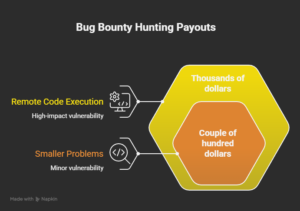
Bug bounty hunting consists of digging through live websites, mobile apps, APIs, cloud setups, and anything else that a company makes available online that it openly asks people to test for security problems. These programs are run by big corporations like Google, Apple, Microsoft, Meta, and many banks, online stores and even government agencies – some free to join, others private and invite only for experienced hunters. If you do detect a vulnerability, you make a good report detailing exactly where you found it, why it matters, how bad it could be if left alone, and what the company should do about it. If you report a problem that is new and has scope, they reward you according to the magnitude of the problem: some smaller problems will fetch a couple of hundred dollars, while a full remote code execution that could have someone take over servers could fetch thousands of dollars – or in rare cases even more.
Most hunters do this completely on their own, usually from home or somewhere that has decent internet service, and they set their own schedules at will. You choose the programs that make you laugh, you decide how long you want to spend bug hunting in each program, and you stop whenever you want without giving a response. HackerOne, Bugcrowd, Intigriti, and YesWeHack make it run smoothly – they list all the programs that are active, tell what rules and safe locations to use for each target, collect your submissions, verify everything is OK and send you the payments so you do not have to chase companies down for your money. Since you are testing real, live systems that actual users are hitting every day, companies draw strict lines around what is allowed and what could cause accidental trouble, and they expect you to stay inside those boundaries.
Hunters mix smart manual testing with automated scanners and tools like Burp Suite, Nuclei, custom Python scripts, or whatever fits the job. They keep their edge by reading fresh write-ups from other hunters, watching new conference talks online, joining Discord servers or forums where people swap ideas, and running their own little test labs to try wild new techniques. The biggest draw is the freedom combined with the shot at really big single payouts that can change your month in one go. Plenty of people begin hunting as something they do after their regular job or on weekends, then ramp it up as they start landing consistent finds and build a name for themselves. The very best hunters pull in six figures or more each year, and a small group has turned into recognizable figures in the scene after chaining together several high-value reports. At the same time, the reality is bumpy: weeks can pass with zero payouts, companies sometimes mark good reports as duplicates or out-of-scope, and the field has gotten a lot more crowded as word spreads about the potential.
What Is Penetration Testing?
Penetration testing—most people just call it pen testing—is a paid, organized service where skilled security pros get hired to pretend they are real attackers and try to break into a company’s networks, web apps, cloud setups, APIs, mobile apps, or even physical hardware if that is part of the deal. The whole point is to uncover flaws that criminals could use so the organization can patch them up before anything bad happens.
As opposed to bug hunters, who go in and out of public programs on their own, pen testers almost always sign contracts that specify exactly what they can touch, how long they have, what methods are not allowed, and what legal protection the client gives them so they don’t get in trouble for doing their job.
A typical pen test follows a normal sequence of planning and scoping with client in order to understand their objectives and risks, reconnaissance to sketch out the surrounding quietly, scanning to see what ports and services are open, attempting to gain that first foothold, pushing deeper, increasing access and wandering around the network, and finally putting everything together into a complete report. The report is not a list of bugs, but proof such as screenshots and logs, clearly measured severity from a business perspective, and step-by-step recommendations for fixing what could actually be used by both tech teams and managers. Clients are from everywhere: big corporations, banks, hospitals, power companies, defense contractors and government offices who are obliged to comply with GDPR, PCI DSS, HIPAA or SOC 2.
Most pen testers work full time at consulting firms, security providers, or within the security units of large organizations; that means regular wages, health benefits, vacation pay, training and certification funding, and a somewhat predictable routine. Some of them work freelance or run small agencies that do one project at a time at fixed costs. Certifications such as OSCP, PNPT, CRTP, CEH, and GPEN open doors and let clients know you are doing what you are doing. Because projects have beginning and ending dates and defined rules, testers can schedule their lives, work with teammates if needed, and deliver on time without constant surprises.
Key Differences Between Bug Bounty and Penetration Testing
Bug bounty hunters are just like penetration testers, they both look for the same kinds of security holes, but almost every detail about their way of working, how they get paid, and what they do with organizations separates them. Hunters usually do fly solo, or share targets freely in groups online, then pick targets from thousands of open programs and decide on their own rules in the program’s rules; pen testers sign explicit contracts upfront stating what kind of assets they can test, when, how many methods are allowed, and what to do if something goes wrong. An hunter writes a brief and detailed report on one particular vulnerability, which is paid only when accepted as unique and valuable, while the pen tester writes a long, professional report on the full test duration, and is paid for doing everything in it, even though they find nothing earth shattering.
Money works very differently too. Bug bounties are all about variable, find-based rewards: you might grind for a month and earn nothing, then hit one monster bug and make more in a day than some people see in a quarter. Pen testing brings steady paychecks—either a reliable salary in a full-time role or agreed project fees—so you know roughly what is coming in each month. Hunters can jump into programs anywhere in the world without resumes or interviews as long as they follow the rules, but they battle heavy competition and the chance their hard work gets dismissed as a duplicate. Pen testers build relationships with fewer clients over time, sometimes turning one-off jobs into repeat business, though they usually need to go through hiring processes, prove credentials, and occasionally travel for hands-on work at a client’s site.
Life is different as well. A bug hunter can jump on at 2 a.m. when an idea strikes, do intense weekends, and take a week off if it happens, while a pen tester prefers to work closer to the hours, meets deadlines on projects, stands on teams, balances multiple clients or internal tasks. Legally, hunters must be extra vigilant to never run beyond the boundaries of the program or risk serious trouble, but pen testers get written permission, and companies offer coverage to help personal risk down a lot.
Skills Required for Each Path
Both careers rest on the same strong base: deep knowledge of how web apps work, common attack types like XSS, SQL injection, SSRF, and IDOR, network basics, reconnaissance tricks, and ways to actually exploit flaws when you find them. Tools like Burp Suite for intercepting traffic, Nmap for mapping networks, Metasploit for quick exploits, Nuclei for fast scans, Wireshark for packet analysis, and scripting in Python or Bash show up in almost every serious hunter’s or tester’s toolkit. On top of the tech side, bug bounty hunters lean hard into creative thinking, stubborn persistence when chasing edge cases, and the knack for noticing tiny misconfigurations that scanners skip.
They must also write clear, brief reports that prove the bug without wasting the triage team’s time, and they must learn constantly because new frameworks, cloud services, and patterning of attacks all appear—reading others’ posts online, joining live streams of talks, and breaking things in personal labs are part of the routine.
Pen testers need everything hunters need plus all the stuff that comes with working in structured situations. Project management skills give them realistic expectations for work scope, timeliness, and delivery. It is a game changer for client communication, because they turn technical details into simple explanations of business risk so that bosses understand why fixes matter and what importance they should pay them. Writing long and polished reports that stand up to scrutiny from auditors or regulators is a job. Teamwork is more of a concern because often in jobs there is a large team task or red-team exercise to do, with coworkers. Understanding compliance standards, cloud architectures like AWS or Azure, and container environments like Kubernetes are becoming almost mandatory as customers are demanding those tests more and more.
Income, Job Stability, and Growth Comparison
Bug bounty earnings swing wildly depending on skill, time put in, luck, and which programs you target. The top hunters—the ones consistently landing critical bugs—can clear well over $200,000 a year and sometimes push much higher during hot streaks, especially on private invites or high-payout programs from tech giants. Mid-level hunters who treat it seriously often land between $20,000 and $80,000 annually, while beginners and casual participants frequently see $0–$10,000 in their first year or two. There are no automatic benefits, no paid sick days, no employer-matched retirement, and you pay for your own gear, tool licenses, courses, and taxes out of pocket. The ceiling is basically unlimited if you get really good and build a reputation, but dry periods where reports get rejected or duplicated can hurt cash flow hard.
Penetration testing usually delivers more even income. Entry-level jobs in many places start around $60,000–$90,000 USD (or roughly ₹10–18 lakhs in India depending on the company and city), mid-level roles with a few years of experience commonly hit $100,000–$140,000 USD (₹18–35 lakhs or more in good locations), and seniors, leads, or independent consultants regularly go past $150,000–$200,000+ with bonuses. Full-time positions almost always include health coverage, vacation time, certification funding, and structured raises or promotions. The market stays hot because laws, insurance companies, and boards keep pushing organizations to run regular tests, so jobs do not dry up easily.
Looking ahead, bug hunters can grow by building a personal brand—writing blogs, making tools, teaching courses, speaking at events, or moving into research roles at security companies or platforms. Many use hunting to create a strong portfolio and later slide into stable pen-testing jobs. Pen testers climb ladders inside companies toward management, specialize in niches like cloud red-teaming or hardware testing, become principal consultants, or launch their own practices. A common move is holding a reliable pen-testing role while hunting part-time for extra money and sharper skills. Both areas keep growing fast as cyber threats rise and more companies need help staying secure.
Which Career Path Should You Choose?
If you love calling your own shots, get energy from working whenever inspiration hits, and can handle stretches without income while chasing the chance for big scores, bug bounty hunting lines up well. It lets you build real, battle-tested skills fast, get noticed in the community through public reports, and experiment without needing anyone’s approval. The downside is the uncertainty, so it works best if you have savings to bridge quiet months or start it as a side project alongside something steady.
If steady money, a clear routine, teamwork, benefits, and a roadmap for promotions feel more important, penetration testing tends to deliver that smoother ride. You get predictable pay to cover bills and family needs, structured projects that teach you depth, and chances to move up into leadership or specialized roles over time. Many people dip into bug bounties first to gain confidence and proof of ability, then use those wins to land pen-testing positions where the pay and security are more reliable.
Think about your own situation honestly. Do you hate fixed schedules and thrive on independence even if it means risk? Hunting might keep you motivated. Do you want reliable income and enjoy explaining findings to clients or working with a team? Testing probably fits better. You can always mix the two: plenty of pros hold day jobs in pen testing and hunt on evenings or weekends to keep skills razor-sharp and add bonus cash.
Enroll in Entri’s AI-Powered Cybersecurity course now!
Final Thoughts
Bug Bounty vs Penetration Testing, for example, provides you two very solid and respected ways to convert cybersecurity knowledge into a good career that pays well and actually protects people and companies. Hunting brings the euphoria of freedom, the freedom of discovery, and the potential for potentially lifechanging single payouts. Penetration testing also gives reliability, professional development, support to the team, and the satisfaction of accomplishing full and concrete security improvements. There is no way to be perfect or “better”; it’s your decision to choose the path that works best for you and what you need right now in life. Embark on the action and start practicing right now: open an account on a bounty platform, take part in free labs, read real reports, break things safely, and keep up the pace. The need for good people in this field is only growing, and effort in either direction will take you farther than you might think at the moment.
Frequently Asked Questions
Do I need a college degree or formal education to succeed in bug bounty hunting or penetration testing?
The short and direct answer is no—you absolutely do not need a formal computer science degree or any kind of university education to build a successful career in either bug bounty hunting or penetration testing. The cybersecurity industry, particularly the offensive security side of things, remains one of the few technical fields where demonstrated skill and practical ability consistently outweigh academic credentials. Employers who hire penetration testers and the companies that run bug bounty programs care almost exclusively about whether you can actually find and exploit vulnerabilities, write clear reports, and think like an attacker. Your ability to do those things matters infinitely more than where you went to school or whether you have a degree hanging on your wall. That said, the absence of a degree requirement does not mean the path is easy or that formal education offers no value whatsoever. There are genuine advantages and trade-offs to consider depending on which direction you lean.
For bug bounty hunting specifically, degrees and certifications carry nearly zero weight when you are submitting reports through platforms like HackerOne or Bugcrowd. The triage teams reviewing your submissions do not ask about your educational background, nor do they care. They look strictly at the quality of your finding, the clarity of your proof-of-concept, and whether the vulnerability falls within the program scope. You can be a seventeen-year-old high school student testing from your bedroom or a forty-year-old career switcher who learned web application security through online courses and capture-the-flag challenges. The company pays the same bounty either way, and your reputation grows based entirely on your track record of valid, high-impact findings. Many of the most successful and well-known bug bounty hunters in the world today never completed formal degrees in computer science. They learned through PortSwigger Web Security Academy, practice labs like Hack The Box and TryHackMe, reading write-ups published by more experienced hunters, and countless hours of hands-on trial and error against real-world targets operating within authorized programs. The barrier to entry remains almost nonexistent financially and bureaucratically. You need a laptop, a reliable internet connection, curiosity, and persistence. You do not need transcripts, recommendation letters, or tuition payments.
Penetration testing presents a slightly more nuanced picture regarding formal education requirements. While it remains entirely possible to land a full-time penetration testing job without a college degree, the hiring process at many consulting firms, boutique security practices, and corporate internal security teams often includes filters that can make the journey harder for those without credentials. Large enterprises and government contractors especially tend to work with human resources departments and third-party recruiters who screen resumes for four-year degrees before technical managers ever see qualified candidates. This reality does not make it impossible, but it does mean that self-taught testers without degrees frequently need to work harder to get noticed. They compensate by earning respected practical certifications like the OSCP, PNPT, or CRTP, building detailed portfolios of vulnerability write-ups, contributing to open-source security tools, speaking at local security meetups or conferences, and networking aggressively within the industry. Once you get past the initial resume screening and reach the technical interview stage, degrees stop mattering almost completely. The hiring manager wants to watch you think through a hands-on challenge, explain how you would approach a black-box assessment, or walk through a past finding and its business impact. If you demonstrate competence and professionalism, the absence of a degree rarely becomes a deciding factor against an otherwise strong candidate. Many penetration testing teams actively value diverse educational backgrounds and appreciate the relentless self-motivation that self-taught practitioners bring to the table.
Formal education, when pursued intentionally, does offer structural advantages that self-study sometimes struggles to replicate. A well-designed computer science, cybersecurity, or information technology degree program builds foundational knowledge in networking, operating systems, programming paradigms, cryptography, and database design in a systematic, progressive manner. Students work through labs, receive feedback from instructors, collaborate with peers on group projects, and develop the academic vocabulary that helps them consume advanced technical documentation and research papers. University programs also frequently provide internship pipelines, career placement services, and alumni networks that open doors to first jobs more smoothly than cold applications. For penetration testing roles in regulated industries like finance, healthcare, or defense contracting, holding a degree sometimes satisfies baseline compliance requirements that organizations must meet to maintain their own certifications or insurance policies. None of this means a degree is necessary or even optimal for every person, but it does explain why many successful penetration testers hold degrees even though the work itself rarely demands academic theory beyond what motivated self-learners can acquire independently.
Ultimately, the most honest answer to this question is that your willingness to learn continuously, embrace constructive criticism, and spend thousands of hours practicing deliberately matters more than any single credential or piece of paper. Some of the best bug bounty hunters in the world never finished high school, and some of the most respected penetration testing consultants hold PhDs in computer science. Both paths offer multiple entry points, and the industry continues trending toward skills-first hiring as the talent shortage grows and traditional education pipelines fail to produce enough qualified practitioners. If you enjoy learning through structured environments, need external accountability, or want the full campus experience, a degree remains a perfectly valid investment. If you prefer learning at your own pace, saving money, and jumping straight into applied work, you lose nothing by starting today with free online resources and working your way up. The market rewards results, and results flow from consistent effort over time regardless of how you acquired your knowledge.
How long does it take to become proficient enough to earn consistent money in bug bounty hunting or land a first penetration testing job?
This question carries no universal answer because the timeline depends heavily on your starting point, how many hours you can invest daily or weekly, the quality of your learning resources, your ability to absorb and apply technical concepts, and the specific area of security you choose to pursue. Beginners coming from completely non-technical backgrounds who have never written a line of code, never used Linux, and never studied how web applications work underneath the hood should realistically expect a minimum of twelve to eighteen months of consistent, focused practice before they reliably find real vulnerabilities in live programs or pass the technical interviews required for entry-level penetration testing roles. This timeline may sound discouraging at first, especially given the glamorous portrayals of hackers pulling all-nighters and landing five-figure bounties within weeks of starting. The reality is that offensive security involves a staggeringly deep stack of knowledge that builds layer upon layer. You cannot skip foundational understanding of HTTP protocols, client-server architecture, authentication mechanisms, session management, database querying, cloud service configurations, and dozens of specific vulnerability classes. Each of these areas takes time to internalize, and the gap between knowing theory and reliably chaining exploits together in unfamiliar environments is where most beginners stall out if they lack patience.
For bug bounty hunting specifically, the earning curve tends to be brutal during the first year for the vast majority of participants. Many hunters submit dozens or even hundreds of reports before landing their first valid, in-scope, non-duplicate finding. Platforms like HackerOne and Bugcrowd host millions of registered users, and the competition on public programs has intensified dramatically compared to five or ten years ago when pioneers were picking low-hanging fruit. Beginners today face experienced hunters who run automated recon pipelines across thousands of subdomains, write custom scripts to detect edge-case vulnerabilities, and submit reports within minutes of new programs launching. Breaking through this noise requires either exceptional creativity, deep specialization in an underserved area like mobile application security or cloud misconfigurations, or sheer volume of hours spent hunting on less crowded private programs. Some hunters begin earning small bounties within six months if they focus narrowly on one vulnerability type like cross-site scripting or open redirects and hammer it relentlessly across many targets. Others take two or three years before they achieve consistency, and many recreational hunters never earn significant money at all. The difference between those who succeed and those who abandon the pursuit usually comes down to how they respond to rejection and duplication. Hunters who treat every wasted report as a learning opportunity, dissect why their finding was marked duplicate or out of scope, and refine their methodology accordingly eventually build the pattern recognition that leads to regular payouts.
Penetration testing offers a more structured timeline with clearer milestones. Entry-level roles typically require demonstrated competence with common tools and vulnerability classes, familiarity with basic network scanning and enumeration, and the ability to write findings in clear English that non-technical stakeholders can understand. Candidates who start from zero but dedicate ten to fifteen focused hours per week often reach employability within twelve to eighteen months. This timeline accelerates significantly if you pursue hands-on certifications like the Practical Network Penetration Tester from TCM Security or the industry-standard Offensive Security Certified Professional. Most people who enroll in self-paced OSCP preparation require three to six months of intense lab work beyond their foundational study, but passing that exam signals to employers that you can operate independently under pressure and bypass the resume pile. Some penetration testing bootcamps promise job readiness in twenty-four weeks or less, though the quality and depth of these programs vary wildly, and graduates often still need substantial on-the-job mentorship before they handle complex assessments alone. The fastest route usually combines self-study through affordable platforms like TryHackMe and Hack The Box, structured practice with PortSwigger’s Web Security Academy, completion of one or two respected certifications, and aggressive networking at local security meetups or virtual conferences to surface hidden job openings before they hit public job boards.
The honest, uncomfortable truth about timelines in this field is that they stretch far longer than most marketing materials and social media success stories suggest. Survivorship bias creates a distorted picture because the hunters and testers who broke in quickly post publicly about their wins, while the much larger group of people who struggled for years or gave up entirely remain invisible. You can absolutely accelerate your progress by studying deliberately rather than passively, seeking feedback from experienced practitioners, building real projects that force you to solve unfamiliar problems, and maintaining discipline when progress feels invisible. But you should also prepare mentally for a multi-year journey if you are starting from scratch. The people who ultimately thrive in offensive security are rarely the ones who progressed fastest. They are the ones who kept showing up, reading one more blog post, solving one more lab machine, submitting one more report, and learning one more hard lesson while others moved on to something easier. That persistence compounds over time until one day you realize you have become the person beginners look to for guidance, and the struggle that once felt endless becomes the foundation of expertise that distinguishes you from the crowd.
Which path pays more overall—bug bounty hunting or penetration testing?
The question of which path pays more resists a simple one-sentence answer because the two career models operate on fundamentally different financial principles, and the comparison depends entirely on whether you value maximum potential upside or predictable, reliable income with benefits. If you look strictly at the highest possible earnings, bug bounty hunting offers a ceiling that salaried penetration testing positions cannot match. The absolute top-tier hunters—individuals ranked in the global top one hundred on major platforms, operating on private programs with elevated rewards, and occasionally chaining together multiple critical vulnerabilities in a single report—have documented annual earnings exceeding half a million dollars, and a tiny handful have crossed the seven-figure mark over several years of consistent top performance. These outliers are genuine outliers, representing perhaps one-tenth of one percent of the registered hunter population. They function more like elite professional athletes than typical security practitioners, combining rare technical talent, obsessive dedication, strategic program selection, and often years of accumulated reputation that grants them access to the most lucrative private bug bounty programs that never appear on public listings. Their existence proves that the theoretical earning potential in bounty hunting is essentially uncapped, which appeals strongly to high-risk-tolerant individuals who dream of life-changing single paydays.
The median bug bounty hunter, however, earns dramatically less than the median penetration tester, and the distribution of earnings follows a severe power law curve where a small minority captures the overwhelming majority of total bounty payouts. Hunters who treat bounty hunting as a serious part-time pursuit typically report annual earnings between five thousand and thirty thousand dollars, though these figures fluctuate wildly from year to year based on luck, program availability, and personal circumstances. Many hunters who devote twenty or more hours per week still experience months with zero accepted reports and zero income, and even successful hunters with solid track records must constantly reinvest in tools, infrastructure, training courses, and tax preparation. The absence of employer-provided health insurance, retirement matching, paid time off, and professional development funding means that a hunter earning seventy thousand dollars in bounties is not necessarily financially better off than a salaried tester earning sixty thousand dollars with full benefits and job security. The hunter also bears sole responsibility for self-employment taxes, accounting, contract review if they pursue private engagements, and the psychological burden of income uncertainty that never fully disappears regardless of skill level.
Penetration testing compensation, by contrast, follows relatively predictable bands that vary by geographic location, experience level, industry sector, and whether you work as a direct employee, government contractor, or independent consultant. Entry-level penetration testers in the United States typically command salaries between seventy thousand and ninety-five thousand dollars, with cost-of-living adjustments in major metropolitan areas. Mid-level testers with three to five years of experience and relevant certifications generally earn between one hundred thousand and one hundred thirty-five thousand dollars, and senior testers, team leads, or principal consultants often exceed one hundred sixty thousand dollars, with total compensation packages including bonuses, profit sharing, and stock awards pushing higher at large technology firms or financial institutions. Independent penetration testing consultants who successfully build their own practices frequently bill between one hundred fifty and three hundred dollars per hour, translating to effective annual earnings between one hundred twenty thousand and two hundred fifty thousand dollars after accounting for unpaid administrative time, vacation, and self-employment expenses. These figures remain remarkably stable across economic cycles because penetration testing has become a compliance necessity rather than a discretionary luxury for most medium-to-large organizations. Regulations like GDPR, PCI DSS, HIPAA, and SOC 2 mandate regular testing, and cyber insurance carriers increasingly require evidence of annual assessments before issuing or renewing policies. This structural demand insulates the penetration testing job market from the feast-or-famine volatility that characterizes bug bounty hunting.
The most financially prudent approach for the vast majority of aspiring security professionals involves pursuing penetration testing as a primary career vehicle while engaging in bug bounty hunting as a supplementary activity. This combination delivers the stability and benefits of salaried employment with the upside potential and skill-sharpening intensity of bounty hunting on the side. Many successful testers report that regular bounty practice keeps their offensive techniques current and exposes them to novel attack surfaces they rarely encounter in client work, which in turn makes them more valuable employees and consultants. The extra income from bounties, even if inconsistent, funds training, conference attendance, or simply pads savings accounts. The reverse model—relying exclusively on bug bounties for primary income—demands either extraordinary skill, substantial financial reserves to weather dry spells, or a lifestyle flexible enough to accommodate significant income variability. Neither path is objectively superior, but the choice between them should reflect honest self-assessment of your financial obligations, risk tolerance, and long-term goals rather than assuming that visible success stories represent typical outcomes.
What technical skills do I absolutely need to start in bug bounty hunting versus penetration testing?
The foundational technical skill set for both bug bounty hunting and penetration testing overlaps so substantially that beginners should treat the two disciplines as sharing a common trunk of knowledge before branching into specialization. At the absolute minimum, you must develop a working understanding of how the internet functions beneath the user-friendly surface. This means understanding the domain name system and how it resolves human-readable addresses to server IP addresses. You need to internalize the HTTP protocol—what happens during a GET request versus a POST request, how headers influence server behavior, what status codes communicate, and how cookies and session tokens maintain state across stateless connections. You should be comfortable navigating the Linux command line, because the overwhelming majority of security tools and remote servers run on Linux, and graphical interfaces will slow you down and limit your capabilities. You need basic proficiency in at least one scripting language, with Python being the most universally useful, followed by Bash for automation tasks and JavaScript for understanding client-side attacks. You must also develop systematic familiarity with the fifteen to twenty most common web application vulnerability classes, including cross-site scripting, SQL injection, cross-site request forgery, insecure direct object references, security misconfigurations, sensitive data exposure, broken authentication, and server-side request forgery. These are not abstract theoretical concepts. You need to know how to identify them in unfamiliar code or live applications, how to craft proof-of-concept exploits that demonstrate impact without causing damage, and how to explain them clearly to people who may not share your technical background.
For bug bounty hunting specifically, certain skills take on heightened importance because you operate without the safety net of a defined scope boundary and without direct access to the development team. Reconnaissance becomes arguably more important than exploitation itself in modern bug bounty hunting. The hunters who consistently find high-severity vulnerabilities are rarely those who know the most obscure exploitation techniques. They are the ones who discover forgotten subdomains, exposed staging servers, misconfigured cloud storage buckets, or deprecated API endpoints that the security team never knew existed. This requires proficiency with subdomain enumeration tools like Amass, Subfinder, and Assetfinder, certificate transparency log analysis, GitHub dorking to find leaked credentials or API keys, and content discovery techniques to map out every accessible directory and parameter on a target. You also need strong writing skills because your report is the only deliverable the company receives from you. A mediocre finding presented with clear screenshots, precise reproduction steps, and well-reasoned impact analysis will often earn a bounty when a more severe vulnerability submitted in a confusing or incomplete manner gets dismissed as low quality. You also need emotional resilience and workflow discipline to manage dozens of concurrent program contexts without mixing up targets or accidentally violating scope.
Penetration testing demands everything mentioned above plus an expanded set of professional competencies that extend beyond pure technical exploitation. You need to understand network architecture at a deeper level because many penetration tests involve moving laterally from an initial foothold through internal networks to reach sensitive systems or data. This means proficiency with active directory attacks, privilege escalation techniques across Windows and Linux environments, tunneling through restricted networks, and evading endpoint detection and response systems that are increasingly deployed in modern enterprises. You need project management skills to scope engagements realistically, estimate hours required for different phases, and deliver complete reports on deadlines that you cannot negotiate after the contract is signed. Client communication skills separate average penetration testers from highly sought-after consultants. You must translate technical findings into business risk language that executives understand and act upon. Explaining that a SQL injection vulnerability exists is insufficient. You need to articulate that this vulnerability could allow an attacker to extract the entire customer database including personally identifiable information, resulting in regulatory fines, reputational damage, and loss of customer trust. You also need report writing discipline because your final deliverable often becomes a legal document used for compliance audits, insurance negotiations, and board-level security reviews. Sloppy language, unverified claims, or insufficient remediation guidance can cause real harm to clients and damage your professional reputation.
The good news for beginners is that you do not need to master all of these skills simultaneously. The learning path that works for the vast majority of successful practitioners involves building the shared foundation first through affordable or free platforms like PortSwigger Web Security Academy, TryHackMe, and Hack The Box. These environments let you practice identifying and exploiting vulnerabilities in controlled settings where you receive immediate feedback and can read walkthroughs when you get stuck. Once you consistently solve intermediate-level challenges without assistance, you can begin hunting on bug bounty programs, starting with low-competition targets or VDP programs that do not offer monetary rewards but still provide real-world experience. That experience, combined with continued lab practice and eventually certification pursuit, creates the bridge to penetration testing readiness. You cannot shortcut this progression by memorizing tool commands without understanding underlying principles. Tools change, new vulnerability classes emerge, and client environments constantly evolve. The practitioners who thrive over decades are those who built genuine conceptual understanding rather than surface-level familiarity with whatever tools happened to be popular when they started.
How do bug bounty hunters and penetration testers handle the legal risks associated with hacking into systems?
The legal dimensions of offensive security work are arguably more important than the technical dimensions, because even the most brilliant vulnerability discovery becomes meaningless if you face criminal charges, civil lawsuits, or permanent bans from the industry before you ever receive payment. Bug bounty hunters and penetration testers operate in fundamentally different legal postures, and understanding this distinction is essential before you ever type a single command against a target you do not personally own. Bug bounty hunters rely entirely on the scope definitions and terms of service established by each individual program. When a company like Google or Microsoft publishes a bug bounty program, they are issuing a limited, revocable license to security researchers authorizing them to probe specific assets for vulnerabilities under specific conditions. If you stay within those boundaries, you are acting legally and the company has explicitly consented to your testing. The moment you deviate outside the defined scope—scanning subdomains that were not listed, testing functionality that was explicitly excluded, using automated tools at rates that trigger denial-of-service protections, or accessing user data beyond what is minimally necessary to prove a vulnerability—you lose that legal protection and become indistinguishable from a malicious actor in the eyes of the law. Companies have prosecuted researchers who violated scope, even when those researchers discovered legitimate vulnerabilities and acted without malicious intent. Ignorance of the rules does not constitute a defense, and platform-provided protections like HackerOne’s safe harbor provisions only apply when you comply fully with program policies.
Professional penetration testers operate under completely different legal arrangements. Every test is preceded by a signed contract, a statement of work, and often a separate authorization letter or rules of engagement document that explicitly grants permission to test specified systems during specified time windows using specified methodologies. These documents protect both the tester and the client by establishing clear boundaries, defining what constitutes acceptable proof-of-concept activity, and designating emergency contacts in case testing causes unexpected service disruptions. Penetration testers also typically carry professional liability insurance, which provides another layer of protection and demonstrates to clients that the tester takes legal and financial responsibility for their work. Many government and financial sector clients require proof of insurance before they allow testing to begin. The contract negotiation phase also addresses data handling procedures, confidentiality obligations, and sometimes nondisclosure agreements that prohibit testers from publicly disclosing vulnerabilities even after remediation. While these contractual constraints limit the tester’s freedom compared to bug bounty hunting, they also provide certainty that you will not face legal repercussions for work performed within the agreed boundaries.
For bug bounty hunters, especially those operating internationally across multiple jurisdictions, the legal landscape becomes extraordinarily complex. A hunter based in India testing a program operated by a company headquartered in the United States but using infrastructure hosted in the European Union must potentially navigate the laws of three different sovereign entities, plus the platform terms of service, plus the individual program rules. The Computer Fraud and Abuse Act in the United States, the Computer Misuse Act in the United Kingdom, and similar legislation in other countries all criminalize unauthorized computer access, and the definition of authorization is often ambiguous when applied to bug bounty research. Even well-intentioned hunters have found themselves on the wrong side of these laws when companies reacted punitively rather than cooperatively to vulnerability disclosures. This is why experienced hunters maintain meticulous records of which programs they are testing at any given time, never mix testing activities across unrelated targets simultaneously, and immediately cease all activity on a program if they encounter any ambiguous language in the scope description. Some hunters also choose to incorporate as limited liability entities to separate personal assets from professional risk, though this adds administrative complexity and cost that many part-time hunters cannot justify.
Penetration testers face legal risks as well, though these risks cluster more around contract performance, professional negligence, and data handling than unauthorized access. A penetration tester who accidentally deletes production data, causes extended service downtime, or exposes sensitive client information during testing may face breach of contract claims, professional liability lawsuits, or regulatory sanctions depending on the severity and applicable laws. This is why professional standards like the PTES framework and industry certifications emphasize careful scoping, backup verification, and communication protocols. It is also why reputable penetration testing firms invest heavily in methodology documentation, peer review processes, and quality assurance procedures. The consequences of a tester’s mistake can extend far beyond legal liability to reputational damage that ends careers and destroys businesses. The compensating advantage is that penetration testers, unlike bug bounty hunters, have contractual clarity, insurance coverage, and organizational support structures that make legal problems manageable rather than existential. The hunter who receives a legal threat from an uncooperative company faces the terrifying prospect of defending themselves against well-funded corporate legal departments with no institutional backing and often limited personal financial resources. This asymmetry explains why many experienced security researchers eventually migrate from exclusive bounty hunting toward penetration testing or hybrid roles that offer greater legal predictability and professional protection.
Which certifications actually matter for bug bounty hunting and penetration testing?
The role of certifications in bug bounty hunting versus penetration testing could hardly be more different, and this distinction frequently confuses beginners who assume that credentials function similarly across both domains. For bug bounty hunting, certifications hold essentially zero direct value. No bug bounty platform requires certifications to participate, no program prioritizes certified hunters over non-certified hunters, and companies do not increase bounty amounts based on your certification status. The triage team reviewing your report has no visibility into your educational credentials or lack thereof, and they would not adjust their evaluation even if they did. You will never miss a bounty opportunity because you lack a particular certification, and you will never receive a bounty simply because you hold one. This does not mean certifications are useless to hunters, but their utility is indirect and personal rather than transactional. Studying for practical certifications like the OSCP or PNPT forces you to work through structured lab environments, develop systematic methodology, and confront your knowledge gaps under conditions that self-study rarely replicates. The knowledge and confidence gained from certification preparation often translates directly into better hunting performance, and the certification itself may open doors to private programs that invite proven, vetted researchers. However, the certification is a side effect of the learning process, not a prerequisite or direct career accelerator.
Penetration testing, by contrast, operates in a professional services ecosystem where certifications serve as widely recognized signals of competence, commitment, and baseline knowledge. Employers and clients use certifications to filter candidates, justify rate cards, satisfy compliance requirements, and reduce perceived hiring risk. The Offensive Security Certified Professional remains the most respected and frequently requested entry-level penetration testing credential, largely because the exam requires candidates to demonstrate actual exploitation skills under time pressure in an isolated, proctored environment. OSCP holders have proven they can enumerate targets, identify vulnerabilities, craft working exploits, and escalate privileges with minimal guidance. This practical demonstration carries far more weight than multiple-choice exams that test memorization rather than applied skill. The Practical Network Penetration Tester certification from TCM Security has gained significant traction as a more affordable and beginner-friendly alternative that still emphasizes hands-on ability. For testers specializing in web applications, the Burp Suite Certified Practitioner credential validates deep familiarity with the most widely used web testing tool. Cloud-focused testers increasingly pursue vendor certifications like AWS Certified Security Specialty or Azure Security Engineer Associate, not because these certify penetration testing skill directly, but because they demonstrate understanding of the environments clients ask them to assess.
Mid-career and senior penetration testers often pursue advanced credentials like the Offensive Security Certified Expert, which certifies proficiency in advanced exploitation, anti-forensics, and covert operations; the Certified Red Team Professional, which focuses on operational security and stealth; or the GIAC Penetration Tester and GIAC Exploit Researcher and Advanced Penetration Tester certifications from the SANS Institute. These credentials carry significant weight in government contracting, financial services, and other regulated sectors where compliance requirements mandate vendor certifications. Independent consultants frequently find that holding respected certifications allows them to command higher daily rates and win contracts against uncertified competitors even when their actual technical capabilities are comparable. The certification signals to procurement departments and non-technical decision-makers that the consultant meets recognized industry standards, which reduces the buyer’s perceived risk. This dynamic strikes many technically skilled practitioners as frustrating and irrational, but it reflects the reality that clients cannot directly observe your skill during the procurement process and rely on imperfect proxy measures.
The certification landscape has grown increasingly crowded and commercialized in recent years, with new vendors entering the market and established players expanding their catalogues. This proliferation makes it essential to research which certifications actually matter for your specific career goals rather than accumulating credentials indiscriminately. Spending several thousand dollars and hundreds of study hours on a certification that holds no weight with your target employers represents wasted resources that could have funded hands-on lab time, conference attendance, or direct skill development. The most reliable approach involves monitoring job postings for roles you aspire to, noting which certifications appear consistently in the requirements or preferred qualifications sections, and prioritizing those credentials while treating vendor marketing claims with healthy skepticism. Mentors working in your target industry or role can provide guidance that online forums cannot because local market conditions vary significantly. A certification that opens doors in Washington D.C. defense contracting may carry minimal weight in Silicon Valley product security roles, and vice versa. The certification itself never substitutes for genuine ability, but in penetration testing, it often functions as the ticket that gets you past the gate so you can demonstrate that ability in interviews and on the job.
Can I do both bug bounty hunting and penetration testing simultaneously, or must I choose one path?
Not only can you absolutely do both bug bounty hunting and penetration testing simultaneously, but this combination represents one of the most effective professional development strategies available in offensive security. The two activities complement each other in ways that create virtuous skill-building cycles, and many of the most respected practitioners in the industry maintain active involvement in both domains throughout their careers. The key is understanding how to structure your time, energy, and expectations so that each pursuit enhances rather than detracts from the other. The typical pattern involves holding full-time employment as a penetration tester, consultant, or internal red team member while dedicating evening and weekend hours to bug bounty hunting as a serious professional hobby and supplementary income source. This arrangement delivers the financial stability, benefits, and career progression of traditional employment while preserving the creative freedom, skill variety, and unlimited upside potential of bounty work. The penetration testing job provides structured learning through client engagements, access to experienced colleagues who review your work and share their methodologies, and funding for certifications, conferences, and training that you would otherwise pay out of pocket. The bounty hunting practice keeps your offensive techniques sharp across a wider variety of targets than any single employer can provide, exposes you to novel vulnerability classes and emerging technologies before they appear in client environments, and generates extra income that funds additional professional development.
The compatibility between these two paths stems from their overlapping but non-identical skill demands. Penetration testing develops depth through extended engagements where you explore a single environment comprehensively, document findings exhaustively, and articulate business risk to diverse stakeholders. Bug bounty hunting develops breadth through rapid context switching across dozens of programs, aggressive reconnaissance methodologies optimized for speed, and concise reporting focused on single high-impact findings rather than exhaustive enumeration. Testers who only perform client work risk becoming overly reliant on established methodologies and missing creative attack vectors that fall outside standard checklists. Hunters who only chase bounties risk developing gaps in post-exploitation, lateral movement, and professional reporting that limit their effectiveness in collaborative team environments. Combining both forces you to strengthen your weaknesses while capitalizing on your strengths. The recon automation script you develop for efficient bounty hunting makes your penetration testing more thorough and faster. The report writing discipline you practice for client deliverables makes your bounty submissions more likely to receive high rewards. The pattern recognition you develop hunting on dozens of programs makes you a more intuitive and effective tester when confronting unfamiliar client environments.
Practical challenges do arise when pursuing both activities simultaneously, and honest self-assessment regarding your energy reserves and time management capacity is essential. Full-time penetration testing demands genuine cognitive effort, especially when traveling to client sites, working under aggressive deadlines, or documenting complex findings after long days of active testing. Arriving home and immediately transitioning to several hours of reconnaissance and exploitation work requires discipline that not everyone can sustain indefinitely without burnout. Successful dual-track practitioners typically establish boundaries and rhythms that preserve sustainability. Some designate specific evenings or weekend blocks exclusively for bounty hunting and refuse to let client work bleed into those protected hours. Others focus their hunting activity around programs aligned with their testing specialties, reducing the cognitive load of switching between completely different technology stacks. Many dial their bounty intensity up or down based on current workload, accepting that some months they will submit dozens of reports and others they will barely log into their platform accounts. The flexibility inherent in bounty hunting makes this ebb and flow entirely acceptable, unlike the fixed deadlines of penetration testing engagements.
Ethical considerations also require careful attention when combining employment with independent bounty hunting. Your penetration testing employer likely maintains policies regarding outside employment, secondary business activities, and intellectual property ownership. Some employers require disclosure and approval of independent security research activities, while others prohibit employees from participating in bug bounty programs entirely due to concerns about conflicts of interest or liability. These policies exist along a spectrum from reasonable to overreaching, but you must understand and comply with whatever rules govern your employment relationship. Additionally, you must never mix employer resources with independent hunting—no using company laptops, software licenses, VPN infrastructure, or paid tool subscriptions for bounty work unless explicitly authorized in writing. Maintaining strict operational separation protects both your employment and your independent professional standing. When these boundaries are respected, however, most employers recognize that bounty hunting makes their testers more skilled and engaged, and many actively encourage the practice as a form of professional development that benefits the organization at no cost. The dual-track path requires more effort than choosing either activity exclusively, but the compound returns to your skill development, professional network, and career optionality make it well worth the investment for those with the drive to sustain it.
What does a typical day look like for a bug bounty hunter versus a penetration tester?
The daily experience of bug bounty hunters and penetration testers differs so fundamentally that understanding these differences is essential for making an informed career choice. A typical day for a full-time bug bounty hunter bears almost no resemblance to the popular imagination of hackers frantically typing green text on black screens while dramatic music plays. The reality involves far more reconnaissance, documentation, and waiting than active exploitation. Most serious hunters begin their day by reviewing program updates and newly announced private invitations, checking forums and Discord servers for interesting target discussions, and launching automated recon pipelines against their current target list. These pipelines may run for hours, scanning thousands of subdomains, probing for open ports, screenshotting live web applications, and collecting endpoints for later manual review. While automation runs, hunters read vulnerability write-ups published by other researchers, study new attack techniques shared on Twitter or infosec blogs, and work through deliberately difficult capture-the-flag challenges to sharpen specific skills. The actual exploitation phase, when it occurs, often involves focused bursts of intense concentration followed by extended periods of methodical probing that yields nothing. Experienced hunters learn to recognize when they are spinning wheels on dead ends and consciously disengage to preserve mental energy. A successful find triggers documentation work—capturing clean screenshots, writing clear reproduction steps, and articulating impact in language that will persuade busy triage teams. The entire cycle operates without external deadlines or manager oversight, which liberates some hunters and paralyzes others who struggle with self-direction. Successful full-time hunters typically treat hunting as a legitimate job, establishing regular working hours, maintaining dedicated office space, and tracking metrics like reports submitted and acceptance rates to evaluate their performance objectively.
Penetration testers experience days shaped by project phases rather than self-directed discovery cycles. Early in an engagement, testers attend kickoff meetings with clients to confirm scope, review architecture diagrams, discuss testing credentials if applicable, and establish communication protocols and escalation contacts. The reconnaissance and scanning phases resemble bounty hunting but within clearly defined boundaries and compressed timelines. Testers run automated tools against the target scope, analyze results to identify high-probability attack surfaces, and begin manual verification of potential findings. Unlike bounty hunters who can abandon unproductive targets and move to different programs, penetration testers must exhaust the agreed scope regardless of initial results. This means pushing through resistance, trying alternative approaches when initial exploitation attempts fail, and methodically documenting both successful findings and areas that resisted testing. Mid-engagement days often involve deep technical work punctuated by client update calls, questions about ambiguous scope boundaries, or emergency notifications when testing inadvertently impacts production systems. The final phase of any engagement shifts heavily toward documentation and communication. Testers transform raw notes into polished findings with clear remediation guidance, aggregate severity ratings according to industry-standard frameworks like CVSS, and prepare executive summaries that communicate risk to non-technical audiences. Report delivery typically includes a readout meeting where testers walk stakeholders through their findings, answer questions, and defend their methodology if challenged.
The social and collaborative dimensions also diverge sharply between the two paths. Bug bounty hunters predominantly work alone, communicating with other hunters through asynchronous forum posts or chat messages but rarely engaging in real-time collaborative problem-solving during active hunting sessions. Some hunters form informal peer groups for idea exchange and motivation, but the actual work remains fundamentally solitary. Penetration testers, particularly those at consulting firms or on internal red teams, frequently collaborate on complex engagements, pair programming to solve difficult exploitation problems, and participate in peer review processes where colleagues critique draft reports before client delivery. This collaborative environment provides continuous feedback and professional development that self-directed hunters must actively seek out through other channels. Testers also interact directly with clients throughout engagements, developing relationship management skills that become increasingly valuable as careers progress toward leadership or independent consulting roles. Hunters interact with companies almost exclusively through written reports and platform-mediated communication, which eliminates certain interpersonal demands but also limits visibility into how findings are actually remediated and what business impact the hunter’s work ultimately achieved.
Both paths offer variety, but of different types. Bug bounty hunters enjoy essentially unlimited variety in targets, technologies, and vulnerability classes, switching context completely from one hour to the next as they move between programs. This variety sustains engagement for people who crave novelty and struggle with repetitive work. Penetration testers experience variety through different client environments and testing objectives but within a consistent professional framework and methodology. The overall shape of a penetration test remains recognizable across engagements, even as specific technologies and findings change. Some practitioners find this structure reassuring and sustainable, while others experience it as monotonous constraint. Neither experience is objectively superior, but they align with fundamentally different personality types and working preferences. Honest self-assessment regarding whether you thrive with unstructured autonomy versus defined expectations is perhaps the single most important factor in choosing which path will provide long-term satisfaction rather than burnout.
How do I get started today with no money, no equipment beyond a basic laptop, and no connections in the industry?
The barriers to entry in offensive security are genuinely low compared to almost any other technical profession that offers similar income potential and career flexibility. You can begin learning and practicing with nothing more than a reasonably modern laptop, a reliable internet connection, and the willingness to invest significant time and cognitive effort. Your laptop does not need to be expensive or powerful. Any system manufactured in the last five to seven years with at least eight gigabytes of RAM and an Intel Core i5 or equivalent processor can handle the majority of beginner-level security tasks. You do not need a dedicated graphics card, multiple monitors, or expensive peripheral equipment. You do not need to purchase any software, because virtually all serious security tools are free and open source or offer free tiers with sufficient functionality for learning. You do not need to enroll in expensive bootcamps or purchase premium training courses at this stage. The internet hosts an almost overwhelming abundance of high-quality, completely free educational resources that will carry you from absolute beginner to job-ready competence if you work through them systematically. The missing ingredient for most people is not money or equipment or connections. It is sustained, deliberate effort maintained through the inevitable periods of confusion and frustration when concepts do not click immediately and practice machines resist exploitation.
Your first step should be creating accounts on TryHackMe and PortSwigger Web Security Academy. TryHackMe structures its content as guided rooms that walk you through fundamental concepts with interactive exercises and hints when you get stuck. Complete the complete beginner path, then the offensive pentesting path, then explore specific rooms aligned with your emerging interests. PortSwigger’s Web Security Academy offers the most comprehensive free training available for web application vulnerabilities, with detailed explanations of each attack type and dozens of deliberately vulnerable lab environments where you practice exploitation techniques. Both platforms require nothing beyond browser access and will teach you more practical security skill in three months of consistent practice than many paid university programs deliver in four years. Supplement these structured platforms with YouTube channels like IppSec, who walks through retired Hack The Box machines with detailed commentary on methodology and tool usage; John Hammond, who explains malware analysis and security challenges accessibly; and The Cyber Mentor, who offers free penetration testing courses that have launched hundreds of careers. Read write-ups published on Medium and security-focused blogs, but always attempt challenges yourself before reading solutions. The struggle to figure things out independently is where genuine understanding forms.
Once you can consistently solve intermediate-level challenges without walkthrough assistance, you are ready for supervised real-world practice through vulnerability disclosure programs and bug bounty platforms. Start with programs that do not offer monetary rewards but provide clear scope and safe harbor policies. The absence of financial pressure allows you to focus on learning rather than immediate results. Submit reports even if you suspect they may be duplicates or low severity. The process of writing clear, professional vulnerability reports is itself a skill requiring deliberate practice, and program triage teams will often provide feedback even on invalid submissions if you are respectful and receptive. Do not expect immediate success or income. Your goal during this phase is accumulating experience, building confidence, and developing the pattern recognition that separates effective hunters from perpetual beginners. Each wasted report, each duplicate submission, each out-of-scope finding teaches you something that brings you closer to your first valid payout or job interview. Document everything you learn in personal notes, create your own methodology checklists, and track which techniques consistently produce results versus those that seem promising but rarely pan out.
Building connections in the industry requires no special access or personal relationships. Join the Discord servers and Slack communities associated with TryHackMe, Hack The Box, and major bug bounty platforms. Participate respectfully by asking thoughtful questions, offering help when you can, and sharing your learning experiences. You do not need to be an expert to contribute value. Beginners who articulate their thought processes, share resources they found helpful, and express genuine curiosity are consistently welcomed and mentored by more experienced community members. Follow security professionals on Twitter, engage with their content thoughtfully, and attend virtual meetups or local security conferences when they are accessible. The infosec community remains unusually open and meritocratic compared to many technical fields, and consistent positive participation over months and years naturally generates professional connections that lead to job referrals, collaboration opportunities, and mentorship. The single greatest advantage you possess is that the work itself is intrinsically engaging to the people who succeed at it. If you genuinely enjoy breaking things, solving puzzles, and understanding complex systems, the hours required to build competence will not feel like drudgery. They will feel like play, and that intrinsic motivation will carry you through the difficult early period when external rewards remain distant and uncertain.
What are the biggest misconceptions people have about bug bounty hunting and penetration testing careers?
The most pervasive and damaging misconception about both bug bounty hunting and penetration testing is that they consist primarily of glamorous, high-intensity exploitation work where skilled operators chain together zero-day exploits and penetrate hardened targets through elegant technical maneuvers. The reality is that the overwhelming majority of valuable work in both domains involves patient, methodical enumeration of basic security failures that persist despite decades of public awareness and available remediation guidance. The critical vulnerability that earns a five-figure bounty or makes the difference between a failed and successful penetration test is far more likely to be a forgotten subdomain running an outdated content management system with default credentials, an exposed cloud storage bucket containing sensitive customer data, or a missing rate limit on an authentication endpoint than an exotic cryptographic flaw or memory corruption exploit. Beginners who fixate on learning advanced exploitation techniques while neglecting foundational reconnaissance and enumeration often struggle to find any vulnerabilities at all, while practitioners who master the art of discovering exposed assets and misconfigurations consistently produce results regardless of their ability to execute complex exploit chains. The work requires creativity and intelligence, but the creativity manifests primarily in how you approach discovery and methodology rather than in writing novel exploitation code.
Another widespread misconception holds that bug bounty hunting offers a realistic path to immediate full-time income for anyone willing to work hard. The platform marketing materials and Twitter success stories create an impression of accessibility that the actual distribution of earnings contradicts. Hunting full-time without substantial financial reserves or alternative income sources places immense psychological pressure on practitioners, particularly during the inevitable dry periods when valid findings elude even skilled hunters. The hunters who sustain full-time careers typically spent years building competence and reputation while working other jobs, accumulated capital buffers to smooth income variability, and developed diversified income streams including private testing engagements, training content creation, tool development, or consulting. Treating bug bounty as a lottery ticket that might pay off next week rather than a craft requiring years to master sets beginners up for disappointment and abandonment of the field entirely. A healthier perspective treats bounty hunting as a demanding technical discipline that may eventually generate significant income for a small minority of participants while providing valuable skill development and occasional supplemental earnings for many others. The income should be viewed as a potential outcome of expertise rather than the primary motivation for pursuing it.
On the penetration testing side, a persistent misconception involves the belief that earning prestigious certifications guarantees employment and professional success. Certifications like the OSCP, PNPT, and OSCE demonstrate important baseline capabilities and absolutely improve your marketability, but they do not substitute for the broader professional competencies that distinguish genuinely effective testers. Employers consistently report encountering certified candidates who can pass technical exams but cannot explain their methodology coherently, adapt when initial exploitation attempts fail, communicate findings to non-technical stakeholders, or collaborate effectively within team environments. The certification proves you can perform under specific test conditions, but it does not prove you can scope engagements realistically, manage client expectations, deliver polished reports on deadline, or maintain professional composure when problems arise during testing. These professional skills develop through experience, mentorship, and deliberate attention to the non-technical dimensions of security work. Candidates who invest exclusively in technical preparation while neglecting communication, project management, and client relationship skills limit their career trajectories regardless of how many certifications they accumulate.
Perhaps the most insidious misconception is that offensive security careers inevitably lead to burnout because of the constant pressure to stay ahead of defenders and maintain intense focus. While burnout certainly affects some practitioners, it is not an inevitable consequence of the work itself. Burnout correlates far more strongly with specific work conditions—unreasonable deadlines, inadequate scoping, toxic workplace culture, insufficient recovery time between engagements, or identity overinvestment in work—than with the nature of security testing. Practitioners who establish sustainable working rhythms, maintain boundaries between professional and personal time, cultivate interests outside security, and work for organizations that respect humane practices often maintain long, satisfying careers without significant burnout. The practitioners who flame out dramatically tend to be those who treat security as a competition they must win rather than a craft they practice, or who accept exploitative work conditions because they believe intensity equals productivity. The field benefits from your sustainable participation over decades far more than from your heroic sacrifices over months. Protecting your long-term capacity to do good work is not weakness or lack of commitment. It is the only rational approach to a career that offers genuine meaning and material rewards for those who manage it wisely.