Table of Contents
The EU Blue Card gives foreign-qualified professionals the choice of a practical and stable path to develop long-term skills and employment in Germany. Germany is one of Europe‘s most stable economies and actively seeks qualified candidates to fill in the gaps in key industries. With an EU Blue Card you can immediately apply for a job that meets your needs, without waiting in long lines or having to go through complicated processes.
One of the great benefits of the EU Blue Card is the ability to bring your family with you from the outset. You can work without limits for your spouse and your children have access to excellent education and health services in Germany. In contrast to other work visa programs, the Blue Card does not create barriers that slow family reunion and makes moving easier and less stressful.
Career-wise, Germany has great opportunities in highly regulated sectors such as IT, engineering, health, research, and skilled technical fields. Salaries are competitive, working conditions are regulated and workers enjoy comprehensive labor protections. Blue Card holders also enjoy the strong social security system in Germany, including health insurance, unemployment and pensions, as well as professional development.
Another huge bonus is the fast track to permanent residency. You may be able to stay at home in as little as 21 to 33 months depending on your German language skills. This allows for future stability, more mobility in the EU, and maybe even citizenship, if you choose to do so.
Germany still lacks skilled workers; thousands of positions remain vacant in every year. This demand, and the EU Blue Card, makes this move realistic, structured and rewarding. Understanding all the steps and all details of EU Blue Card processing can help you avoid delays, prepare well, and get approved sooner than many applicants expect.
Introduction
Germany developed the EU Blue Card as a gift for highly qualified people with a university degree or equivalent and who have a job offer which pays more than minimum wage. By 2026, that minimum gross annual salary is €50,700 for typical positions while shortage jobs such as IT specialists, engineers, doctors, nurses and other major positions are eligible for a lower threshold of €45,934.20, provided that the Federal Employment Agency approves the employment. This card is a 4-year, one-time residence permit, equals the terms of your contract plus a little extra time, and can be renewed quickly if the job continues.
Family members can join immediately, and spouses gain the right to work without separate permission. Because Germany continues to face real shortages in skilled workers, authorities give these applications serious attention, and the law sets a firm upper limit of 90 days for a decision. In real life, most people with complete paperwork hear back much sooner—often between four and twelve weeks—which turns this visa into one of the quickest and most reliable options for professionals who want to relocate and start contributing quickly.
Learn German from the best mentors in the field! Join the Entri online course!
Average Processing Time (Inside vs Outside Germany)
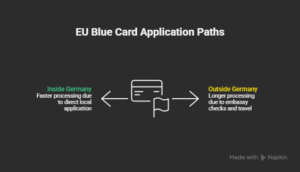 People who already live in Germany with a valid residence permit, whether from studies, a job search, or another work category, apply straight to the local Foreigners’ Authority, the Ausländerbehörde, and this inside approach tends to move noticeably faster. The office looks over the job contract, salary confirmation, qualification documents, and everything else needed, then prints and issues the EU Blue Card residence permit in an average of four to eight weeks, though places with very high numbers of cases, like Berlin or Munich, sometimes take closer to ten weeks. Since you deal directly with the local team, often in person or through convenient online systems, and skip many of the extra international checks, the whole procedure stays shorter and easier to predict.
For those starting out of Germany, the flight to Germany takes place at a German embassy or consulate back home where you first get an D visa from the country to enter and then go back to the full EU Blue Card residence permit after boarding. Embassy workloads, the need to check documents thoroughly, and additional input from the Federal Employment Agency may push the average tally to six to twelve weeks but 90 days is still the maximum amount allowed. Many embassies now offer digital uploads, which eliminate physical documents and aid with reviews, particularly if the job falls into a shortage category given priority.
Once you have had the entry visa you travel back to Germany and complete the residence permit process at the local authority before the visa runs out, bringing a small additional period to your destination but guaranteeing your long-term status. Ultimately, applications from within Germany need less steps and contact, and applications from abroad need the travel component but provide a clean and efficient entry point for anybody who has a good job lined up, so they’re both good options when everything is planned well.
|
German A2 Exercises – Download Free PDF |
||
Step-by-Step Timeline
Once you have accepted an EU Blue Card, there is a natural sequence of steps that tie together as smoothly as possible, beginning at the time you make a good job offer and moving through recognition checks, processing of the visa, and finally issuance of the residence card. Getting ready in advance at the right time minimizes most hold-ups and helps you move your application forward smoothly.
Job Offer Received
All this starts with a firm, binding job offer from a German firm for a skilled, background specific position that will last at least six months. The contract must provide a clear outline of what is to be done, start date, and salary, with a value of €50,700 gross per year for the standard position, or €45,934.20 for a shortage position and some young professionals above this level. Many employers who are familiar with the EU Blue Card system add a short message explaining that the job is in line with the rules, so that your file is stronger from the start. You then take up this offer, along with the other main papers, and officially begin the application, showing the authorities that you will fill an important gap in Germany’s workforce.
Degree Recognition
You have to be able to show that you have an education in line with German standards after the job offer, or better yet before it arrives if possible, because the job and your qualification have to be in close proximity. This step is completely lost if you did your degree in Germany but for foreign qualifications you either check comparability directly from the free Anabin database for a quick match or call up a formal statement from the Central Office for Foreign Education if you require further analysis.
A full evaluation takes 2 to 4 months, although simple cases are more likely to be completed online through a search. You send in your diploma, transcripts, and any certified translations, and for fields like medicine, teaching, or law that require official licensing, you handle those extra approvals from the right professionals at the same time. Honoring recognition early reduces one of the biggest reasons applications slow down and makes sure that your skill sets are at the best level possible for the employer and the immigration regulations.
|
Goethe 2026 Exam Dates: Multiple Test Centers |
|
| Trivandrum Goethe Exam Dates | Kochi Goethe Exam Dates |
| Chennai Goethe Exam Dates | Coimbatore Goethe Exam Dates |
Visa Appointment
Once the job contract and recognition proof is in your hands, you call the German embassy or consulate online, as many of the popular hotels have already booked weeks or even months in advance. You send the passport, photos, proof of Germany-specific health insurance, job applications, certificate of recognition and more to the appointment where you bring your complete paperwork, your visa bill between €75 and €100, your fingerprints, and a few simple questions about how you intend to get there. The embassy checks everything, gets all required clearances, and issues a three- to six month national D visa that allows you to enter the country and work. When you organize all the materials neatly, include proper translations, and show up fully prepared, the decision comes quicker and the entry process flows without problems, setting everything up nicely for the last residence permit stage.
Residence Permit Issuance
After you land in Germany with the entry visa, you register your address at the local residents’ office, make sure you have full health insurance arranged, and schedule a follow-up appointment at the Ausländerbehörde in your city while the visa still remains valid. The authority examines the original documents, takes biometrics if they need to update them, and then produces the electronic EU Blue Card residence permit, which normally stays valid for the length of your employment contract plus three extra months and reaches a maximum of four years.
This final part generally wraps up in four to eight weeks, and during the wait a temporary sticker or paper note in your passport keeps you legally working and living in the country. They mail the physical plastic card to you or ask you to pick it up once printing finishes, marking your complete shift to official Blue Card holder status and opening the door to family reunification, easy travel across much of Europe, and your path toward permanent settlement.
Processing Time by Country
EU Blue Card processing times change depending on the country where you apply because each embassy deals with different numbers of cases, appointment availability, and local factors, but Germany keeps the same high standards everywhere and pushes complete applications from in-demand professions through faster.
India
Applicants from India usually go through VFS Global centers in places like Delhi, Mumbai, or Chennai, and after they submit at the appointment, processing averages six to ten weeks, although busier periods can stretch it to twelve or sixteen weeks. Digital tools now in place plus extra attention given to tech, engineering, and other shortage jobs help a lot of people get decisions in five to eight weeks, and then the residence permit conversion after arrival happens quickly too, which makes this option especially practical for Indian professionals looking for better salaries, work conditions, and long-term growth in Germany.
UAE
In the United Arab Emirates, the embassies in Abu Dhabi and the consulate in Dubai manage applications with comparatively lighter loads, so appointment slots open up sooner and decisions frequently land between four and eight weeks from the time you submit everything. Reviews move efficiently for applicants who already hold strong qualifications and experience, and many cases close in just three to six weeks when the file arrives well organized. This route feels particularly smooth for skilled workers based in the Gulf who want to switch to Germany’s reliable economy, strong worker protections, and high quality of life.
Philippines
From the Philippines, people apply via centers in Manila or Cebu, where the average time after submission falls between six and ten weeks, with healthcare roles like nursing getting noticeable priority because Germany actively recruits in those areas. Booking the embassy appointment early matters a great deal since interest stays steady, but applicants who prepare carefully and submit complete packets see reliable timelines around eight weeks in most situations. Strong English skills, solid training, and growing demand for Filipino talent in German hospitals and care facilities help many succeed and build stable, well-paid lives in Europe.
Factors That Delay Approval
Overlooking small but important details can slow down even promising applications, pausing the review or forcing extra steps, but spotting these issues early lets you fix them before they add weeks or months to the wait.
Missing Documents
The single biggest reason for delays comes from submitting an incomplete file, which forces the embassy or local office to stop work and send a request for missing pieces like updated translations, fresh salary statements, insurance certificates, or other proofs, often adding two to six weeks while you gather and resend them. Going over the official checklist carefully twice, collecting every item in advance, and arranging originals plus copies keeps the process uninterrupted and moving at full speed.
Salary Mismatch
If the salary written in the job contract sits below the current threshold—whether the full €50,700 or the lowered €45,934.20 that applies to qualifying shortage roles—the authorities reject the application outright or send it back for changes, sometimes requiring you to renegotiate with the employer and start parts of the process over, which can stretch the timeline dramatically. Checking that the offered pay hits or exceeds the 2026 figure from the beginning removes this obstacle completely and keeps approval on track.
Incorrect Degree Recognition
How to Speed Up the Process
Using a few simple and effective steps, you can significantly speed up EU Blue Card processing and reach a positive decision in less time. One of the most beneficial options employers could consider is to adopt the accelerated skilled worker procedure. Often, employers can cut the time from an offer of employment to approval for their Blue Card to only two or three months by paying a fixed fee and working directly with immigration authorities. This route indicates seriousness and professionalism to officials and helps ease many administrative knots.
Applying through official online sites, where available, also makes a difference. Because digital processes simplify paperwork, reduce document lost, and reduces manual labor, many immigration offices report processing times are shortened by 20-30 percent. Equally as important, it is important to prepare an application package that is complete and correct prior to applying. If the applicant already has the signed employment contract, qualification recognition certificate, health insurance proof, passport copies, biometric photos and supporting documents on hand, follow-up requests can easily take weeks to process.
Timing and organization help back your case up. The best way to avoid unnecessary waiting is to call your embassy or consulate appointment immediately following the filing of your document. Proper, timely follow-ups on applications status can move your file as smoothly as possible without glaring. If your position falls into a recognized shortage occupation, you may want to consider priority processing that can dramatically accelerate approval. Together, these steps expedite things, and present you as a trained and trustworthy candidate, an advantage employers and immigration officials value.
The EU Blue Card offers long term benefits that include jobs, family security, robust healthcare and education systems, and a clear path to permanent residency in Europe. With Germany’s ongoing demand for skilled professionals and policies that favor qualified applicants, the process is far more achievable than it may first appear. By preparing smartly and acting decisively, you position yourself to begin a confident new chapter in one of Europe’s strongest economies.
Learn German from the best mentors in the field! Join the Entri online course!
Conclusion
1: How do you say "Good Morning" in German?
The EU Blue Card is still one of the most reliable and structured ways for skilled professionals to establish a long-term career in Germany. It has level wage caps, speedy processing, family-friendly policies and a fast track to permanent residency, providing the level of stability few work visa programs can match. Since Germany is still lacking qualified workers, well prepared applications are embraced and placed at the forefront of attention.
For the EU Blue Card, preparation is the key to success. A properly submitted job offer, proper degree recognition, appropriate documentation, and timely appointments cover most of the tussle and allow approval to come in easily. You can apply outside or through Europe knowing every step ahead so that you can move forward confidently instead of indecisive.
For professional who plan, and invest in language and skill acquisition, the EU Blue Card is more than a residence permit – it is a means to advance career prospects, family security, and a place to work in one of Europe’s biggest economies.
Free German A1 Mock Tests – Powered by AI!
Test your skills on our interactive platform. Get instant feedback from our AI to help you communicate better and track your progress. Start your free German mock test now.
Test Your German A1 for FreeFrequently Asked Questions
What exactly is the EU Blue Card for Germany, and how does it fundamentally differ from a standard German work visa?
The EU Blue Card is not merely a work visa; it is a specialized, premium residence permit explicitly designed for highly qualified non-EU nationals holding a university degree and a concrete job offer in Germany that meets a specific high-salary threshold. Its fundamental purpose is to attract and retain global talent to strengthen Germany’s competitive economy and address critical skill shortages. The key differences from a standard work visa (like the Fachkräfteeinwanderungsgesetz, or Skilled Workers Immigration Act) are profound. Firstly, the salary requirement is significantly higher. For 2026, the general threshold is a gross annual salary of at least €50,700, while shortage occupations (like IT, engineering, and healthcare) have a reduced—but still substantial—threshold of €45,934.20. A standard work visa for recognized skilled workers has no fixed national salary threshold, focusing instead on the local going rate.
Secondly, the path to permanent residency (Niederlassungserlaubnis) is accelerated. Blue Card holders can obtain permanent settlement in as little as 21 months with a certified B1 level of German, or 33 months with a basic A1 level. This is drastically faster than the standard 60 months required under other permits. Thirdly, the family reunification process is streamlined and privileged. Spouses can join the holder immediately without facing language proficiency requirements and are granted an unrestricted work permit from day one. This contrasts with some other permits where family reunification can be slower or conditional. Furthermore, the Blue Card offers enhanced mobility. After 18 months of employment in Germany, holders can move to another EU member state (with some conditions) under simplified rules. Ultimately, the EU Blue Card is a fast-track, high-benefit program for professionals whose qualifications and earning potential place them at the top tier of the skilled migrant spectrum, offering stability, family integration, and a clear, rapid route to long-term settlement in the EU.
I have a job offer. What are the precise 2026 salary thresholds, and how do I know if my occupation qualifies for the lower "shortage occupation" rate?
The salary thresholds are non-negotiable legal criteria and are adjusted annually. For 2026, the figures are set at €50,700 gross per year for general professions. However, a crucial benefit exists for roles in fields where Germany faces acute labor shortages. For these, the threshold is €45,934.20 gross per year. Determining if your job qualifies for this lower threshold involves a two-step check. First, the profession itself must be officially classified as a shortage occupation. These are predominantly in STEM fields (Science, Technology, Engineering, and Mathematics), healthcare, and academia. The most common and clearly defined categories include: IT specialists (even without formal university degrees if they have comparable experience and a high salary), engineers (all disciplines, e.g., mechanical, electrical, software), doctors and physicians, nurses and healthcare practitioners, and scientific researchers in universities and R&D institutions.
Secondly, and critically, the Federal Employment Agency (Bundesagentur für Arbeit) must approve your specific employment. This is not automatic. Your prospective employer must demonstrate that no suitable candidate from Germany or the EU/EEA is available for the position (a “priority check” or Vorrangprüfung). For shortage occupations listed in the “Positive List” or for positions with a salary exceeding the Blue Card threshold, this check is often waived or simplified, but formal approval is still a mandatory part of the application. You cannot self-declare your job as a shortage occupation. The final authority lies with the Agency during the visa/residence permit approval process. Therefore, your employment contract must clearly state a salary meeting or exceeding the correct threshold, and your employer should be prepared to engage with the Agency if required. Always verify the most current thresholds and lists on the official Make it in Germany website, as these figures are updated each January.
How does the degree recognition process work, and what should I do if my degree or university is not listed in the Anabin database?
Degree recognition is the cornerstone of the EU Blue Card application, proving your qualification is comparable to a German university degree. The primary tool is the Anabin database, an official online resource maintained by the Standing Conference of the Ministers of Education and Cultural Affairs. You should first check two things in Anabin: the status of your university (H+ means recognized, H- means not) and the status of your degree (the equivalency level). If both your institution and degree are listed favorably, you can print the relevant pages to include in your application as proof.
If your university or degree is not listed or has a negative assessment, you must initiate a formal recognition procedure through the Central Office for Foreign Education (ZAB – Zeugnisbewertungsstelle). This involves submitting certified copies and translations of your final diploma, transcripts (listing all subjects and grades), and a detailed description of your university’s accreditation. The ZAB will then issue a “Statement of Comparability” (Zeugnisbewertung), which evaluates your foreign qualification against the German system. This process is not an accreditation of your degree but an expert opinion on its comparability, which immigration authorities accept. It typically takes 2 to 4 months, so initiating this before you have a job offer is a highly strategic move that can shave months off your overall timeline. For regulated professions like medicine, law, or teaching, an additional, more stringent state-level recognition (Berufsanerkennung) is required to practice. Starting the recognition process early is the single most effective step to prevent a major delay, as an unrecognized degree leads to an automatic rejection. Consider it the foundational step of your entire Blue Card journey.
Can my family really join me immediately, and what rights do they have upon arrival in Germany?
Yes, one of the most significant advantages of the EU Blue Card is the privileged and immediate family reunification it affords. Unlike other permits that may impose waiting periods or language requirements on spouses, the EU Blue Card allows your spouse and minor, unmarried children to apply for their dependent residence permits concurrently with your application or to follow you at any time afterward. Crucially, your spouse receives an independent, unrestricted work permit from the moment their residence permit is issued. They are not limited to specific jobs or employers and do not need separate approval from the Federal Employment Agency. This is a game-changer for dual-career couples, as it allows your partner to pursue their own professional ambitions in Germany without bureaucratic hurdles.
Your children have the right to reside with you and are granted immediate access to Germany’s education and childcare system. They can attend public Kitas (daycare), schools, and universities under the same conditions as German children, often with additional integration and language support offered by the schools. Furthermore, the entire family is integrated into Germany’s robust social security network. From day one, you and your dependents will be covered by the statutory health insurance system, which provides comprehensive medical care. This immediate stability and security—the ability to build a complete family life without separation or restrictive conditions—is a core benefit that makes the EU Blue Card uniquely attractive for relocating professionals with families.
What is the realistic, step-by-step timeline from job offer to holding the physical Blue Card residence permit?
Understanding the end-to-end timeline helps manage expectations. The total process can range from 4-5 months for optimally prepared applicants already in Germany to 7-9 months for those applying from abroad, depending on individual circumstances and embassy workloads.
Phase 1: Preparation (Can be done in parallel with job hunting, 1-3 months). This includes initiating your degree recognition (ZAB evaluation, 2-4 months) and securing proof of German health insurance that meets visa requirements. Doing this early is critical.
Phase 2: Job Offer & Document Collection (1-4 weeks). Once you have a signed contract meeting the salary threshold, gather all documents: passport, biometric photos, certified copies and translations of your degree/diplomas, the ZAB statement, your employment contract, a detailed job description from your employer, and your health insurance confirmation.
Phase 3: Visa Application (For applicants outside Germany, 6-12 weeks). Book an embassy appointment—this can be a bottleneck, so book as soon as you have your contract. Submit all documents. The embassy conducts checks and, if approved, issues a national (D) visa valid for 3-6 months for entry. The legal maximum for this decision is 90 days.
Phase 4: Entry & Local Registration (First weeks in Germany). Upon arrival, you must register your address (Anmeldung) at the local town hall and then schedule an appointment with the local Foreigners’ Authority (Ausländerbehörde) to apply for the actual Blue Card residence permit.
Phase 5: Residence Permit Issuance (4-10 weeks). The Ausländerbehörde reviews your original documents, takes your biometrics, and orders your physical, credit-card-sized EU Blue Card. You receive a temporary paper permit (Fiktionsbescheinigung) allowing you to work and travel while you wait. The card is then mailed or picked up. For applicants already in Germany on another residence permit (e.g., Job Seeker), you apply directly to the Ausländerbehörde, skipping Phases 3 and 4, which can compress the total time to as little as 8-12 weeks.
Is it faster to apply for the EU Blue Card from within Germany (e.g., on a Job Seeker Visa) or from my home country?
Both pathways are valid, but they have distinct procedural differences that affect speed and convenience. Applying from within Germany is generally faster and more streamlined. If you are already in Germany on a valid residence permit (such as a Job Seeker Visa, Student Visa, or other work visa), you apply directly to your local Foreigners’ Authority (Ausländerbehörde). You skip the entire German embassy visa process abroad. Since you are dealing with a single authority that has direct access to your current file and can conduct checks locally, the average processing time for the Blue Card itself is 4 to 8 weeks. You avoid potential embassy backlogs, international mail delays, and the extra layer of scrutiny applied abroad.
Applying from your home country involves a two-step process: first obtaining a national (D) visa from the German embassy/consulate, then converting it to the Blue Card after arrival in Germany. The embassy stage averages 6 to 12 weeks due to higher volumes, necessary security checks, and coordination with the Federal Employment Agency. After entry, you still need the 4-8 weeks at the Ausländerbehörde. Therefore, the total time is longer. However, applying from abroad has its own advantage: it provides certainty before you move. You land in Germany with an approved visa and can begin working immediately for your employer. For those who cannot or do not wish to move to Germany without a guaranteed work and residence permit in hand, this is the safer, more structured approach despite the longer timeline. The choice depends on your personal risk tolerance, current location, and ability to secure a job offer remotely.
What are the most common reasons for delays or rejection, and how can I avoid them proactively?
Most delays and rejections are preventable with meticulous preparation. The top pitfalls are:
-
Incomplete or Incorrect Documentation: Submitting documents without certified translations, missing the Anmeldung (address registration) proof, or providing outdated versions of forms can halt processing for weeks. Solution: Use the official checklist from the German mission’s website and the Ausländerbehörde. Double-check that every document is present, translated by a sworn translator, and is a clear copy.
-
Salary Below the Threshold: This is a strict legal requirement. If your contract’s gross annual salary is even slightly below the 2026 figures (€50,700/€45,934.20), your application will be rejected. Solution: Verify the salary in your contract meets the threshold before signing. If it’s a shortage occupation, ensure the employer mentions this and is prepared for the Federal Employment Agency’s approval process.
-
Problems with Degree Recognition: An unrecognized degree or a pending ZAB evaluation is a complete blocker. Solution: Initiate the Anabin check or ZAB evaluation process at the earliest opportunity, ideally before the job search concludes. Do not wait until you have a contract to start this, as it takes months.
-
Lack of “Comparable” Qualification: The Blue Card requires a university degree or comparable qualification. For IT specialists without a degree, proving “comparable” experience (usually at least 3-5 years) is complex and requires extensive documentation from past employers. Solution: If using the experience route, prepare detailed reference letters, project portfolios, and certifications to build a robust case.
-
Inadequate Health Insurance: The insurance proof for the visa must explicitly cover the period from entry and meet German statutory standards. Travel insurance is not sufficient. Solution: Secure a confirmed policy from a German public (like TK, AOK) or a private insurer recognized for visa purposes before applying.
How does the accelerated path to permanent residency work, and what are the exact language requirements for the 21-month and 33-month options?
The accelerated permanent residency is a premier benefit of the Blue Card. The standard path to settlement (Niederlassungserlaubnis) for most work permits is 60 months (5 years) of contributions to the pension system. The Blue Card shortcuts this dramatically.
-
After 33 Months: You can apply if you have held the Blue Card and been employed for 33 months, and have made mandatory pension contributions during that time. You must also demonstrate basic German language skills at the A1 level of the Common European Framework of Reference for Languages (CEFR). The A1 exam tests very basic everyday expressions and the ability to introduce yourself.
-
After Just 21 Months: This ultra-fast track requires all the conditions of the 33-month route, but with a higher language proficiency: certified German skills at the B1 level. B1 signifies intermediate competency—you can handle most travel situations, describe experiences, and give simple explanations. You must provide an official certificate from an approved institute like the Goethe-Institut, telc, or TestDaF.
In both cases, you must also prove you have adequate living space for your household and that you and your family members are integrated into German life (no criminal record, etc.). Passing the B1 exam is the single most impactful step to cutting your time to permanent residency by a full year, offering unparalleled long-term stability and freedom within the EU.
What specific documents does my employer in Germany need to provide or prepare to support my application?
Your employer is an active partner in the process. They must provide more than just a job offer; they must supply documents that satisfy both immigration and labor market authorities. The essential employer-provided documents are:
-
A Signed, Detailed Employment Contract (Arbeitsvertrag): This is the cornerstone. It must be unconditional, state a start date, be valid for at least six months, and clearly specify the gross annual salary that meets or exceeds the Blue Card threshold. The job title and duties should align with a skilled, graduate-level profession.
-
A Concrete Job Description (Stellenbeschreibung): This should detail your tasks, responsibilities, and required qualifications. It helps the Federal Employment Agency understand that the role is specialized and requires your high level of education.
-
Declaration in Lieu of an Oath (Versicherung an Eides statt): Often required by the Ausländerbehörde, this is a formal document where the employer declares the authenticity of the provided contract and job description. It may need to be signed before a public notary.
-
Potential Engagement with the Federal Employment Agency: If the salary is at the lower shortage-occupation threshold (€45,934.20), the employer may need to interact with the Agency. While the priority check (Vorrangprüfung) is often waived for Blue Card positions, the Agency still formally approves the employment. The employer should be prepared to answer any queries promptly.
A proactive employer familiar with the Blue Card process can significantly smooth the application. Some larger companies even have relocation departments that guide candidates through these steps.
Once I have the EU Blue Card, what are my rights regarding changing jobs, periods of unemployment, and moving to other EU countries?
The EU Blue Card offers significant stability and mobility, but with specific rules:
-
Changing Jobs: During the first two years of employment, changing jobs requires prior approval from the Foreigners’ Authority. You must submit a new employment contract that also meets the Blue Card salary requirements, and the authority will conduct a quick check. After two years, you enjoy unrestricted access to the German labor market. You can change jobs freely without needing permission, provided you inform the authority of the change. The new job must still be a qualified position, but the approval process is a simple notification.
-
Periods of Unemployment: The Blue Card is tied to employment. If you lose your job, you have a grace period of three months to find new qualified employment. You must notify the Foreigners’ Authority immediately. During this time, your residence permit remains valid. If you find a new job within three months, you apply to have your Blue Card updated. If you cannot, the authority may, at its discretion, grant a temporary residence permit for job-seeking (usually for 6 months) if you have prospects, but there is no guarantee. Long-term unemployment can lead to the non-renewal of your permit.
-
Moving to Other EU Countries: One of the EU-wide benefits is enhanced mobility. After 18 months of legal residence in Germany as a Blue Card holder, you can relocate for qualified work to another EU Member State (excluding Denmark and Ireland) under a simplified procedure. You must apply to that second country’s authorities, who will have a faster process recognizing your existing Blue Card status. This facilitates career mobility within the EU, making the German Blue Card a powerful springboard for a pan-European career.