The German economy relies heavily on foreign workers in the fields of technology, engineering, healthcare and research, and therefore attracts professionals from across the globe. For non-EU citizens considering a career in the EU there are often two routes, EU Blue Card and Job Seeker Visa, which is now closely tied to the Opportunity Card system following recent immigration reforms. EU Blue Card vs Job Seeker Visa in Germany is a choice mostly based on one factor: whether you have an offer or need time to find a job.
EU Blue Card is a program for professionals who have been offered a qualified job in Germany. It provides the immediate right to permanent residency and work, faster access to permanent residency, and substantial advantages including reunification of family and mobility across much of the EU. This option is suitable for those with specialized skill sets, proven qualifications and the appropriate levels of compensation. The Blue Card for them is both a source of security from day one and a clear path toward long-term settlement.
On the other hand, the Job Seeker Visa is designed for professionals who would like to experience the German work market on a personal level. It allows for temporary free-standing; candidates can attend interviews, establish relationships, and get an understanding of local hiring procedures. The Opportunity Card system has been recently reformed to allow for this route to be more flexible with the addition of a points-based testing system. But it does not allow long-term work unless an offer of employment is received and the visa is replaced.
This is an easy choice in practice. If you already have a solid job offer, the EU Blue Card is the easier and more secure route. If not, and you need time on the ground to find the right role, the Job Seeker Visa offers a practical starting point. The better door depends on your readiness—certainty versus exploration.
Intro: Which Visa Is Right for You?
Imagine arriving in Germany, geared up for a well-paying job that grows toward permanent residency, or dropping off the plane with enough savings in hand, and a desire to network until the perfect job arrives. These two photographs capture the difference of the visas. EU Blue Card applicants have a qualifying job offer and have already met salary requirements, meaning that work starts almost immediately following approval. The Job Seeker Visa (or in many cases Opportunity Card) is a visa that allows qualified applicants to come first to apply for employment without a contract.
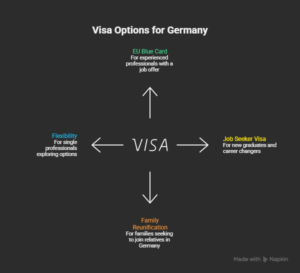
Personal circumstances determine whether to make decisions. The Blue Card, which is faster and more secure for those with experience, and the contract with a German firm, often means instant employment rights and faster family reunification. The Job Seeker is more often used by a new graduate or career changer as it gives him some breathing room to conduct interviews, make contacts locally and test the market. Families are the most valued factors in stability and the Blue Card tends to be an exception there since the immediate spouse has work authorizations and there are fewer waiting periods for permanent status. Single professionals who value flexibility might incline towards the Job Seeker option, which allows them to explore cities and sectors openly.
Both are relatively cheap—applications cost 75 to 100 euros, but delays in processing, financial proof, and language requirements are several things to consider. In either case, a little more German opens up the door, but English is a must for many tech and international firms. For ease of selecting, the sections below provide comparisons, advantages, limitations, and profiles.
Learn German from the best mentors in the field! Join the Entri online course!
Side-by-Side Comparison Table
The juxtaposition of important features makes the confusing information easier to see in one glance. A clear comparison helps readers quickly identify what is important rather than sifting through long explanations or jumping between sources. This is particularly helpful when dealing with immigration laws, where small details can have a big impact on eligibility, timelines and future plans.
The table below was created for that purpose. It brings together the most important criteria at once so that readers can compare requirements, benefits, and conditions without over exerting effort. By drawing the information visually and logically it removes miscommunication, and draws the reader into what is different in making the real decisions; such as rights to work, family reunification, EU mobility and entry into permanent residence.
The information is sourced directly from official sources within the government of Germany for accurate and reliable purposes. These include Make it in Germany, the federal government‘s official portal for skilled professionals, and the Federal Office for Migration and Refugees (BAMF), the agency responsible for immigration policy and implementation. Both sources are considered authoritative and are frequently updated with new legal and procedural developments.
| Aspect | EU Blue Card | Job Seeker Visa / Opportunity Card |
| Main Purpose | Start qualified employment with an existing contract | Enter Germany to search for a suitable job |
| Eligibility Basics | Recognized university degree (or equivalent experience in IT); binding job offer; gross annual salary at least €50,700 (or €45,934.20 for shortage occupations, young professionals, or certain IT roles) | Recognized degree or points-based qualification; proof of financial means (blocked account with around €1,091 per month in 2026); no job offer required initially |
| Duration | Up to four years (matches contract plus three months); renewable | Typically one year for Opportunity Card (up to 18 months in some extensions); non-extendable beyond limits if no job found |
| Work Rights | Full employment rights from the start; job changes allowed after notification (restrictions in first year) | Limited part-time work (up to 20 hours/week) and trial jobs (up to two weeks); full work only after converting to employment permit |
| Permanent Residency Path | Settlement permit after 27 months (or 21 months with B1 German); pension contributions required | No direct fast track; convert to work permit first, then standard five-year residence for settlement permit |
| Family Reunion | Immediate for spouses and children; spouses gain work rights | Possible after securing employment and switching permits |
| Application Location | Often from home country via embassy or in Germany if eligible | From home country via German embassy |
| Approximate Fee | Around 100 euros | Around 75-100 euros |
This overview shows the Blue Card as a direct employment bridge while the Job Seeker path serves as an entry ticket for exploration. Rules evolve, so always verify the latest on official portals before applying.
|
German A2 Exercises – Download Free PDF |
||
Eligibility
The first filter for both options is eligibility rules. EU Blue Card applicants need a recognized higher education degree or equivalent, such as three years of tertiary training. What is required to make a binding job offer is that it must be for at least six months, match the qualification and pay a salary-range of €50,700 in 2026 for standard positions. Shortage employments drop to €45,934.20 with Federal Employment Agency approval; the same drop is for recently graduated graduates with at least three years of relevant work experience in the fields except for those with a degree. The list also includes a clean criminal record, full health coverage, and the proof of the work is skilled work.
The job seeker visa, becoming increasingly replaced by the Opportunity Card under new legislation, addresses opportunities rather than immediate employment. The applicants must have a recognized qualification or score enough points for education, experience, language level, age, and German connections. Money is extremely valuable, so make use of a bank account where it is blocked with €1,091 net per month for the planned stay (often one year). No sponsor job is required at the door, but health insurance and a passport are required. Both routes require embassy interviews and document checks, and insufficient files result in most common rejections.
Duration
Duration shapes how much security or flexibility the visa provides. The EU Blue Card typically lasts up to four years, aligned with the employment contract plus an extra three months for transition time. Extensions happen smoothly when the job continues, and the permit supports long-term planning without constant renewal pressure. Job changes require notification, especially early on, but the overall stability suits people ready to commit.
The Job Seeker Visa or Opportunity Card grants a maximum of one year in most cases, with possible extensions to 18 months under specific conditions. The clock starts upon entry, and the time limit pushes quick action in networking and applications. If no suitable role appears, departure becomes necessary unless conversion to a work permit succeeds. This shorter window fits exploratory phases but creates urgency compared to the Blue Card’s longer horizon.
Work Rights
Work rights determine daily financial reality. Holders of the EU Blue Card enjoy full employment privileges right away, including the contracted role, overtime, promotions, and eventual job switches with proper checks. Access to social benefits builds over time through contributions, and part-time arrangements stay possible if salary averages meet thresholds.
The Job Seeker path restricts paid work during the search phase. Opportunity Card holders can take part-time jobs up to 20 hours per week or short trial positions to test fit, but the main focus remains finding qualified long-term employment. Once a job offer arrives, conversion to a work permit unlocks full rights, though paperwork can delay income. The Blue Card clearly leads for immediate earning power.
|
Goethe 2026 Exam Dates: Multiple Test Centers |
|
| Trivandrum Goethe Exam Dates | Kochi Goethe Exam Dates |
| Chennai Goethe Exam Dates | Coimbatore Goethe Exam Dates |
PR Pathway
The path to permanent residency rewards steady progress EU Blue Card holders can qualify for a settlement permit after 27 months of living and working, as long as they pay pension contributions and meet basic living conditions. Reaching B1 German shortens this to 21 months, accelerating access to unrestricted status and eventual citizenship options. This route offers one of the quickest ways to root permanently in Germany.
The Job Seeker Visa lacks a built-in fast track to settlement. Success depends on securing employment and switching to a work-based permit, after which the standard five-year residence requirement applies before PR eligibility. Integration steps like language courses add up along the way. The Blue Card shortens the overall timeline significantly for those who start with a contract.
Pros & Cons of Each Visa
Each visa carries distinct advantages and trade-offs that influence the final pick.
The EU Blue Card stands out for its security and speed. Immediate work rights mean income starts soon after arrival, family members join without long waits, and spouses receive automatic work permission. The faster PR clock appeals to long-term planners, and EU-wide mobility opens after 18 months. High salary requirements ensure competitive pay, and employer involvement often streamlines paperwork.
Limitations exist too. A qualifying offer proves essential, tying the applicant to specific conditions early on, and salary thresholds exclude lower-paid entry roles outside shortage fields.
The Job Seeker Visa or Opportunity Card excels in openness. No pre-arranged job is needed, so exploration covers multiple cities, companies, and sectors. Part-time work during the stay eases financial pressure, and the points system broadens access for diverse profiles.
Drawbacks include the strict time limit that pressures quick results, no full work rights at first, and reliance on personal savings or support. Family reunion waits until employment converts, and unsuccessful searches end with departure.
Best Visa by Profile
Profiles guide the smarter choice. Fresh graduates often lack the experience or salary offers needed for the Blue Card, so the Job Seeker or Opportunity Card gives valuable time to gain local exposure, attend career events, and build a German-style resume. Entry-level roles become reachable through on-the-ground effort.
Experienced professionals with proven track records and offers find the EU Blue Card far superior because it delivers instant stability, higher pay, and a shorter PR path. Their qualifications align easily with thresholds, especially in demand areas.
IT specialists enjoy advantages in both, but the Blue Card often wins due to relaxed rules for the field—lower salary needs, experience-based entry without degrees in some cases, and fast processing from eager employers. The Job Seeker route helps when testing startups or niches without commitment.
Real-World Scenarios
Real stories illustrate how choices play out. Consider a software developer from India with five years of experience who receives an offer from a Munich firm paying above the threshold. The EU Blue Card allows quick relocation, immediate work, and family joining within months, leading to PR application after two years with language progress.
A recent engineering graduate from Brazil arrives via the Opportunity Card, funds a blocked account, and spends months networking in Berlin. Part-time gigs cover basics while interviews build momentum, resulting in a full-time role and permit conversion before the year ends.
An experienced nurse from the Philippines secures a hospital contract in a shortage field. The Blue Card’s lower threshold applies, enabling fast entry and family support, with settlement permit achieved in under two years thanks to B1 German.
These examples show preparation and fit determine success. The Blue Card rewards readiness with a job; the Job Seeker path rewards persistence in the search.
Learn German from the best mentors in the field! Join the Entri online course!
Final Recommendation
Assess the situation honestly to win. The EU Blue Card is the more attractive option with immediate employment, family ease and faster permanent residency if a job offer has already been made and salary reaches 2026 levels. It reduces risk and provides skilled workers with a long-term advantage in Germany’s growing economy.
The Job Seeker Visa or Opportunity Card is not an offer, but it provides the entry point to explore, network, and convert upon arrival, especially with graduates or those moving in the opposite direction. Prove funding well, act within the time frame, and use part-time allowances wisely.
The EU Blue Card is the better option for experienced professionals in most industries or those in high demand and delivers security, speed, and benefits. Prepare documents on time, consult official sites or advisors, and follow the action that best fits current readiness. Real possibilities await Germany: the right visa makes dreams real.
Free German A1 Mock Tests – Powered by AI!
Test your skills on our interactive platform. Get instant feedback from our AI to help you communicate better and track your progress. Start your free German mock test now.
Test Your German A1 for FreeFrequently Asked Questions
I have a recognized university degree but no job offer yet. My salary expectations are around €48,000. Is the EU Blue Card completely out of reach for me, or are there exceptions I can leverage?
While the standard EU Blue Card salary threshold for 2026 is set at €50,700, the path is not entirely closed to you. The German immigration system incorporates several crucial exceptions designed to attract talent in specific sectors and circumstances. The most significant exception is the reduced threshold for shortage occupations and young professionals, set at €45,934.20 for 2026.
First, you must verify if your profession is on the official “shortage occupation” list maintained by the Federal Employment Agency (Bundesagentur für Arbeit). This list consistently includes:
-
STEM Fields: Engineers (especially in mechanical, automotive, electrical, and software), IT specialists, data scientists, and certain research scientists.
-
Healthcare: Doctors (particularly specialists like anesthesiologists and radiologists), nurses, geriatric care workers, and medical technicians.
-
Other Professions: Skilled crafts in specific trades like plumbing, electrical work, and HVAC.
If your degree and intended role fall into a shortage category, your potential €48,000 offer could indeed meet the reduced threshold, making the Blue Card viable. The employer must obtain pre-approval from the Federal Employment Agency, confirming that no preferential EU/EEA candidate is available for the position—a standard but manageable procedure for genuine skilled roles.
Second, the “young professional” clause benefits recent graduates. If you completed your degree within the last three years and have at least three years of relevant professional experience (which can include internships and working student positions), you may also qualify for the lower salary threshold, even outside strict shortage lists.
A strategic approach is to target companies in shortage sectors and explicitly discuss the Blue Card eligibility during salary negotiations. Presenting the reduced threshold as a mutually beneficial immigration pathway can make a €48,000 package acceptable. However, if your field (e.g., marketing, business administration, some humanities) is not in shortage and you are not a recent graduate, the standard threshold is firm. In that case, the Job Seeker Visa/Opportunity Card becomes the essential tool to enter Germany, network, and potentially secure a higher offer or find an employer in a related shortage field where your skills are valued. The key is thorough research into how your specific profile aligns with the defined exceptions.
How exactly does the points-based system for the Opportunity Card work, and what can I do to maximize my score before applying?
The new Opportunity Card (Chancenkarte) replaces the traditional Job Seeker Visa with a transparent, points-based system focusing on future potential. You need a minimum of 6 points to qualify. Points are awarded across six categories:
-
Qualifications & Education (Up to 4 points): A recognized foreign university degree (comparable to a German degree) grants 3 points. A vocational training qualification recognized as equivalent grants 2 points. An additional point is awarded if your qualification is in a shortage occupation.
-
Professional Experience (Up to 3 points): You earn points based on the length of relevant professional experience gained in the last five years: 2 years = 1 point, 5 years = 3 points.
-
Language Skills (Up to 3 points): German skills are highly rewarded. A2 level = 1 point, B1 = 2 points, C1 or higher = 3 points. Note: English points are not part of the standard system but proficiency is expected for many international roles.
-
Age (Up to 2 points): Applicants under 35 years receive 2 points. Those between 35 and 40 receive 1 point.
-
Previous Stays in Germany (Up to 1 point): Having legally lived in Germany for at least 6 continuous months in the past 5 years grants 1 point.
-
Partner Potential (Up to 1 point): If your spouse/partner applies with you and also meets minimum qualification/language criteria, you receive 1 point.
To maximize your score:
-
Get Your Qualifications Recognized: Start the Anerkennung (recognition) process for your degree or vocational training through the ZAB (Central Office for Foreign Education) or the relevant German chamber (Kammer). This is the single most important step.
-
Invest in German Language Courses: Even achieving A2 level (≈200-250 hours of study) before applying gives you a crucial point and significantly improves your daily life and job prospects. Aiming for B1 should be a top priority.
-
Document Your Experience Meticulously: Gather notarized employment certificates, tax documents, and social security records that clearly state your job title, responsibilities, and exact duration. Vague descriptions will not suffice.
-
Apply While Under 35: The age bonus is a straightforward way to secure points. If you’re close to a birthday that pushes you into a lower point bracket, consider applying before that date.
This system rewards proactive preparation. Don’t just check if you have 6 points; aim for 8-10 to make your application robust and demonstrate strong integration potential to authorities.
Can I truly bring my family with me immediately on an EU Blue Card, and what are the concrete rights and processes for my spouse?
Yes, one of the most significant advantages of the EU Blue Card is the entitlement to immediate family reunification. Your spouse and minor, unmarried children can apply for their residence permits simultaneously with your application or join you immediately after your Blue Card is issued. There is no mandatory waiting period.
Concrete Rights for Your Spouse:
-
Unrestricted Work Rights: Your spouse receives a residence permit that explicitly grants them the right to take up any employment or self-employment in Germany without requiring prior approval from the Federal Employment Agency. This is a game-changer, as it allows your partner to build their career from day one.
-
Access to Integration Courses: They are entitled to participate in state-subsidized German integration courses.
-
Access to Education & Social Services: They have full access to the healthcare system, childcare (Kita), and the education system.
The Process:
-
You secure your Blue Card (either from a German embassy abroad or the local Foreigners’ Office (Ausländerbehörde) if you’re already in Germany on another permit).
-
Your family members apply for a “National Visa for Family Reunification” at the German embassy in their home country. Required documents typically include:
-
Your valid passport and Blue Card.
-
Proof of relationship (marriage certificate, birth certificates—apostilled/legalized and with a certified German translation).
-
Proof of adequate living space in Germany (rental contract showing sufficient square meters).
-
Proof of health insurance coverage for the family.
-
Your spouse’s basic A1 German language certificate is generally not required for Blue Card family reunification, a major exemption that simplifies the process.
-
-
Once in Germany, they register their address (Anmeldung) and then apply for their own electronic residence card at the local Foreigners’ Office.
This policy is designed to make the relocation of skilled workers and their families as smooth and attractive as possible, removing a major barrier to long-term settlement.
On a Job Seeker Visa/Opportunity Card, what are the precise rules for "trial work" and part-time jobs? How can I use this legally to secure a full-time position?
The Opportunity Card is designed for exploration, and the rules allow for limited work to facilitate this. Understanding the limits is crucial to avoid violating your visa conditions.
1. Trial Employment (Probearbeit):
-
You are allowed to take on short-term trial work for up to two weeks per potential employer. This is intended for you to demonstrate your skills and for the employer to assess your fit.
-
The key is that this must be a genuine trial. It should be directly related to the qualified job you are seeking. You can be paid for this trial period.
-
Strategy: Use this provision proactively. When networking or in later-stage interviews, propose a short, paid trial project. This transforms an abstract interview into a concrete demonstration of your value, dramatically increasing your chances of a full offer.
2. Part-Time Work:
-
You are permitted to work up to 20 hours per week in any job to support yourself during your search.
-
This can be in a field unrelated to your qualifications (e.g., working in a cafe, retail, or as a delivery driver) to cover basic living expenses.
-
Alternatively, you can work part-time (≤20h/week) in a role related to your career. This is an excellent way to get a foot in the door with a company, build internal networks, and often transition into a full-time position. Many employers prefer to convert a known, proven part-time worker into a full-time employee.
Critical Conversion Step: You cannot simply start working full-time for an employer, even if they offer you a job. The offer triggers a mandatory visa conversion process. You and your employer must apply to convert your Opportunity Card into a standard work permit or, if all criteria are met, directly into an EU Blue Card. You can begin the new full-time role only after the new permit is issued. Using trial and part-time work strategically to build relationships and prove your worth is the core legal pathway from searcher to employee.
How does the path to Permanent Residency (Niederlassungserlaubnis) differ in practice between the Blue Card and Job Seeker routes, considering factors like language, pensions, and bureaucratic hurdles?
The difference is not just in timeline but in the entire nature of the journey.
EU Blue Card Path (The Fast Track):
-
Timeline: 27 months with mandatory pension contributions and a position matching your qualifications. With demonstrated B1 German language skills, this shortens to 21 months.
-
Core Requirement: You must have made 60 months of contributions (or 21/27 months if using the fast-track) to the statutory German pension insurance (Deutsche Rentenversicherung). Your Blue Card employment typically covers this automatically.
-
Process: The application is relatively straightforward for the Foreigners’ Office. You prove: stable Blue Card employment, continued pension payments, adequate living space, B1 German (or enrollment in a course if applying at 27 months), and passing the “Life in Germany” test (Einbürgerungstest). The process is well-defined for Blue Card holders.
Job Seeker → Work Permit Path (The Standard Track):
-
Timeline: Starts from zero after conversion. Once you secure a job and obtain a standard German work permit (like the Skilled Worker Residence Permit), the clock for permanent residency begins. You generally need 60 months (5 years) of continuous legal residence and pension contributions.
-
The “Hidden” Time: The critical factor is the search period. If you spend 10 months on the Opportunity Card finding a job, those 10 months do not count toward the 5-year requirement. Only the time after you get your work permit counts.
-
Compounded Requirements: During this 5-year standard period, you will need to achieve a stronger integration proof, often a higher German level (B1 is a minimum, B2 is advantageous), and demonstrate greater financial stability.
Practical Implication: For a professional who arrives on a Blue Card, learns German to B1, and works steadily, permanent residency is achievable in under two years. For someone arriving on an Opportunity Card, it may look like this: 8 months searching + 5 years on a work permit = nearly 6 years to PR. The Blue Card doesn’t just shorten the timeline; it provides a more predictable and streamlined bureaucratic pathway focused on your high-skilled contribution from day one.
I work in IT and have over 7 years of experience but no formal university degree. Which visa pathway is actually available to me given Germany's new recognition rules?
Germany has made significant accommodations for IT specialists, making it one of the most accessible fields for non-degree holders. Your pathway is viable, but the choice between a Blue Card and a Job Seeker/Opportunity Card depends on whether you have a job offer.
Option 1: EU Blue Card Without a Degree (With a Job Offer)
You can qualify for an IT Specialist Blue Card if you can prove:
-
A Concrete Job Offer in IT with a gross annual salary of at least €45,934.20 (2026 threshold for shortage/IT roles).
-
Professional Experience: At least three years of relevant professional IT experience gained within the last seven years. This experience must be documented in detail (employment contracts, references, project lists).
-
Recognized IT Knowledge: Your experience and knowledge must be deemed equivalent to a German IT degree. This is not a formal “recognition” process but an assessment by the Federal Employment Agency based on your CV, certificates (like vendor certifications from AWS, Microsoft, Cisco, etc.), and the employer’s justification.
If you have a compelling offer, the employer can make the case to the employment agency. Your 7+ years of experience make you a strong candidate for this route.
Option 2: Opportunity Card Without a Degree (No Job Offer)
The points-based system for the Opportunity Card also values experience. Here’s how you might score:
-
Qualifications: Since you lack a recognized degree, you start at 0 points here unless you have formal vocational training.
-
Professional Experience: 7 years = 3 points (maximum).
-
Language Skills: If you have only English, you get 0 points for language. Learning German to A2 (1 point) or B1 (2 points) is critical.
-
Age: If you are under 35, that’s 2 points.
-
This likely puts you at 5-6 points, scraping the minimum. To be competitive, learning German is non-negotiable. An A2 certificate could push you to 6 points; B1 would make your application much stronger.
Recommendation: If you can secure a job offer from abroad (common in IT via platforms like LinkedIn, Honeypot, etc.), pursue the Blue Card directly as an IT specialist. It’s faster and more secure. If you cannot, the Opportunity Card is your entry ticket, but you must bolster your points with German language skills and meticulously document your 7-year career to maximize your score in the experience category.
What are the most common reasons for rejection for both visas, and how can I avoid these pitfalls in my application?
Application rejections are often due to avoidable errors or insufficient proof.
Common EU Blue Card Rejections:
-
Salary Below Threshold: The most frequent cause. Ensure your contract’s brutto (gross) annual salary meets the exact figure (€50,700 or €45,934.20 for 2026). Bonuses may not be counted if not guaranteed.
-
Non-Qualified Job: The role must correspond to your university degree. A mismatch (e.g., an engineer offered a generic sales job) will be rejected. The job description must clearly require your specific academic qualification.
-
Unrecognized Degree: Degrees from certain institutions may not be recognized as equivalent by the ZAB (Central Office for Foreign Education). Always get a Vorprüfungsverfahren (preliminary review) certificate from the ZAB before applying.
-
Insufficient Health Insurance: Travel insurance is not accepted. You must have confirmed, comprehensive German public health insurance (gesetzliche Krankenversicherung) or an equivalent private plan approved for long-term stays.
-
Incomplete or Poorly Translated Documents: Every document (diploma, marriage certificate, job contract) needs a certified translation by a sworn translator in Germany. Apostilles or legalizations are mandatory.
Common Job Seeker/Opportunity Card Rejections:
-
Insufficient Proof of Financial Means: The blocked account (Sperrkonto) must show the exact required amount (€1,027 per month for 2026, totaling €12,324 for one year) and be from an approved bank. Personal bank statements are often deemed insufficient.
-
Failing the Points Test: Applicants often miscalculate or fail to provide documented proof for each claimed point (e.g., a language certificate for A2/B1, a recognized degree certificate). Self-assessments are not accepted.
-
Vague Motivation & Lack of Search Plan: Your cover letter and interview must convincingly outline a concrete job search plan: target cities, industries, companies, and networking strategies (e.g., LinkedIn, Xing, job fairs). A vague “I’ll look for a job” is a red flag.
-
Inadequate Health Insurance: Similar to the Blue Card, you need valid, comprehensive health insurance for the entire intended stay. Many are rejected for submitting inadequate international travel insurance.
-
Doubt about Return Intention (for traditional Job Seeker Visa): While the Opportunity Card focuses on points, consular officers must be convinced you will leave if you fail. Strong ties to your home country (property, family, job leave of absence) can help.
Universal Avoidance Strategy: Be meticulous, literal, and over-prepared. Use the official checklists from the German embassy website and the Make it in Germany portal. Submit documents in the required order, with translations. For financial proof, use a reputable blocked account provider like Fintiba or Expatrio. Treat the application like a critical professional project.
Once I have an EU Blue Card, how flexible am I to change jobs, especially in the first two years? What is the process and what are the risks?
Your job mobility on a Blue Card evolves over time, with significant freedom after the initial period.
First 24 Months (Restricted Period):
-
Rule: You are tied to the specific employment stated on your Blue Card. Changing jobs is not freely permitted.
-
Process: If you wish to change jobs, you must apply for prior approval from the Foreigners’ Office (Ausländerbehörde). The new job must also qualify for the Blue Card (matching qualification, meeting salary threshold).
-
The Federal Employment Agency Check: The Ausländerbehörde will forward the new contract to the Federal Employment Agency. The agency will check if a preferential EU/EEA worker could fill the new position. This is a formality for highly skilled, high-salary roles but is not automatic.
-
Risk: If approval is denied, you cannot take the new job and must remain with your original employer to keep your residence permit valid.
After 24 Months (Unrestricted Period):
-
Rule: You gain full freedom in the German labor market. You can change to any job, including those that do not meet Blue Card criteria (e.g., a lower salary, a different field).
-
Process: You only need to notify the Foreigners’ Office of the change of employment. No approval is needed. Your Blue Card remains valid, but if the new job no longer meets Blue Card criteria, it may affect your eligibility for the fast-track permanent residency (which requires continued qualified employment). Your path to PR would then revert to the standard 5-year rule.
Strategic Advice: The first two years require stability. Only pursue a job change if the new opportunity is significantly better and you are confident the new employer will provide a contract meeting Blue Card criteria. Ensure your application for approval is submitted before resigning from your current position. After 24 months, you have earned considerable flexibility to advance or pivot your career within Germany.
Can I combine visas? For example, enter on a Job Seeker Visa, find a job, and then apply directly for an EU Blue Card without getting a standard work permit first?
Yes, absolutely. This is not only possible but is often the ideal scenario for qualified candidates using the Job Seeker/Opportunity Card route. The process is called “changing your residence purpose.”
The Process:
-
You enter Germany on your valid Opportunity Card.
-
You conduct your job search and receive a formal, written job offer that meets all EU Blue Card criteria: recognized degree, qualified role, salary ≥ threshold.
-
You then apply at your local Foreigners’ Office (Ausländerbehörde) to change your residence title from an “Opportunity Card for job seeking” (§20 BeschV) to an “EU Blue Card for employment” (§18b AufenthG).
-
You do not need to first get a standard Skilled Worker Permit. You jump directly to the more advantageous permit.
Requirements for the Switch:
-
Your Opportunity Card must still be valid.
-
You must have all the standard Blue Card documents for the new job: recognized degree, signed contract meeting salary threshold, health insurance, etc.
-
You must have fulfilled the conditions of your Opportunity Card (e.g., actively searching for work).
Advantages of This Route:
-
No Return Home: You avoid leaving Germany to apply for a new visa at an embassy.
-
Faster PR Clock: The time you spent on the Opportunity Card does not count toward the 21/27-month Blue Card PR timeline. However, by switching to the Blue Card, you start that fast-track clock immediately upon issuance of the new permit, rather than starting a 5-year clock on a standard work permit.
-
Immediate Family Reunification: Once you hold the Blue Card, your family can apply for reunification under its favorable rules.
This pathway makes the Opportunity Card a powerful “try before you buy” tool for highly qualified individuals, allowing for a seamless upgrade to Germany’s premier work and settlement permit.
Beyond the official requirements, what are the unspoken challenges and cultural adjustments one should prepare for when using either visa to build a life in Germany?
The bureaucratic hurdle is just the first step. Long-term success requires navigating the unspoken social and professional landscape.
Professional & Job Search Challenges:
-
The “German CV” (Lebenslauf): It must be in a specific, chronological, photo-included format (unless applying to very progressive startups). Gaps are scrutinized. Cover letters (Anschreiben) are expected to be formal, detailed, and directly tied to the job description.
-
Networking Culture: Business is formal. Use surnames and “Sie” unless invited to use “Du.” Networking happens on Xing (the German LinkedIn) as much as on LinkedIn itself. “Cold” applications to online portals are common, but a referral from a contact or a well-executed trial period is far more effective.
-
Interview Style: Expect direct, technical questions. Self-promotion should be factual and backed by examples. Punctuality is non-negotiable.
Bureaucratic & Daily Life Adjustments:
-
Paperwork Persistence: Everything requires an appointment (Termin), often booked weeks in advance for registration (Anmeldung), visa extensions, etc. Systems are digitalizing but slowly. Keep every document in organized folders—you will need them repeatedly.
-
The Housing Battle: Finding an apartment, especially in cities like Berlin, Munich, or Hamburg, is intensely competitive. You will need a Schufa (credit report), proof of income, and a landlord’s questionnaire (Mieter-Selbstauskunft). Start looking early and consider temporary housing (Zwischenmiete) first.
-
Cash & Privacy: Germany still has a strong preference for cash in many places. Also, be prepared for a culture that values data privacy highly but also requires you to register your address and religion with the state.
Social Integration & The Language Reality:
-
The “English Bubble”: While you can work in tech in English, life outside work—dealing with authorities, contracts, doctors, tradespeople, and building community—runs on German. A1/A2 lets you survive; B1/B2 lets you live. Not learning German severely limits your social circle to other expats and creates daily friction.
-
Friendship Pace: Germans can seem reserved initially. Friendships are built slowly through repeated, shared activities (sports clubs Vereine, hobby groups, work events). They are deep but not quickly formed. Initiative and consistency are key.
Mindset Preparation: Success requires a blend of proactive planning (for bureaucracy), patient persistence (in the job and housing search), and genuine openness to learning the language and social codes. The visa gets you in the door; adapting to these unspoken rules determines how well you thrive.