Table of Contents
A fleet management engineer is a professional that is in charge of the operation, maintenance, and optimisation of vehicles, equipment, and logistics assets within an organisation. The fleet management engineer skills, roles and responsibilities are quite extensive. They manage fleets by doing the following:
- Ensuring compliance with safety regulations
- Reducing operational costs
- Implementing tracking systems
- Maintaining vehicles for peak performance
The roles and responsibilities of a fleet management engineer also include preventive maintenance, cost optimisation, regulatory compliance, and the integration of fleet tracking technologies. The main sectors which offer fleet management engineer career opportunities are logistics, construction, public transport, oil & gas, and delivery services.
Want to learn robotics? Learn from the best in the field! Join Entri now!
Introduction to Fleet Management Engineering
Fleet management engineering is a very specialised discipline. It is unique in the aspect that it combines technical expertise with operational strategy. The duty of a fleet management engineering role is to ensure that the fleets are safe, efficient, and cost‑effective. A fleet includes any modes of transportation or logistics used by the company. It can include trucks, buses, construction machinery, or delivery vehicles. In short, we can say that fleet management engineers are the backbone of transportation and logistics operations.
What is Fleet Management?
Fleet management refers to the administration of vehicle and equipment assets of a firm. This includes many things such as monitoring usage, scheduling maintenance, tracking fuel consumption, and ensuring compliance with industry regulations. Now, the modern version of fleet management also integrates digital solutions like GPS tracking, telematics, and predictive analytics.
Master Robotics and AI!
Ready to build the future? Join our comprehensive robotics course to bridge the gap between complex code and physical motion. You’ll gain hands-on experience giving you the technical edge needed to lead in the age of automation.
Know MoreRoles and Responsibilities of a Fleet Management Engineer
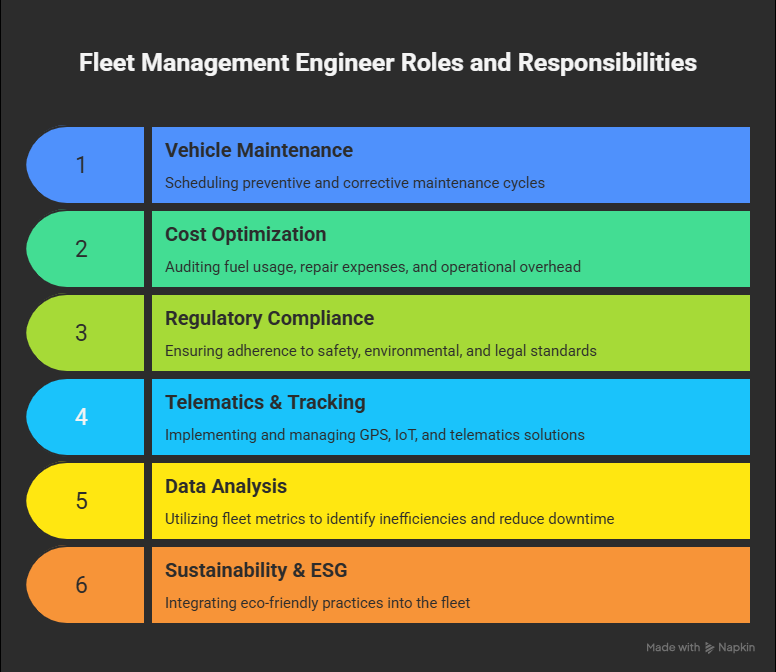
The roles and responsibilities of fleet management engineers are quite extensive. The importance of fleet management in business is something that should be discussed as a main aspect of running a business. All you must do to understand more on this topic is to go through a few job postings and analyse the fleet management engineer job description given in them. A table with all relevant information regarding roles and responsibilities of fleet management engineers is given below.
| Key Responsibility Area | Functional Duties |
| Vehicle Maintenance | Scheduling preventive and corrective maintenance cycles. |
| Cost Optimization | Auditing following things:
|
| Regulatory Compliance | Ensuring adherence to:
|
| Telematics & Tracking | Implementing and managing following things:
|
| Data Analysis | Utilizing fleet metrics to identify inefficiencies and reduce downtime. |
| Sustainability & ESG | Integrating eco-friendly practices (EVs/Hybrids) into the fleet. |
Key Skills Required for a Fleet Management Engineer
It is important to understand the skills required to land a fleet management engineer position before applying for jobs or joining a course. What are the skills required for fleet management jobs? A condensed version of all needed info that answers the above question is provided in the table below.
| Skill Category | Core Competency |
| Technical Knowledge | Automotive Engineering & Systems |
| Analytical Skills | Data Interpretation & Forecasting |
| Software Proficiency | Fleet Management Systems (FMS) & ERP |
| Problem-Solving | Crisis Management & Troubleshooting |
| Communication | Cross-Functional Coordination |
| Project Management | Budgeting, Timeline & Resource Allocation |
This table will also help you understand the necessary Fleet management engineer qualifications.
Career Opportunities and Industry Demand
Demand for fleet management engineers in 2026 is certainly on the rise. But like any other career, it is important to understand its scope, employability and growth possibilities before joining a course to learn it. Fleet management engineer career paths and roles are taking innovative turns in 2026. In this section, we can look at the sector that offers the most in fleet management engineer career opportunities and how their role is changing in the said industry as per the innovations of 2026.
| Industry Sector | Primary Demand Drivers | The 2026 Strategic Shift |
| Logistics & Supply Chain | Global trade resilience and the need for “Zero-Downtime” shipping. | Transitioning from reactive repairs to AI-driven predictive maintenance. |
| Construction & Mining | High-value asset protection and specialized heavy machinery uptime. | Integration of autonomous & remote-controlled equipment fleets. |
| Public Transportation | Government mandates for urban decarbonization and smart city connectivity. | Rapid electrification (EV) of bus and rail transit systems. |
| Oil, Gas & Energy | Remote asset tracking and specialized equipment safety in harsh environments. | Deployment of IoT sensors for real-time monitoring of specialized tankers. |
| E-commerce & Delivery | Explosion of “Last-Mile” delivery and ultra-fast fulfillment expectations. | Scaling Micro-fulfillment centers and drone/EV delivery optimization. |
| Utilities & Services | Critical infrastructure maintenance and emergency response readiness. | Leveraging Digital Twins to simulate fleet response during climate events. |
From the table above we can understand that the demand for skilled fleet engineers is growing rapidly in 2026 due to the rise of smart mobility and sustainability initiatives.
Master Robotics and AI!
Ready to build the future? Join our comprehensive robotics course to bridge the gap between complex code and physical motion. You’ll gain hands-on experience giving you the technical edge needed to lead in the age of automation.
Know MoreWhy Fleet Management Engineers Are Crucial for Businesses?
Fleet management engineers are important to business in that their contribution directly impacts profitability, safety, and sustainability aspects of the firm. A fleet management engineer ensures that the fleets operate at maximum efficiency. They also take measures to reduce costs and ensure that all the operations comply with regulations. The role of fleet management engineer is indispensable in industries where downtime equals lost revenue.
Learn robotics from the best mentors! Join the Entri online course now!
Fleet Management Engineer – Skills, Roles and Responsibilities: Conclusion
The final takeaway of this blog is that fleet management engineers are vital professionals in industries like logistics, energy, construction, e-commerce, etc. These are the professionals who bridge technology, logistics, and operations and hence ensure that fleets remain reliable, cost‑effective, and compliant with regulations. The role of a fleet management engineer will continue to become more and more important as the innovations evolve toward smart mobility and sustainability.
Master Robotics and AI!
Ready to build the future? Join our comprehensive robotics course to bridge the gap between complex code and physical motion. You’ll gain hands-on experience giving you the technical edge needed to lead in the age of automation.
Know MoreFrequently Asked Questions
What does a fleet management engineer do daily?
They monitor vehicle performance, schedule maintenance, analyse fleet data, and ensure compliance with regulations.
Which industries hire fleet management engineers?
Logistics, construction, public transport, oil & gas, and delivery services.
What skills are most important for success?
Technical expertise, data analysis, software proficiency, and strong communication skills.
Is fleet management a good career path?
Yes, with increasing demand for efficient logistics and sustainable transport, it offers strong career growth.