Table of Contents
Imagine trying to describe a day without words like “quickly” or “here.” Your stories would fall flat. German adverbs add that spark. They tell how, when, where, or how much actions happen. In German, these words shape sentences and make them vivid. Learners often struggle with word order or mix them up with adjectives. This guide clears that up. You will learn definitions, types, and rules. See examples in sentences with translations. By the end, you can build better German phrases. Expect tips for exams and common pitfalls to avoid. Dive in to boost your skills and speak like a native.
Adverbs are key in German grammar. They modify verbs, adjectives, or other adverbs. Unlike English, German adverbs fit into strict sentence spots. This structure helps ideas flow smooth. Master them, and your speech gains clarity. You express time, place, or manner with ease. This guide offers a full view. From basics to advanced use, it covers all. Gain confidence in writing and talking. Spot mistakes early and fix them. Ready to level up your German? Let’s start with the core.
Learn German from the best mentors in the field! Join the Entri online course!
What Are Adverbs in German?
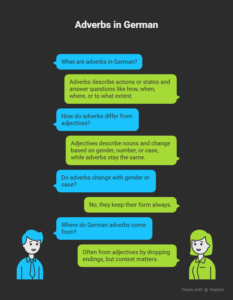 Adverbs in German describe actions or states. They answer questions like how, when, where, or to what extent. For example, “schnell” means fast and shows how something moves. These words add detail to verbs most often. They can also change adjectives or other adverbs. Take “sehr gut” – very good. Here, “sehr” boosts “gut.”
Adverbs differ from adjectives in key ways. Adjectives describe nouns and change based on gender, number, or case. They get endings like -e or -en. Adverbs stay the same. No shifts for gender or case. This makes them simple to use. Adjectives agree with nouns, but adverbs stand alone.
Do adverbs change with gender or case? No. They keep their form always. This rule helps beginners. Forget about declensions here. Focus on meaning and placement instead.
Look at examples. “Ich laufe schnell.” (I run fast.) “Schnell” modifies “laufe.” Another: “Sie singt schön.” (She sings beautifully.) “Schön” tells how she sings. In English: “The dog barks loudly. Der Hund bellt laut.” “Laut” stays unchanged. These show adverbs in action. They make sentences lively without extra rules.
German adverbs come from adjectives often. Drop endings, and they work as adverbs. But context matters. Use them right to avoid mix-ups. This sets the base for deeper types.
Types of German Adverbs
1: How do you say "Good Morning" in German?
German adverbs split into groups based on what they describe. This setup helps organize thoughts. Each type answers a specific question. Time adverbs handle when. Place ones cover where. Manner explains how. Frequency tells how often. Degree shows intensity. Knowing these builds strong sentences. Let’s break them down one by one.
Adverbs of Time (Temporaladverbien)
Time refers to a moment in which a person acts. They set the tone for events. Words like these are stories of anchorage, past, present or future. Place them early in a sentence to ensure clear flow.
Heute for today is a common example. “Gestern” means yesterday. Tomorrow is “Morgen.” It is “Jetzt,” for now. In German, “immer” means never.
See them in use through this table:
| German Adverb | English Meaning | Example Sentence (DE) | Translation (EN) |
| heute | today | Ich gehe heute einkaufen. | I go shopping today. |
| gestern | yesterday | Wir haben gestern gespielt. | We played yesterday. |
| morgen | tomorrow | Er kommt morgen an. | He arrives tomorrow. |
| jetzt | now | Mach es jetzt! | Do it now! |
| immer | always | Sie ist immer pünktlich. | She is always on time. |
| bald | soon | Das Essen ist bald fertig. | The food is ready soon. |
| schon | already | Ich habe schon gegessen. | I have already eaten. |
| noch | still/yet | Er schläft noch. | He is still sleeping. |
| früher | earlier | Komm früher nächstes Mal. | Come earlier next time. |
| später | later | Wir treffen uns später. | We meet later. |
These adverbs make timelines sharp. Use them to sequence events without confusion.
Adverbs of Place (Lokaladverbien)
Adverbs of place show where actions take place. They guide the reader through spaces. These words paint locations without extra nouns.
Key examples: “hier” for here. “Dort” means there. “Draußen” is outside. “Oben” translates to up or above. “Unten” means down or below.
In sentences, they fit after verbs often. “Ich bin hier.” (I am here.) This pins the spot. “Das Buch liegt oben.” (The book lies up there.) Clear direction helps.
More examples build understanding. “Geh draußen spielen.” (Go play outside.) “Sie sitzt unten.” (She sits down there.) “Komm her!” (Come here!) Short commands use them well.
These adverbs link actions to settings. They prevent vague descriptions. Practice placing them to map scenes better.
Adverbs of Manner (Modaladverbien)
Adverbs of manner describe how actions unfold. They add style to verbs. These words reveal speed, quality, or approach.
Examples: “schnell” for fast. “Langsam” means slowly. “Gut” is well. “Schlecht” translates to badly.
Use in context: “Er fährt schnell.” (He drives fast.) Speed shows. “Sie kocht gut.” (She cooks well.) Quality shines. “Das Kind läuft langsam.” (The child runs slowly.) Pace matters.
Table for clarity:
| German Adverb | English Meaning | Example Sentence (DE) | Translation (EN) |
| schnell | fast | Der Zug fährt schnell. | The train goes fast. |
| langsam | slowly | Gehe langsam die Treppe hinunter. | Walk slowly down the stairs. |
| gut | well | Er spricht gut Deutsch. | He speaks German well. |
| schlecht | badly | Das Team spielt schlecht. | The team plays badly. |
| laut | loudly | Die Musik ist laut. | The music is loud. |
| leise | quietly | Sprich leise im Kino. | Speak quietly in the cinema. |
| schön | beautifully | Sie tanzt schön. | She dances beautifully. |
| hässlich | uglily | Er malt hässlich. | He paints uglily. (Rare, but shows form.) |
| freundlich | friendly | Begrüße sie freundlich. | Greet her friendly. |
| böse | angrily | Er schaut böse. | He looks angrily. |
Manner adverbs enrich narratives. They turn basic actions into detailed ones.
Adverbs of Frequency
Frequencies are verbs that describe actions and are commonly used to describe patterns, habits and daily events. They can help make sense of actions because they show what’s happening regularly, occasionally, or no matter what. These adverbs are important in language learning because they allow the speaker to say something naturally about everyday behavior, personal activities, and habits. Without them, sentences are incomplete or vague.
Oft is one of the most frequent German adverbs; selten is another, sometimes, nie once. Each word represents another level of repetition. For example, oft means that an action takes place many times and rare means it takes place infrequently. Manchmal is in the middle, meaning something occurs sometimes but not often. Nie is right that an action is not even in progress. These words are simple but powerful tools for clear communication.
Frequency adverbs are practically unproblematic to insert into a sentence. Ich esse oft Obst is a common habit. Sie reist rare suggests she has no plans to travel. We go manchmal ins Kino describes one activity that happens a few times. In order to emphasis extremes more sharply, extremes include immer and nie. Er hilft immer discusses consistent behavior, but Ich rauche nie clearly notes the absence of the habit.
In general, frequency adverbs are useful in structuring conversations around patterning and routines. They make advice sound real, stories and descriptions more believable. These adverbs are appropriate for use in the context of language such as health, work, travel, or personal habits as these adverbs permit language to communicate frequency clearly and naturally, and are therefore an important part of everyday language usage.
Adverbs of Degree / Quantity
Degree verbs indicate intensity or quantity. They are generally used to give meaning a boost or boost, but can also help writers and speakers understand how much, how little, or how much is useful. Degree adverbs add the precision and emotional weight of a description, rather than flattening a statement or making it vague.
Common German adjectives of degree are „sehr“ (very), „zu“ (too), „genug” (enough), and „sehr” (very). „fast“ (almost). Each modifiers an adjective, verb, or other adverb in order to clarify intensity. For example, in „Das ist sehr interessant“ (That is very interesting), “sehr” takes up the adjective and clearly increases interest. The sentence becomes more expressive than it was saying something interesting.
This is an adverb which means to go above or to go above. In „Es ist zu heiß“ (It is too hot), the speaker indicates that the heat is too hot. This adverb is important for it introduces judgment rather than description. So too does “genug” equate with sufficiency. In “Ich habe genug Geld” (I have enough money), the amount meets the requirement—neither too little nor excessive.
The verb „fast“ identifies the stage near completion or one not yet fully completed. In „Er ist fast fertig“ (He is almost finished), the task is almost done, though not completely. This adverb is useful when talking about progress, timing, or expectations because it places something relatively close to the end.
Other degree adverbs have soft or more abstract meanings. „Etwas“ (somewhat) decreases intensity, in “Sie ist etwas müde” (She is somewhat tired), where “Etwas” is a hint of mild tiredness rather than exhausted. On the other hand, „kaum“ (hardly) is of a very low quality. In „Ich sehe kaum etwas“, the speaker emphasizes minimal visibility.
In general, degree adverbs are needed for fine-tuning expression. They help avoid dull, one-dimensional statements and allow speakers to communicate nuance, balance, and emphasis. By choosing the right degree adverb, a sentence becomes clearer, more accurate, and more natural in real communication.
|
German A2 Exercises – Download Free PDF |
||
Free German A1 Mock Tests – Powered by AI!
Test your skills on our interactive platform. Get instant feedback from our AI to help you communicate better and track your progress. Start your free German mock test now.
Test Your German A1 for FreePosition of Adverbs in German Sentences
This is the detailed, polished rewrite in short paragraphs that is concise and natural while considering the entire rule set:
In German, adverb placement is not complicated. If written correctly, sentences sound natural and easily digestible. If placed incorrectly, they confuse the listener and teeter on meaning.
The most important rule is the Time–Manner–Place rule. Time is first followed by manner, then place. This order reflects logical thinking and improves sentence flow.
The verb usually comes second in main clauses. Adverbs follow the verb and follow the TMP sequence. “Ich gehe heute schnell nach Hause. ” Time (heute), manner (schnell), place (nach Hause). It is the order of subject – verb – time – manner – place.
Subordinate clauses require that the verb be moved to the end. Adverbs remain in the TMP order but appear before the last verb. “Weil ich heute schnell nach Hause gehe.” The order of the verb changes.
This is also apparent from other examples. “Sie liest oft laut im Zimmer” . Frequency (oft), manner (laut), place (im Zimmer). Subordinate clause: „Obwohl er langsam fährt, kommt er pünktlich an.“ Manner precedes the verb.
Adverbs are most often placed following the verb in a question. For example, „Wann kommst du hierher?“ First, the verb, followed by time or place.
Practice of these positions adds accuracy and eliminates meaning errors. When used correctly, German sentences are clear, believable and confident.
Adverbs vs Adjectives in German (Common Confusion)
Many learners mix adverbs and adjectives. The words look alike, but roles differ. Clear this up to write clean.
Same word can serve both. “Schnell” as adjective: “Der schnelle Zug.” (The fast train.) Agrees with noun – adds -e.
As adverb: “Der Zug fährt schnell.” (The train goes fast.) No ending. Modifies verb.
Key: Adverbs lack adjective endings. No -er, -e, -en based on case.
Another pair: “Gut” adjective – “Der gute Freund.” (The good friend.)
Adverb: “Er arbeitet gut.” (He works well.)
Spot the verb link for adverbs. Noun link for adjectives.
Examples show traps. Wrong: “Sie singt schönen.” No – “schön” as adverb stays bare.
Right: “Das schöne Lied.” Adjective with ending.
Master this split. Sentences gain precision. Avoid errors that mark beginners.
|
Goethe 2026 Exam Dates: Multiple Test Centers |
|
| Trivandrum Goethe Exam Dates | Kochi Goethe Exam Dates |
| Chennai Goethe Exam Dates | Coimbatore Goethe Exam Dates |
Common German Adverbs List (Beginner-Friendly Table)
High-frequency adverbs speed up learning. This table lists 25 common ones. Each with meaning and sample sentence. Use it as a quick reference.
| German Adverb | English Meaning | Example Sentence (DE + EN) |
| heute | today | Ich lerne heute Deutsch. (I learn German today.) |
| gestern | yesterday | Wir haben gestern gefeiert. (We celebrated yesterday.) |
| morgen | tomorrow | Komm morgen vorbei. (Come by tomorrow.) |
| jetzt | now | Ich brauche jetzt Hilfe. (I need help now.) |
| immer | always | Er ist immer nett. (He is always nice.) |
| nie | never | Sie trinkt nie Kaffee. (She never drinks coffee.) |
| oft | often | Ich gehe oft spazieren. (I go for walks often.) |
| selten | rarely | Das passiert selten. (That happens rarely.) |
| manchmal | sometimes | Manchmal regnet es. (Sometimes it rains.) |
| hier | here | Setz dich hier hin. (Sit down here.) |
| dort | there | Das Auto steht dort. (The car stands there.) |
| draußen | outside | Die Kinder spielen draußen. (The children play outside.) |
| oben | up/above | Der Ball ist oben. (The ball is up there.) |
| unten | down/below | Schau unten nach. (Look down there.) |
| schnell | fast | Lauf schnell! (Run fast!) |
| langsam | slowly | Iss langsam. (Eat slowly.) |
| gut | well | Das schmeckt gut. (That tastes good.) |
| schlecht | badly | Er fühlt sich schlecht. (He feels bad.) |
| sehr | very | Es ist sehr kalt. (It is very cold.) |
| zu | too | Das ist zu teuer. (That is too expensive.) |
| genug | enough | Hast du genug Wasser? (Do you have enough water?) |
| fast | almost | Ich bin fast da. (I am almost there.) |
| bald | soon | Wir sehen uns bald. (We see each other soon.) |
| schon | already | Hast du schon gegessen? (Have you already eaten?) |
| noch | still/yet | Warte noch einen Moment. (Wait a moment still.) |
| laut | loudly | Sing laut mit. (Sing loudly along.) |
| leise | quietly | Die Maus ist leise. (The mouse is quiet.) |
| freundlich | friendly | Sei freundlich zu allen. (Be friendly to all.) |
| böse | angrily | Er rief böse. (He called angrily.) |
| etwas | somewhat | Ich bin etwas hungrig. (I am somewhat hungry.) |
Bookmark this. Pull from it for daily practice. Builds vocab fast.
Free German A1 Mock Tests – Powered by AI!
Test your skills on our interactive platform. Get instant feedback from our AI to help you communicate better and track your progress. Start your free German mock test now.
Test Your German A1 for FreeCommon Mistakes with German Adverbs
Errors with adverbs trip up many. Fix them to polish your German. Word order tops the list. Ignore TMP, and sentences jumble.
Example: Wrong – “Ich gehe nach Hause schnell heute.” Mixes place, manner, time. Right – “Ich gehe heute schnell nach Hause.” Follows TMP.
Confusing adverbs with adjectives follows. Add endings to adverbs by mistake. “Sie läuft schnelle.” Wrong. Drop the -e. “Sie läuft schnell.”
Overusing “sehr” dulls writing. “Sehr gut, sehr schön, sehr interessant.” Vary with “wirklich” (really) or “besonders” (especially).
Other slips: Placing adverbs before subjects in main clauses. Verbs must be second. Wrong: “Schnell ich laufe.” Right: “Ich laufe schnell.”
Frequency mix-ups: “Oft nie” makes no sense. Pick one.
Watch subordinate clauses. Adverbs before end verbs. Wrong: “Weil ich gehe schnell.” Right: “Weil ich schnell gehe.”
Spot these early. Review sentences. Ask for feedback. Clean German impresses.
Learn German from the best mentors in the field! Join the Entri online course!
German Adverbs for Exams (A1–B2 Focus)
The German exams compare A1 to B2, so it’s important to start with the basics. Adverbs can help you to build strong sentences and make your answers clearer and more natural.
At the A1-A2 level it is focused on simple adverbs. These include time words like heute and jetzt, place words such as here and dort, manner words such as gut and schlecht, and frequency words such as immer and nie. Tests use fill-in-the-blank questions such as “Ich gehe _____ ins Kino.“ (oft). These questions test daily practice and habit formation.
Adverbs advance at B1–B2, but are more advanced at B2. You use degree adverbs, like sehr and zu, and you use them in longer, more complex sentences. “Ich esse zu viel, weil ich hungrig bin,” for example. This level checks that you are able to connect ideas and justify why.
Adverbs are important, because they link ideas and give meaning. They indicate language range on writing exams. In speaking tests they help you to sound fluent and confident.
To make more sense, learn ten or more adjectives each type and use them in short diary entries. Record your speech and check placement of adverbs. Read basic German books to see natural use. Practice the mock tests with a timer and adjust your adverbs to score higher.
Each level of knowing adverbs gives confidence and opens the door to advanced German.
Free German A1 Mock Tests – Powered by AI!
Test your skills on our interactive platform. Get instant feedback from our AI to help you communicate better and track your progress. Start your free German mock test now.
Test Your German A1 for FreeFrequently Asked Questions
What is the single most important rule for German adverb placement, and why does it feel so unnatural for English speakers?
The cardinal rule is the Time-Manner-Place (TMP) sequence in main clauses: Temporal (when?), then Modal (how?), then Lokal (where?). The structure is Subject + Verb + Time + Manner + Place.
This feels unnatural to English speakers because English adverbial order is far more flexible and often follows a default Place-Manner-Time pattern or scatters adverbs throughout the sentence. English relies heavily on prepositions to clarify meaning, while German relies on rigid positional grammar.
Example & Comparison:
-
German (TMP): Ich fahre morgen [time] mit dem Zug [manner] nach Berlin [place].
-
English (Flexible): I’m going to Berlin [place] by train [manner] tomorrow [time]. (Or: I’m going by train to Berlin tomorrow).
The German logic is chronological and conceptual: First establish when the action happens (setting the time frame), then describe how it is performed (defining the action’s quality), finally pinpoint where it occurs (the destination or location). Mastering TMP is non-negotiable for achieving natural sentence flow (Satzrhythmus) in German.
How can I definitively tell if a word is being used as an adverb or an adjective, especially when they look identical?
The definitive test is function and form:
-
What is it modifying?
-
Adjectives modify nouns or pronouns. They answer “What kind of?” or “Which one?”
-
Adverbs modify verbs, adjectives, or other adverbs. They answer “How?”, “When?”, “Where?”, or “To what degree?”.
-
-
Does it have a declension ending?
-
Adjectives change form (get an ending like -e, -er, -es, -en) to agree with the gender, case, and number of the noun they describe.
-
Adverbs are invariable. They never, ever change their form.
-
Analysis in Practice:
-
“schnell” in context:
-
Adjective: Der schnell****e Zug fährt nach München. (The fast train…). “Schnelle” has an -e ending because it describes the noun “Zug” (masculine, nominative).
-
Adverb: Der Zug fährt schnell. (The train travels fast). “Schnell” has no ending because it modifies the verb “fährt”.
-
Remember: If you can add a declension ending, it’s almost certainly an adjective. If the word stands alone and unchanged, it’s acting as an adverb.
Are there any German adverbs that do change form? What about comparative and superlative forms?
Yes, but the change is not for grammatical agreement—it’s for comparison. Many adverbs (especially those of manner) can form comparative and superlative degrees, just like adjectives, but without declension endings.
-
Positive (Grundform): schnell (fast), gut (well), oft (often)
-
Comparative (Vergleichsform): schneller (faster), besser (better), öfter (more often)
-
Used with als (than): Er läuft schneller als ich.
-
-
Superlative (Superlativ): am schnellsten (the fastest), am besten (the best), am häufigsten (the most often)
-
The adverbial superlative is always formed with am + [stem] + -sten.
-
Crucial Distinction from Adjectives:
-
Adjective Superlative: Das ist der schnellste Zug. (This is the fastest train.) – Describes a noun.
-
Adverb Superlative: Dieser Zug fährt am schnellsten. (This train travels the fastest.) – Modifies a verb.
So, while the base form is invariable, its comparative and superlative forms are used to express degrees of intensity.
Where exactly do adverbs of frequency (like "oft," "nie," "manchmal") go in a sentence with multiple verbs?
This is an advanced point of word order. Adverbs of frequency generally occupy the position directly after the conjugated (main) verb in a main clause. However, with modal verbs, perfect tenses, or separable prefixes, it gets specific.
-
In simple tenses (one verb): After the verb.
-
Ich gehe oft ins Kino.
-
-
With modal verbs (können, müssen, wollen, etc.): Usually between the modal and the infinitive.
-
Ich kann oft nicht schlafen. (I often can’t sleep.)
-
-
In perfect tense (haben/sein + past participle): Usually between the auxiliary and the participle.
-
Ich habe ihn oft gesehen. (I have often seen him.)
-
-
With separable prefixes: The adverb typically goes after the prefix part attached to the verb.
-
Ich stehe normalerweise um 7 Uhr auf. (I usually get up at 7.)
-
A good rule of thumb: The frequency adverb wants to be as close to the lexical core of the action as possible, which often means slotting in before the second (infinitive or participle) verb.
What are "Pronominaladverbien" (da-/wo- compounds like "damit," "worüber"), and why are they so important for fluency?
Pronominal adverbs are compound adverbs formed with da- (or dar- before a vowel) or wo- + a preposition (e.g., mit, über, für, von). They are indispensable for elegant, non-repetitive German.
-
da- compounds (damit, davon, dazu) refer back to things, ideas, or situations already mentioned. They replace prepositional phrases with inanimate or abstract nouns to avoid repetition.
-
Repetitive: Ich denke über das Problem nach. (I’m thinking about the problem.)
-
Fluid: Ich denke darüber nach. (I’m thinking about it.)
-
-
wo- compounds (womit, wovon, wozu) are used in questions or relative clauses referring to things or ideas.
-
Womit schreibst du? (What are you writing with?)
-
Das Thema, worüber wir sprechen, ist wichtig. (The topic we’re talking about is important.)
-
Why they matter: Using them correctly is a hallmark of intermediate-to-advanced proficiency (B1+). They make your speech more connected, less clunky, and demonstrate a command of German’s pro-drop (pronoun-dropping) tendencies. Without them, your German will sound repetitive and simplistic.
Can an adverb ever be placed at the very beginning of a German sentence? What effect does this have?
Absolutely. Placing an adverb (or adverbial phrase) in the first position (Vorfeld) is not only allowed but very common. According to German’s strict verb-second (V2) rule, when you do this, the conjugated verb must immediately follow in the second position, and the subject then moves to a later spot.
This structure is used for emphasis, stylistic variation, or to create a logical link to the previous sentence.
-
Neutral: Ich lerne heute Abend Deutsch.
-
Emphatic/Transitional: Heute Abend lerne ich Deutsch. (Tonight, I’m studying German. [implying maybe not other nights]).
-
Narrative: Gestern war ein langer Tag. Zuerst ging ich zur Arbeit. Dann besuchte ich meine Mutter. Schließlich kam ich spät nach Hause.
Adverbs of time and place are most commonly fronted. This technique is key for writing coherent paragraphs and for natural-sounding storytelling in speech.
How do "doch," "ja," "schon," and "mal" function as modal particles, and how is this different from their use as regular adverbs?
This is a core nuance of spoken German. As modal particles (Abtönungspartikeln), these words lose their literal adverbial meaning and instead convey the speaker’s attitude, emotion, or subtle nuance. They are often untranslatable directly.
-
“schon” as an adverb: Ich habe schon gegessen. (I have already eaten.) – Literal time meaning.
-
“schon” as a particle: Das ist schon richtig, aber… (That’s admittedly correct, but…) – Concedes a point.
-
“ja” as an adverb: Er ist ja hier! (He is indeed here!) – Emphatic confirmation.
-
“ja” as a particle: Du weißt ja, wie das ist. (You know, after all, how that is.) – Assumes shared knowledge.
-
“mal” as an adverb: Ich war einmal in Rom. (I was in Rome once.)
-
“mal” as a particle: Hör mal zu! (Listen up! / Just listen!) – Softens a command or makes it more casual.
The difference is purely functional and contextual. As particles, they add flavor, politeness, emphasis, or irony but do not modify an action’s time, place, or manner. Mastery of these particles is one of the final frontiers in sounding authentically native.
What are the most common, subtle mistakes even intermediate learners make with adverbs?
Beyond basic word order, watch for these subtle pitfalls:
-
Overusing “sehr”: It becomes a crutch. Use wirklich (really), äußerst (extremely), besonders (particularly), or ziemlich (quite) for variety.
-
Misplacing “nicht”: The position of “nicht” changes meaning. It generally negates the element that comes directly before it.
-
Ich arbeite nicht heute. (I’m not working today [but maybe tomorrow].)
-
Ich arbeite heute nicht. (I’m not working today [at all].)
-
-
Confusing “noch” and “schon”:
-
Noch = still (continuing action) / yet (in negative sentences).
-
Schon = already (completed earlier than expected).
-
-
Using adjective endings on adverbs: The classic “Ich laufe schnelle” error.
-
Forgetting the “am + -sten” structure for adverbial superlatives: Saying “der schnellsten laufen” instead of “am schnellsten laufen.”
Are there resources or exercises specifically designed to master adverb placement?
Yes, targeted practice is essential.
-
Sentence Scrambling: Take a jumbled sentence (e.g., / nach Hause / ich / gehe / schnell / heute) and force yourself to order it correctly using TMP.
-
Translation Contrast: Translate English sentences into German, then re-translate your German back into English. The differing adverbial order will highlight the structural thinking.
-
“Lückenübungen” (Cloze Exercises): Use workbooks or online exercises (from reputable sources like Deutsche Welle or Goethe-Institut) focused on “Adverbien der Zeit, Art und Stelle.”
-
Dictation & Shadowing: Listen to a clear audio clip (a news segment, a podcast dialogue) and write it down, paying special attention to adverb placement. Then, read your transcript aloud, mimicking the rhythm.
-
The “Adverb Journal”: Write 3-5 sentences daily about your routine, consciously using at least one adverb of time, manner, and place in the correct order.
How does the use of adverbs differ between formal written German and casual spoken German?
The core grammar remains, but usage and frequency differ significantly.
-
Formal Written German:
-
Precision: Favors specific, formal adverbs like folglich (consequently), dennoch (nevertheless), inzwischen (in the meantime), überdies (furthermore).
-
Structure: Relies heavily on fronted adverbial phrases for logical flow (e.g., Im Gegensatz zu…, In Bezug auf…).
-
Less Use of Particles: Avoids casual modal particles like “mal,” “ja,” “halt.”
-
-
Casual Spoken German:
-
Particles Galore: Filled with “doch,” “schon,” “mal,” “eben,” “halt” to modulate tone.
-
Simpler Vocabulary: Uses da and dort more interchangeably for “there.” Uses ganz as a generic intensifier (“ganz gut,” “ganz schön”).
-
Flexibility with TMP: While TMP is still the rule, colloquial speech sometimes allows slight deviations for emphasis, especially in short sentences.
-
Contractions: Adverbs can blend, e.g., “‘n bisschen” (for “ein bisschen”), “‘ rauf” (herauf).
-
To advance, you must practice both registers: studying formal texts to see precise placement and listening to native dialogues to absorb the rhythmic, particle-filled flow of everyday speech.