
Table of Contents
Think of those brisk words you say every day that you do not notice. You say things like “I always wake up early,” “I usually drink coffee in the morning” or “I never watch TV at night.” These small words may sound silly but they calmly describe your schedule, your tastes, and even your personality. They help listeners to know how often something happens, not just what happens. This is precisely why adverbs of frequency are so important in German. They make simple words into real-life conversation.
Adverbs of frequency function in German much the same way they function in English, but their placement in a sentence is what makes them interesting. Immer usually starts after the verb, oft (often), manchmal (sometimes), rare (rarely) and nie (never), depending upon the sentence structure. Once you get this rhythm, your German starts to work with less fluff and feels less like a grammar book.
What makes these adverbs so powerful is their ability to fit naturally in everyday conversations. You can say “Ich esse Frühstück” instead, but to make it seem more real. This small change helps to make your speech more precise and personal. Native speakers rely on these words constantly because real life is seldom all or nothing. The truth is that we don’t always do things the same way every day, and these adverbs prove that.
It doesn’t take weeks of practice to learn adverbs of frequency. You can start with adding one or two words to your daily sentences. Talk about how you get around, what you eat, or how you are working. Keep in mind that your German will also go from right but stiff to natural and confident. That’s when the language really starts to feel like your own.
Learn German from the best mentors in the field! Join the Entri online course!
What Are Adverbs of Frequency in German?
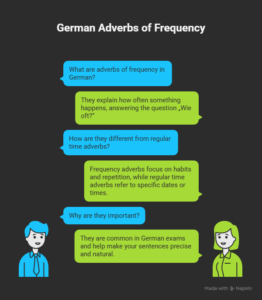
German adverbs of frequency, at the heart, explain how often something happens. They answer only one simple question, „Wie oft?“ The moment you use one, the listener is immediately aware of the pattern. Are you talking about something that happens every day, most days, occasionally, rarely, or never? This clarity is exactly why these adverbs are so effective in everyday German. They break the guesswork and make your sentences precise without a need for explanation.
It’s important to distinguish between adverbs of frequency and regular time. Words like „gestern Abend“ (yesterday evening), „nächste Woche“ (next week), or “um halb acht” (at half past seven) refer to when something happens on a calendar or clock. Frequency adverbs have no problem with dates or times. Instead, they focus on habits and repetition. They say something is routine or rare. Making these two categories in a sentence look like two different things can make it appear unnatural and the ways these are divided in your mind makes your German sound cleaner and more confident.
Frequency adverbs are the norm in the Goethe-Zertifikat, TestDaF, TELC and school tests. Questioners on exams frequently ask to describe your daily routine, pick the right verb to use to complete a sentence, or alter a word to get the frequency adverb where it should go. Understanding their meaning and placement can significantly improve your reading, writing, and especially speaking scores.
These adverbs can also be used to describe the real world outside of exams. When you can say what you do often, sometimes, or rarely ever do, your German stops sounding memorized and starts sounding natural. The real conversation is there, and real progress is there.
|
German A2 Exercises – Download Free PDF |
||
List of German Adverbs of Frequency
1: How do you say "Good Morning" in German?
Here are the six adverbs the most people use first because they pretty much describe everything you want to say about habits in German. When students begin to describe routines, frequency, or repeating actions, these words come up repeatedly because they seem natural, flexible, and easy to put in a sentence. They are used in everyday conversations without thinking; Germans use them more often than they would in a textbook, which makes them essential for fluent rather than perfect sounding.
The first and most absolute adverb is immer. It’s used if something happens without exception. Immer is used by Germans to create routines, rules or strong personal habits. For example, someone might say they drink coffee every morning or walk the same route to work. It suggests consistency and stability and is often followed immediately after the verb in simple sentences.
Next comes oft or häufig (often). These are employed when something occurs frequently but not every time. Oft is more conversational, while häufig is a little more neutral or formal. These are used by Germans to describe everyday habits, repeated behaviors or more often than not.
Middle is manchmal (sometimes). This adverb is useful when something happens occasionally without a fixed pattern. Manchmal allows the Germans to be flexible and honest when they do not want to overstate how often something happens.
Rare, rare is at the lower end of frequency. It is used when something happens, but not often enough to be considered a habit. Germans frequently use selten to elide frequency in polite or factual terms.
Last but not least, nie is the completely opposite of immer. It’s unconditional and powerful, when nothing happens at all. Nie is used by Germans, but only if they are certain, as it is not open to deviation.
| German Adverb | English Equivalent | Everyday Example Sentence (with a little context) |
| immer | always | Ich trinke immer Kaffee am Morgen – ohne den komme ich einfach nicht in Gang. |
| oft | often | Meine Schwester geht oft joggen, meistens gleich nach der Arbeit, wenn das Wetter mitspielt. |
| manchmal | sometimes | Wir kochen manchmal zusammen, aber ehrlich gesagt bestellen wir viel öfter Essen. |
| selten | rarely | Ich gehe selten in Clubs – ich bin einfach kein Nachtmensch mehr. |
| nie | never | Er isst nie Frühstück, sagt er brauche nur seinen Kaffee und los geht’s. |
| regelmäßig | regularly | Ich treffe meine beste Freundin regelmäßig zum Spazierengehen – das hält uns beide fit und auf dem Laufenden. |
When learning German, you don’t need dozens of adverbs to make your sound naturally good. In fact, you’ll go far in a conversation with just six key words. Once those are an active vocabulary item, you can easily and confidently describe habits, routines, and patterns.
“Immer” is your strongest, most absolute choice. It shows something that happens all the time, with no exception. Immer makes that clear if you eat breakfast every day, drive the same route to work, or never go hungry again. At the other end of the spectrum, is “nie”, which has a tight, non-negotiable line. It does not allow for interpretation and is ideal when something just doesn’t happen, never happens.
Between those extremes you have a number of harder, more flexible options. “Oft” describes what you do with your time, but not obsessively. It’s suitable for normal habits but with room for improvement. “Manchmal” can relate to those relaxed, situational moments in life; things that happen sometime, depending on mood, time or situation. If you want to accentuate frequency even further, “selten” means stoutly “hardly ever” without being dramatic or overly dramatic.
Lastly, “regelmäßig” is a word for structure and healthy consistency. It’s especially useful if you do something you like to do every day, such as doing something that makes you feel good, like studying or teaching something. It evokes discipline, not repetition, for its own sake.
You can add nuances later, like “meistens” (mostly), “häufig” (mostly), “gelegentlich” (occasionally), or “ab und zu” (every now and then). But if you understand and are comfortable with using these core six, you will already sound much more natural than the majority of learners, and much closer to what native speakers actually speak.
|
Goethe 2026 Exam Dates: Multiple Test Centers |
|
| Trivandrum Goethe Exam Dates | Kochi Goethe Exam Dates |
| Chennai Goethe Exam Dates | Coimbatore Goethe Exam Dates |
Free German A1 Mock Tests – Powered by AI!
Test your skills on our interactive platform. Get instant feedback from our AI to help you communicate better and track your progress. Start your free German mock test now.
Test Your German A1 for FreePosition in German Sentences
German word order can feel like a small puzzle at first, especially when you’re used to flexible English words. The good news is that regular adverbs, such as oft, immer, manchmal and nie, follow obvious and reliable patterns. Once you understand their position, your sentences will sound much more natural and confident.
Frequency adverbs are generally present at the middle of a standard declarative sentence. In particular, they follow the conjugated verb, but before the main object or other important information. Native German speakers might be comfortable with this position. For example, in „Ich esse oft Obst” the verb oft fits neatly between esse and Obst. Nothing feels forced, and the sentence follows without interruption.
For instance, if you want to show how often something happens you can move the frequency adverb to the beginning of the sentence. When you do so German’s verb-second rule sets in, meaning the verb must go immediately after the adverb. Compare „Oft esse ich Obst“ to the neutral version. In the center is oft, useful here as a means of storytelling or of persuasion, such as „Oft denke ich daran, nach Berlin zu ziehen.“
The German rule is TMP: Time – Manner – Place, when multiple adverbial elements are connected. Frequency is under manner, which means it follows time expressions, but not preceded place. That’s why I like to call “Ich gehe jeden Tag oft in den Park” . The words are correct separately, but in order they all work together the sentence is smooth.
Questions are the same. The verb advances and the frequency adverb is in the usual middle position: „Gehst du oft einkaufen?“ In sentences with auxiliary or modal verbs, the adverb appears before the main verb at the end, for example “Ich habe oft ferngesehen” or “Ich möchte regelmäßig Deutsch üben.”.With a bit of practice, these patterns quickly become second nature.
Adverbs of Frequency for Daily Conversations
This is where the magic really happens. Once you start tossing these adverbs into real talks, everything feels more alive. Instead of flat “Ich stehe um sieben Uhr auf,” you say “Ich stehe immer um sieben Uhr auf – egal wie müde ich bin.” Suddenly the other person gets a peek into your discipline (or stubbornness!). Or when a friend asks “Gehst du oft ins Fitnessstudio?” and you answer “Manchmal, aber meistens schaffe ich es nur zweimal die Woche,” it sounds honest and human instead of robotic.
Casual chats about food love these words too: “Ich esse nie Fertigsuppe – schmeckt mir einfach nicht.” Weather small talk gets funnier: “Hier regnet es oft im Sommer, das nervt echt.” Family stories flow better: “Meine Kinder spielen selten drinnen – sie sind am liebsten draußen im Dreck.” Even complaining about work becomes more relatable: “Wir haben regelmäßig Überstunden, aber das Geld ist gut.”
The beauty is that these little words invite the other person to respond. When you say “Ich reise selten ins Ausland,” people almost always ask “Warum nicht?” and suddenly you’re having a proper conversation instead of trading facts. Use them honestly, mix them up, don’t overuse “immer” and “nie” unless you really mean it, and watch how much warmer and more connected your German chats become.
Learn German from the best mentors in the field! Join the Entri online course!
Common Errors to Avoid
When using German adverbs of frequency, learners wiggle and wiggle over the same few problems repeatedly, so be aware of them early so that you will not have to worry about them again later. Once these habits are established you can make your German sound much more natural and confident.
The first is that the adverb is in English at the end of the sentence. I’m not technically wrong to say something like “Ich esse Obst oft” but that almost sounds foreign. And most often these adjectives appear at the end of sentences, in common German phrases such as “Ich esse oft Obst.” It initially seems strange to look at this order of words, but after a few minutes practice it becomes almost normal.
Second is a confusion of TMP order (Time–Manner–Place). If you make the oft before time phrase “Ich gehe oft jeden Tag spazieren,” the sentence is unprofessional for native speakers. Then comes the expression of time, followed by frequency. This order makes your sentences flow more smoothly.
Another common problem is forgetting inversion in questions. “Du gehst oft spazieren?” sounds like a statement with a question mark. It may be understood, but it sounds odd. This is the correct and natural form of “Gehst du oft spazieren?” In German, it is vital to get used to this structure.
Many students also rely too much on immer and nie. Real life isn’t that perfect and overuse of these words can make you sound stiff or overwrought. Adding words like meistens, oft and manchmal adds an element of variety to your speech making it more balanced and human.
Finally, beware of double negatives and small pronunciation issues. It’s not an issue to double Nie, because it already means “never.” Read the spelling and stress, write down, and listen. Fix these habits early, and your German will improve faster than you expect.
Free German A1 Mock Tests – Powered by AI!
Test your skills on our interactive platform. Get instant feedback from our AI to help you communicate better and track your progress. Start your free German mock test now.
Test Your German A1 for FreeFrequently Asked Questions
What exactly are adverbs of frequency in German, and why are they so crucial for fluency?
Adverbs of frequency (Häufigkeitsadverbien) are words that describe how often an action occurs, answering the core question “Wie oft?” (How often?). They range from immer (always) to nie (never). Their crucial role in fluency stems from moving you from stating simple facts to expressing habits, routines, and personal nuances. While “Ich trinke Kaffee” states a fact, “Ich trinke morgens immer Kaffee” reveals a ingrained habit. Native speakers use these adverbs constantly because real life is about patterns, not absolutes. Mastering them transforms your speech from textbook-correct to authentically descriptive and engaging, which is the true hallmark of moving beyond the beginner level.
Where is the correct position for adverbs of frequency in a standard German sentence?
The golden rule for standard declarative sentences (subject-verb-object) is: After the conjugated verb, but before other sentence elements. Linguistically, this is the “middle field” position. For example: “Ich gehe oft ins Kino.” (I often go to the cinema). Here, oft snugly fits between the conjugated verb gehe and the rest of the information. This position is non-negotiable for sounding natural. Placing the adverb at the end (e.g., “Ich gehe ins Kino oft”) is a direct translation from English and is one of the most common tell-tale signs of a learner. Internalizing this verb-adverb rhythm is fundamental to German sentence flow.
How does word order change when I start a sentence with an adverb of frequency?
When you begin a sentence with an adverb for emphasis or stylistic variety, you trigger German’s verb-second (V2) rule. The adverb occupies the first position, which forces the conjugated verb to move immediately into the second position, followed by the subject. For instance: “Manchmal gehe ich erst spät schlafen.” (Sometimes I go to sleep late). This structure is perfectly correct and is often used to start stories, emphasize a habit, or create a conversational flow. It’s a powerful tool for making your speech more dynamic, but the core rule remains: the verb is always in the second position of a main clause.
What is the "TMP" rule, and how do frequency adverbs fit into it?
TMP stands for Time – Manner – Place, the standard German order for multiple adverbial information in a sentence. Adverbs of frequency fall under the “Manner” category. Therefore, if you have a time expression and a frequency adverb, the time expression comes first. Correct: “Ich fahre jeden Sommer (Time) oft (Manner/Mode) an die Ostsee (Place).” A common error is to reverse Time and Manner: “Ich fahre oft jeden Sommer an die Ostsee” sounds jarring to a native ear. Think of TMP as a logical sequence: When > How > Where.
Where do frequency adverbs go in sentences with modal or auxiliary verbs (like können, müssen, haben, sein)?
In sentences with two verbs (a conjugated modal/auxiliary and an infinitive/past participle at the end), the frequency adverb typically precedes the main verb at the sentence’s end. For example: “Ich kann selten vor 22 Uhr entspannen.” (I can rarely relax before 10 pm). “Ich habe nie in Berlin gewohnt.” (I have never lived in Berlin). This placement emphasizes the frequency of the action itself (the relaxing, the living) rather than the modality or tense. It’s a subtle but important nuance that advanced sentence structures require.
What are the most common mistakes learners make with these adverbs, and how can I avoid them?
The top mistakes are:
-
English Word Order: Placing the adverb at the end of the sentence. Fix: Drill the “verb-adverb” pattern.
-
Ignoring TMP: Jumbling time and frequency. Fix: Memorize the sequence: Time (wann?) > Manner (wie oft?) > Place (wo?).
-
Overusing Absolutes: Relying too heavily on immer and nie, which can sound rigid or exaggerated. Fix: Incorporate nuanced adverbs like meistens (usually), häufig (frequently), and gelegentlich (occasionally).
-
Forgetting Inversion in Questions: Saying “Du gehst oft joggen?” instead of the correct “Gehst du oft joggen?” Fix: Remember that questions almost always start with the verb.
Awareness and targeted practice of these specific pitfalls will dramatically accelerate your proficiency.
Beyond the basic list, what are some more nuanced adverbs of frequency I can learn?
Once you’ve mastered the core six (immer, oft, manchmal, selten, nie, regelmäßig), enrich your vocabulary with these nuanced alternatives:
-
meistens / in der Regel: (usually / as a rule) – For strong habits with occasional exceptions.
-
häufig: (frequently) – Slightly more formal than oft.
-
gelegentlich / ab und zu / hin und wieder: (occasionally / now and then) – Great for irregular but repeated actions.
-
fast immer: (almost always) – Adds useful flexibility.
-
so gut wie nie: (hardly ever) – A stronger alternative to selten.
Using these variants prevents your speech from sounding repetitive and allows for precise self-expression.
How are adverbs of frequency tested in formal German exams like the Goethe-Zertifikat or TestDaF?
Examiners assess your command of frequency adverbs across all four skills:
-
Speaking: When describing charts (e.g., “35% der Jugendlichen lesen regelmäßig“), your daily routine, or habits.
-
Writing: In letters or essays where you discuss routines, compare lifestyles, or express opinions with nuance (e.g., “Man sollte meistens öffentliche Verkehrsmittel nutzen”).
-
Reading & Listening: You’ll need to understand them to grasp the frequency of actions in texts or dialogues.
-
Grammar Tasks: Directly tested in sentence transformation exercises, where you might be asked to insert a given adverb into the correct position. Demonstrating correct placement and variety directly impacts your accuracy score.
Can adverbs of frequency be used with the imperative (command form) or the subjunctive (Konjunktiv II)?
Absolutely, and doing so adds sophistication.
-
With Imperative: They soften or emphasize a command. “Ruf mich bitte oft an!” (Please call me often!) or “Komm nie zu spät!” (Never be late!). The adverb usually follows the imperative verb.
-
With Subjunctive II (for wishes or hypotheticals): They specify the frequency of an unreal situation. “Ich würde öfter reisen, wenn ich mehr Zeit hätte.” (I would travel more often if I had more time). Here, öfter sits between the conjugated würde and the infinitive reisen, following the two-verb rule.
What is the best strategy to practice and internalize these adverbs to make their use automatic?
Move from theory to habitual use with this 3-step strategy:
-
Auditory Immersion: Actively listen for these adverbs in podcasts, TV shows, and conversations. Notice their position and the nuance they convey.
-
Personalized Drills: For one week, consciously describe your own daily routines using a variety of adverbs. Write three sentences each day (e.g., “Ich checke morgens meistens sofort mein Handy. Ich koche selten aufwendig. Ich vergesse nie, meiner Pflanze Wasser zu geben.”).
-
The “Wie oft?” Challenge: In conversation with a partner or tutor, ask “Wie oft…?” questions. The need to answer spontaneously forces you to access the grammar rules under pressure, cementing the correct word order.
The goal is to make the verb-adverb connection as automatic as saying “please” and “thank you.”