
Table of Contents
Imagine walking through a busy Berlin street market. Vendors shout from stalls, and aromas fill the air. You spot a friend across the crowd and wave. In German, you might say, “Ich sehe dich dort!” This simple word “dort” tells exactly where the action occurs. German adverbs of place add precision to such moments. They describe locations without extra fuss. Learning them opens doors to clearer talks in everyday life. Readers who grasp these words find German conversations flow better. Stick around to see how these tools boost your skills.
German adverbs of place point out spots where things happen. They answer questions like “where?” in a direct way. For example, “hier” means here, right at your spot. These words fit into sentences to show position. People often mix them up with other parts of speech. Yet, they stand alone and paint clear pictures. Think of them as shortcuts for location details. Once you know them, your German sentences gain strength. This guide breaks them down step by step. By the end, you’ll use them with ease.
Learn German from the best mentors in the field! Join the Entri online course!
What Are German Adverbs of Place?
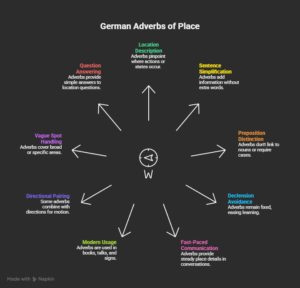 German adverbs of place describe the location of an action or state. They tell where something occurs, exists, or moves. Words like “hier” for here or “dort” for there fall into this group. These adverbs help speakers pinpoint spots in space. In a sentence, they add key info without needing more words. For instance, “Das Buch liegt oben” means the book lies up there. Here, “oben” shows the place above.
These adverbs differ from prepositions in clear ways. Prepositions like “in” or “auf” connect nouns and need cases. They change form based on the noun’s role. Adverbs of place do not link to nouns directly. They modify verbs or the whole sentence. Prepositions require objects, but adverbs stand on their own. Consider “Ich gehe in das Haus.” The preposition “in” takes “das Haus” as its object. Now compare to “Ich gehe hinein.” The adverb “hinein” means into there, with no object needed. This shift makes adverbs simpler for quick location notes.
Adverbs of place follow no declension rules. Nouns and adjectives change endings for case, gender, or number. Adverbs stay the same in all spots. This rule eases learning for beginners. You pick up “draußen” for outside and use it anywhere. No need to worry about accusative or dative forms. Prepositions demand such changes, which can trip up new speakers. Adverbs skip that hassle. Their fixed form lets you focus on meaning over grammar tweaks.
This stability helps in fast-paced chats. Picture ordering coffee: “Ich warte draußen.” The adverb “draußen” stays put, no matter the sentence setup. Prepositions might shift with motion or rest. Adverbs ignore those rules. They provide a steady tool for place details. Learners who master this difference build stronger sentences. Errors drop when you spot adverbs versus prepositions early.
German adverbs of place come from old roots, but their use stays modern. They appear in books, talks, and signs. Street directions often rely on them. “Gehen Sie dort links” guides someone without complex words. This direct style suits German’s clear nature. Adverbs cut through fluff and get to the point. Speakers value this for quick exchanges.
Some adverbs pair with directions. “Hin” suggests motion away, while “her” means toward the speaker. Yet, basic place adverbs like “hier” work alone. They set scenes in stories or describe rooms. “Die Lampe hängt oben” paints a clear image. No extra words clutter the view. This efficiency draws people to learn more.
Adverbs also handle vague spots. “Überall” covers every place, broad and useful. It fits in warnings or searches. “Ich suche überall nach dem Schlüssel.” Here, the adverb spans all areas. Prepositions might limit to one spot. Adverbs expand or shrink the focus as needed.
In questions, these adverbs shine. “Wo bist du?” asks where you are. Answers use adverbs: “Ich bin hier.” Simple and to the point. Questions with prepositions add layers: “In welchem Zimmer bist du?” Adverbs keep it light.
German adverbs of place form a core part of the language. They bridge gaps in descriptions. Without them, sentences feel vague. With them, locations snap into focus. This section sets the base. Next comes a list of common ones in a table for easy reference. Use it to practice and build your word bank.
|
German A2 Exercises – Download Free PDF |
||
Common German Adverbs of Place
1: How do you say "Good Morning" in German?
German adverbs of place vary in meaning and use. Some point to near spots, others to far ones. A table below lists key examples. It includes English meanings and sample sentences. Study the table to see patterns. These words appear often in daily talk.
| Adverb | English Meaning | Example Sentence | Translation |
| hier | here | Das Auto steht hier. | The car stands here. |
| dort | there | Sie wohnt dort. | She lives there. |
| da | there (casual) | Der Hund läuft da. | The dog runs there. |
| oben | up, above | Die Vögel fliegen oben. | The birds fly up. |
| unten | down, below | Die Katze schläft unten. | The cat sleeps down. |
| draußen | outside | Kinder spielen draußen. | Children play outside. |
| drinnen | inside | Wir essen drinnen. | We eat inside. |
| überall | everywhere | Blumen wachsen überall. | Flowers grow everywhere. |
| nirgendwo | nowhere | Ich finde es nirgendwo. | I find it nowhere. |
Place adverbs in German culture are fairly simple at first, but have a more subtle meaning according to distance, context and tone. The table you have mentioned covers the basics, but there are many more location words used in everyday speech in German. The most common are „hier“, „dort“, and „da“, all of which contain different names for “there.” The label “Hier” signifies the speaker’s current position or something very close. It is used for near surroundings or things that are happening where the speaker stands.
When someone says „Komm hier“, it is short and personal. That is, „Dort“, by contrast, clearly signals distance. It refers to something that I feel is far away, physically and mentally. You may hear it when someone speaks of another city, another building, or even a field across the road. „Da“ is between these two. It sounds more relaxed and conversational, though it loosely says “there”. Friends prefer „da“ to traditional friends because it feels informal and natural, especially when distance is not of any significance.
Vertical space navigation requires both „oben“ and „unten“, which are essential for entering buildings and spaces. Boden means anything above, upstairs, or higher. In a home, “Das Zimmer ist oben” immediately tells someone to go upstairs. It can also refer to physical place, such as a shelf or hill. „Unten” is like its own opposite and covers everything below or downstairs. Visitors can read a house, e.g., “Die Küche ist unten” without much explanation. These two adverbs are best learned separately, because German often relies on opposites to decipher meaning more quickly and efficiently.
German refers to “draußen” and “drinnen” as the moveable space between the indoor and outdoor space. The term Raußen is applied to open or outdoor spaces, and often appears in weather reports, instructions, or casual observation. A sentence like „Es regnet draußen“ provides clarity without the need to go too far. Drinnen is the focus outside of confined spaces. In cold weather, parents may say „Bleib drinnen”, in reference to safety and warmth. These adverbs are often used in everyday speech and are helpful when offering advice, warnings or even simple descriptions.
For larger notions of place, German uses “überall” and “nirgendwo”. „Überall” refers to “everywhere” and carries an action or situation across a wide area. It is often found in text, in experiences of travel, or in emotional stories such as „Menschen tanzen überall“, which indicates energy and movement across a space. Nowhere means “nowhere,” which means “nowhere.” It appears to be often when something is missing or can’t be found, for example “Der Schlüssel ist nirgendwo”. Such words give weight to emotion and clarification, especially in terms of experience rather than location.
The right place adverb should be selected in accordance with contextual factors. Especially in cities, „hier“ is used to tell directions or to point out landmarks. In rural areas, speakers use the term „dort” to describe distant fields, roads, or houses. Practicing pairs such as „oben/unten” or “drinnen/draußen” helps to internalize contrast which is central to German sentence structure. In fact, when these words are spoken in complete sentences, memory is much stronger than memory a single list.
Once it is comfortable to get started, forms of compound form expand expression further. The words „hierher” or “dorthin” or “to here” amplify movement and direction. Beginners should be able to master only pure place adverbs before blending motion and location. A strong foundation avoids confusion later, when the sentence structure becomes more complex.
Mistakes often happen when learners transfer English habits directly into German. While English “there” works in almost all situations, German separates meaning by tone and distance. „Da“ sounds casual and spoken, while „dort“ feels more deliberate. Choosing the wrong one may not break understanding, but it can make speech sound unnatural. Paying attention to the audience and setting helps avoid this issue.
Practical learning methods make these adverbs stick. Flashcards work well when they include both meaning and a short example sentence. Daily review reinforces recall. Reading simple German stories, especially children’s books, helps learners see adverbs in action. Sentences like „Der Ball rollt unten“ clearly connect movement and place. Songs and folk music also use place adverbs naturally, making them useful listening tools. Repetition through games, pointing to objects, and naming locations aloud turns passive knowledge into active speech.
Together, these adverbs and practice techniques prepare learners for building accurate sentences. The next step is understanding placement rules, which determine where adverbs fit within German word order. Once mastered, sentences sound more fluent and closer to native usage.
|
Goethe 2026 Exam Dates: Multiple Test Centers |
|
| Trivandrum Goethe Exam Dates | Kochi Goethe Exam Dates |
| Chennai Goethe Exam Dates | Coimbatore Goethe Exam Dates |
Free German A1 Mock Tests – Powered by AI!
Test your skills on our interactive platform. Get instant feedback from our AI to help you communicate better and track your progress. Start your free German mock test now.
Test Your German A1 for FreeSentence Position & Word Order
The German sentence structure may seem simple on paper, but it follows firm patterns that give the language its acoustics and rhythm. The most important patterns are adverbs of place: here, dort, draußen, oben, überall. These words describe what happens. Although German allows for flexibility, ordinary sentences are given rules based on which speech is not translated from English but sounds natural.
The V2 rule in main clauses is at the heart of German sentence structure. The finite verb is therefore always in the second position, not always after the subject. The subject is often the first line in a neutral sentence, followed by the verb, and then the remainder. This structure often causes place-related adverbs to appear after the verb and after other details, particularly in simple statements.
Place adverbs sit toward the end of the sentences. This is the least polarizing and common position. For example, I lese das Buch hier. Here, lee is used over hier. The sentence works as it should because the action is shown first and the location follows naturally. That order fits the sense of the common sense of German speakers: what happens first, what happens second.
When asking questions, the structure changes. Question words move to the first position, and the verb still comes immediately after them. In place-related questions, words like wo (where) take the lead:
Wo bist du?
The answer mirrors the normal statement structure:
Ich bin da.
The verb bin stays early, and the place adverb da follows, maintaining clarity.
A crucial guideline for ordering details in German is the TMP rule: Time – Manner – Place. When multiple adverbial elements appear in one sentence, German prefers this sequence. Time answers when, manner answers how, and place answers where. For example:
Ich gehe morgen schnell nach Hause.
Here, morgen (time) comes before schnell (manner). When a place adverb is added, it usually comes last:
Ich gehe morgen schnell hierher.
This order sounds natural and avoids confusion.
The TMP rule also applies when pure place adverbs are used. Consider:
Gestern habe ich gut geschlafen oben.
The sentence follows the pattern precisely—gestern (time), gut (manner), oben (place). Even though English might place “upstairs” earlier, German prefers it at the end unless emphasis is intended.
Simple examples make this clearer.
Der Ball fällt unten.
The verb fällt comes first, followed by the place adverb unten. This structure keeps the sentence direct and neutral.
Another example:
Sie sitzen draußen im Garten.
Here, draußen is a place adverb, while im Garten is a prepositional phrase. The adverb appears immediately after the verb, with the more specific location added afterward. This layering is very common in spoken and written German.
With imperatives, the verb naturally comes first, and place adverbs follow it:
Komm hier!
The command is clear and natural because the action leads and the location completes it. German relies heavily on this pattern in everyday speech.
However, German allows movement for emphasis. When the speaker wants to stress location, the place adverb can be placed at the beginning of the sentence. This does not break the verb-second rule; it simply pushes the subject after the verb:
Hier steht das Haus.
The focus is clearly on hier. This structure is common in descriptions, directions, and storytelling.
Subordinate clauses follow a different rule entirely. Conjunctions like weil, dass, wenn send the verb to the end of the clause. In these cases, place adverbs appear before the final verb:
Weil ich da bin.
The adverb da comes before bin, which waits at the end. This word order is fixed and must be learned early, as it differs sharply from English.
Practice sentences show how naturally place adverbs fit at the end:
Die Blumen blühen überall.
Er sucht nirgendwo nach Hilfe.
Wir wohnen oben in der Stadt.
Each sentence sounds balanced because the verb introduces the action and the place completes it.
Many learners struggle because English often places location earlier in the sentence. German usually resists this unless emphasis is intended. Translating word-for-word often leads to sentences that are understandable but sound unnatural. Adjusting to the German preference for end placement is key to sounding fluent.
Long sentences test these rules but still follow them. Consider:
Am Montag fahre ich mit dem Zug schnell nach Berlin, wo meine Freunde warten dort.
Here, dort reinforces the location at the end of the clause. While optional, it adds clarity and emphasis in spoken language.
In creative language—poetry, advertising, headlines—these rules may bend. Writers sometimes move place adverbs for rhythm or impact. However, in normal conversation, news reports, and academic writing, the standard patterns dominate and should be mastered first.
Dialogues rely heavily on place adverbs in short answers:
Bist du drinnen?
Ja, ich bin drinnen.
The repetition reinforces clarity and sounds natural in everyday speech.
News writing uses similar structures:
Das Feuer brennt draußen.
The sentence is factual, neutral, and follows the standard verb-then-place order.
Descriptive writing also depends on correct placement:
Das Schloss ragt oben auf dem Berg.
The place adverb oben sets the scene, followed by the more precise location auf dem Berg. This layering helps readers visualize the setting clearly.
To build confidence, practical writing helps. Describing daily routines forces correct placement:
Ich esse Frühstück drinnen. Dann gehe ich draußen spazieren.
Short, clear sentences reinforce natural order and reduce overthinking.
Listening practice strengthens intuition. Podcasts, audiobooks, and news broadcasts reveal where native speakers naturally place adverbs. Repeating full sentences—not isolated words—helps internalize structure.
Language apps and exercises are useful for feedback, especially for word order mistakes. Noticing patterns matters more than memorizing rules in isolation.
Mastering place adverbs sharpens overall German fluency. Once this feels natural, comparing adverbs with prepositional phrases reveals their differences and overlaps. Both express location, but they behave differently in sentence structure. Understanding that distinction is the next step toward writing and speaking German with precision and confidence.
Learn German from the best mentors in the field! Join the Entri online course!
Adverbs of Place vs Prepositions
Adverbs of place and prepositions tend to confuse learners because they are both in relation to location. They seem to do the same thing on the surface. Nevertheless, they are different grammatical actors in German, and knowing this difference is a big step towards fluency. When you understand how and why they work, your sentences are cleaner, more natural, and more confident.
In truth, the difference is simple. Adverbs of place create and insert the verb on its own. They say where?, from where?, or to where? nothing. On the other hand, prepositions always have an attachment to a noun. They cannot be their own, and they control that noun‘s grammatical case. This one rule accounts for most usage errors.
Consider a basic example:
“Ich bin hier.”
Here, hier is an adverb. It tells us where the speaker is, and it does so without naming a place. The sentence is complete and correct on its own. In English, this becomes “I am here.” No object is required.
Now compare it with:
“Ich bin in der Schule.”
The word in is a preposition. It cannot exist alone. It must be followed by a noun, der Schule, and it forces that noun into the dative case because the sentence describes a static location. This structure gives more information. Instead of a general position, we now know the exact place: the school.
This contrast highlights a key difference. Adverbs keep location general and flexible, while prepositions add precision and detail. If you do not need to specify the place, an adverb is enough. If you want clarity or description, a preposition becomes necessary.
Another clear comparison is:
“Das Kind spielt draußen.”
The adverb draußen means “outside.” There is no object, no case, and no extra grammatical load. The sentence feels light and fast. In English: “The child plays outside.”
Now look at:
“Das Kind spielt auf dem Hof.”
Here, auf is a preposition, and dem Hof is the noun it governs. This version tells us exactly where outside the child is playing: in the yard. The meaning is more specific, and the grammar reflects that added detail.
This shows how choice depends on the level of detail you want. When speaking casually or narrating quickly, adverbs are often preferred. When describing scenes, giving instructions, or writing formally, prepositions become more common.
Movement introduces another important layer. Many German prepositions change case depending on whether the action is static or directional. For example:
“Ich gehe in die Schule.”
Here, in takes the accusative case (die Schule) because the verb gehen shows motion toward a destination.
Adverbs can also express motion, but they do so without cases or objects.
“Ich gehe hinein.”
The adverb hinein already contains direction. It means “inside” with movement implied. There is no noun, no article, and no case to worry about. This makes adverbs especially useful for beginners and for fast speech.
When there is no movement, prepositions switch to dative:
“Ich bin in der Schule.”
Adverbs, however, never change. They do not care about cases. Whether the action is static or dynamic, the adverb stays the same. This grammatical simplicity is one of their biggest advantages.
A very common beginner mistake is mixing the two systems. Learners sometimes say:
“Ich bin in hier.”
This is incorrect because hier is already an adverb. Adding a preposition creates a grammatical clash. The fix is simple: check whether a noun follows. If there is no noun, do not use a preposition.
There are cases where the line between adverbs and prepositions looks blurred, especially with compound forms like darauf, darin, or damit. These words combine da- with a preposition, but grammatically they still function as adverbs because they replace a full prepositional phrase. Even so, pure adverbs like hier, dort, and drinnen remain the simplest and most direct tools.
Usage also changes with context. In spoken German, adverbs appear more often because they are quick and efficient. People prefer saying “Bin hier” instead of giving full location details. In formal writing, reports, or academic texts, prepositions are used more because clarity and precision matter.
Storytelling shows another contrast. Adverbs help maintain speed and rhythm:
“Er läuft dort.”
This sentence moves fast and keeps the focus on action.
Descriptions, however, rely on prepositions:
“Er läuft durch den Wald.”
Now the reader can visualize the scene clearly.
A powerful exercise is switching between the two. Take a sentence with a preposition and rewrite it using an adverb.
“Ich sitze auf dem Stuhl.” becomes “Ich sitze da.”
Then reverse the process by adding detail. This trains flexibility and control.
Adverbs of place also extend far beyond basic location. Directional adverbs like links and rechts combine naturally with them.
“Geh links dort.”
This structure is short, direct, and common in spoken directions.
Negative and broad-location adverbs expand expression even more.
Nirgendwo contrasts with überall.
“Ich gehe nirgendwo hin.”
This sentence communicates a complete idea without a single noun.
Questions rely heavily on adverbs as well.
“Woher kommst du?”
The answer often uses an adverb instead of a full phrase, making conversation smoother and more natural.
Idioms show how deeply embedded these words are in German culture.
“Da liegt der Hund begraben.”
Here, da is part of a fixed expression that has nothing to do with physical location, proving how flexible adverbs can be.
You see them everywhere in real life. Signs say:
“Hier parken verboten.”
Travel apps give instructions like:
“Hier rechts abbiegen.”
Social media posts read:
“Bin hier am See.”
They appear in news reports, films, songs, business meetings, sports commentary, recipes, health advice, weather reports, and everyday chat. From oben and unten to drinnen and draußen, adverbs of place cover every domain of life.
For learners, grouping helps retention. Learn them by meaning: near (hier), far (dort, da), vertical (oben, unten), inside/outside (drinnen, draußen), and broad (überall, nirgendwo). Practice by describing rooms, scenes, and routines using only adverbs, then rewrite them with prepositions.
The payoff is real fluency. Adverbs of place unlock a vital layer of German. They simplify structure, speed up communication, and make speech sound natural. Prepositions then add depth when needed.
Master both, and you gain full control over location in German. Your sentences become sharper, your descriptions clearer, and your confidence stronger.
Free German A1 Mock Tests – Powered by AI!
Test your skills on our interactive platform. Get instant feedback from our AI to help you communicate better and track your progress. Start your free German mock test now.
Test Your German A1 for FreeFrequently Asked Questions
What is the fundamental difference between "hier," "da," and "dort," and why does choosing the right one matter for sounding natural?
While all three translate to some form of “here” or “there,” their usage is nuanced and deeply tied to perception and context. “Hier” is unambiguous: it refers to the immediate location of the speaker. It’s the “here” where you are standing. “Dort” indicates a location distinctly separate and distant from the speaker. It’s used to point to a specific, visible spot over there, like a building across the street or a town on a map. It carries a sense of defined separation.
The most flexible and frequently used term is “da.” It acts as a linguistic chameleon. It can mean “there” in a general sense, often replacing “dort” in casual conversation (“Siehst du das Haus? Ja, es ist da.”). Crucially, “da” can also refer to a location that is not necessarily far away but is the current topic of discussion or a place previously mentioned. It’s less precise but more conversational. Choosing the wrong one rarely breaks comprehension, but overusing “dort” for every “there” can make speech sound oddly formal or stilted. Mastering this triad is less about hard rules and more about absorbing the native feel for proximity and focus.
How do the directional pairs "hin" and "her" combine with place adverbs, and what is the logic behind this often-confusing system?
This is a core concept that adds precision to movement. The system is logical once you internalize the perspective. “Hin-“ indicates movement away from the speaker’s point of reference (which is often, but not always, the speaker themselves). “Her-“ indicates movement toward that point of reference.
Combine these with place adverbs, and you get powerful directional compounds:
-
“hierher” = to here (movement toward where I am). “Komm bitte hierher.” (Come here, to me.)
-
“dorthin” = to there (movement away to a specific distant spot). “Ich gehe dorthin.” (I’m going over there.)
-
“herauf” = up (toward me, e.g., if I’m upstairs). “Bring den Koffer herauf.”
-
“hinunter” = down (away from me, e.g., if I’m staying up). “Wirf den Ball hinunter.”
The point of reference can shift. In a narrative, it can be the protagonist’s location. The key is to always ask: “Is the movement oriented toward the central point (her-) or away from it (hin-)?” This system eliminates the ambiguity of English “come” vs. “go.”
Where exactly should I place an adverb of place in a complex German sentence with multiple elements (time, manner, objects)?
German adheres to a renowned framework often called the “Tekamolo” rule: Temporal (time), Kausal (cause), Modal (manner), Lokal (place). This is the standard order for adverbial information in a sentence’s middle field (after the conjugated verb).
Adverbs of place (Lokal) typically come last in this sequence. For example:
-
“Ich fahre morgen (time) mit dem Zug (manner) nach Berlin (place).”
When using pure adverbs instead of prepositional phrases, the order holds: -
“Ich arbeite heute (time) konzentriert (manner) hier (place).”
This rule provides remarkable clarity. By consistently placing where last, the listener processes the action, its timing, and its method before finally anchoring it in location. Violating this order (e.g., placing “hier” before “morgen”) is grammatically possible for emphasis but sounds marked and unnatural in neutral statements.
Can an adverb of place ever be used at the very beginning of a sentence, and what effect does that have?
Absolutely. Placing an adverb of place in the first position is a powerful tool for emphasis and scene-setting. Remember, German’s verb-second (V2) rule remains ironclad: the conjugated verb must still occupy the second structural slot.
-
Neutral: “Das Buch liegt dort.” (The book is lying there.)
-
Emphatic: “Dort liegt das Buch.” (There lies the book.)
This inversion immediately draws attention to the location. It’s commonly used in:
-
Descriptions: “Oben auf dem Berg thront ein Schloss.” (Up on the mountain, a castle looms.)
-
Directions: “Hier links müssen Sie abbiegen.” (Right here, you need to turn left.)
-
Dramatic effect in storytelling: “Plötzlich, draußen, erklang ein Schrei.” (Suddenly, outside, a scream rang out.)
This fronting technique shifts the topic of the sentence from the subject to the place itself, making it the central point of departure for the message.
How do adverbs of place function in questions, and what are the key interrogative adverbs I must know?
Questions are where these adverbs become essential tools for gathering information. The primary interrogative adverb is “wo” (where). It asks for a general location.
-
“Wo ist der Bahnhof?” (Where is the train station?)
For direction to a place, use “wohin” (where to).
-
“Wohin gehst du?” (Where are you going to?)
For direction from a place, use “woher” (where from).
-
“Woher kommst du?” (Where do you come from?)
The answers will naturally use the corresponding adverbs or prepositional phrases:
-
“(Ich komme) von dort / von daheim.“ (I come from there / from home.)
-
“(Ich gehe) dorthin / nach Hause.“ (I’m going there / home.)
Mastering “wo,” “wohin,” and “woher” allows you to navigate virtually any situational conversation about location and movement.
What are the most common mistakes English speakers make with German place adverbs, and how can I avoid them?
The primary pitfalls stem from direct translation and grammatical carryover:
-
Overusing Prepositions: English often says “I am at here” or “Put it in there.” German adverbs stand alone. Mistake: “Ich bin in hier.” Correct: “Ich bin hier.”
-
Ignoring the “Hin/Her” Distinction: Using “kommen” (to come) with “dorthin” creates a logical clash, as “kommen” implies movement toward, but “dorthin” implies movement away. Mistake: “Komm dorthin!” (sounds like “Come away to there!”). Correct: “Komm her! / Geh dorthin!”
-
Word Order Misplacement: Putting the place adverb too early in a sentence with other information, following English patterns. Mistake: “Ich hier arbeite heute.” Correct: “Ich arbeite heute hier.” (Remember Tekamolo: Time before Place).
-
Confusing “da” as a Conjunction: The word “da” can also mean “since” or “because” as a subordinating conjunction. Context is key. “Da bin ich” (There I am) vs. “Da ich müde bin…” (Since I am tired…).
Avoidance Strategy: Practice thinking in German patterns, not translating. Use flashcards with full sentences, listen to native dialogue to absorb word order, and consciously practice the “hin/her” logic with physical movement.
Beyond basic location, how are adverbs of place used in idiomatic expressions and abstract contexts?
Their utility extends far beyond physical space. Adverbs of place are embedded in countless German idioms, metaphorically describing situations, states of mind, or abstract concepts.
-
“überall und nirgendwo” = everywhere and nowhere (describes something ubiquitous but elusive).
-
“sich aus dem Staub machen” (to make oneself from the dust) = to sneak away, but uses a place-related concept.
-
“Da liegt der Hase im Pfeffer.” (That’s where the rabbit lies in the pepper.) = That’s the heart of the problem. (“Da” points to the core issue).
-
“von oben herab behandeln” (to treat someone from above downward) = to treat condescendingly.
-
“nicht ganz hier sein” (to not be entirely here) = to be distracted, not all there.
In these cases, words like “da,” “oben,” “draußen,” etc., lose their literal meaning and become figurative tools. Learning these expressions provides cultural insight and greatly enriches conversational fluency.
Is there a formal vs. informal usage difference for certain place adverbs?
The distinction is less about formality registers and more about colloquial preference and regional variation. The most notable example is the “da” vs. “dort” spectrum.
-
In many southern regions (e.g., Bavaria, Austria) and in casual speech everywhere, “da” is overwhelmingly preferred for “there.” “Gehst du da hin?”
-
“Dort” is perfectly correct and understood everywhere but can sound slightly more formal, deliberate, or is used more frequently in northern Germany and in written language to specify a particular distant spot.
Similarly, “hier” is universal. There are also delightful regional variants like “driben” (over there, especially in the south) or “hüben” (on this side), but these are not necessary for standard German. For learners, standardizing on “hier,” “da,” and understanding “dort” is the safest and most effective path.
How do I correctly use and pronounce the adverbs for "inside" and "outside" ("drinnen" vs. "innen," "draußen" vs. "außen")?
This pair highlights the difference between adverbs (describing an action/location) and adjectives (describing a noun).
-
“drinnen” / “draußen” are adverbs. They answer “where?” for a verb.
-
“Die Kinder spielen draußen.” (The children are playing outside.)
-
“Es ist warm drinnen.” (It’s warm inside.)
-
-
“innen” / “außen” are primarily adjectives (or part of prepositional phrases). They describe the inherent quality of a noun.
-
“Die äußere Tür ist verschlossen.” (The outer door is locked.)
-
“Die Wand ist innen nass.” (The wall is wet on the inside [adjacent to the noun].)
-
Pronunciation Tip: The key difference is the “dr-“ prefix. “Drinnen” and “Draußen” have a harder, more distinct initial sound. “Innen” and “außen” start with a vowel sound. Confusing them (“Wir sind außen”) is a common learner error that will be noticed but usually understood.
What is a systematic, step-by-step method to master German adverbs of place from beginner to advanced levels?
A structured approach ensures steady progress:
Phase 1: Foundation (A1-A2)
-
Memorize the Core 10: Use the table from the guide (hier, da, dort, oben, unten, drinnen, draußen, überall, nirgendwo, links/rechts).
-
Practice with Static Verbs: Use “sein” (to be), “stehen” (to stand), “liegen” (to lie). Create simple sentences: “Der Tisch ist hier. Das Bild hängt oben.”
-
Master Word Order: Drill the “verb + place” structure in main clauses.
Phase 2: Expansion (B1)
-
Introduce Direction: Learn the “hin/her” compounds (hierher, dorthin, hinauf, herunter). Practice with movement verbs: “gehen”, “legen”, “stellen”.
-
Learn the Interrogatives: Practice forming and answering questions with “wo?”, “wohin?”, “woher?”.
-
Apply Tekamolo: Build longer sentences, consciously placing time and manner before place.
Phase 3: Refinement (B2+)
-
Incorporate Subordinate Clauses: Practice placing adverbs correctly before the final verb in clauses with “weil”, “dass”, etc.
-
Learn Idiomatic Usage: Start collecting and using common idioms that feature place adverbs.
-
Practice Emphasis: Experiment with fronting adverbs for stylistic effect in writing and speech.
-
Active Listening & Shadowing: Listen to podcasts or watch films, pausing to repeat sentences exactly, focusing on the natural flow and placement of location words.
Consistent, contextual practice—writing descriptions of your room, giving directions to an imaginary friend, narrating your daily movements—will integrate these powerful tools into your active vocabulary, moving you toward genuine fluency.