Table of Contents
Picture yourself seated in a cozy cafe in Berlin, steaming out of your coffee, trying to tell your new German friend about the wonderful weekend you just had. You start talking confidently, but at about halfway you notice their eyebrows tend to rise. Something is off. They’re not sure when something happened. You said all the right verbs, your sentence structure was fine. Was it yesterday, earlier today or something you’re planning next week? German adverbs of time have their place in that tiny moment of confusion and they’re important far more than most learners realize at first.
German adverbs of time are not decorative grammar pieces you add after being “advanced.” They are the bedrock of good communication. These words are like a timeline, indicating to your listener whether something happens in the past, is happening right now, or is planned for the future. Without them even correct sentences can seem vague or incomplete. Your stories suddenly become organized with them. The listener knows when to imagine events unfolding, and you deliver the message exactly where you intended.
Many students find themselves frustrated because they understand vocabulary and can conjugate verbs but their German still sounds slightly off-putting or unnatural. This often occurs because time references are missing or unclear. In English, we can sometimes rely only on the context or verb tense, while in German, it prefers clarity. Plus, today, gestern, morgen, jetzt, damals, and bald anchor sentences in time with no guesswork. When you use them naturally, conversations are easier and more comfortable, not just with the listener, but with you as well.
As you practice using German adverbs of time on an everyday basis, you will begin to notice how much easier it is to communicate in everyday situations. Simple things like seeing a friend, traveling, or telling them about your schedule become less stressful. Your words are not interrupted by awkward silences or follow-up questions but run smoothly from moment to moment. Emails are easier to read, messages are more professional, and even casual exchanges begin to resemble the way that native speakers organize thoughts.
When you understand these adverbs, there is also a mental shift. You stop translating straight from English and you start thinking in time as German does. You instinctively use time information early in the sentence, setting the scene before describing it. But this habit isn’t only better at grammar, it also makes it clearer. It is helpful to keep your listener informed before the verb even arrives, especially in longer sentences.
|
German A2 Exercises – Download Free PDF |
||
If you ever felt that your German is technically correct but not quite right, then time adverbs are the missing piece. They bring clarity, rhythm, and confidence to your speech. Once you can accept them, you stop worrying about being misunderstood and start thinking about what you actually want to say. Conversations are more natural, stories become enjoyable, and your German begins to sound more intentional than assembled.
Knowing these words step by step, with real-world examples and everyday uses, is the key. Instead, you start to recognize patterns and use them instinctively. That awkward café moment is removed, replaced by nods, smiles, and genuine engagement. The moment you realize that you are not just writing German sentences, but that you are talking clearly, comfortably and purposefully.
Learn German from the best mentors in the field! Join the Entri online course!
What Are Adverbs of Time in German?
We use words like verbs of time to answer very basic but important questions such as: When did it happen? When? How often does it occur? These are the everyday, high-frequency words that you hear regularly in real conversations in German. Today, today, gestern, today, morgen, tomorrow, immer, always, oft, often, sometimes, and nie, never, do much more work than they seem to at first glance. They quietly organize events, time anchoring, and help the listener to follow a story without reading it over. Even short sentences seem clearer and complete once a word is added.
One reason adverbs of time make such a welcome addition to beginners is because they are so simple compared with many of the other parts of German grammar. They do not change their shape. There are no gendered endings, case endings to memorize, and no plural versions to worry about. You know gestern once, and it is gestern forever, no matter what you say or what verb you use. This consistency is an easy relief in a language in which learners struggle with the articles, adjective endings and declension tables. It gives you time to think about meaning and not memorize, which boosts confidence at an early age.
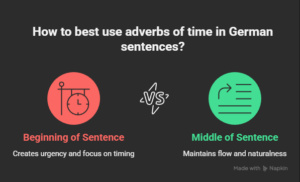
But, adverbs of time are not always in changing form, but their place in the sentence is very important. In German, meaning and dynamism are key ingredients in word order. Place a time adverb at the beginning of a sentence to create a sense of urgency and that the timing is important. Starting with Heute or Gestern tells the listener right away what is being done, and slight shifts the focus to time, rather than the content. This is particularly prevalent in spoken German and storytelling, where context matters just as much as the act itself.
The adverbs of time that appear in the middle of a sentence are quieter but equally important. They are able to carry on the primary verb and subject without being too critical. This is where the aforementioned guideline Time Manner Place – sometimes as TMP – comes in handy. This way, your German usually sounds natural and fluent if you put information together in the middle of a sentence. For example, putting time before how something happens and where it happens helps your sentence to flow in a way that native speakers expect.
Something interesting happens as the student becomes comfortable with these patterns. Sentences start to feel like tools you can shape rather than puzzles you’re pressing together. And the words of time begin to speak with you rather than against you, steering the order of your sentences and making your meaning more clear less difficult. Eventually, you stop thinking about where to put them, and they automatically fit together, helping you tell your story smoothly, clearly, and confidently.
Common German Adverbs of Time (With Examples)
1: How do you say "Good Morning" in German?
German time adverbs are easier to learn if you arrange them into clear sets rather than memorising them all. Most of these fall naturally into patterning consistent with the way we think about time in our daily lives.
The first group is calendar-based adverbs, such as today, yesterday and tomorrow. These are the more concrete, and are used in every day conversations, schedules, and storytelling.
The second group is dominated by relative time or context-based adverbs, such as now, earlier, or back then. They are not about a date; they are about a moment related to something other than that, so they’re essential for explanations and narratives.
The last group consists of frequency adverbs: always, never, sometimes, often, and rarely. These indicate how frequently something happens and are very common in opinions, habits and exam questions.
The following table lists the most important German time adverbs to learn first because they often appear in real conversations, textbooks, podcasts, and exams.
| Adverb | Meaning | Example (DE) | English |
| heute | today | Heute habe ich endlich mal wieder richtig gut geschlafen. | Today I finally slept really well again. |
| gestern | yesterday | Gestern bin ich durch den ganzen Regen gelaufen und trotzdem glücklich gewesen. | Yesterday I walked through all the rain and still felt happy. |
| morgen | tomorrow | Morgen treffe ich meine Sprachpartnerin zum ersten Mal live. | Tomorrow I’m meeting my language partner in person for the first time. |
| jetzt | now | Jetzt sitze ich hier und versuche, nicht aufzugeben. | Now I’m sitting here trying not to give up. |
| damals | back then | Damals dachte ich, Deutsch wäre viel schwerer als es wirklich ist. | Back then I thought German was much harder than it actually is. |
| früher | earlier / in the past | Früher habe ich jeden Tag drei Stunden Vokabeln gepaukt. | Earlier / In the past I crammed vocabulary three hours every day. |
| immer | always | Meine Mutter sagt, ich komme immer zu spät—und sie hat recht. | My mom says I’m always late—and she’s right. |
| nie | never | Ich habe nie verstanden, warum manche Leute Kaffee ohne Milch trinken. | I’ve never understood why some people drink coffee without milk. |
| manchmal | sometimes | Manchmal wache ich auf und habe plötzlich Lust, alles auf Deutsch zu denken. | Sometimes I wake up and suddenly feel like thinking everything in German. |
| bald | soon | Bald werde ich endlich mal nach Deutschland fahren können. | Soon I’ll finally be able to travel to Germany. |
| später | later | Später erzähle ich dir die ganze Geschichte—jetzt muss ich erst lernen. | Later I’ll tell you the whole story—for now I have to study first. |
| schon | already | Ich habe schon drei Kapitel gelesen und bin total stolz auf mich. | I’ve already read three chapters and I’m really proud of myself. |
| noch | still / not yet | Ich bin noch nicht müde—lass uns noch eine Runde üben. | I’m not tired yet—let’s do another round of practice. |
| oft | often | Oft höre ich deutsche Podcasts beim Kochen; das macht Spaß. | I often listen to German podcasts while cooking; it’s fun. |
| selten | rarely | Selten habe ich so viel Motivation wie heute Abend. | Rarely do I have this much motivation like tonight. |
Look at those example sentences for a second. They don’t sound like textbook German—they sound like real people talking about real feelings. That’s the goal. Learn the adverb, then steal the kind of natural sentence it lives in. The more sentences like that you collect, the less you’ll feel like you’re “doing grammar” and the more you’ll feel like you’re just chatting.
|
Goethe 2026 Exam Dates: Multiple Test Centers |
|
| Trivandrum Goethe Exam Dates | Kochi Goethe Exam Dates |
| Chennai Goethe Exam Dates | Coimbatore Goethe Exam Dates |
Free German A1 Mock Tests – Powered by AI!
Test your skills on our interactive platform. Get instant feedback from our AI to help you communicate better and track your progress. Start your free German mock test now.
Test Your German A1 for FreePosition of Adverbs of Time in German Sentences
Here’s where a lot of learners start to sweat: word order. But honestly, once you see the pattern, it’s not as scary as it looks.
The easiest and most common move is to put the time adverb right at the beginning of a main clause. When you do so, the verb automatically shifts to second position and everything else falls back on itself. “Gestern habe ich endlich meinen alten Freund wiedergetroffen.” Boom—time is set, verb is happy in position two, and the listener knows exactly where we are on the timeline.
If you don’t want to start with time (maybe the subject is more important right now), you put the adverb in the middle field and—here comes that TMP rule again—make sure time comes before manner and before place. “Ich treffe sie morgen um elf in der Altstadt.” Time (morgen), manner implied in the time phrase, place (in der Altstadt). The sentence feels balanced and natural.
In subordinate clauses things change somewhat. The time adverb normally falls somewhere between the middle, most often right after the subject, since the conjugated verb gets kicked to the end. “Ich freue mich, weil ich morgen endlich frei habe.” See how morgen followed ich but after the verb waiting at the end? That’s the usual pattern.
The practice tip that helped me the most was to take a simple sentence and rewrite it five ways, changing the time adverb around, and switching between main and subordinate clauses. After a week or so of doing that with different adverbs your brain senses the rhythm rather than just memorizing rules.
Adverbs of Time for A1–B2 Exams
If you’re working through the Goethe, TELC, or ÖSD exams from A1 to B2, here’s the honest truth: the examiners love time adverbs because they show whether you can actually tell a story or describe a day instead of just listing facts.
At A1–A2 you mostly need the big seven: heute, gestern, morgen, jetzt, immer, nie, manchmal. You should be able to use them in simple main clauses and maybe one or two easy weil-sentences. Examiners are happy if you can say things like “Gestern war ich krank” or “Ich lerne immer am Abend.”
By B1–B2 they expect more color: damals, früher, bald, später, schon, noch, oft, selten.
You should be able to compare the past and present (“Früher habe ich viel Sport gemacht, aber jetzt habe ich keine Zeit mehr”), talk about unfinished actions (“Ich habe das Buch noch nicht fertig gelesen”) or make future plans sound natural (“Bald werde ich eine längere Reise machen”).
The best exam prep trick I know is to push myself to use at least six time adverbs each time I write or record a response to a speaking prompt. It feels artificial at first, but you stop thinking about it and the words come out when you need them. That’s when you know you’re ready.
Learn German from the best mentors in the field! Join the Entri online course!
Common Mistakes
Let’s be real—everyone makes these mistakes at some point.
The number one slip is putting the time adverb at the end because that’s what feels normal in English or many other languages. “Ich lerne Deutsch heute Abend” sounds okay to you but a little strange to a German ear. Much more natural: “Heute Abend lerne ich Deutsch” or “Ich lerne heute Abend Deutsch.” Small change, big improvement in how native the sentence feels.
Second trap: using jetzt in almost every present-tense sentence. Native speakers drop it unless they really want to stress “right this second.” So instead of “Ich esse jetzt,” most people just say “Ich esse.” Save jetzt for moments like “Jetzt reicht’s mir!” or “Komm jetzt endlich!”
Third common headache: mixing up pure time adverbs with frequency ones. You can’t really say “heute immer” or “gestern manchmal”—it just doesn’t make sense.
Keep calendar words like heute, morgen, damals, and vorgestern out of your brain, and from repeating words like immer, oft, and rare. They are different things and when the grammar is right on paper, it is mixing them up that is one of the main reasons German sentences begin to feel awkward. By learning to recognize this difference automatically in your brain, you see a faster pace of sentences.
What these three issues can do is eliminate almost 80% of that gruesome “something sounds wrong” feeling, e.g., the placement of time words, calendar vs. frequency words, and natural sentence order. This requires no deep knowledge of complicated rules. Instead, look for native speakers’ uses of these words in real sentences and patterns that repeat itself every now and then.
The real test is when you stop dreaming in German and wake up realizing that you used übermorgen or vorgestern without thinking. That’s when those small time words stop being rules and start to become instinct. But until then, be patient with yourself, keep collecting natural example sentences and continue to speak or write every day. Progress is being made, even when it is slow.
Free German A1 Mock Tests – Powered by AI!
Test your skills on our interactive platform. Get instant feedback from our AI to help you communicate better and track your progress. Start your free German mock test now.
Test Your German A1 for FreeFrequently Asked Questions
What Exactly Are German Adverbs of Time, and Why Are They Considered More Critical Than in English?
German adverbs of time (Temporaladverbien) are words that definitively anchor an action, event, or state to a specific point or period on the timeline, answering the questions “wann?” (when), “wie oft?” (how often), or “wie lange?” (how long). They include words like gestern (yesterday), oft (often), and bald (soon). Their critical importance stems from a fundamental difference in how German and English handle temporal context. English often relies heavily on verb tenses (e.g., progressive, perfect aspects) and context to convey timing. German, while having tenses, places a higher premium on explicit, often adverb-driven, clarity. A sentence like “Ich schrieb den Bericht” can mean “I wrote the report” or “I was writing the report.” Adding gerade (just now) or gestern instantly eliminates ambiguity. This explicitness is woven into the language’s logic, making these adverbs not just helpful additions but foundational pillars for coherent communication, preventing the vague, “floating” sentences that often frustrate learners and listeners alike.
How Does the Infamous "Time-Manner-Place" (TMP) Rule Specifically Govern the Placement of Time Adverbs?
The TMP rule is the golden framework for structuring information in the middle field of a standard German main clause (after the conjugated verb). It dictates the order: Temporal (Time), Manier (Manner), Platz (Place). An adverb of time, therefore, typically occupies the first position within this cluster. For example: “Ich fahre morgen (T) mit dem Zug (M) nach Berlin (P).” This order isn’t arbitrary; it follows the German principle of moving from the more general, framing information (time) to the more specific (exact location). Placing the time adverb here creates a natural, fluent rhythm that native speakers expect. Violating this order, such as saying “Ich fahre nach Berlin morgen mit dem Zug,” sounds distinctly foreign and can cause momentary cognitive dissonance for the listener, as the information is presented in an illogical sequence. Mastering TMP is less about rote memorization and more about internalizing this logical flow of information.
When Should I Place a Time Adverb at the Very Beginning of a Sentence, and What Grammatical Effect Does That Trigger?
Placing a time adverb in the first position of a main clause is a powerful and common stylistic choice used to emphasize the time element as the topic or most important frame of the sentence. It’s particularly prevalent in storytelling (“Gestern passierte etwas Merkwürdiges…”), journalistic writing, or simply when the when is the crucial piece of information. Grammatically, this triggers the mandatory verb-second (V2) rule: the conjugated verb must immediately follow, in the second position. The subject then usually drops to after the verb. For instance: “Heute lerne ich Deutsch.” / “Morgen wird es regnen.” This inversion is automatic and non-negotiable. Starting with a time word is an excellent way to sound more narrative and dynamic, shifting focus from the actor (subject) to the temporal context of the action.
Can You Explain the Nuanced Differences Between "schon," "noch," and "noch nicht," and How to Use Them Correctly?
This trio deals with the concepts of “already,” “still,” and “not yet,” and their nuanced use is a hallmark of proficient German.
-
Schon implies that an action or state has begun or been completed earlier than expected. It often carries a tone of surprise or emphasis. “Ich habe schon gegessen” (I’ve already eaten – perhaps you thought I hadn’t).
-
Noch indicates that an action or state is continuing or remains true. “Ich wohne noch in München” (I still live in Munich). It can also mean “another” in contexts like “noch ein Bier” (another beer).
-
Noch nicht is the clear negation of a change that is expected to happen in the future. It means the action/state has not begun up to this point, but the expectation remains. “Ich habe den Film noch nicht gesehen” (I haven’t seen the film yet [but I might]).
The key is mindset: schon looks backward at what has happened; noch looks at the present continuation; noch nicht looks forward to an anticipated change.
How Do Adverbs of Time Function Within Subordinate Clauses, and Does the TMP Rule Still Apply?
In subordinate clauses (introduced by dass, weil, obwohl, etc.), the conjugated verb is sent to the very end of the clause. The placement of adverbs, however, still follows a logical structure. Typically, the time adverb finds its place in the middle of the subordinate clause, often directly after the subject or the introductory conjunction + subject. Crucially, the TMP principle still holds within the confines of the clause. For example: “Ich weiß, dass ich morgen (T) schnell (M) zum Bahnhof (P) gehen muss.” The verb cluster (gehen muss) remains at the end, but the internal order of information maintains the Time-Manner-Place sequence. This consistency across clause types makes the rule incredibly reliable for building complex, yet grammatically sound, sentences.
What Are the Most Common Mistakes Learners Make with Adverbs of Time, and How Can I Actively Avoid Them?
Three pervasive errors consistently mark non-native speech:
-
The English-Style End Placement: Putting the time word at the sentence end (“Ich besuche meine Oma am Wochenende“) is understandable but jarring. Solution: Force it to the beginning or into the middle field early in your learning. “Am Wochenende besuche ich meine Oma” or “Ich besuche am Wochenende meine Oma.”
-
Overusing “jetzt”: Learners pepper present-tense sentences with jetzt where it’s not needed. Native speakers use it primarily for contrast or immediate emphasis. Solution: Omit jetzt unless you mean “right this second” or “as opposed to before.”
-
Conflating Calendar-Based and Frequency Adverbs: Trying to combine them in illogical ways (e.g., “Ich ging gestern oft ins Kino”). Solution: Categorize them mentally. Gestern is a fixed point; oft is a pattern over time. Frame sentences around one primary temporal frame first.
Is There a Strategic List of Adverbs I Should Prioritize for Goethe/TELC Exams at Levels A1-B1 and B2-C1?
Absolutely. A strategic, tiered approach aligns perfectly with exam requirements:
-
A1-A2 (Foundation): Master the concrete and essential: heute, gestern, morgen, jetzt, immer, nie, manchmal, oft. Focus on using them correctly in simple main clauses.
-
B1 (Independent Use): Expand into narrative and relational time: früher (in the past), damals (back then), bald (soon), später (later), schon, noch, noch nicht. You should now be comparing past/present and discussing future plans using these.
-
B2-C1 (Fluency & Nuance): Incorporate precision and sophistication: vorhin (a while ago), sofort (immediately), gelegentlich (occasionally), inzwischen (meanwhile), seither (since then), einst (once, formerly), neulich (recently). Exam candidates at this level are expected to structure complex narratives, argue points with temporal precision, and understand subtle distinctions in formal texts.
How Can Practicing with Adverbs of Time Actually Accelerate My Overall German Fluency and "Thinking" in German?
They act as a neurological shortcut. By forcing you to establish time first—whether at the sentence start or early in the TMP sequence—you are forced to structure your thought process the German way. You begin conceptualizing the when before the what or how. This reduces mental translation from English, where time is often an afterthought. As this becomes automatic, your sentence assembly becomes faster and more confident. Furthermore, using these adverbs correctly provides immediate, clear feedback in conversations (fewer confused looks), which builds confidence and encourages more speaking, creating a positive feedback loop for fluency.
Beyond "gestern" and "morgen," What Are Some Key Adverbs for Discussing the Past and Future with More Nuance?
To move beyond basics, enrich your vocabulary with these:
-
Past: vorgestern (the day before yesterday), neulich / kürzlich (recently), vorhin (a short while ago), ehemals / früher (formerly, in the past), damals (back then, at that time).
-
Future: übermorgen (the day after tomorrow), demnächst (in the near future, soon), in Kürze (shortly), bald (soon – general), später (later), irgendwann (sometime).
Where Can I Find Authentic, Real-World Examples of These Adverbs in Use to Move Beyond Textbook Learning?
Immersion is key. Actively listen and read for these words in:
-
German-Language Podcasts & YouTube Vlogs: Listen for how hosts naturally frame stories. “Also, damals habe ich gedacht…” or “Vorhin ist mir eingefallen…”
-
News Articles & Blogs: Journalistic writing strictly follows clear temporal framing. The first paragraph often establishes wann.
-
Film & TV Dialogue (with German Subtitles): Pay attention to everyday conversations. Notice how rarely jetzt is used without reason and how often stories start with a time adverb.
-
Song Lyrics: Great for seeing poetic or colloquial uses.
-
Language-Learning Apps with Native Audio: Use them not just for vocabulary, but to dissect sentence structure and adverb placement.
Create a “Sentence Mining” document where you collect real sentences you encounter, grouping them by the adverb used. This builds an intuitive, practical understanding no textbook alone can provide.