Table of Contents
German compound nouns combine smaller words into one clear term. They are written together without using any spaces. The last word decides both meaning and gender. For example, Haus and Tür form Haustür. Haus means house and Tür means door. The full meaning becomes the main door of a house. This shows how German builds precise and logical words.
Learn German language in your own language! Get free Demo Classes Here!
Key Takeaways:
- German compound nouns combine multiple words to one.
- Words are usually written without spaces.
- The ending word guides grammar and usage rules.
- Long words become easier when split into parts.
- Context matters more than direct word translation.
- Regular practice improves reading and understanding speed.
1. What Makes German Compound Nouns Important?
Clear and Precise Meaning
German compound nouns create clear and exact meanings. They combine small words into one meaningful term. Example: Haustür (house door) shows a specific idea. It avoids long and confusing word phrases. This makes communication simple and direct.
Efficient Vocabulary Building
It reduces the need for many words. One word can explain a full idea easily. Example: Bahnhof (train station) replaces longer explanations. This helps us remember vocabulary more effectively.
Logical Language Structure
German words follow a clear and logical pattern. Each part adds meaning step by step. The final word gives the main idea clearly. Example: Example: Schlafzimmer -> (sleep + room) or bedroom.
Easier Understanding with Practice
Long words may look difficult at first glance. Breaking them makes understanding much easier quickly. Practice helps recognize patterns in many words.

2. What Are German Compound Nouns?
1: How do you say "Good Morning" in German?
2: What does the German verb “essen” mean?
3: What is the German word for "blue"?
4: What does “Schule” mean in English?
5: How would you say "How are you?" formally in German?
Get Your German Language Proficiency Score
Simple Definition
These nouns are formed by joining two words. They form one new word with a clear meaning. These words are written without spaces. This makes them different from English phrases. They help express ideas in a compact form.
How They Work
Each part of the word adds to the meaning. The words combine to form one complete idea. The final word shows the main meaning clearly. This helps in understanding the purpose quickly. The structure stays simple and logical.
Common Examples
| Compound Word | Meaning |
|---|---|
| Haustür | house door |
| Bahnhof | train station |
| Fußballspieler | football player |
These above table show how words join to form meaning. Each word part contributes to the final idea. Learning them improves vocabulary understanding quickly.
|
German A2 Exercises – Download Free PDF |
||
Free German A1 Mock Tests – Powered by AI!
Test your skills on our interactive platform. Get instant feedback from our AI to help you communicate better and track your progress. Start your free German mock test now.
Test Your German A1 for Free3. How Are German Compound Nouns Formed?
They follow a simple and clear structure. They combine two or more words into one noun. The words are joined together without using spaces. This makes the formation easy to recognize and learn.
Structure
Word + Word forms a new noun easily. Each word adds meaning to the final term. The pattern stays consistent across many examples.
Examples
- Haus (house) and Tür (door) form Haustür.
- Auto (car) and Bahn (road) form Autobahn.
These combinations create specific and clear meanings.
Important Rule
The last word defines the main meaning clearly. It shows what kind of thing is described. Haustür means a type of door, not a house. This rule helps in understanding compound nouns quickly.
4. How Is Gender Determined?
Basic Rule
The gender of a compound noun depends on the last word. However, the gender is shown by the article, not the word. German uses der (masculine), die (feminine), and das (neuter). These articles help identify gender clearly.
How It Works
Always check the last word and its article together. The earlier words only add meaning to the noun. They do not affect the gender in any way. The article stays the same as the last word.
Examples
| Word | Gender |
|---|---|
| die Tür (the door – feminine) | die Haustür (the house door – feminine) |
| der Spieler (the player – masculine) | der Fußballspieler (the football player – masculine) |
| das Zimmer (the room – neuter) | das Schlafzimmer (the bedroom – neuter) |
Easy Tip
Focus on the article of the last word. This gives the correct gender every time.
5. What Are the Types of German Compound Nouns?
Common Patterns
German compound nouns follow simple and common patterns. These patterns help form clear and meaningful words. Each pattern combines different types of words together. Understanding these patterns makes learning much easier.
Noun + Noun
This is the most common type in German. Two nouns combine to form a new noun. Each word adds meaning to the final term.
Examples:
- Haus + Tür → (house + door) or Haustür
- Bücher + Regal → ( books + shelf) or Bücherregal
- Bade + Zimmer → ( bath + room ) or Badezimmer
Adjective + Noun
An adjective describes the noun in the compound. It adds more detail to the main word clearly.
Examples:
- Hoch + Haus → (high + house) or Hochhaus
- Groß + Stadt → (big + city) or Großstadt
Verb + Noun
A verb combines with a noun to show function. It often explains the purpose of the object.
Examples:
- Schlafen + Zimmer → (sleep + room) or Schlafzimmer
- Waschen + Maschine → (wash + machine) or Waschmaschine
Learn German language in your own language! Get free Demo Classes Here!
Free German A1 Mock Tests – Powered by AI!
Test your skills on our interactive platform. Get instant feedback from our AI to help you communicate better and track your progress. Start your free German mock test now.
Test Your German A1 for Free6. What Are Linking Letters (Fugenlaute)?
What Are Linking Letters?
Linking letters are small letters added between compound words. They help connect words smoothly in pronunciation. These letters make long words easier to say clearly. They are very common in German compound nouns.
Why Are They Used?
Some word combinations sound difficult without linking letters. Adding a letter improves the flow of the word. It makes pronunciation more natural and comfortable. These letters do not change the actual meaning.
Common Linking Letters
The most common linking letters are simple and short. These include s, n, and en in many words. They appear between the two parts of compounds.
Examples
- Arbeit + Zimmer → (work + room) or Arbeitszimmer
- Liebe + Brief → (love + letter) or Liebesbrief
- Auge + Farbe → (eye + color) or Augenfarbe
Key Point
Linking letters only improve sound and word flow. They do not add any new meaning.
7. Why Are German Compound Words So Long?
Reason for Long Words
German allows combining many words into one noun. This helps express detailed ideas in a single term. Instead of long sentences, one word gives full meaning. This makes communication more precise and compact.
How It Works
Each small word adds meaning to the final word. These parts join together without using spaces. The structure remains logical and easy to follow. Breaking the word helps understand it clearly.
Example Breakdown
Donaudampfschifffahrtsgesellschaft is a very long compound word.
- Donau (Danube) -> river name.
- Dampf (steam) -> steam power.
- Schiff (ship) -> a boat or vessel.
- Fahrt (journey) -> travel or movement.
- Gesellschaft (company) -> an organization or company.
Key Idea
All parts combine into one precise meaning. It replaces a long descriptive phrase easily.
8. How to Understand German Compound Nouns Easily?
Practical Approach
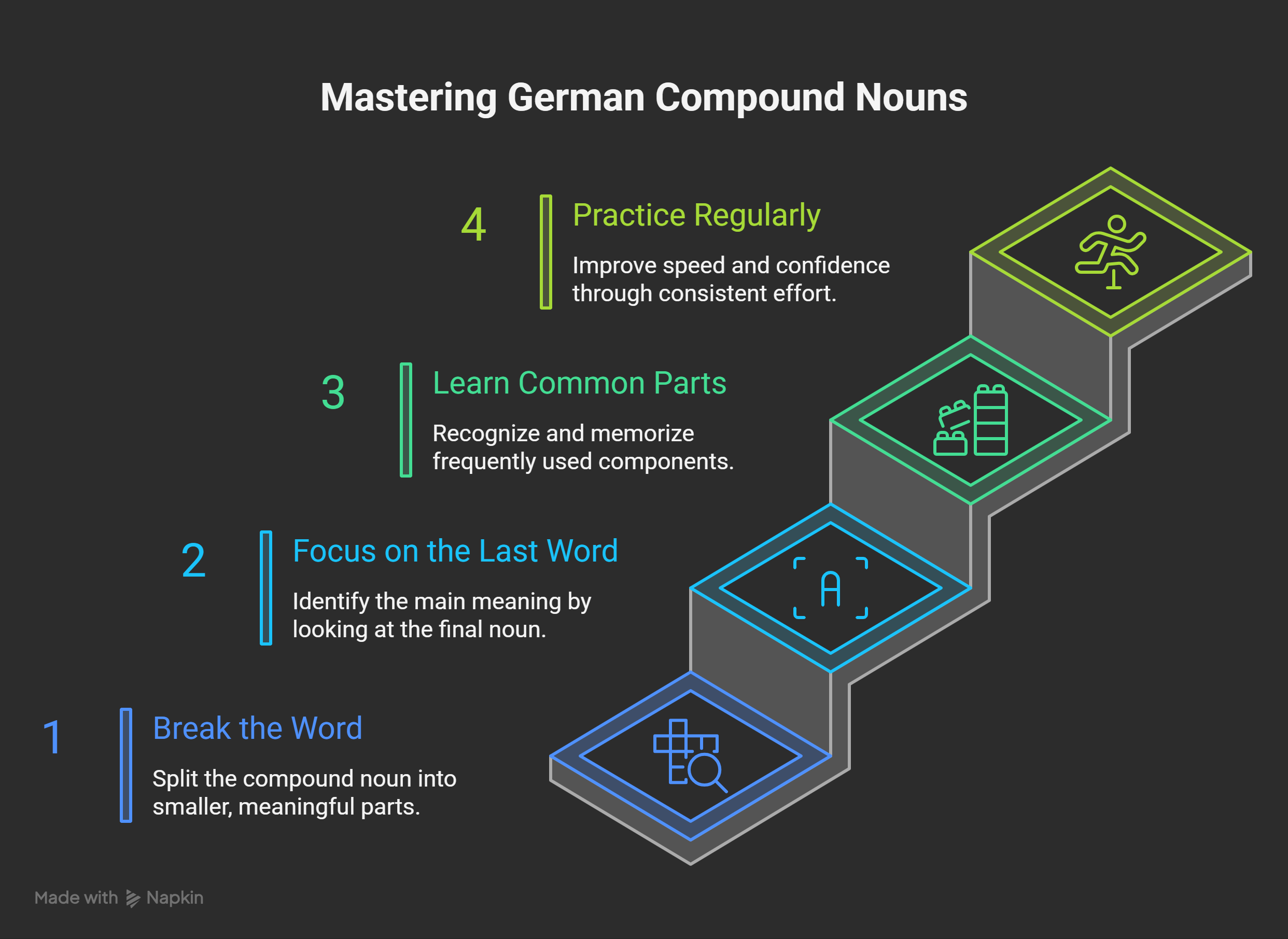
Understanding compound nouns becomes easier with simple steps. Long words may look confusing at first glance. Breaking them helps reveal their actual meaning clearly. Practice improves speed and confidence over time.
Break the Word
Always split the compound into smaller meaningful parts. Each part adds something to the full meaning. This helps in understanding the word step by step.
Focus on the Last Word
The last noun gives the main meaning clearly. It tells what kind of object is described. This makes interpretation faster and more accurate.
Learn Common Parts
Many words repeat in different compound nouns. Learning common parts builds vocabulary quickly. It also helps recognize patterns in new words.
Practice Regularly
Reading long words daily improves understanding skills. Practice helps identify parts more quickly and easily.
Example
Handschuh can be broken into two simple words.
- Hand (hand) + Schuh (shoe) = glove
The meaning may not always be literal exactly.
💡 Pro Tip
Always start reading compound nouns from right to left. The last word gives the main meaning instantly. Then move left to add extra details step by step. This method makes even very long words easy to understand. It also improves reading speed and confidence quickly.
9. What Are Common Mistakes?
Literal Translation Mistake
A common mistake is translating words word by word. This often leads to incorrect or confusing meanings. German compounds do not always match literal translations. Example: Handschuh means glove, not hand shoe.
Ignoring the Last Word
Many learners ignore the final word in compounds. This causes misunderstanding of the main meaning. The last word gives the correct idea clearly. Always focus on it first for accuracy.
Not Breaking the Word
Some learners try to read the whole word at once. This makes long words look difficult and confusing. Breaking words into parts makes understanding much easier.
Misunderstanding Linking Letters
Linking letters can confuse learners during reading. They may think these letters change the meaning. However, they only improve pronunciation and flow.
Lack of Practice
Not practicing regularly slows down learning progress. Reading and breaking words helps improve understanding speed.
|
Goethe 2026 Exam Dates: Multiple Test Centers |
|
| Trivandrum Goethe Exam Dates | Kochi Goethe Exam Dates |
| Chennai Goethe Exam Dates | Coimbatore Goethe Exam Dates |
10. Practice Exercises
Exercise 1: Break the Compound Words
Break each compound noun into smaller parts clearly. Write the individual words and their meanings. This helps understand how the words are formed.
- Schlafzimmer
- Haustür
- Fußballspieler
- Waschmaschine
- Bücherregal
Exercise 2: Identify the Last Word
Look at each compound noun carefully. Identify the last word in each example. Write what the last word means in English.
- Autobahn
- Großstadt
- Liebesbrief
- Arbeitszimmer
- Badezimmer
Exercise 3: Find the Meaning
Read each compound noun given below. Try to guess the meaning by breaking it. Then write the correct meaning in English.
- Handschuh
- Hochhaus
- Augenfarbe
- Bahnhof
- Schlafzimmer
Answers
Exercise 1 Answers:
- Schlafzimmer
- Schlaf -> sleep
- Zimmer -> room
- Haustür
- Haus -> house
- Tür -> door
- Fußballspieler
- Fußball -> football
- Spieler -> player
- Waschmaschine
- Waschen – >to wash
- Maschine -> machine
- Bücherregal
- Bücher – >books
- Regal -> shelf
Answers to Exercise 2:
- Bahn (road/track)
- Stadt (city)
- Brief (letter)
- Zimmer (room)
- Zimmer (room)
Answers to Exercise 3:
- Handschuh
Hand (hand) + Schuh (shoe) → glove. Meaning is not literal. - Hochhaus
Hoch (high) + Haus (house) → high-rise building. Shows a tall building. - Augenfarbe
Augen (eyes) + Farbe (color) → eye color. Describes eye color. - Bahnhof
Bahn (railway) + Hof (yard) → train station. Place for trains. - Schlafzimmer
Schlafen (to sleep) + Zimmer (room) → bedroom. Room for sleeping.
11. Quick Summary
German compound nouns join two or more words together. They are written as one word without spaces. Each part adds meaning to the whole word. The last word gives the main meaning clearly. It also helps you know the correct gender.
There are different types like noun, adjective, and verb combinations. Sometimes small letters are added for easy pronunciation. Long words can be understood by breaking them. Meanings are not always exactly literal. Regular practice helps you read and understand faster.
Free German A1 Mock Tests – Powered by AI!
Test your skills on our interactive platform. Get instant feedback from our AI to help you communicate better and track your progress. Start your free German mock test now.
Test Your German A1 for FreeFrequently Asked Questions
What are German compound nouns?
They are nouns formed by combining two or more words. These words join together to create one meaningful term.
How are German compound nouns written?
They are written as a single word without spaces. This makes them look longer than English phrases.
Why does German use compound nouns?
They help express ideas clearly using fewer words. One compound word can replace a full phrase.
How do you understand long compound words?
You can break the word into smaller parts. Each part helps build the overall meaning.
What determines the meaning of a compound noun?
The last word gives the main meaning clearly. The earlier words only add extra detail.
How is gender decided in compound nouns?
The article of the last word decides the gender. This rule stays the same in most cases.
What are linking letters in German compounds?
They are small letters added between words for better flow. They help make pronunciation smoother.
Do linking letters change the meaning?
No, they do not change the meaning of the word. They only improve how the word sounds.
Are compound meanings always literal?
No, meanings are not always exactly literal. Some words have meanings different from direct translation.
How can you learn compound nouns easily?
Practice regularly and learn common word parts. Breaking words helps improve understanding quickly.