
Table of Contents
Key Takeaways:
- German grammar uses four cases to define noun roles.
- Each case clearly shows how nouns function in sentences.
- Articles change based on the case and gender used.
- Masculine forms show the most noticeable article changes.
- Noun endings sometimes change in dative and genitive cases.
- Cases help maintain meaning even with flexible word order.
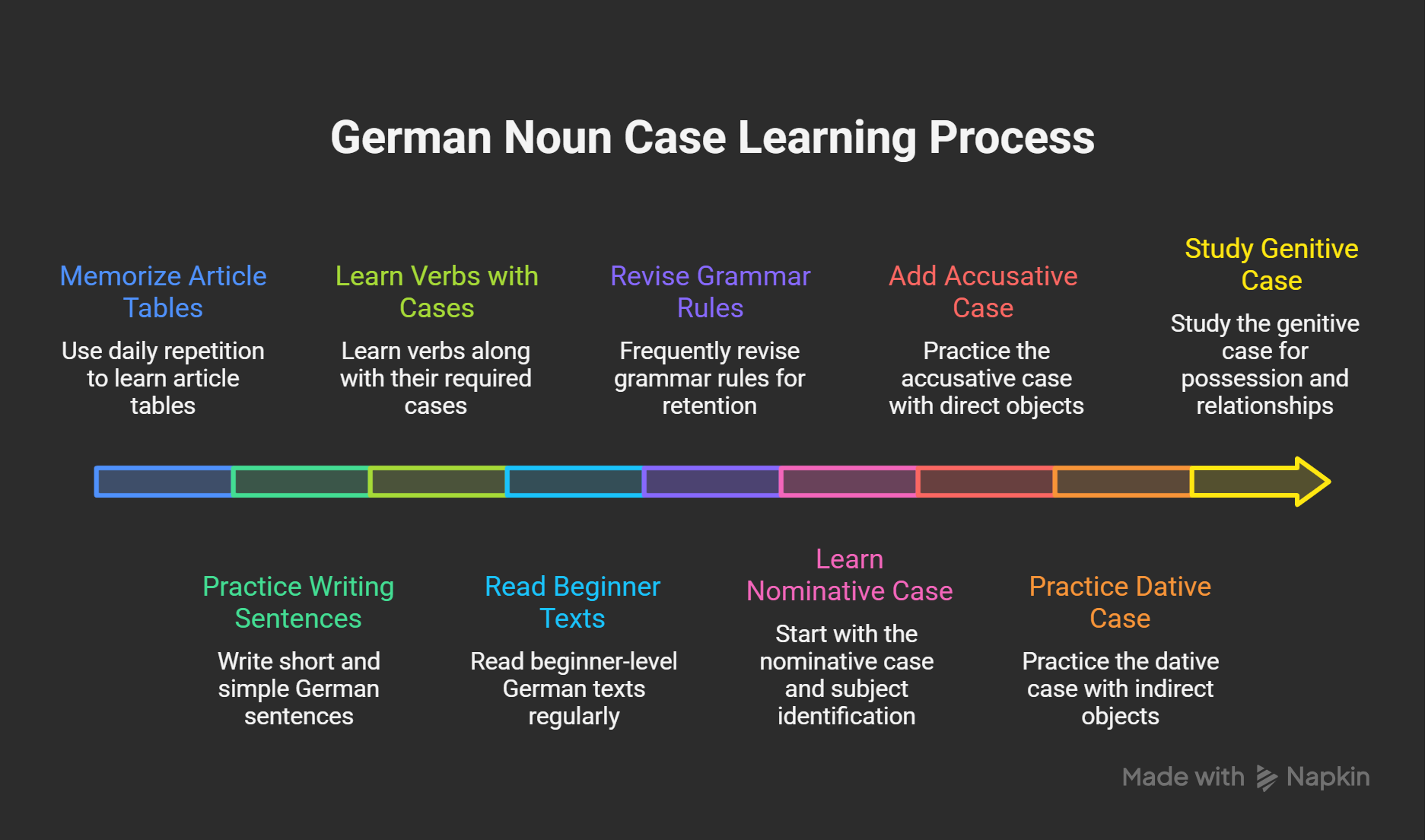
- Learning article tables improves accuracy in sentence formation.
- Regular practice with examples strengthens understanding of cases.
German noun cases explain how nouns function within sentences. They help identify roles like subject and object clearly. German grammar uses four main cases for this purpose. Each case changes the article used with nouns. Sometimes, the noun ending also changes slightly.
Consider this complete example sentence carefully: “Der Mann gibt dem Kind den Ball des Hundes.” This sentence includes all four German cases together. Sentence Meaning in English : “The man gives the child the dog’s ball.”
In this sentence, each noun has a clear role.
-
Der Mann is the subject performing the action.
-
dem Kind is the receiver of the action.
-
den Ball is the object being given here.
-
des Hundes shows who owns the ball.
The article der shows the nominative case here. Where as dem shows the dative case clearly. The article den shows the accusative case here. Where as des shows the genitive case here.
German has four important noun cases overall:
-
Nominative shows the subject of the sentence.
-
Accusative shows the direct object clearly.
-
Dative shows the indirect object or receiver.
-
Genitive shows possession or relationship between nouns.
Understanding these cases improves sentence clarity significantly. They also help in forming correct and natural sentences.
Learn German language in your own language! Get free Demo Classes Here!

What Are German Noun Cases?
German noun cases show how nouns function in sentences. They help identify subjects, objects, and relationships clearly. Cases make sentence meaning clear with flexible word order. They allow sentences to remain understandable despite word changes. Each noun role becomes easier to identify quickly.
Case Functions Overview
| Case | Function |
|---|---|
| Nominative | Subject performing the action |
| Accusative | Direct object receiving the action |
| Dative | Indirect object receiving something |
| Genitive | Shows possession or relationship |
Each case answers a specific question in sentences. These questions help identify correct noun usage clearly. Articles change based on the case used. This rule is central in German grammar learning. It helps distinguish roles without changing sentence structure.
|
German A2 Exercises – Download Free PDF |
||
Why German Cases Are Important
-
German cases prevent confusion in sentence meaning clearly.
-
They show relationships between words very clearly.
-
They support flexible and natural word order.
-
These cases improve overall grammar accuracy in writing tasks.
-
They help learners understand complex sentences more easily.
Example Breakdown
Consider this example sentence carefully:
Der Mann gibt dem Kind den Ball. (The man gives the child the ball.)
Der Mann is the subject performing the action here. dem Kind is the indirect object receiving something here. den Ball is the direct object in the sentence. Each noun uses a different case form clearly.
What Is the Nominative Case (Subject)?
1: How do you say "Good Morning" in German?
The nominative case is used for the subject in sentences. The subject performs the action described in the sentence. This case helps identify who or what acts clearly. It is the most basic and important German case.
Basic Examples
Der Mann ist heute hier. (The man is here today.)
Die Frau arbeitet im Büro. (The woman works in the office.)
Das Kind spielt im Garten. (The child plays in the garden.)
Die Lehrer erklären die Grammatik. (The teachers explain the grammar.)
Each sentence shows the subject in nominative case clearly. The subject performs or represents the main action here.
Article Table
| Gender | Article |
|---|---|
| Masculine | der |
| Feminine | die |
| Neuter | das |
| Plural | die |
These articles stay in their original base forms here. They do not change in the nominative case usage.
Key Points About Nominative
-
The nominative case answers “Who or what performs action?”
-
The nominative case is usually the first case learned.
-
The nominative case keeps articles in their base forms.
-
The nominative case always marks the subject clearly.
Additional Practice Examples
Der Hund läuft schnell im Park. (The dog runs quickly in the park.)
Die Katze schläft ruhig auf dem Sofa. (The cat sleeps quietly on the sofa.)
Das Buch liegt auf dem Tisch. (The book lies on the table.)
Die Kinder lachen laut im Garten. (The children laugh loudly in the garden.)
The nominative case appears in every complete sentence. It always identifies the subject clearly and correctly.
👉 Learn more: https://entri.app/blog/nominative-case-in-german/
Free German A1 Mock Tests – Powered by AI!
Test your skills on our interactive platform. Get instant feedback from our AI to help you communicate better and track your progress. Start your free German mock test now.
Test Your German A1 for FreeWhat Is the Accusative Case (Direct Object)?
The accusative case shows the direct object clearly in sentences. The direct object receives the action from the subject. This case helps identify what is affected by action. It is very common in everyday German sentences.
Example Sentence
Der Mann sieht den Hund im Park. (The man sees the dog in the park.)
Der Mann is the subject performing the action here. den Hund is the direct object receiving the action here. The verb shows an action directed at the object.
Article Table
| Gender | Article |
|---|---|
| Masculine | den |
| Feminine | die |
| Neuter | das |
| Plural | die |
Masculine articles change clearly from nominative to accusative. Feminine, neuter, and plural forms often remain unchanged. This pattern helps learners identify accusative usage quickly.
Key Points About Accusative
-
The accusative case answers “Whom or what receives action?”
-
The accusative case shows the direct object in sentences.
-
Masculine articles change most clearly in this case.
-
Feminine and neuter forms often remain unchanged.
More Examples
Ich sehe den Hund jeden Tag. (I see the dog every day.)
Sie liest das Buch am Abend. (She reads the book in the evening.)
Er kauft die Blume für seine Mutter. (He buys the flower for his mother.)
Wir besuchen die Stadt im Sommer. (We visit the city in summer.)
Each example shows a direct object receiving the action. The accusative case clearly marks that object in sentence.
Verbs Commonly Using Accusative
Some verbs always require the accusative case for objects:
-
sehen
-
kaufen
-
lesen
-
besuchen
These verbs usually act directly on an object. Learning such verbs helps identify accusative case quickly.
Learning Tip
Focus on masculine article changes while learning this case. They clearly show differences between nominative and accusative forms.
👉 Learn more: https://entri.app/blog/accusative-case-in-german/
Free German A1 Mock Tests – Powered by AI!
Test your skills on our interactive platform. Get instant feedback from our AI to help you communicate better and track your progress. Start your free German mock test now.
Test Your German A1 for FreeFrequently Asked Questions
What are German noun cases used for?
They show noun roles clearly. They define sentence meaning precisely.
How many cases exist in German grammar?
German grammar has four cases. Each case has a specific role.
Which case should beginners learn first?
Beginners should learn nominative case first. It is the simplest case.
Why do masculine articles change often?
Masculine forms show clear differences. They reflect case changes strongly.
Is dative case difficult for beginners?
Dative needs practice and repetition. Verbs help understanding faster.
Is genitive case used in daily speech?
It is less common in speech. Dative often replaces it.
Do nouns always change in every case?
Articles change more often. Some nouns also change endings.
How can cases be memorized easily?
Use tables and examples daily. Practice improves memory retention.
Which verbs require the dative case?
Verbs like helfen and geben require dative case.
How long does it take to master cases?
Basics are learned quickly. Mastery needs consistent practice.