Table of Contents
Imagine that you were in German conversation and suddenly reluctance, saying the wrong “he” or “you”. The sentence was flowing fine, but one big pronoun error makes everything feel wrong. This type of frustration is a common German learning experience but it doesn’t have to stop. Understanding your personal pronouns can clear out this barrier and help you speak much more confidently.
Personal pronouns in German are short words that replace verbs like names, people, animals or objects. They are used principally to make sentences sound natural and to prevent unnecessary repeating. Pronouns enable communication to be smooth and efficient rather than repeating a name repeatedly. While this notion is similar to English, German uses pronouns in a very different way and can be jarring for beginners.
Unlike the English pronouns, which are generally the same regardless of position, German personal pronouns change grammatical case. These examples give a sense of the pronoun and its place in a sentence. The nominative case is used when the pronoun is the action subject. The accusative case arises when the pronoun is the subject of the action. The indirect object is the person or thing who is benefiting from the action.
These changes may seem overwhelming at first, but they develop clear and consistent patterns. When you begin to see these patterns, German sentences become more appropriate. You will no longer have to guess which form to use and it will feel more natural to speak and write.
The complete German personal pronouns chart presented below brings all these forms together across the three main cases. Seeing them organized in one place makes it easier to notice how each pronoun changes. When you study this chart alongside real sentence examples, you build a strong foundation that makes everyday German less intimidating and far more approachable.
Learn German from the best mentors in the field! Join the Entri online course!
What Are Personal Pronouns in German?
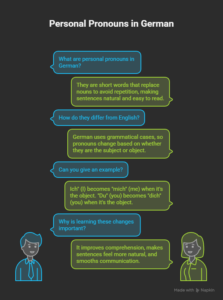
Personal pronouns are very short but important words that replace nouns so we do not have to repeat names or objects, and again and again. We do not repeat the name of someone, we write “he,” “she” or “they” to make sentences natural and easy to read. It is very simple in English because the pronouns change very little. The difference in whether a pronoun is the subject or the object is minimal. But German works differently.
German case system adds clarity by clearly labeling who is doing and who is receiving an action. At the same time, this system requires more attention from the student. It is not possible to use the same pronoun over and over again. In other word, the pronoun for “I” is ich when it is the subject, as in “Ich esse einen Apfel” (I eat an apple). When the same pronoun is used as the object in directness, it becomes mich, or “Sie sieht mich” (She sees me). The change signifies that the speaker is not putting the action but is putting it there.
The same pattern applies to other pronouns. Du is the informal “you” when it is the subject, such as “Du läufst schnell” (You run fast). Then someone takes action upon you, and the name becomes dich, “Ich rufe dich an”. These changes may seem insignificant, but they carry important grammatical information that helps German sentences to be clear and clear.
Because personal pronouns appear constantly in everyday speech, learning their case-based forms early is extremely helpful. Once learners understand why these changes happen, sentences begin to feel more natural, comprehension improves, and communication becomes smoother from the very beginning.
German Personal Pronouns Chart (All Cases)
The table below presents every personal pronoun in German across the nominative, accusative, and dative cases, making it easy to compare forms side by side and notice helpful patterns at once.
| Person | Nominative | Accusative | Dative |
| I | ich | mich | mir |
| you (singular informal) | du | dich | dir |
| he | er | ihn | ihm |
| she | sie | sie | ihr |
| it | es | es | ihm |
| we | wir | uns | uns |
| you (plural informal) | ihr | euch | euch |
| you (formal) | Sie | Sie | Ihnen |
You can immediately see that some forms remain the same across cases, such as “uns” for “we” in accusative and dative or “euch” for informal plural “you” while others entirely change, such as “er” becoming “ihn” and then “ihm.” In nominative and accusative the word “Sie” is retained, but is replaced by “Ihnen” in dative, and the word “sie” appears in two very different contexts depending on capitalization. Having this single chart in your pocket—printable, or save it on your smartphone—will allow you to check forms easily while practicing so you don‘t guess, but spend more time actually using German.
|
German A2 Exercises – Download Free PDF |
||
Nominative Personal Pronouns (Subject)
Nominative pronouns are always the subject of the sentence, which means they indicate who or what is doing the action, and the verb is person and number with them. Because the subject usually happens within or near the beginning of a German statement, these pronouns tend to set the stage for everything that follows. For example, the pronoun “ich” in “Ich lerne Deutsch jeden Tag” clearly means that the speaker is learning German. Similarly, “Du spielst Fußball mit Freunden” entails the word “du” to suggest that the person being addressed is playing soccer. When someone else is mentioned, you might say “Er fährt jeden Morgen mit dem Zug zur Arbeit” – “er” being the driver, or “Sie malt herrlich Landschaften” being the artist who makes the pictures.
For neutral things or weather, “Es regnet heute den ganzen Tag” uses the word “es” as the subject doing the raining. For example, in the plural “Wir essen zusammen im Restaurant” the group is split between eating and the informal plural “Ihr tanzt wirklich gut,” when several friends dance skillfully.
Accusative Personal Pronouns (Direct Object)
Accusative pronouns are used when a noun or pronoun is called the direct object of a sentence. In simple words, they experience the verb’s action and ask “whom?” or “what?” . In German, many of the used verbs such as sehen (to see), lieben (to love), kaufen (to buy) and treffen (to meet) require object in the accusative. This patterning is a must in order for sentences to be natural and grammatically correct.
For example, in “Er sieht mich im Park”, er performs the action of seeing, while mich is the being seen. Because the action goes directly from verb to person, mich shows up in the accusative form. This same structure is found in emotional words such as “Ich liebe dich wirklich sehr.” Hier, dich represents the recipient of the sensation of love and thus this sentence is personal and direct.
A case in point is that accusative pronouns are not only useful in a case of something. The German language uses pronouns rather than nouns. The object das neue Handy might be translated to “Sie kauft es” as in “Sie kauft das new Handy.” The es is the phone, and it remains in the accusative case because it is what is being bought.
This applies to people, too. Sie is the object of the act, and him means that man who was met in “Sie trifft ihn morgen Nachmittag” . So, “Er küsst sie sanft auf die Wange” the subject er carries out the act of kissing, and she gets it.
Because accusative verbs appear so frequently in daily conversation, mastering accusative pronouns helps you express actions clearly and confidently, avoiding sentences that sound incomplete or unnatural.
|
Goethe 2026 Exam Dates: Multiple Test Centers |
|
| Trivandrum Goethe Exam Dates | Kochi Goethe Exam Dates |
| Chennai Goethe Exam Dates | Coimbatore Goethe Exam Dates |
Dative Personal Pronouns (Indirect Object)
The descriptive pronouns are an indirect object, meaning “to whom?” they often begin with verbs like “helfen” (to help), “geben” (to give), “sagen,” (to say to), or “zeigen” (to show to). In “Er hilft mir immer, wenn ich Probleme habe,” the use of the pronoun “mir” indicates that the speaker is helping him. Another etymology is “Ich gebe dir morgen das Buch zurück,” where the word “dir” refers to the book being returned.
For example, if “Sie schickt him eine lange Nachricht” puts “ihm” as recipient of the message and “Wir erzählen ihr die ganze Geschichte,” “ihr” as listener to the tale. You could “Sie leiht euch das Geld für das Projekt,” “euch” as the group that borrowed the money, and “Ich antworte Ihnen” in polite or formal form. “So schnell wie möglich,” where “Ihnen” is addressed respectfully. Many of the verbs that are important, as well as some common prepositions such as “mit” (with), “bei” (at), and “von” (from), have the dative case, so the ability to learn these pronouns well allows you to bring action into direct connection with the people or things they affect in a natural and grammatically appropriate way.
German Formal vs Informal Pronouns (Sie vs du)
German makes an important distinction between informal “du” and formal “Sie” when addressing “you,” and choosing the correct one shows respect and helps conversations feel appropriate for the situation.
The informal “du” is used with close friends, family, children and people you know. Well, the “Sie” (with a capital letter always) is used when talking to strangers, old people, teachers, colleagues, shop assistants, or anyone working in the office until they suggest that they go with “du.”
But, learners often miss the word “du” too soon when communicating with someone who is expecting formality – and it can sound rude, even when the intent is not to harm. The plural informal “ihr” and “du” are often used in conversation in spoken German, and the plural formal “Sie” is applied for both singular and plural formal situations, and listeners have to look at the context and verb endings in order to see what is meant. Learning to switch between pronouns by acting out this transition through role-plays—like greeting the teacher with “Sie” and a friend with “du”, helps the learner make the appropriate pronoun choices quickly and politely.
Common Mistakes with German Personal Pronouns
Many students find themselves adding lowercase “sie” (she / they) to capital ‘Sie’ (formal you), especially when they are writing quickly, and such an impossibility of capitalization can completely change the meaning of a sentence. Another common problem is using the wrong case, such as placing a nominative pronoun next to an accusative or dative pronoun, which makes grammar ungrammatical and also often confuses the listener. Order in words can be troublesome as well: German expects pronouns to behave according to certain rules; e.g., if a dative and an accusative object are in the same sentence; to place them in the wrong order appears natural to native speakers.
When putting a noun with a pronoun, beginnings sometimes forget to pair the gender: they use “er” rather than “sie” for a feminine word like “die Katze” which violates the agreement rule. Another mistake that erodes politeness and can lead to awkward moments is to use “du” with people who think “Sie” is “real.” Read aloud your own sentences to correct these errors, compare them to the chart and pay attention to every time you write or speak a sentence that contains more than one pronoun.
Personal Pronouns in German Sentence Structure
The verb-second rule in German sentences follows, so the conjugated verb always occupies the second position, and personal pronouns must smoothly wrap around this fixed point to keep the order of words sorted. If a pronoun is used as the subject, it usually stands at the beginning, “Ich gehe jetzt nach Hause,” but if something else takes an interest in the front, it stands behind the verb, “Jetzt gehe ich nach Hause.” In questions the verb follows immediately, such as “Gehst du heute ins Kino?” The dative pronoun almost always precedes the accusative pronoun, in “Ich gebe dir es später.” This is the norm for direct and indirect objects following the verb.
The sentence “Mir hilft er immer sofort” is already in the active voice because the subject “er” is the one doing helping In either case the sentence is still in action, and the change only has a function for emphasis, not the grammatical voice. Because this loose, yet rule-based structure is one of the keys to sounding natural, practicing different word order with the same pronouns helps you feel patterns and produce sentences that sound fluent rather than stiff or foreign.
Learn German from the best mentors in the field! Join the Entri online course!
Personal Pronouns for A1–A2 Exams
At the A1 and A2 levels, learners frequently examine the personal pronouns ich, du, er, sie, es, wir, ihr, and Sie as they appear in simple conversations, descriptions, and written texts. For example, in typical tests you must write the correct pronoun, according to the case, and whether “du” is right or “Sie” is the right pronoun, or you can rewrite a sentence by substituting a noun with the correct pronoun. In speaking tasks the testers are very attentive to whether you use “Sie” politely in a shop or office scene, or whether you’re using “du” naturally in a conversation with a friend. For writing assignments you should write short paragraphs or messages with different pronouns without being too repeatable; so you will score higher for short texts that talk about family, everyday routines or plans.
Best practices are to memorize the chart on regular flashcards, to say the entire example sentence in loud voice, to listen to beginner podcasts and learn about the use of pronouns, and to do practice quizzes that mix cases and formality levels. Pronouns are the backbone of nearly every A1–A2 activity, so learning pronouns early serves as an advantage and makes passing these beginner exams much more feasible.
Frequently Asked Questions
Why do German personal pronouns change so much more than English ones, and how does this actually improve clarity?
German pronouns change according to grammatical case—nominative, accusative, and dative—which is a system largely absent from modern English. This might seem like an extra hurdle, but it serves a critical function: it precisely labels the grammatical role of each person or thing in a sentence, independent of word order. For example, in the sentence “Der Hund beißt den Mann” (The dog bites the man), the articles tell us who is doing the biting. Even if we scramble the words to “Den Mann beißt der Hund,” the meaning remains clear because “den Mann” is in the accusative case, marking it as the one being bitten. When we replace nouns with pronouns, this case system continues to provide that clarity. This allows German sentence structure to be more flexible and reduces ambiguity, especially in complex sentences. Mastering this system means you can understand who is doing what to whom with greater certainty.
What is the single most common mistake learners make with "sie" and "Sie," and how can I avoid it permanently?
The most frequent and impactful error is the confusion of lowercase “sie” (she/they) and the capitalized formal “Sie” (you). A simple typo can completely alter a sentence’s meaning and level of politeness. For instance, “Kennen Sie ihn?” means “Do you (formal) know him?” while “Kennen sie ihn?” means “Do they know him?” To avoid this permanently, develop a two-part mental checklist: First, context. Are you addressing someone directly with respect? If yes, it’s formal “Sie.” Second, capitalization and verb conjugation. The formal “Sie” always takes a capital ‘S’ and is conjugated identically to the third-person plural “sie” (they). A reliable trick is to remember that the formal “You” in German deserves a capital letter out of respect, just like the English “I.”
Beyond "du" and "Sie," how do I navigate the social nuances of choosing the correct "you" in real-life situations?
The choice between informal “du” and formal “Sie” is a cornerstone of German social etiquette. The safe default rule is to always start with “Sie” when interacting with strangers, professionals, service personnel, and anyone significantly older than you. The switch to “du” is a meaningful step that is typically offered by the older person, the superior, or the one more established in the relationship, often accompanied by the phrase “Wir können uns duzen” (We can use “du”). In workplace settings, many modern startups use “du” from the start, while traditional corporations may retain “Sie.” Among peers of similar age, especially in informal settings like universities or sports clubs, “du” is common. When in doubt, err on the side of formality; it is never rude to be too polite initially, but being overly familiar can be.
How can I reliably remember the accusative and dative pronouns, especially the tricky ones like "ihm," "ihr," and "Ihnen"?
Effective memorization requires moving beyond rote learning to pattern recognition and active use. Notice these key patterns: The masculine pronouns follow a distinct path: er → ihn → ihm. The feminine “sie” stays sie in both nominative and accusative, only changing to ihr in the dative. For the formal “Sie,” it remains Sie in nominative/accusative and changes to Ihnen in the dative—note the shared “-n” ending with “ihm,” “ihr,” and “uns.” The best practice is to learn them within fixed, high-frequency verb phrases. Drill pairs like: “Ich helfe dir“ (dative), “Ich sehe dich“ (accusative). Using flashcards with full sentences, not just isolated pronouns, will build the neural pathways for correct application.
What is the correct word order when a sentence has both a dative and an accusative pronoun?
German has a specific “pronoun sequence” rule that is crucial for sounding natural. The standard order is: Nominative → Dative → Accusative → Verb. When both objects are pronouns, the dative pronoun always comes before the accusative pronoun. For example: “Ich gebe dir es“ (I give it to you). However, if the accusative object is a pronoun but the dative object is a noun, the order flips: “Ich gebe es meiner Freundin“ (I give it to my friend). This rule is a major key to fluent-sounding sentence construction. A helpful mnemonic is “Dative Before Accusative, Pronouns in a Pack” for when both are pronouns.
When do I use the dative case with pronouns, and can you explain it with verbs that are different from English?
You use the dative case for the indirect object—the recipient or beneficiary of the action. Many verbs that are transitive in English require a dative object in German. This is a major point of divergence. Key examples include:
-
helfen (to help): Ich helfe ihm. (Not “Ich helfe ihn” – a very common error.)
-
danken (to thank): Wir danken Ihnen.
-
folgen (to follow): Er folgt mir.
-
antworten (to answer): Antwortest du mir?
-
gehören (to belong to): Das Buch gehört mir.
A useful test is to see if you can insert “to” or “for” before the object in English (I give to him, I help to him). If you can, it’s a strong indicator for the dative case in German.
How important are personal pronouns for passing the Goethe-Institut A1 and A2 exams?
They are absolutely foundational and are integrated into every part of the exam. In the Hören (Listening) and Lesen (Reading) sections, you must track who is doing what based on pronoun case and formality. In Schreiben (Writing), you’ll be tasked with writing emails or notes where correctly using “du,” “Sie,” and object pronouns is essential for coherence and politeness. The Sprechen (Speaking) section explicitly tests your ability to interact appropriately—using “Sie” in a simulated shop dialogue or “du” with a partner. Misusing pronouns consistently would severely impact your score across all modules, as it demonstrates a fundamental gap in grammatical competence and sociolinguistic awareness.
Does the pronoun "es" only mean "it," or does it have other functions that confuse learners?
“Es” is a multifunctional pronoun that goes far beyond simply replacing neuter nouns. Its other key uses include:
-
The Impersonal Subject: For weather (Es regnet), time (Es ist spät), and general statements (Es gibt… – There is/are…).
-
The placeholder “Es”: At the beginning of a sentence where the real subject comes later. “Es sind viele Leute hier” (Many people are here). “Es freut mich, dich zu sehen” (It pleases me to see you).
-
Referring to an entire idea or clause: “Ich habe mein Studium beendet. Es war schwer” (I finished my studies. It was hard).
Understanding these functions prevents the mistake of trying to force a literal “it” translation in every instance and helps you parse sentence structure correctly.
What are effective, step-by-step strategies to practice and internalize all these pronoun forms? A
A structured approach yields the best results:
-
Master the Chart: Start by memorizing the complete chart in a logical order (first person, second person, third person).
-
Learn with Verb Partners: Don’t study pronouns in isolation. Pair them with key verbs: “Ich sehe dich/sie/es. Ich helfe dir/ihr/ihm.”
-
Sentence Transformation Drills: Take a simple sentence and change one element at a time. “Der Mann gibt der Frau das Buch.” → “Er gibt ihr es.” → “Gibt er ihr es?”
-
Controlled Output Practice: Use writing prompts that force case choice: “Write three sentences about what you give to friends (dative) and what you see (accusative).”
-
Active Listening & Shadowing: Listen to simple dialogues (podcasts for learners) and pause to identify every pronoun’s case. Then repeat the sentence aloud, focusing on pronoun pronunciation.
-
Get Feedback: Use language exchange apps to write and speak sentences, specifically asking partners to correct your pronoun usage.
How do possessive pronouns (like "mein," "dein") relate to personal pronouns, and does their declension follow a similar logic?
Possessive pronouns are the direct descendants of personal pronouns and indicate ownership. Each personal pronoun has a corresponding possessive base form: ich → mein, du → dein, er → sein, etc. The critical link is that possessive pronouns must be declined according to the gender, case, and number of the noun they describe. This means the ending on “mein-” changes just like the ending on “der/die/das.” For example:
-
Nominative: Mein Bruder (My brother).
-
Accusative: Ich sehe meinen Bruder.
-
Dative: Ich helfe meinem Bruder.
While the declension patterns are similar to the “der-word” endings, the mental connection starts with knowing which possessive to use (mein, dein, sein) based on the personal pronoun it represents. This creates an interconnected system where mastering personal pronouns provides the key to correctly using possessives.