Table of Contents
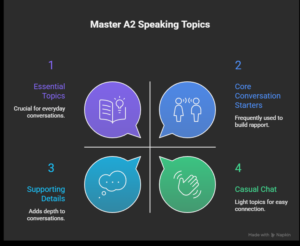
To pass the Goethe-Zertifikat A2 exam, you need to possess a good understanding of the 8 main areas of conversation in order to hold real conversations with native speakers. It is important to get to grips with your normal daily activities in Germany, Austria or Switzerland. Things like shopping, travel, the weekend, work or school, food and eating, taking care of your health, and entertainment are all issues you will face in A2 level speaking exams.
Key Takeaways
- For A2 learners its achievable to hold short conversations about familiar topics using fairly simple language.
- The topics that tend to get tested most in A2 speaking exams are your daily routine, shopping, travel and weekend plans.
- Success basically comes from learning the right vocabulary for each topic area and practicing common question patterns.
- Native speakers are more interested in someone speaking correct, simple German than trying to use complex sentences that they get wrong
- The more you practice using these 8 topics the more confident you’ll become – not just in exams but in day-to-day life.
What Can I Actually Do in German at the A2 Level
1: How do you say "Good Morning" in German?
Once youve reached A2 level youve moved beyond just memorising single words and phrases and can now have a conversation about your daily life and share experiences with others – this is when German starts becoming really useful for everyday situations.
Think of A2 as your stepping stone from classroom German to real-world German. You can now make sense of sentences that get straight to the point about routine things. You can have a simple conversation to get some straightforward information. You can even tell people about where you live , the people you know and what your basic needs are.
The big difference from A1 is that at A2 you can start building your own sentences from scratch. No longer can you just say “Ich heiße Anna”, now you can say “Ich heiße Anna und komme aus Köln aber jetzt wohne ich in Berlin.” You can string ideas together, add extra bits of information and make conversations sound natural and flowing.
Learn German language in your own language! Get free Demo Classes Here!
Free German A1 Mock Tests – Powered by AI!
Test your skills on our interactive platform. Get instant feedback from our AI to help you communicate better and track your progress. Start your free German mock test now.
Test Your German A1 for FreeA2 Speaking Topics You Must Master
Daily Routine and Habits
Daily routine topics pop up in nearly every A2 conversation. Be ready to tell native speakers about your morning, workday, and evening – they often ask about daily life to find some common ground to talk about.
Key words to have in your back pocket are “waking up” (aufstehen), “eating breakfast” (frühstücken), “heading off to work” (zur Arbeit gehen), and “chilling out” (sich entspannen). Time of day is also important – expressions like “in the morning” (morgens), “at noon” (mittags), or “in the evening” (abends) are a must.
Shopping and Consumer Life
When it comes to shopping conversations, you need to be able to use your language skills in real-life situations – like asking for prices or describing what you’re after. You might also need to talk about where you buy things from.
Learning the names of shops like a bakery (Bäckerei), supermarket (Supermarkt), or clothes store (Kleidungsgeschäft) is useful. Knowing what different foods are called like bread (Brot), milk (Milch), or vegetables (Gemüse) is a good idea too. Practice asking for the price and understanding the answer – that would be “Wie viel kostet das?”
Travel and Transportation
German people love to travel – they will ask you about your holidays, and you should ask them about theirs. Conversations about travelling might cover planning a trip, talking about a trip you took previously or using public transport.
Learning words for different ways of getting from A to B like a train (Zug), bus (Bus), or plane (Flugzeug) is a good idea. And don’t forget basic direction words like “to the left” (links), “to the right” (rechts), or “straight on” (geradeaus). Practice talking about tickets, platforms, and timetables too.
When it comes to talking about a past holiday using the simple past with “haben” and “sein”, A2 speakers can do this in a pretty straightforward way.
Weekend and Leisure Activities
One of the most common conversation starters in Germany is “what did you do last weekend?” So be ready with a good answer.
Weekend talk often covers hobbies, socialising, and just relaxing. If you’re into sports, then words like swimming (schwimmen), hiking (wandern), or cycling (Rad fahren) will be useful. Words for entertainment like cinema (Kino), restaurant (Restaurant), or concert (Konzert) are good to know too.
The thing to aim for is giving more than just a one-word answer. Instead of just saying “cinema”, you might say “last Saturday I was at the cinema and watched an action film”.
|
German A2 Exercises – Download Free PDF |
||
Work, School, and Study
Talking about your daily job or studies builds connections with other people. When you work or go to school, try to tell others what you do, where you do it and who you do it with.
Learning a few key job titles, the words used in different workplaces, and a little about the subjects you’re studying can be really helpful. Get used to talking about what you like or dislike about different things and why. Germans, for example, are often interested in hearing about your reasons for doing something and what you’re aiming to achieve.
Food, Restaurants and Your Daily Grub
Food has a way of bringing people together – and restaurant conversations can be a great way to put your language skills to the test. You’ll have to learn how to order food, make polite complaints and then pay the bill. You might also just chat about your favourite foods, or about cooking and eating at home.
Learn the words for the menu, how to ask for a recommendation, and how to say what you like and what you don’t. You might also want to get used to saying “I’d really like to have…” (Ich hätte gern…) and “Can I pay the bill please?” (Kann ich bitte zahlen?).
Your Health
All sorts of health topics can come up in conversations. Someone might ask if you’re feeling okay, or you might have to go to the pharmacy and tell them what’s wrong with you.
Learn the names of the different parts of your body, some common illness words, and how to describe what’s wrong with you. It’s also a good idea to know how to say “I’ve got a headache” (Ich habe Kopfschmerzen) and “I’m feeling a bit under the weather” (Mir ist schlecht).
Your Favourite Films, Music and Books
Talking about films, music and books is a great way to connect with others without getting too personal. Just describe what you like about something and why.
Learn some key genre words – like comedy (Komödie), drama (Drama) and action (Action) – and know how to describe something as interesting (interessant) or a bit dull (langweilig).
Learn German language in your own language! Get free Demo Classes Here!
Example Questions and How to Answer Them
Questions About Free Time
Was machst du am Wochenende ? (Whats going on with you on weekends?)
A strong answer: “On Saturday I hang out with my mates and we play football together . On Sunday I go visit my family and we have lunch together : ”
A weak answer: “Football & Family.”
The strong answer shows a bit of sentence variety, a bit of time markers, and some detail , that is just what examiners are after.
Was machst du mit deinen Freunden ? (Whats up with you and your mates?)
Good response: “We often go to the cinema or grab a bite to eat at a restaurant. Occasionally we even cook together at my place too.”
This answer uses those helpful connecting words like “oder” and “auch” to link all the bits together naturally.
|
Goethe 2026 Exam Dates: Multiple Test Centers |
|
| Trivandrum Goethe Exam Dates | Kochi Goethe Exam Dates |
| Chennai Goethe Exam Dates | Coimbatore Goethe Exam Dates |
Questions About Travel
Wohin reist du gern ? (Where is your go to place for holidays?)
Better answer: Im happy to go to the mountains and last year I was in Austria and used to go hiking there too : the countryside is just beautiful and all that ”
This uses your past tense properly and also gives a reason why you like to go there. Native speakers do really appreciate you putting in that bit of extra detail.
Questions About Daily Life
Wie sieht dein normaler Tag aus ? (What does your average day look like?)
Good structure: “I normally wake up at 7 . Then I head off to work . After work I cook some dinner and watch telly . By 11 I am off to bed”
Time markers make all this easy to follow and each sentence adds one piece of information to the mix.
Questions About Preferences
Was ist dein Lieblingsessen ? (What is your go to food?)
Answer well: “My favourite thing to eat is pizza . I love pizza because you can put loads of different ingredients on it . My absolute favourite is a pizza with salami and mushrooms”
The word “weil” introduces a reason why bit of grammar. This is just the sort of thing A2 examiners are looking out for.
Welche Filme magst du ? (What sort of movies do you like?)
Better response: “I like comedies because they are funny . Action films are alright too , but I don’t really like horror films they are too spooky”
This answer shows you can make some comparisons and put different ideas together. It uses “auch” and “aber” to keep all the ideas linked up nicely.
Questions About Shopping
Wo kaufst du am liebsten ein ? (Where do you love to shop?)
Strong answer: “I shop at the market , the fruit and veg is fresher there than in the supermarket, and its also usually cheaper and its also nice and easy”
Comparative words like “frischer als” and “cheaper” show you are really on top of things. The word “außerdem” adds a bit of extra polish to your answer
Building Your Speaking Skills

Practice with a Partner when you can – It really helps! The Goethe Institut advises that you try to practice under exam conditions with another person. This does loads for boosting your confidence and helping you deal with unexpected questions that might come up .
Record yourself answering common questions as you go along, then listen back and see where you hesitate. Work on those weak areas until it all sound much more natural. Your goal is to speak smoothly and clearly – not to be perfect.
Keep learning new vocabulary – but group it by theme. Words stick in your head when they’re connected to something. Study all the shopping words together, for example, or travel words as a batch. This is how your brain organises language in the first place.
Free German A1 Mock Tests – Powered by AI!
Test your skills on our interactive platform. Get instant feedback from our AI to help you communicate better and track your progress. Start your free German mock test now.
Test Your German A1 for FreeCommon Mistakes to Avoid
Don’t go around memorising whole answers – that’s just going to get you caught out by the examiners. What’s more useful is to learn the individual words and phrases and then use them to come up with fresh answers each time .
Don’t ignore the question words when someone asks you a question. If they ask “Wann…?” (when ) you need to give a time , or if they ask “Warum…?” ( why ) you should be able to use “weil” to explain. The key is to show that you really do understand what’s going on .
Learn German language in your own language! Get free Demo Classes Here!
Conclusion
Mastering these eight speaking topics will prepare you for both the Goethe-Zertifikat A2 exam and for when you need to have an actual conversation with a German speaker. Go back to basics and start with everyday routines and weekend activities – these are the things you’re most likely to need to talk about. Practice answering questions out loud – don’t just think about it in your head. Record yourself and track your progress. Within a few weeks of focused practice, you should be able to handle these conversations with confidence.
Free German A1 Mock Tests – Powered by AI!
Test your skills on our interactive platform. Get instant feedback from our AI to help you communicate better and track your progress. Start your free German mock test now.
Test Your German A1 for FreeFrequently Asked Questions
What specific vocabulary do I need for German A2 speaking topics?
You need about 500-800 words across eight core areas: daily routines, shopping, travel, work, food, health, entertainment, and weekend activities. Focus on nouns, verbs, and common adjectives for each topic.
How is the A2 speaking test structured?
The test has three parts. First you introduce yourself. Then you talk about a topic card. Finally you complete a task with your partner, like planning something together.
Can I use simple sentences or do I need complex grammar?
Simple sentences work best at A2 level. Use present tense mostly. Add past tense with “haben” and “sein” for experiences. Keep sentences short and clear.
What happens if I don't understand the examiner's question?
Politely ask them to repeat. Say “Können Sie die Frage bitte wiederholen?” or “Bitte langsamer.” Examiners expect this and will help you understand.
How long should my answers be in the speaking test?
Aim for two to three sentences per answer. Give the direct answer first, then add one detail or reason. This shows you can sustain basic conversation.
Do I need a perfect accent to pass?
No. Clear pronunciation matters more than accent. Speak slowly and say each word fully. Germans understand many accents as long as words are clear.
What are the most common mistakes at A2 level?
Word order errors top the list. Remember verbs go second in main clauses and last in “weil” clauses. Also forgetting noun genders causes confusion.
How can I practice without a speaking partner?
Talk to yourself in German. Describe what you see. Narrate your daily routine. Record and listen back. This builds fluency and confidence between real conversations.
Which topics appear most often in the exam?
Daily routine, hobbies, and weekend activities appear most frequently. Travel and food topics come second. Health and media questions appear less often but still matter.
What resources help with A2 speaking practice?
DW’s Nicos Weg offers free video lessons with speaking practice. Goethe-Institut provides sample tests. Anki flashcards help build topic vocabulary quickly.