Table of Contents
Arrange the words in the correct order while you are writing or speaking German. This is of the utmost importance. With regard to the arrangement of words, German adheres to stringent norms, but English is more flexible. It is important to keep in mind that verbs often come after named words and adjectives. Those who adhere to these principles on a regular basis can quickly acquire the ability to do so because they make perfect sense.
Learn German from the best mentors in the field! Join the Entri online course!
Basic German Sentence Structure
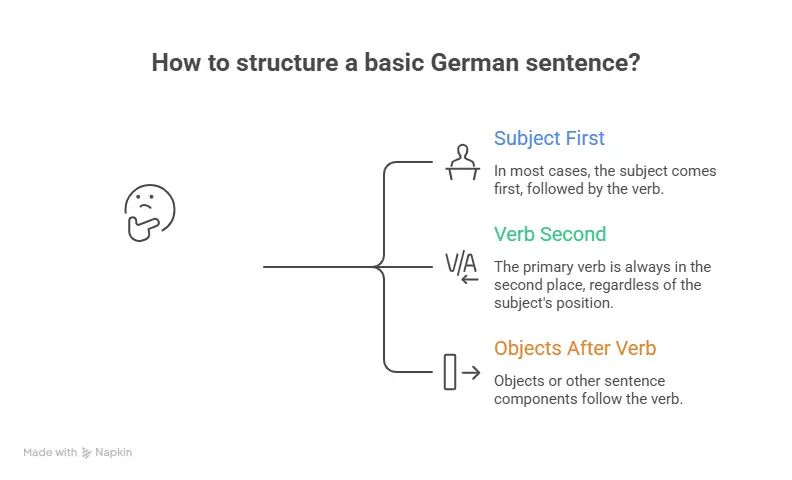
Like English, the typical German sentence form is SVO, which stands for subject, verb, and object. It makes no difference what comes first in a phrase; the verb always remains in the second place. In order to construct phrases in German that sound natural and accurate, this is the base.
Important Considerations:
- In most cases, the subject comes first.
- The location of the primary verb is always in the second place.
- After the verb comes the objects or other components of the sentence.
Example:
- Ich lerne Deutsch.
(I learn German.)
Verb in the Second Position Rule
1: How do you say "Good Morning" in German?
In German, the main verb always goes in the second position of a sentence. But be careful—“second position” does not always mean the second word. Other elements like time expressions, adverbs, or locations can come first, pushing the subject after the verb.
Key Points:
- Verb is always in position 2, not necessarily the second word.
- Anything can come first: time phrases, adverbs, or places.
- The subject often comes after the first element if something else starts the sentence.
Examples
- Heute lerne ich Deutsch.
(Today I learn German.) - Zu Hause arbeite ich.
(At home I work.)
Free German A1 Mock Tests – Powered by AI!
Test your skills on our interactive platform. Get instant feedback from our AI to help you communicate better and track your progress. Start your free German mock test now.
Test Your German A1 for FreeWord Order With Time, Manner, Place (TMP Rule)
When adding details to a statement in German, the typical sequence for adverbs and phrases is Time → Manner → Place (TMP). This order is used to add details to the sentence. This imparts a sense of naturalness to phrases and makes them simple to comprehend.
A Few Key Points:
- Time is the moment when something takes place (i.e., heute, morgen, um 8 Uhr).
- a manner, or the manner in which something occurs (gern, schnell, with Freude).
- Home, school, or park are all examples of places where something takes place.
- Even after the addition of TMP parts, the verb remains in the second position.
Example:
- Ich lerne heute gern zu Hause.
(I like learning at home today.)
|
German A2 Exercises – Download Free PDF |
||
Word Order in Questions
In German questions, the word order changes from normal statements. The subject comes after the verb, which goes to the first place. In assertions, the verb is normally in the second place.
Main Points:
- In yes/no questions, the verb comes first.
- The topic comes after the verb.
- Details about time, method, or place normally come after the subject.
Examples:
- Kommst du heute?
(Are you coming today?) - Hast du Zeit?
(Do you have time?)
Word Order in Sentences With Modal Verbs
The word order varies slightly when a sentence contains a modal verb, such as wollen, können, müssen, sollen, dürfen, or wollen:
- The modal verb, like any other major verb, takes up the second place.
- At the conclusion of the sentence, the main verb takes on the infinitive form.
Main Ideas:
- When using modal verbs, the primary action verb’s placement is defined differently.
- The sentence’s subject or another element still comes first.
- The TMP rule states that sentences involving time, manner, and place must follow verbs.
Example:
- Ich möchte Deutsch lernen.
(I want to learn German.)
|
Goethe 2026 Exam Dates: Multiple Test Centers |
|
| Trivandrum Goethe Exam Dates | Kochi Goethe Exam Dates |
| Chennai Goethe Exam Dates | Coimbatore Goethe Exam Dates |
Free German A1 Mock Tests – Powered by AI!
Test your skills on our interactive platform. Get instant feedback from our AI to help you communicate better and track your progress. Start your free German mock test now.
Test Your German A1 for FreeWord Order in Subordinate Clauses
To begin a subordinate sentence in German, you can use phrases like weil, dass, wenn, ob, and many more.
Important Principle:
- In every phrase, the verb comes last.
- The remainder of the sentence is structured normally, with the primary verb moved to the end.
Main Ideas:
- Dependent clauses are unable to function independently of subordinate clauses.
- There is no set order for when the main sentence and subordinate phrase should appear.
- Within the clause, the order of time, manner, and location is still TMP.
Example:
- Ich lerne Deutsch, weil ich in Deutschland arbeite.
(I learn German because I work in Germany.)
Common German Word Order Mistakes
Similar blunders in sentence formation are common among German learners. You can improve the accuracy of your speech and writing by being aware of these.
Typical blunders:
1. Ignoring the rule of the second person in primary sentences
- Wrong: Ich morgen gehe in die Schule.
- Correct: Morgen gehe ich in die Schule.
2. Using the wrong verb form in dependent clauses
- Wrong: Ich bleibe zu Hause, weil ich arbeite in Deutschland.
- Correct: Ich bleibe zu Hause, weil ich in Deutschland arbeite.
3. Using the wrong format for the question
- Wrong: Du kommst heute?
- Correct: Kommst du heute?
4. Rearranging the TMP sequence (Time → Manner → Place)
- Wrong: Ich lerne zu Hause gern heute.
- Correct: Ich lerne heute gern zu Hause.
5. Misalignment between main verbs and modal verbs
- Wrong: Ich Deutsch lernen möchte.
- Correct: Ich möchte Deutsch lernen.
Learn German from the best mentors in the field! Join the Entri online course!
German Word Order Summary (Quick Rules)
- Main (independent) sentences with the verb in the second position.
Ich lerne Deutsch.
Er spielt Fußball.
- After the prepositions weil, dass, wenn, etc., the verb moves to the end of the subordinate sentence.
Ich bleibe zu Hause, weil ich Deutsch lerne.
Sie freut sich, dass er sie besucht.
- In yes/no questions, the verb comes first.
Kommst du heute?
Hast du Zeit?
- Details according to the TMP rule: Time → Manner → Place.
Ich lerne heute gern zu Hause.
Er spielt morgen schnell im Park.
- The modal verb comes second, while the main verb comes last, in a modal verb.
Ich möchte Deutsch lernen.
Wir können morgen ins Kino gehen.
- Adverbs, places, or time expressions can come before the verb.
Heute lerne ich Deutsch.
Zu Hause arbeitet er.
- Unless the sentence begins with a time, place, or adverb, the subject normally comes first.
Ich esse einen Apfel.
Morgen gehe ich zur Schule.
Practice Exercises (With Answers)
Exercise 1: Sentence Rearrangement
Rearrange the words to form correct German sentences.
- Deutsch / ich / lerne / heute / gern / zu Hause
- du / kommst / morgen / nach Berlin
- weil / arbeiten / ich / in Deutschland / muss
Answers:
- Ich lerne heute gern Deutsch zu Hause.
- Kommst du morgen nach Berlin?
- Ich muss arbeiten, weil ich in Deutschland arbeite.
Exercise 2: Identify the Verb Position
Find the position of the main verb in each sentence:
- Ich möchte Deutsch lernen.
- Morgen fahre ich nach München.
- Ich bleibe zu Hause, weil es regnet.
Answers:
- möchte → 2nd position (modal verb), lernen → at the end
- fahre → 2nd position
- regnet → at the end (subordinate clause)
Exercise 3: Convert Statements to Questions
Change the following statements into yes/no questions:
- Du lernst Deutsch.
- Er arbeitet heute.
- Wir gehen morgen ins Kino.
Answers:
- Lernst du Deutsch?
- Arbeitet er heute?
- Gehen wir morgen ins Kino?
Exercise 4: TMP Rule Practice
Put the time, manner, and place words in the correct order (Time → Manner → Place):
- Ich / gern / Deutsch / lernen / zu Hause / heute
- Er / Fußball / spielt / morgen / schnell / im Park
Answers:
- Ich lerne heute gern Deutsch zu Hause.
- Er spielt morgen schnell Fußball im Park.
Final Thoughts
It might look like a mess, but German word order makes sense and stays the same. To easily write correct and natural sentences, just remember the rules for questions, modal verbs, and subordinate clauses, as well as the places where verbs go and the TMP order.
To learn the rules, you should try putting words in different order, asking questions, and using time, manner, and place phrases. As you practice and learn German word order, you will sound more smooth and sure of yourself when you speak and write.
Learn German from the best mentors in the field! Join the Entri online course!
Free German A1 Mock Tests – Powered by AI!
Test your skills on our interactive platform. Get instant feedback from our AI to help you communicate better and track your progress. Start your free German mock test now.
Test Your German A1 for FreeFrequently Asked Questions
Why is German word order important?
German relies on strict word order rules to make sentences clear. Correct verb placement helps others understand your meaning easily.
What does “verb in second position” mean?
It means the main verb usually comes in the second slot of the sentence, even if the first word is a time phrase, adverb, or place.
How do I know where the verb goes in a subordinate clause?
In subordinate clauses (introduced by weil, dass, wenn, etc.), the verb always moves to the end of the clause.
How do modal verbs affect word order?
With modal verbs, the modal verb is in second position, and the main verb goes to the end in infinitive form.