Table of Contents
Career advancement as a MRD Executive within the Medical Records Department at a hospital is both exciting and challenging. Every clinical decision, audit, quality check, and legal requirement is determined by accurate and kept to a high standard, and it is important to maintain this position within the hospital. For this job, this is not a cheap interview process. The challenge here is far more important than the basic questions: to understand a candidate’s technical knowledge, analytical thinking, leadership, and long-term strategic understanding of how a medical records system should function.
Hospitals expect MRD Executives to be prepared to meet compliance standards, patient data confidentiality, electronic health record (EHR) systems, medical coding basics and document procedures. They seek professionals who can supervise teams, coordinate with doctors and nurses, maintain audits, conduct medico-legal documentation, streamline workflows without compromising accuracy.
This also enables interviewers to assess how well candidates comprehend departments’ functions, how confident they can speak with patients about processes in the medical record and how well they can deal with problems in the field. They also look for a candidate’s ability to articulate, make decisions and maintain reliability in the face of pressure. Therefore, the interview is not only a test of knowledge, but it provides an assessment of the mindset required for the job.
This guide provides clear, structured and practical guidance from which you can navigate this process. This introduction looks at the specific job that MRD Executives must perform in the job, what tasks it requires a MRD Executive to take on and what kinds of questions the hiring panel asks. In this way, well-prepared candidates are naturally advantageous; preparedness is based on competence, confidence, and preparedness to accept responsibility. They are exactly what interview panels look for when selecting the right person for such a sensitive and challenging department.
This resource is designed to help you build that advantage. It aims to give you the clarity and depth you need to approach the interview with conviction. Let us begin by establishing a solid understanding of the role and the expectations that come with it.
Secure Your Future in Hospital Administration – Enroll Now!
Understanding the Role of an MRD Executive
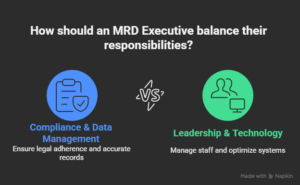
The Hospital MRD Executive leads the Medical Records Department. This position is critical for hospital function and compliance. It is not just about managing paper files. Modern medical records are complex digital systems. The executive ensures these systems work perfectly every day. They protect patient data, support clinical staff, and meet strict laws.
A primary duty is managing health information. This includes all patient records from admission to discharge. The executive guarantees records are complete, accurate, and secure. They oversee the coding of medical data for billing and research. Accurate coding affects hospital revenue and care quality. The executive must spot errors and fix them quickly.
Another core responsibility is compliance. Hospitals must follow many rules. These include HIPAA for privacy and other government regulations. The MRD Executive ensures every department action follows these laws. They set policies for data access and release. They also plan for audits and government reviews. A compliance failure can result in large fines and lost trust.
The role also involves leading a team. MRD departments have technicians, coders, and clerks. The executive hires, trains, and manages this staff. They create schedules, set goals, and review performance. Strong leadership keeps the team motivated and productive. The executive resolves conflicts and fosters a cooperative environment.
Technology management is a growing part of the job. Most hospitals use Electronic Health Record (EHR) systems. The MRD Executive helps choose and implement these systems. They work with IT staff to solve technical problems. They also push for updates that improve efficiency and security. Understanding both healthcare and software is vital.
Finally, the executive serves as a department link. They communicate with doctors, nurses, and administrators. They explain record-keeping needs and provide critical data. This collaboration ensures smooth hospital operations. The MRD Executive turns information into actionable insights for better patient care.
Key Skills Required for MRD Interview Success
1: What is the primary role of a hospital administrator?
Interviewers are looking for a certain combination of skills. Showing these skills convinces them you are the right person. The foundation for tech knowledge is technical knowledge. You need to know the principles of health information management. This includes medical terminology, disease classification, and ICD-10 codes. You must know EHR software very well. It has solved real problems.
The knowledge of laws and regulations is unconfiable. You must know HIPAA, HITECH, and state regulations. If you have taken this same set of rules into this role you should discuss how you applied them in your later work. Examples of the policy or compliance training are: Show that you can defend the hospital against legal risk.
Leadership and people skills are also of importance. MRD Executive manages a diverse team. Tell me about staff development. Talk about making clear expectations and giving feedback. If you were more productive or pleasant, would you write about what kind of teamwork it was. Show that you can accept difficult conversations with a fair amount of humor.
Analytical and problem solving skills are very important. This functions as a process and data review. There is a bottleneck in coding backlog retrieval or record retrieval. Explain how you think about a workflow problem. In what order do you describe a problem that I have solved and the solution. Number your impact with numbers whenever you can.
Communication is important. It has to be complicated data for different audiences. Practice explaining a technical process in simple terms. Show how you worked with clinical staff not known as record experts. To show that you can write plain reports and policies. You keep the department aligned with hospital goals.
Project management experience is a valuable asset. Another common project is the implementation of a new software system. Talk about how you plan, organize and lead such projects. Discuss your timelines, budgets and stakeholders expectations. Show how you can guide a project between conception and completion.
Top candidates are adaptable and persistent learners. As health technology and regulations change, so too do healthcare technologies and regulations. Keep up-to-date. To summarize specific courses, certifications or conferences you attend. You show that you are a person who learns and adjusts to no one.
Hospital Administration Course with Assured Career Growth
Hospital Administration Course by Entri App: Master essential healthcare management skills, gain certification, and secure top roles in leading hospitals
Join Now!Basic MRD Interview Questions and Answers
Preparing answers to common questions is the best practice. Here are essential questions and strong response strategies.
“Tell us about your experience in health information management.”
This open question is your first big chance. Structure your answer clearly. Start with your years of experience and settings you have worked in. Mention specific roles like coding supervisor or records manager. Highlight major achievements. For example, “I managed a team of fifteen for five years. We improved coding accuracy by eight percent. This increased revenue and reduced claim denials.” Connect your past directly to the executive role’s needs.
“How do you ensure your department complies with HIPAA regulations?”
This tests your practical compliance knowledge. Do not just recite the law. Explain your daily actions. “First, all staff receive mandatory HIPAA training yearly. I perform random audits of record access logs. We use role-based security in our EHR. Only authorized personnel see sensitive data. I also review all release-of-information requests personally. This layered approach minimizes risk.” Provide a specific example of correcting a compliance issue.
“Describe your experience with Electronic Health Record systems.”
Name the specific systems you have used, like Epic or Cerner. Go beyond basic use. “I led the transition from paper records to an EHR at my last hospital. I worked with vendors and IT on configuration. I trained over two hundred clinical users. After launch, I gathered feedback to improve the physician interface. This increased system adoption rates significantly.” Show you are a power user and a strategic partner.
“How do you handle a significant backlog in medical coding?”
This probes your problem-solving and management skills. Outline a step-by-step approach. “I analyze the backlog’s cause first. Is it a staff shortage, a software issue, or complex cases? I would temporarily reallocate staff or approve overtime for the team. I might simplify coding guidelines for common cases to speed up work. Then, I would find the root cause. If it is a training gap, I schedule immediate sessions. My goal is to clear the backlog and prevent its return.”
“What is your leadership style? How do you manage underperformers?”
Be honest and reflective. “My style is collaborative but clear. I set definite goals and provide the tools to meet them. I give regular feedback, both positive and constructive. For an underperforming employee, I start with a private conversation. I seek to understand any barriers they face. We create a performance improvement plan with clear steps and deadlines. I offer coaching and support. If performance does not improve, I follow hospital policy for further action. My focus is always on fairness and respect.”
“How do you stay updated on changes in health information management?”
List concrete activities. “I am a member of AHIMA and read their publications. I complete at least twenty hours of continuing education each year. I attend the state health information conference annually. I also participate in an online forum with peers from other hospitals. This network helps me learn about new regulations and technology trends before they become urgent.”
“How would you handle a physician who consistently fails to complete records on time?”
This tests diplomacy and process enforcement. “I would request a brief, respectful meeting with the physician. I would present the data on their delayed records, focusing on the impacts. These impacts include billing delays and care quality risks. I would listen to their challenges. Perhaps they need better EHR training or a template. I would offer help and solutions. If the issue continued, I would follow the hospital’s formal protocol. This likely involves notifying their department head. The goal is to solve the problem, not create conflict.”
“Describe a time you improved a process in your department.”
Use the STAR method: Situation, Task, Action, Result. “Situation: Our record retrieval process was slow. Nurses waited too long for patient histories. Task: I needed to increase access to the world without sacrificing security. Action: I map the entire process and found the bottleneck. This was a manual check-in. I proposed bar code scanning system on the records desk. I wrote the proposal, got budget approval, and managed the installation. Result: Average retrieval time dropped from twelve minutes to three. Nurse satisfaction scores for our department rose by thirty percent.”
“Why do you want to be an MRD Executive at this hospital?”
This is your moment to show research and passion. “I have followed this hospital’s growth and its focus on community care. Your recent implementation of a new EHR shows a commitment to technology. I want to lead a team in that environment. My skills in process improvement and compliance align with your strategic goals mentioned in the latest annual report. I am excited by the challenge of supporting such a respected institution.”
“Where do you see the MRD function in five years?”
Show strategic vision. “The MRD will be even more central to patient care and hospital analytics. Records will be fully interoperable between different care sites. Artificial intelligence will help with coding and finding data gaps. The MRD Executive will be a key data strategist. They will help clinicians use information to predict health risks. My role is to guide this department from a records keeper to a clinical intelligence partner.”
Secure Your Future in Hospital Administration – Enroll Now!
Conclusion
Hospital Administration Course with Assured Career Growth
Hospital Administration Course by Entri App: Master essential healthcare management skills, gain certification, and secure top roles in leading hospitals
Join Now!Frequently Asked Questions
What are the primary legal and compliance risks a Hospital MRD Executive must actively manage daily, and what concrete steps should be taken to mitigate them?
The Hospital MRD Executive faces significant legal exposure every day. The main risks involve breaches of patient privacy under HIPAA, improper release of information, inaccurate medical coding leading to fraud allegations, and failure to meet state-specific record retention laws. Mitigation requires a proactive, multi-layered strategy. This includes implementing strict, role-based access controls within the Electronic Health Record (EHR) system. Regular, mandatory staff training on compliance protocols is non-negotiable. The executive must also conduct frequent internal audits of record access logs and coding accuracy. Establishing a clear, documented chain of custody for all record requests and maintaining a robust disaster recovery plan for data are also critical steps. The executive’s role is to build a culture of compliance where rules are understood and followed by everyone.
How does the role of a Hospital MRD Executive directly impact a hospital's financial health and revenue cycle?
The MRD Executive’s department is a direct revenue driver, not just a cost center. Their team’s accuracy in medical coding is the foundation of the revenue cycle. Clean, precise, and timely coding ensures claims are submitted correctly the first time. This drastically reduces claim denials and delays from insurance companies. Faster, accurate billing leads to improved cash flow. Conversely, coding errors or backlogs create a direct financial drain. The executive also controls operational costs by streamlining records management processes, reducing overtime, and leveraging technology for efficiency. By ensuring complete and legally defensible documentation, the MRD Executive also protects the hospital from lost revenue in audits and legal disputes.
In the event of a suspected data breach or HIPAA violation, what is the exact step-by-step process the MRD Executive must immediately initiate?
Time is critical. The MRD Executive must have a pre-established incident response plan. The first step is to contain the breach by immediately revoking access and securing affected systems. The executive must then launch a formal investigation to determine the scope: what data was involved, how many patients were affected, and how the breach occurred. This investigation must be documented thoroughly. Legal counsel and senior hospital administration must be notified without delay. The executive is responsible for coordinating with these parties to determine if regulatory bodies and affected individuals must be notified, as required by law. Finally, a root cause analysis must be conducted to adjust policies and training, preventing a repeat of the incident.
What are the most critical metrics and Key Performance Indicators (KPIs) a Hospital MRD Executive should track to gauge departmental efficiency and quality?
Effective management relies on data. Key metrics include Coding Accuracy Rate (targeting 95%+), Discharge-to-Code Completion Time (measuring how quickly records are coded after a patient leaves), and Claim Denial Rate tied to documentation issues. Record Retrieval Time for clinical staff is vital for care delivery. Release of Information Turnaround Time measures responsiveness to external requests. Internally, Staff Productivity (records processed per FTE) and Employee Turnover Rate within the department are crucial for operational health. The executive should review these KPIs in regular performance dashboards to identify trends, address problems early, and demonstrate the department’s value to hospital leadership.
How should an MRD Executive strategically approach the selection, implementation, and optimization of a new Enterprise EHR system?
This is a major strategic project. The approach begins with forming a cross-functional committee including clinicians, IT, and finance. The executive must lead the effort to define detailed requirements based on departmental workflows, not just generic features. A rigorous vendor evaluation process, including site visits to existing users, is essential. During implementation, the executive’s role is to champion change management. This involves developing comprehensive, role-specific training programs and providing continuous support during the go-live period. Post-implementation, the executive must actively gather user feedback to work with the vendor on system optimizations and configuration tweaks, ensuring the EHR evolves to meet the hospital’s specific needs.
What is the most effective strategy for managing the delicate relationship between the MRD and the hospital's physicians and clinical staff to ensure timely and accurate documentation?
This relationship requires diplomacy, service, and education. The strategy must move from being perceived as a policing body to a supportive partner. The MRD Executive should implement regular rounding or office hours where coders and clinical documentation improvement specialists are available to answer questions. Providing physicians with clear, concise “cheat sheets” on common documentation deficiencies can be very effective. The executive should present data to department chairs showing how better documentation improves patient care and hospital performance, framing it as a shared goal. Automating reminders within the EHR and streamlining the query process for clarifications also reduces friction and improves compliance.
Facing a significant and persistent backlog in medical transcription or coding, what is the systematic problem-solving methodology an executive should employ?
A backlog is a symptom of a deeper problem. The executive must first diagnose the root cause through data analysis. Is it a staffing shortage, a surge in complex cases, inefficient software, or a training gap? Temporary measures may include authorized overtime or using qualified temporary staff. However, the long-term fix requires process redesign. This could involve rebalancing workloads, implementing computer-assisted coding software, creating specialized teams for complex cases, or revising workflow steps to eliminate bottlenecks. The executive must also monitor the impact of any changes closely to ensure the backlog is resolved and does not reoccur, adjusting the strategy as needed.
How can a Hospital MRD Executive justify budget requests for new technology, additional staff, or advanced training programs to the hospital's CFO or Board?
Justification must be framed in terms of return on investment and risk mitigation. Requests should be supported by hard data. For new technology, present a cost-benefit analysis showing how it will reduce labor costs, decrease claim denials, or improve coding speed. For staff, demonstrate the current workload metrics versus industry standards, showing how additional personnel will reduce burnout and prevent costly errors. For training, link it directly to compliance risk reduction and quality improvement. The proposal should articulate the financial and operational consequences of not approving the request, such as ongoing revenue leakage or increased audit penalties.
With the rise of telehealth and interoperability between health systems, what new challenges and opportunities does this present for medical records management?
These trends create both complexity and strategic opportunity. Challenges include ensuring complete documentation for telehealth encounters, managing patient data flowing from external providers, and maintaining privacy across shared networks. The MRD Executive must develop policies for integrating outside records and ensure the EHR can handle new data types. The opportunity lies in positioning the MRD as the integrator of this comprehensive patient data. A complete record improves care coordination and population health management. The executive can lead projects to create a unified patient view, which enhances clinical decision-making and positions the hospital as a more effective partner in accountable care organizations.
What is the career progression path for a Hospital MRD Executive, and what advanced skills or certifications are most valuable for moving into higher hospital administration roles?
The MRD Executive role is a strategic springboard. Common progression paths include moving into roles like Chief Information Officer, Vice President of Operations, or Chief Compliance Officer. To make this transition, the executive must develop skills beyond departmental management. This includes mastering hospital-wide financial acumen, strategic planning, and broader information technology governance. Earning advanced certifications like the RHIA, an MBA, or a fellowship with the American College of Healthcare Executives is highly valuable. Success requires actively seeking cross-departmental projects, volunteering for hospital-wide committees, and building a strong network with other senior leaders to demonstrate strategic thinking and enterprise-level value.