You have been studying German for weeks. You know a few words. But real conversations still feel impossible. How much longer until you actually understand and speak?
The Bottom line is – your answer is here.
Most learners take between 350 to 600 hours to reach German B1. Full timers need 4 to 6 months. Part timers need 6 to 12 months. Self taught students need 8 to 14 months. That’s not a hard and fast rule – the exact time depends on your daily routine, how you learn, and how consistent you are.
Take Aways
- German B1 is the intermediate level where you can start to communicate on your own.
- Total study time is typically 350 to 600 hours.
- Full timers can usually finish in 4 to 6 months.
- Part timers will typically need 6 to 12 months.
- If English is your native language you’ll probably find it easier to learn as there are so many similarities in the two languages.
What is German B1 Level?

German B1 is the third stage – the stage where people generally reach after the Common European Framework of Reference for Languages. It lies between the basic level (A1, A2) and advanced (B2). It is referred to as the threshold level – the stage where people become not tourists but communicative beings.
On reaching the German B1 level, one can easily navigate almost all day-to-day situations without any assistance. You will not need anyone to interpret things or talk slowly so that you could understand; you will be able to voice your opinions, recount personal experiences, and articulate your plans.
Learn German language in your own language! Get free Demo Classes Here!
What are you able to do at B1 level?
You’ll be able to join in on conversations about everyday things like work, school, or your favorite hobbies. You’ll be able to get a sense of what’s going on in radio shows or TV programmes. You’ll be able to read simple articles in the newspaper or on websites and write a clear email to your landlord or a colleague.
This level really opens doors. Its the minimum standard for lots of jobs, its a requirement for German citizenship and its what most serious learners aim for.
How long does it take to reach German B1?
The numbers don’t lie – official language schools and governments agree that its going to take 350 to 600 hours of actual studying to pass a B1 exam. Actual studying means classes, homework, and actually putting in the effort to learn. Doesn’t include things like just listening to music in the background.
Breakdown of learner types
Full timers put in 3 to 5 hours study per day and are often on intensive courses. They can often knock off A1 in 4 to 6 weeks and A2 in 6 to 8 weeks and then get to B1 in 8 to 12 weeks – total time is 4 to 6 months.
Part timers will study 1 to 2 hours per day and take evening or weekend classes. They can usually complete A1 in 8 to 10 weeks and A2 in 12 to 16 weeks and then get to B1 in 16 to 20 weeks – which adds up to 6 to 12 months.
Self learners control their own schedule. They use apps, books, and free online resources. They often lack speaking practice. Progress is slower. They reach A1 in 3 to 4 months.
Total hours needed by level
A1 requires 80 to 120 hours. You learn basic greetings, numbers, and simple sentences. A2 requires 120 to 180 hours. You learn past tense, more vocabulary, and common phrases. B1 requires 150 to 300 hours. You learn complex grammar, longer texts, and real conversations.
Factors That Affect Learning Time
Not every student moves at the same speed. Several factors explain the difference.
Daily study time
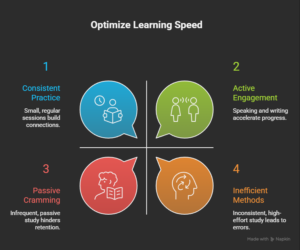
Thirty minutes per day is better than three hours on Saturday only. Language learning needs small, regular sessions. Your brain builds connections during sleep. Daily practice feeds that process. Irregular study forces your brain to restart each time. This adds months to your timeline.
Learning method (self versus guided)
A good teacher cuts your learning time by half. Teachers correct mistakes immediately. They explain grammar clearly. They force you to speak. Self learners often repeat the same errors for weeks. They avoid speaking because it feels uncomfortable.
Language background
English speakers have a massive leg up – german and english come from the same family of languages. Loads of words look deceptively similar too – water is Wasser, house is Haus, and friend is Freund. And to make matters even easier, the grammar patterns in the two languages mirror each other.
Consistency is Key
Trying to cram two weeks of study into a one week period is a recipe for disaster , all you end up doing is forgetting more than you learn. A learner who sticks to a daily routine of just an hour of study a day is likely to outrun someone who studies four hours three times a week but is all over the shop with their schedule.
Practice your ear
Reading and listening are about as passive as you can get. Writing and speaking on the other hand require way more effort. The thing is, active skills take longer to get going but learners who chat from day one seem to reach the B1 level a lot faster.
Fast Track versus Taking it Slow
So the question is, do you want to go for the express route or take it slow and easy. Which path you choose will depend on what your goals are and how much time you’ve got to devote to the whole thing.
The Intensive path – the fast track
This one is for people with loads of time and a burning ambition to learn german fast. 3 to 5 hours a day, 7 days a week – we’re talking classes or a strict self study routine, german TV every night for 30 minutes, a daily chat with a tutor or language partner, flashcards during breaks… all this and you’ll be chatting at B1 level in 4 to 6 months.
The Regular path – not bad
This one is a bit more realistic for most people. 1 to 2 hours a day, two evening classes per week, 20 minutes of app practice every morning, german podcasts during your commute and a daily diary entry… with this sort of routine you’ll be chatting at B1 level in 6 to 12 months.
The Casual path – for people who don’t have much time
This path is for those who can only manage a few hours a week. 2 to 3 hours on saturday and sunday, then nothing till the following weekend. let’s be honest, your brain forgets most of what you learned in between sessions and you end up repeating the same lessons over and over.
Study Plan to Reach German B1 Faster
A clear roadmap removes confusion. Follow this plan week by week.
Phase 1: A1 (Months 1 to 2)
Your goal is survival German. Learn 500 basic words. Focus on greetings, numbers, food, family, and directions. Master present tense verbs. Learn sentence structure for statements and questions.
Daily tasks for A1: 30 minutes of app study, 10 minutes of flashcard review, 5 minutes of speaking out loud.
Phase 2: A2 (Months 3 to 5)
Your goal is past events and future plans. Learn 1000 new words. Focus on daily routines, work vocabulary, and emotions. Master simple past tense of common verbs. Learn future tense with werden. Understand cases (nominative, accusative, dative).
Daily tasks for A2: 45 minutes of textbook study, 15 minutes of listening practice, 10 minutes of writing.
Phase 3: B1 (Months 6 to 9)
Your goal is independent conversation. Learn 1500 new words. Focus on opinions, arguments, and explanations. Master subordinating conjunctions (weil, dass, obwohl). Learn adjective endings. Understand passive voice.
Daily tasks for B1: 60 minutes of mixed practice, 20 minutes of speaking with a partner, 15 minutes of reading news.
Vocabulary targets by level
A1 needs 500 to 800 words. A2 needs 1000 to 1500 total words. B1 needs 2000 to 2500 total words. These are active words you can use, not just recognize.
Grammar focus by level
A1 focuses on word order and present tense. A2 adds past tense and cases. B1 adds complex sentences and passive voice. Do not rush grammar. Each level builds on the last.
Practice tips that work
Write three sentences about your day every night. Say them out loud. Record yourself speaking for one minute. Listen to the recording. Find the mistakes. Fix them. Repeat. This simple habit doubles your speaking speed.
Common Mistakes That Slow Progress
Avoid these errors to stay on schedule.
Inconsistency
The biggest killer of progress is skipping days. One missed day becomes two. Two becomes a week. A week becomes a month. Protect your study time like a work meeting. Do not skip for any reason except emergency.
Ignoring speaking practice
Reading German is not speaking German. Your mouth needs training. The muscles for German sounds are different. Speaking practice feels uncomfortable at first. Do it anyway. Silent learners stay silent.
Over reliance on apps
Apps teach vocabulary but not conversation. You cannot reach B1 with Duolingo alone. Apps lack speaking practice. They lack grammar explanations. They lack correction. Use apps as a supplement, not your main method.
Not revising old material
Learning new words while forgetting old ones is common. This creates a ceiling. You cannot reach B1 with a weak A2 foundation. Spend 20 percent of your time reviewing old lessons. Use spaced repetition flashcards for this purpose.
Fear of mistakes
Perfectionism kills progress. You will make thousands of mistakes before B1. That is normal. Every mistake is a lesson. Speak anyway. Write anyway. Germans will understand you even with errors.
Tips to Reach German B1 Quickly

Use these proven methods to cut your timeline by months.
Practice daily for 30 minutes
Thirty minutes every day beats three hours once per week. Short daily sessions keep the language fresh in your mind. Set a specific time each day. Morning works best before your brain gets tired.
Watch German content with subtitles
Switch your Netflix to German audio. Turn on German subtitles, not English. Your brain connects the sounds to the words. Start with children’s shows. Peppa Pig auf Deutsch is perfect for A2 learners. Move to news shows at B1. Tagesschau uses clear, standard German.
Use flashcards with spaced repetition
Anki is a free flashcard app. It shows you words right before you forget them. This system doubles retention. Create your own cards from things you read. Do not use premade decks. Making your own cards is part of learning.
Speak from day one
Find a language partner on Tandem or HelloTalk. Pay a tutor on iTalki for 10 dollars per session. Talk to yourself in the shower. Describe what you see during your walk. Speaking activates different brain pathways than reading. Activate them early.
Focus on high frequency words
The most common 1000 words cover 80 percent of daily conversation. Learn these first. Ignore rare words until B1. Words like encyclopedia or democracy can wait. Words like want, have, go, and come cannot wait.
Immerse without traveling
Change your phone language to German. Label items in your home with German words. Listen to German radio while cooking. Think in German for five minutes each morning. Immersion creates constant exposure without leaving your city.
Is German B1 Enough?
B1 is not fluency. But it is enough for many real world needs.
For jobs
B1 meets the requirement for many positions. Customer service, retail, hospitality, and manual trades accept B1. Office jobs typically need B2. Healthcare roles need B2 or C1. Check your specific job postings before applying.
For study
German universities require B2 or C1 for degree programs. But B1 is enough for preparatory courses. You can enroll in a Studienkolleg with B1. This is a one year program that prepares you for university. You reach B2 during that year.
For visa and residency
German permanent residency requires B1. Citizenship applications require B1. Family reunion visas require A1 only, but B1 helps. Spouses of German citizens need B1 for permanent residency. Vocational training visas often require B2.
For daily life
B1 is comfortable for daily living. You can talk to neighbors. You can understand your landlord. You can read letters from the bank. You can explain symptoms to a doctor. You can help your child with homework. Life stops being stressful at B1.
Learn German language in your own language! Get free Demo Classes Here!
Conclusion
German B1 is a realistic goal. The timeline depends on you. Full time students can reach it in 4 to 6 months. Part time learners need 6 to 12 months. Self learners take 8 to 14 months. The total study hours are 350 to 600.
Speed does not matter as much as consistency. A learner who studies one hour daily for one year will succeed. A learner who crams for three months then quits will fail. Choose your pace based on your life. Then show up every day.
Free German A1 Mock Tests – Powered by AI!
Test your skills on our interactive platform. Get instant feedback from our AI to help you communicate better and track your progress. Start your free German mock test now.
Test Your German A1 for FreeFrequently Asked Questions
Can I reach German B1 in 3 months?
Only with full time study of 6 to 8 hours daily. Most learners need 4 to 6 months even with intensive courses. Three months is possible only for very disciplined students with prior language learning experience.
Is German B1 harder than A2?
Yes, significantly harder. A2 adds vocabulary and basic past tense. B1 introduces complex sentence structures, passive voice, and adjective endings. The jump from A2 to B1 is the biggest difficulty increase in the entire German learning path.
How many German words do I need for B1?
You need 2000 to 2500 active words. Active words are ones you can use in a sentence without thinking. Passive recognition of 3000 to 4000 words helps with reading but does not count for speaking exams.
Can I pass B1 without a teacher?
Yes, but it takes 30 to 50 percent longer. Self learners need 8 to 14 months compared to 4 to 6 months with a teacher. The speaking section is the hardest part without guided practice.
Which German B1 exam is easiest?
Goethe B1 and Telc B1 have similar difficulty. Goethe has more reading and writing. Telc has more listening and speaking. Neither is objectively easier. Choose based on your strengths and which test centers are near you.
Do English speakers learn German B1 faster?
Yes, much faster. English and German share thousands of similar words and grammar patterns. English speakers need 350 to 450 hours. Speakers of Asian or African languages often need 500 to 700 hours.
How many hours per week should I study?
At least 7 hours for steady progress. Ten hours per week is better. Fifteen hours is ideal for fast results. Less than 5 hours per week leads to forgetting more than you learn each week.
Can I skip A2 and go straight to B1?
No. A2 grammar and vocabulary are required for B1 materials. Without A2, B1 textbooks will make no sense. Skipping levels creates gaps that stop progress completely.
Is B1 enough to get a job in Germany?
For many jobs, yes. Retail, hospitality, delivery, warehouse, and cleaning jobs accept B1. Office jobs, nursing, and teaching require B2 or higher. Always check the specific job posting before applying.
What is the fastest way to learn German B1?
Take an intensive course with daily speaking practice. Study for 3 hours in class. Review for 1 hour at home. Speak with a tutor for 30 minutes. Watch German TV for 30 minutes. Do this 5 days per week. Reach B1 in 4 months.