You’ve been trying to learn German for weeks now, you’ve sort of got the hang of some basic phrases but still get tongue-tied when a native speaker starts rattling off in German fast. Your long-term goal is either to study in Berlin , or land a job with a German company – both of which are a lot easier with a B2 level of proficiency.
The answer is that to reach B2 level in German – the kind of level that would let you work or study in Germany pretty seamlessly – is going to take anywhere from 6 to 12 months with dedicated effort (around 15-20 hours a week) or 1.5 to two years if you only have time to study for a bit (5-8 hours a week).
Key Takeaways
- The B2 level is the point at which you’re actually able to get a job or study in Germany.
- From total newbie to B2, you’re looking at a minimum of 500 to a max of 800 hours of learning.
- Your mileage may vary, but with super intensive learning – 15-20 hours a week – you can get to B2 in anywhere from 6 to 12 months.
What is the B2 Level in German?
The B2 level has a nice ring to it – being the “upper-intermediate” level on the CEFR scale – which is a six level system that goes A1 ( absolute newbie) all the way up to C2 (language mastery). By the time you hit B2, you’ve stopped relying on just a phrasebook to get you by as a tourist and you can actually use the language to do real things. A person with B2 level German can do certain things. They can usually follow what’s going on in more complex texts on a range of subjects – both the concrete and the abstract kind.
Join Entri, a structured B2 preparation course
How Many Hours Does the CEFR Recommend for B2?
The CEFR framework sets out some fairly standard estimates for each level, and all these numbers have come from many years of research into language teaching right across Europe.
- From A1 to A2: it takes around 200 hours to get to that level
- From A2 to B1 : another 200 hours
- From B1 to B2: and then another 200 hours
A lot of sources do combine those first two chunks together – so if you’re starting from scratch and aiming for B1, you’re looking at anything between 350 and 400 hours. And if you’re aiming for B2, you’re talking about between 500 and 800 hours in total.
What is the Average Timeline For Different Starting Points?
The starting point makes a huge difference, though – someone who is starting from scratch faces a much longer road than someone who already has some basic German skills
From nothing (zero) to B2
If you’re starting right from the beginning, you can expect:
Intensive study (15-20 hours per week): 6 to 12 months
Regular study (5-8 hours per week): 1.5 to 2 years
Casual study (2-3 hours per week): 3 to 4 years – or longer
From A1 (beginner) to B2
So if you already know some basic greetings, numbers and simple sentence structures – you’ll be skipping over some of the initial foundation work.
Intensive study: 5 – 9 months
Regular study: 1 to 1.5 years
From A2 (elementary) to B2
A2 level learners can handle everyday situations like shopping and talking about the family. You’ll need to put in around 400 hours to get to that B2 level.
Intensive study: 3 to 6 months
Regular study: 10 to 14 months
From B1 (intermediate) to B2
If you’re already at B1 level – you can already travel and have conversations about familiar topics. Then it’s just a matter of another 200 hours to get to B2.
Intensive study: 2 to 3 months
Regular study: 5 to 7 months
What Factors Affect How Fast You Learn German B2?
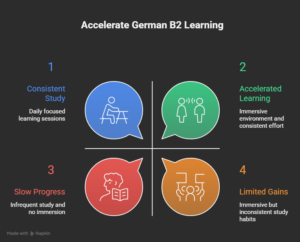
No two learners follow the same timeline and that’s just the way it is . Several key factors will determine whether you finish learning German in 6 months or 2 years.
Daily Study Time
Let’s cut to the chase – consistency is way more important than having a few marathon sessions a week. A learner who puts in 2 hours of study time every single day will make way faster progress than someone who only studies 10 hours on Saturdays and then does nothing all week.
Learning Method
Self study with apps and language books is fine for highly motivated learners, but it’s unlikely to give you the kind of feedback on pronunciation and grammar mistakes that you really need to improve.
Language Difficulty for English Speakers
Yes, German is a bit of a beast for English speakers – but not impossible. The Foreign Service Institute has it down in Category II, which means it takes around 750 hours for an English speaker to reach a reasonable level of proficiency.
Practice Consistency
The learner who studies for 30 minutes a day is likely to make way better progress than the learner who does 3 hours all at once every week. Let’s be honest, there’s just no substitute for daily practice when it comes to keeping the language active in your brain.
Immersion Level
Immersion is a fancy word for “surrounding yourself in the language”. That means listening to German podcasts, watching German shows, reading German news, and actually speaking with native speakers.
What is the Fastest Way to Reach B2 German?
Speed comes from smart work, not just grinding away. The best results come from trying these methods which are backed up by the habits of successful language learners.
Build a daily practice routine that really works for you
Dedicate a small chunk of time each day to German. Thirty minutes a day beats trying to cram three hours in one go at the end of the week. Create a routine that you can stick to.
Start speaking from day one, even if you feel like a total fool
People often think that speaking a new language is something you develop after a lot of study, but the truth is, speaking is how you learn a language in the first place. Rather than waiting until you feel confident enough to have a conversation, just start having a conversation – even if it’s just with yourself.
Combine your favourite language apps with a serious course
Apps like Duolingo and Memrise are great for building vocabulary, but they’re not much good for teaching you proper grammar or how to have a proper conversation.
Get your daily dose of German entertainment
Make a conscious effort to switch to German when it comes to your entertainment. Watch your favourite show or movie with German audio and German subtitles. Listen to some German podcasts like ‘Slow German mit Annik Rubens’ or ‘Easy German.’
Take real B2 practice exams to see where you need to improve
Taking a practice exam really helps you see where you need to focus your studying. The Goethe-Institut and Telc both offer sample B2 tests – take one every month or so, and then really take a close look at your results to see where you’re going wrong.
Get a speaking partner or tutor – it’s the best way to really make progress
Just speaking on your own will only get you so far. You really need to have real conversations with real people to make any real progress. Use platforms like iTalki or Tandem to find a language exchange partner or tutor.
What common mistakes can slow you down trying to reach B2?
Watch out for these pitfalls. They can add months to your timeline without actually helping your German at all.
Not making time for speaking practice
If you’re not speaking, you’re not going to make any progress. Reading and writing may be fun, but they won’t help you develop fluency. You need to be practicing speaking or you’ll stay a beginner. It feels uncomfortable at first, but speaking is where the real learning happens.
Spending too much time studying grammar rules
Grammar is a tool, not the goal. Don’t get me wrong, it’s great to learn the rules of a language, but if you get too hung up on memorising all the article endings or something, you’re not actually going to make any progress.
Studying inconsistently
Two weeks of daily studying followed by a couple of weeks with no studying creates a cycle of feeling like youre forgetting everything. Every break causes you to have to relearn stuff youve already got through before.
A Word of Warning: Steer Clear of Textbook German
Textbook German is all clean and easy to follow. Real German however is messy and moves at a thousand miles an hour. The learners who only ever use textbooks are going to struggle like mad when they hear the real thing being spoken.
Casting Off the Crutch of Translation
Translation is a habit that if you get too used to it will actually hold you back. When you hit B2 level you dont need to be translating everything inside your head to understand what is being said.
What Does a B2 Study Plan Actually Look Like?

Here is a study plan that actually works with 10 hours a week. Make sure you adjust the hours here to suit your schedule
Monday
- 30 minutes: Go through 20 new vocabulary words on flashcards, try to get the German word to pop into your head first
- 30 minutes: Sort out one grammar exercise – focus on a specific area that you know you’re weak at (cases, prepositions, adjective endings etc) and get it nailed
Tuesday
- 30 minutes: Read one page of a German news article and mark the words that you dont know – see if you can figure out the meaning from context
- 30 minutes: Write a little bit about your day using some new vocabulary that you learned on Monday
Wednesday
- 30 minutes: Go over any vocab that you learned on Monday, add 10 new ones to the pile
- 30 minutes: Give a German podcast episode a listen and jot down 5 sentences that you understood completely on the first go
Thursday
- 30 minutes: Give that news article from Tuesday another go, dont look up any words this time and try to figure it out on your own
- 30 minutes: Write 10 sentences using this weeks grammar topic – dont worry if they arent perfect just try to make them work
Friday
- 30 minutes: Go over all vocab from the week and see how many of those new words are sticking\
- 30 minutes: Do a short quiz on the grammar topic and see if you can show off your new skills\
Saturday
- 60 minutes: Do a section of a B2 practice test and see how you get on – dont worry if you get some stuff wrong, its all part of the learning
- 60 minutes: Go over any mistakes that you made and make a note of the rules behind each error – this is where you really learn and improve
Sunday
- 30 minutes: Just listen to some German music or a podcast, just chill and let the words wash over you – dont worry too much if you dont understand everything just enjoy the sound of the language in the background
Why Does B2 Level Matter for Your Life?
B2 is more than just a certificate – it’s a game-changer.
Jobs start to open up to you
International companies in Germany, Austria and Switzerland are always on the lookout for people who can speak B2 German – and nowadays they’re even listing it as a minimum requirement for real jobs in things like engineering, IT and customer service.
University is just a step away
German public universities are pretty much free – and yet they still have one requirement: language proficiency. And guess what – many of them will take a B2 as the entry standard.
Having B2 changes everything
At this level, you’re not just about to have to rely on others to do things for you – no, at B2 you’re ready to take charge. Want to make a doctor’s appointment? Do it yourself.
You’ll start to build real relationships
At B1 level you can probably manage the odd bit of small talk with a German speaker – but with B2 you’re into the deep stuff. You can share your opinions, tell stories and even laugh at jokes together.
Getting started really is as easy as starting today
So how long does it take to reach B2? Well – it’s a pretty flexible timeline. Some people can do it in 6 months, while others might need closer to 2 years. It really depends on how much effort you put in, what method you use and how consistently you stick to it.
The EU says somewhere between 500 and 800 hours of study is what you need to reach this level – which sounds like a lot but trust me, those hours will pass anyway – either watching your favourite TV show in your native language, or building a valuable skill that’s going to change your life.
Ready to reach German B2 faster? Join a structured B2 preparation course
Free German A1 Mock Tests – Powered by AI!
Test your skills on our interactive platform. Get instant feedback from our AI to help you communicate better and track your progress. Start your free German mock test now.
Test Your German A1 for FreeFrequently Asked Questions
Can I reach B2 German in 6 months?
Yes, but only with intensive study. You need 15 to 20 hours of focused learning each week. This includes classes, self study, and speaking practice. Casual study of a few hours per week will take 1.5 to 2 years.
Is B2 German enough to get a job in Germany?
Yes, many companies hire B2 speakers. Roles in engineering, IT, healthcare, and customer service accept B2. You can handle meetings, emails, and daily conversations. Some positions may request C1 for advanced communication.
How many words do I need for B2 German?
You need roughly 4,000 to 5,000 active words. Active words are those you can use correctly in speaking and writing. Your passive vocabulary, words you understand but do not use, may reach 6,000 to 8,000 words.
Is the Goethe B2 exam harder than Telc B2?
Both exams test the same CEFR standards. Goethe uses more academic topics and formal language. Telc includes more everyday situations. Neither is objectively harder. Choose based on your goals and the test locations near you.
Can I skip A2 and go straight to B2?
No, skipping levels does not work. Each level builds on the previous one. A2 grammar and vocabulary appear constantly in B2 materials. Without A2 foundations, B2 content will feel impossible. Follow the sequence for lasting progress.
How much does it cost to prepare for German B2?
Self study costs little to nothing using free apps and YouTube. Online group courses range from 20 to 50 dollars per month. Private tutors charge 15 to 40 dollars per hour. Exam fees for Goethe or Telc B2 are typically 150 to 250 dollars.
What is the minimum daily study time to reach B2 in one year?
You need at least 90 minutes of active study each day. Active study means reading, writing, speaking, or doing exercises. Passive listening during commutes helps but does not replace active work. One year of daily 90 minute sessions totals roughly 550 hours.
Can a native English speaker learn B2 German faster than other learners?
Slightly faster, but not dramatically. German and English share Germanic roots. Many basic words are similar. However, German grammar with cases and genders takes time regardless of your native language. Expect similar timelines to other Indo European language speakers.
Do I need a teacher to reach B2, or can I learn alone?
You can learn alone, but a teacher speeds up progress significantly. Self study lacks pronunciation correction and speaking feedback. A teacher identifies your specific mistakes and explains why they happen. The fastest learners combine self study with teacher led sessions.
What happens after B2? Should I aim for C1?
B2 is functional fluency. C1 is advanced fluency. If you want to study at a German university, many programs require C1. If you want leadership roles in German companies, C1 helps. For daily life and most jobs, B2 is enough. Moving from B2 to C1 takes another 200 to 300 hours.