Table of Contents
Key Takeaways:
- Environmental engineers in Germany work on high-impact projects in renewable energy, pollution control, and sustainable infrastructure under robust environmental regulations.
- Germany’s Energiewende, green jobs push, and industrial decarbonisation are creating strong and sustained demand for environmental and sustainability engineers.
- Typical salaries range from about 42,000–50,000 EUR at entry level to 80,000–95,000 EUR or more in senior roles, varying by city, sector, and experience.
- High quality of life, strong infrastructure, and realistic pathways to long-term residence and Schengen mobility make Germany a compelling choice for international environmental engineers.
- Learning German through structured programs like Entri’s A1–C2 online course can significantly boost your chances of getting hired, integrating smoothly, and building a stable, long-term career in Germany.
Introduction
If climate change, clean energy, and sustainable cities are constantly on your mind, environmental engineering in Germany might be exactly where your passion and career can finally meet. Germany is not just another European country hiring engineers; it is one of the world’s leaders in green technology, renewable energy, and environmental policy, making it a dream destination for sustainability-focused professionals.
For many Indian and international engineers, Germany offers a rare combination: world-class infrastructure, a booming green job market, high salaries, and a realistic pathway to long-term migration within the Schengen area. Add to that a strong demand for engineers who understand both technology and the environment, and you get a career path that is future-proof, globally relevant, and personally meaningful.
Role and Responsibilities of Environmental Engineers in Germany
1: How do you say "Good Morning" in German?
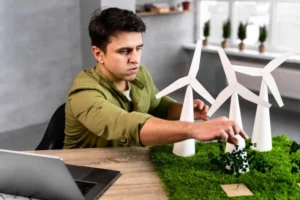
Environmental engineers in Germany design, plan, and manage solutions that reduce pollution, protect natural resources, and ensure compliance with strict German and EU environmental regulations. They work at the intersection of engineering, environmental science, and policy, supporting Germany’s energy transition, industrial decarbonisation, and sustainable urban development.
Typical responsibilities include:
- Conducting environmental impact assessments for infrastructure, energy, and industrial projects.
- Designing wastewater treatment, solid waste management, air pollution control, and remediation systems.
- Working on renewable energy projects (wind, solar, biomass) to minimise ecological impact and ensure regulatory compliance.
- Advising companies on ESG (environmental, social, governance), sustainability reporting, and resource efficiency.
In job descriptions, in-demand skills often include life-cycle assessment, environmental modelling, knowledge of ISO 14001, German/EU regulations, and experience with large infrastructure or energy projects. Long-tail keywords that naturally align with these roles include “environmental engineer jobs in Germany for foreigners”, “sustainability engineer Germany”, and “green jobs in Germany for engineers”.
Free German A1 Mock Tests – Powered by AI!
Test your skills on our interactive platform. Get instant feedback from our AI to help you communicate better and track your progress. Start your free German mock test now.
Test Your German A1 for FreeEligibility to become an Environmental Engineer
Eligibility can be viewed at three levels: school, university, and professional practice. Exact criteria vary by country and institution, but the core pattern is quite consistent worldwide.
Basic eligibility (school level):
- Completion of higher secondary/10+2 (or equivalent) with science subjects, typically including mathematics, physics, and chemistry.
- Competitive performance in these subjects is often required as engineering programs often require minimum grades or entrance exam scores.
Bachelor’s degree eligibility (environmental engineering or related field):
- Admission to a bachelor’s program in environmental engineering, civil engineering, chemical engineering, or a closely related discipline.
- Some universities, including those in Germany, require proof of specific prior coursework (math, basic sciences, introductory engineering) and sometimes entrance tests or aptitude checks.
Master’s / advanced study eligibility (optional but beneficial):
- A recognised bachelor’s degree in environmental, civil, chemical, or general engineering, often with a minimum GPA or grade threshold.
- For international study (e.g., environmental engineering in Germany), universities can require:
- Proof of 13 years of schooling or equivalent (for undergraduate entry).
- Documented ECTS-equivalent credits in mathematics, water/waste/energy-related engineering, and natural sciences at the bachelor’s level (for master’s entry).
- Language proficiency (English test scores such as IELTS/TOEFL, and German at B2–C1 for German-taught programs).
Professional eligibility (licence or registration, depending on country):
- In many countries, engineers who offer services directly to the public need a professional licence (such as a PE licence).
- This usually requires: an accredited engineering degree, passing the Fundamentals of Engineering (FE) exam, gaining several years of supervised work experience, and then passing a Professional Engineering (PE) exam.
Also read: What Level of German is Required to Work in Germany?
|
German A2 Exercises – Download Free PDF |
||
Step-by-step guide: How to become an environmental engineer
1. Build a strong science and math foundation at school
Start by choosing the science stream (or equivalent) with a focus on mathematics, physics, and chemistry in your higher secondary education. These subjects underpin environmental engineering topics like fluid mechanics, environmental chemistry, hydrology, and process design, so good grades here will make both admissions and future coursework easier.
During this stage, it helps to:
- Participate in science fairs, environmental clubs, or sustainability projects at school.
- Explore basic environmental issues such as water pollution, air quality, waste management, and climate change through documentaries, articles, and simple projects.
2. Choose an environmental or related engineering degree
After school, the key step is enrolling in an engineering degree that can lead to environmental engineering roles. Many universities offer a dedicated Bachelor’s in Environmental Engineering, while others provide environmental specialisations within civil, chemical, or general engineering.
Common degree options that are accepted for environmental engineering careers include:
- Bachelor’s in Environmental Engineering.
- Bachelor’s in Civil Engineering with an environmental or water resources focus.
- Bachelor’s in Chemical or Process Engineering with environmental modules.
If your goal is to study or work in Germany later, you can either:
- Do your bachelor’s locally (in your home country) in a relevant engineering field and then apply for a master’s in environmental engineering in Germany.
- Or directly pursue environmental engineering in Germany, meeting eligibility such as 10+2 equivalence, 13 years of schooling, and language requirements.
3. Gain hands-on experience during your degree
Employers and universities value practical exposure, not just classroom knowledge. While studying, look for:
- Internships in environmental consultancies, government pollution control boards, water utilities, NGOs, or construction/energy companies.
- Final-year or capstone projects focused on real-world issues like wastewater treatment design, solid waste management, air quality modelling, or renewable energy’s environmental impacts.
These experiences help you:
- Understand day-to-day tasks in roles such as environmental engineer, sustainability engineer, or water resources engineer.
- Build a portfolio that strengthens applications for higher studies and jobs, especially abroad.
4. Develop core technical and soft skills
Beyond formal coursework, environmental engineers are expected to master a mix of technical tools and soft skills.
Important technical skills include:
- Environmental chemistry, water and wastewater treatment, air pollution control, and solid waste management.
- Hydrology, hydraulics, fluid mechanics, and environmental hydraulics.
- Modelling and design tools, including CAD and sometimes GIS or specialised environmental modelling software.
Complementary soft skills:
- Analytical thinking and problem-solving are essential, as much of the job revolves around diagnosing environmental issues and designing solutions.
- Communication and report writing, especially for explaining complex technical findings to non-technical stakeholders and regulators.
- Teamwork and project management skills are required, given that environmental projects are often interdisciplinary.
If you aim for Germany or other non-English-speaking countries, begin learning the local language (for example, German up to B1/B2) while still in college—this adds a major competitive advantage later in job applications and integration.
5. Consider a master’s degree (especially for specialised or international roles)
Although a bachelor’s degree is often enough for entry-level environmental roles, a master’s degree is increasingly common and valuable for specialised positions, research, and overseas opportunities.
A Master’s in Environmental Engineering or a related field helps you:
- Deepen expertise in areas like water resources, climate adaptation, environmental modelling, or renewable energy systems.
- Strengthen your profile for roles in research institutes, multinational companies, and international organisations.
For Germany specifically:
- Many universities offer English-taught master’s programs in environmental engineering or environmental sciences, especially targeted at international students.
- Typical eligibility includes a relevant bachelor’s, specific ECTS credits in core subjects, and English and/or German proficiency proof.
6. Get relevant certifications and (where applicable) licensure
In several countries, practising as an engineer for public projects or signing off on designs requires you to be licensed as a professional engineer. While the exact process depends on the country, a common pattern (e.g., in the US and similar systems) is:
- Take the Fundamentals of Engineering (FE) exam after or near the end of your bachelor’s degree to become an Engineer-in-Training (EIT).
- Gain around four years of supervised work experience under a licensed engineer.
- Take the Principles and Practice of Engineering (PE) exam in environmental engineering to qualify for full licensure.
For those targeting Germany, the focus is more on:
- Recognised engineering degrees, relevant experience, and sometimes professional registration with local engineering chambers.
- Meeting visa and Blue Card salary thresholds for foreign engineers, rather than US-style FE/PE exams.
7. Enter the workforce and build a niche
Once you have your degree (and optionally a master’s/certifications), start applying for entry-level environmental engineering positions. Typical entry roles include junior environmental engineer, environmental consultant, water/wastewater engineer, sustainability analyst, or HSE (health, safety, environment) engineer.
Over time, you can specialise in niches such as:
- Water and wastewater treatment.
- Air quality and emissions control.
- Solid waste and resource recovery.
- Environmental impact assessment and permitting for infrastructure or energy projects.
If your long-term plan is to move to Germany, gaining a few years of relevant experience in your home country while developing German language skills can make your profile stronger for environmental and green engineering roles there.
|
Goethe Exam Dates: Multiple Test Centers |
|
| Trivandrum Goethe Exam Dates | Kochi Goethe Exam Dates |
| Chennai Goethe Exam Dates | Coimbatore Goethe Exam Dates |
Opportunities in Germany’s energy and green industry
Germany is in the middle of its “Energiewende” – a national transition towards renewable energy, energy efficiency, and climate neutrality – and environmental engineers sit right at the core of this shift. The country is phasing out coal, expanding onshore and offshore wind, scaling solar, and investing heavily in hydrogen and grid modernisation, which creates a sustained demand for environmental and renewable energy specialists.
Key opportunity areas include:
- Renewable energy: Environmental engineers work with wind farms, solar parks, hydropower, and biomass projects to assess environmental risks, plan mitigation, and ensure permits.
- Sustainable industry: Large German companies in chemicals, automotive, and manufacturing are investing in decarbonisation, circular economy, and cleaner production processes, creating roles in environmental compliance, life-cycle analysis, and resource optimisation.
- Green infrastructure and smart cities: Urban water management, flood protection, climate-resilient infrastructure, and sustainable mobility projects require environmental and civil engineering expertise.
Germany’s labour market reports and green jobs platforms show a consistent shortage of professionals for “green jobs” in engineering, especially in renewable energy, environmental technology, and climate-related roles, which makes this a strong career choice for the coming decade. Additionally, Germany has recently announced a major increase in their minimum wages. The increase is scheduled to be in effect in two phases – 2026 and 2027.
Read in detail: Germany’s Booming Energy Industry
Free German A1 Mock Tests – Powered by AI!
Test your skills on our interactive platform. Get instant feedback from our AI to help you communicate better and track your progress. Start your free German mock test now.
Test Your German A1 for FreeSalary of environmental engineers in Germany (2026)
Environmental engineering is a well-paid profession in Germany, and salaries tend to increase significantly with experience, specialisation, and location. Different sources quote slightly different averages, but together they paint a clear, realistic range.
Recent data suggests:
- Average salaries for environmental engineers across Germany are often quoted around 50,000–55,000 EUR gross per year at mid-career.
- Some salary surveys show averages ranging roughly from the low 40,000s EUR for early career to above 80,000 EUR for highly experienced professionals, depending on role, seniority, and city.
Approximate salary ranges by experience
| Experience level | Estimated annual salary range (gross, EUR) | Notes |
|---|---|---|
| Entry-level (0–2 years) | 42,000–50,000 | Typical for new graduates or early-career engineers. |
| Early to mid-level (3–5 years) | 50,000–65,000 | Often after completing a master’s and gaining project experience. |
| Mid to senior (6–10 years) | 65,000–80,000 | Project leads, consultants, or specialists in large firms. |
| Senior/lead roles (10+ years) | 80,000–95,000+ | Management, strategic roles, or niche high-responsibility positions. |
Salaries can be higher in large cities such as Munich, Stuttgart, Frankfurt, and Hamburg, or in multinational firms and consulting companies, while smaller municipalities and NGOs may offer lower ranges. For comparison, some engineering fields in Germany can exceed 100,000 EUR at senior levels, so environmental engineers with strong technical and management skills can also grow into top-paying roles over time.
People also read: Salary Guide for Germany
Lifestyle and living conditions in Germany for environmental engineers
Germany offers a high standard of living, strong worker protections, and a good work-life balance, which is particularly attractive for engineers relocating from more stressful job markets. Typical full-time contracts include 38–40 hours per week, paid vacation (often 25–30 days), health insurance, and social security benefits.
Some key lifestyle aspects:
- Cost of living: Cities like Munich, Frankfurt, Stuttgart, and Hamburg are more expensive, especially for rent, while mid-sized cities and eastern regions are more affordable. Many engineers still find the salary-to-cost-of-living ratio reasonable, especially compared to other Western European countries.
- Public transport and infrastructure: Germany has excellent trains, buses, cycling infrastructure, and well-planned cities, making everyday commuting and travel convenient even without a car.
- Safety and social life: Germany consistently ranks high for safety, healthcare, and quality of life, and major cities have vibrant international communities, especially around universities and tech hubs like Berlin, Munich, Hamburg, and Cologne.
For environmental engineers in particular, working in a country that takes climate policy, recycling, and sustainable urban planning seriously can be deeply motivating in day-to-day professional life.
Future Prospects in Environmental Engineering in Germany
The outlook for environmental and sustainability-related roles in Germany is strong through 2030 and beyond, driven by climate goals, EU regulations, and ongoing investment in renewable energy and green infrastructure. Germany has committed to ambitious emission reductions and a massive expansion of renewables, which requires specialised engineers at every stage, from planning and permitting to construction, monitoring, and optimisation.fly+2
Trends shaping future roles:
- Growth of green jobs: Germany’s official green jobs and migration portals highlight increasing demand for engineers involved in renewable energy, environmental technology, and climate adaptation.
- Circular economy and industry decarbonisation: Companies need experts to manage waste reduction, recycling, low-carbon production, sustainable supply chains, and ESG reporting.
- Research and innovation: Universities, Fraunhofer institutes, and research centres actively work on water, air, soil, and energy systems, creating opportunities in R&D and PhD-level roles.
For international engineers, this means that environmental engineering is not a short-lived trend but a long-term, future-proof career path in Germany’s economy.
You might also like: Top Industries and Career Opportunities in Germany
Migration Opportunities and Schengen Mobility
Germany is part of the Schengen Area, which is a major advantage for professionals who want career flexibility across Europe. After securing a job as an environmental engineer, many professionals obtain either a standard work visa or the EU Blue Card, which is designed for highly skilled workers and comes with easier long-term residence and family reunification options.
Key migration aspects:
- Work visa and EU Blue Card: Engineers typically qualify due to their degree and salary level, and once in Germany, they can later apply for permanent residence after meeting time and language requirements.
- Schengen travel: A valid German residence permit usually allows visa-free travel within the Schengen Area for short stays, enabling professionals to attend conferences, interviews, or explore job prospects in neighbouring countries such as the Netherlands, Austria, Denmark, and Sweden.
- Intra-European mobility: Experience as an environmental engineer in Germany, especially with recognised companies or research institutions, is highly valued across Europe and can be leveraged when applying for roles in other EU states.
For Indian and other non-EU candidates, Germany often serves as a strong base country for long-term European careers, combining job stability with wider mobility across Schengen.
Also read: Opportunities in Other Countries After Learning German
Why German language skills are a game-changer (and how Entri can help)
While there are English-speaking environmental engineering jobs in Germany, especially in multinational companies and research projects, German language skills significantly expand your opportunities. Many roles in public authorities, consulting, and local infrastructure projects require communication with clients, government agencies, and communities, which is much easier if you can work confidently in German.
Entri’s German language course: A practical stepping stone
Entri’s online German language course offers structured training from A1 to C2 levels, with live interactive sessions, recorded classes, mock tests, and Goethe exam-focused preparation. The course is delivered in collaboration with a specialised German training institute and is designed to build solid communication skills through speaking practice, grammar foundations, and regular assessments.
Key benefits for aspiring environmental engineers:
- Career advantage: Learning German improves your chances of getting shortlisted for engineering roles, especially in companies that deal with local authorities or German-speaking teams.
- Study and visa support: German proficiency supports applications to German universities, helps with integration, and is often a plus for long-term residence and permanent settlement.
- Structured progression: Entri’s course covers levels from A1 up to higher levels with clear weekly plans, live sessions, homework, and mock tests aligned with Goethe-style exams, helping you move from basic to professional communication.
If you are serious about an environmental engineering career in Germany, combining your technical profile with B1–B2 level German can be one of the most effective ways to stand out in the job market and feel more at home once you move.
Conclusion
Environmental engineering in Germany brings together purpose, stability, and growth: you contribute to solving real climate and sustainability challenges while building a career in one of Europe’s strongest and most forward-looking economies. With growing green jobs, attractive salaries, strong worker protections, and freedom to move within the Schengen zone, Germany stands out as a top destination for engineers who want both professional success and a meaningful impact.
If you combine your technical expertise with German language skills through a focused course like Entri’s, you position yourself not just for a job, but for a long-term future in Europe’s green transition.
Free German A1 Mock Tests – Powered by AI!
Test your skills on our interactive platform. Get instant feedback from our AI to help you communicate better and track your progress. Start your free German mock test now.
Test Your German A1 for FreeFrequently Asked Questions
Is environmental engineering a good career in Germany?
Yes. Environmental engineering is a strong career choice in Germany due to the country’s focus on renewable energy, strict environmental regulations, and long-term climate goals, which continually generate demand for specialists.
Are there environmental engineering jobs in Germany for foreigners?
Yes, there are many opportunities for international candidates, especially those with a relevant degree, some experience, and at least basic German skills; roles exist in consulting, renewable energy, industry, and public-sector projects.
How much do environmental engineers earn in Germany?
Most environmental engineers can expect starting salaries roughly in the low-to-mid 40,000 EUR range, rising to 50,000–65,000 EUR with experience and up to around 80,000–95,000 EUR in senior or specialised positions.
Do I need German to work as an environmental engineer in Germany?
Some positions in international companies and research institutes are possible with English, but German is a major advantage for most roles, especially those involving regulatory work, local clients, or public authorities, and it improves long-term career and migration prospects.
Can environmental engineers in Germany move to other European countries?
Yes. With a German work visa or EU Blue Card and relevant experience, environmental engineers can often transition to roles in other EU/Schengen countries, and their German work experience is valued across Europe’s green and energy sectors.