
Table of Contents
Imagine opening your laptop every day, knowing that you could poking around in company networks, exploited vulnerabilities, and be paid handsomely for protecting valuable data from cyber criminals. That kind of work seems almost too exciting to be true, especially when you are coming into it from scratch with no tech background or computer experience. Many assume the best path will take you through coding years, fancy degrees, or tech connections before they even talk to you. The good news is that none of that is a necessary evil. You can actually enter ethical hacking as a beginner ethical hacker without a prior education, just keep making smart, steady progress and follow the right path. This guide shows you exactly what you need to do—from the first steps to that first paycheck—for you to learn how to turn interest into a real job in cybersecurity.
Enroll in Entri’s AI-Powered Cybersecurity course now!
What Is a Junior Ethical Hacker?
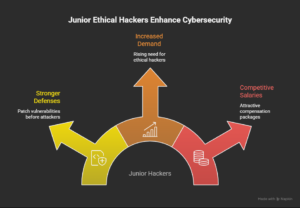
The younger ethical hacker is always looking for flaws in computers, websites, networks and apps so that companies can patch them before anyone with bad intentions finds them. Organizations use people to join this staff so that they can run safe, authorized tests that mimic what real attackers might attempt, thus allowing the business to find issues and construct stronger defenses in general. It is an entry level position, so a bit of the everyday, in this case, is to start a small scan with a common tool, make simple reports about what was discovered, and help senior colleagues in bigger security checks.
The big difference from criminal hacking is that everything happens with the written, signed consent of the owners of the systems, and that every action is legal and ethical. This is the whole point—to secure things rather than swindle or rob. Working hours may consist of scanning a block of network space to find connected devices, searching a web app for mistakes that may seem obvious, reading activity logs for information that is surprising, or creating a list of problems that programmers and bosses can see and fix.
Companies everywhere are increasingly challenged by growing cyber threats, and so the demand for aspiring ethical hackers rises constantly. Big companies, large banks, hospitals, government offices, the ones that lose billions of dollars and trust in data theft, so they look for eager newcomers who can pick things up quick and put it to work right away. In many places around the world, people just starting out in these roles see salaries between roughly $55,000 and $80,000 USD per year, though the exact number shifts depending on the country, city, and company size. In India, freshers or juniors often begin around ₹4–7 lakhs per year, with stronger packages in tech hubs like Bangalore or Hyderabad pushing toward ₹8–12 lakhs after a bit of experience.
Folks come into this line of work from all sorts of places—some used to fix computers at help desks, others finished non-tech degrees, and quite a few switched from completely different fields like sales or teaching. The common thread among those who make it is real curiosity about how digital systems connect and behave, plus the willingness to keep practicing even when progress feels slow. The job stays interesting because new tools, fresh vulnerabilities, and changing attack methods appear all the time, so you never run out of things to figure out.
Is Experience Required to Start Ethical Hacking?

Ethical hacking is completely new to you; however, most successful professionals in the industry started exactly where you are now—with no experience at all. Managers have more to do with what you can actually do, how fast you learn, and whether you are a real driven individual than they do with a resume filled with previous cybersecurity posts. Newcomers who show through projects, challenges, and basic certifications they have started building real ability, have many good entry level jobs.
Industry facts prove that ethical hacking is not limited to computer science graduates or long-time programmers, despite what some people argue. Many of the prominent penetration testers and security researchers learned all they could in online courses, private labs, free challenges, and community support rather than taking the college-to-job route. Despite the continual shortage of talented cybersecurity professionals, businesses take risks with promising beginners who already have initiative and willingness to sweat the little stuff.
When you begin without experience, it is best to get straight into the real world so you can gain confidence and collect stories to share during interviews. There are hundreds of free or extremely cheap places that make it totally legal to run tools, attacks, see what happens, and clean up afterwards without exposing anything real or risky. Each completed lab or solved puzzle is proof that you are able to apply concepts in action—not just theory from a book or video.
Money worries or limited free time stop a lot of beginners before they start, yet the huge amount of no-cost material, friendly online groups, and clear learning tracks available today knock down most of those obstacles. Forums, chat servers, video channels, and study groups put you in touch with folks further along who happily answer questions and point out better ways to approach problems. What really separates people who eventually land junior ethical hacker jobs from those who stay stuck is steady effort over weeks and months, because regular practice turns small daily improvements into serious skill and noticeable progress.
Skills You Need to Learn First
Learning to hack ethically starts with some of the things that are tied to almost everything you will do in the future. First, it is important to spend some time on computer networking because virtually all kinds of attack or protection depend on the way devices talk to each other via wires or via wireless signals. Understand IP addresses, what ports are and how TCP and UDP package and move data securely from place to place. Once the pieces align, you can see exactly where someone might listen in, turn traffic around, or slip past guards.
Knowledge of operating systems follows closely behind, and Linux is particularly worth examining because most serious hacking tools would enjoy playing there. Download Ubuntu from anywhere, use a free virtual machine program and move files around, set permissions, monitor running processes, and write short scripts in the terminal. Plus, learn to become comfortable with Windows because most firms use it, and to understand how to manage users, PowerShell commands, services, and find common setups. so you know what normal looks like when you test.
A little programming experience is a good thing and Python is best for beginners because of the clear style and heavy use across security projects. Start with simple scripts that read files, sort text, automate small jobs, or reach out to network services. The goal at first is to not become a full-grown developer in a matter of days; you have already opened many doors by reading other people’s code, by modifying tools, or by creating your own little helpers.
The basics come down to concepts of security. Study the types of attacks that people actually use most frequently—phishing emails that scam people, malware which can be downloaded, SQL injections that rip databases, cross-site scripting bugdies that hijack browsers, and privilege increases that turn low level access into full control. Understand how traditional defenses rip up: firewalls that block traffic, antivirus programs that flag bad files, intrusion detection programs that look for strange patterns, and encryption that scrambles data down so that only the right people can see it. Knowing both sides of the fight allows you to think like an attacker while also learning to defend.
Beyond technical pieces, strong problem solving skills, a natural ability to explain complex ideas clearly, and attentiveness to detail are just as important. Train yourself to divide the big problems that seem confusing into small clear steps, write reports or notes that people with no experience can take very seriously, and go back and check your work twice to make sure there are not mistakes that cause trouble. These all grow automatically as you work on real projects a lot and reflect on what worked or needs to be fixed.
Beginner Roadmap to Ethical Hacking
The only clear route from complete beginner to ready for junior ethical hacker jobs is along a gradual progression that is based upon everyday practice and incremental challenge. Start out by spending the first two to four weeks learning to use computers – what hardware does, how different types of software work, simple command-line navigation, and how the internet zaps information between machines. These ideas are explained clearly and feel confident, yet unfettered by plenty of free video playlists or online lessons.
Now that’s the foundation, begin networking for the next four to six weeks. Snuggle into the layers of OSI models, learn about subnets, packet headers, and use free apps like Wireshark to follow real traffic. Set up a home-sized test network on virtual machines or other devices so you can see patterns and begin to notice something off.
After networking is familiar, turn to the operating systems for another four or eight weeks. Push into Linux, tackle daily commands and learn how to run Windows via user, policy, and service control. The end goal is to get between Linux and Windows to feel smooth and natural.
Bring in Python programming around month three or four. Finish the beginner to intermediate course, and then immediately apply it, writing a simple script to check for portability, test for password strength, or test for log file integrity. Small working tools cement ideas in ways that are far more empowering than watching videos.
If you start using actual ethical hacking software in safe, isolated labs from month four onwards. Become adept at Nmap for finding devices and open ports, Metasploit for practicing controlled exploits, Burp Suite for mucking around with web applications, and Wireshark for checking deeply packets. Start with follow-up, following the steps, and repeat the steps without help until they are second nature to you.
Make your own home lab out of free virtualization software and vulnerable machines that you can pirate from trustworthy sites. This private playground allows you to play with your body, make mistakes by reason, break things, fix them, and learn fast without consequences.
Keep online communities with you throughout—pose genuine questions, share what you did, celebrate small victories, and get some advice from other people who have also done the same thing. Engage in forums, watch streaming TV shows or join study groups keeps our brains going, and shows us new ways of solving the same problem.
In months five through seven, I cover more specific topics such as web application failures, wireless network attacks, basic cryptography, and common Active Directory exploits. Keep going and push your way through harder situations at practice sites and keep notes or screenshots of every step, so you can build your own portfolio that displays your progress.
Make consistency your priority: spend at least an hour per day on focused work, check what you did and run back to weak spots every couple of weeks. This rhythm builds the knowledge, muscle memory, and quiet confidence to make you stand out in the competition for junior ethical hacker positions.
Certifications and Practice Platforms
Certifications act like strong signals to recruiters that you took the time to learn properly and can handle real responsibilities. CompTIA Security+ remains the top pick for most beginners because it teaches core security ideas, common threats, basic tools, and good practices without demanding any previous work history. People usually prepare in 40 to 80 focused hours and pass the exam for about $350, which makes it a smart, respected first win.
After that, the Certified Ethical Hacker (CEH) from EC-Council fits naturally since it zeros in on penetration testing steps and tool usage. Beginners often reach it successfully after Security+ by mixing official study guides with lots of lab time.
Free options like the Google Cybersecurity Professional Certificate offer solid training at no cost and fit nicely into part-time schedules over a few months, giving another trustworthy credential to list.
Practice platforms turn book smarts into actual skill through fun, realistic challenges. Hack The Box hosts hundreds of vulnerable machines sorted by difficulty so you attack them whenever you want and collect badges along the way. TryHackMe lays out guided learning paths with rooms that teach one concept at a time before asking you to use it on your own. Both keep generous free access while paid plans unlock even more content.
Capture-the-flag events on CTFtime let you compete against thousands of others in timed puzzles that test creativity and speed. OverTheWire’s Bandit levels teach Linux mastery through a story-like series of increasing challenges. VulnHub provides downloadable machines you run locally and attack at your leisure.
Approach these platforms with a plan: begin on easy content, solve at least one thing daily, study solutions carefully when you get stuck, and climb difficulty gradually. Pairing respected certifications with hundreds of solved challenges convinces employers you bring both theory and hands-on capability to the table.
Entry-Level Job Roles and Career Growth
Realistic starting jobs for new junior ethical hackers include junior security analyst positions where you watch for alerts, run regular vulnerability scans, sort through incidents, and help with basic follow-up work. Vulnerability assessment roles concentrate more on finding and describing weaknesses across apps and infrastructure, often needing less background than full-scale penetration testing.
IT support or help-desk jobs that touch security give another common entry point, letting you learn company systems while quietly sharpening personal hacking skills outside work hours. Consulting companies and managed security providers frequently take on interns or apprentices who prove themselves and move into full junior ethical hacker spots.
Put together a resume that highlights certifications, lab write-ups, CTF results, and any small scripts or tools you built. Customize each application to match tools and skills mentioned in the posting. Reach out on LinkedIn, attend virtual security meetups, and join active chat groups to discover openings that never make it to public job boards.
When interviews come, practice explaining vulnerabilities in everyday language, walking through how you use common tools, and thinking out loud through made-up scenarios. Confidence builds fast once you realize you already solved similar problems dozens of times in your own lab.
Advancement moves quicker in cybersecurity than in most fields. After one to two years of consistent good work, many junior ethical hackers step up to mid-level penetration tester, red-team member, or security consultant roles with noticeably better pay. Picking a specialty—like cloud environments, mobile apps, or Internet of Things devices—can push earnings higher even sooner.
Longer-term options include senior penetration tester, security architect, team leader, or freelance consultant working with several clients at once. Staying sharp through harder certifications like OSCP, real projects, and conference talks keeps opportunities flowing no matter where you are in your career.
Enroll in Entri’s AI-Powered Cybersecurity course now!
Final Thoughts
Turning yourself into a junior ethical hacker starting with zero experience takes real commitment, but the path is clear, proven, and completely reachable when you stay focused and keep showing up. Begin right now with the fundamentals, stick to daily hands-on practice, collect meaningful certifications, and carefully track everything you learn so others see your growth. The cybersecurity world has an urgent need for people who care enough to keep learning, and the payoff—work that actually protects people and companies, solid earning potential that grows quickly, endless mental challenges, and the satisfaction of making a difference—makes every hour worthwhile. Take that first small step today, push through the slow days, and before long you will look back and realize you really did build a career as a junior ethical hacker from nothing. The door is open—go walk through it.
Frequently Asked Questions
Do I Really Need to Know How to Code to Become an Ethical Hacker, or Can I Skip Programming Altogether?
The question of whether programming is truly necessary for ethical hacking generates considerable debate among beginners, largely because people want reassurance that they can enter this field without tackling something that feels intimidating or mathematically heavy. The honest answer contains both good news and important caveats that every aspiring ethical hacker should understand before mapping out their learning journey. You absolutely do not need to be a software engineer who builds complex applications from scratch, nor do you need to spend several years mastering multiple programming languages before anyone will consider hiring you. However, the idea that you can become a competent, employable ethical hacker while knowing absolutely zero programming is unfortunately more myth than reality, and believing this misconception will eventually create a ceiling that prevents your career from progressing beyond the most basic tasks.
Think about programming for ethical hackers less like becoming a novelist and more like learning enough grammar and vocabulary to read, edit, and slightly modify existing documents. The majority of professional penetration testers and security analysts spend far more time reading code, tweaking existing scripts, and understanding what automated tools are doing behind the scenes than they do writing massive original programs from blank screens. When you run an automated scanning tool against a target network, that tool is executing thousands of lines of code written by developers who spent years building it, and you do not need to replicate that effort. What you do need is the ability to look at a Python script that someone else wrote, identify which variable controls the delay between connection attempts, change that number, and save the modified version. You need to recognize when an exploit script you downloaded from a public repository contains a function call that conflicts with your specific target environment, and you need enough comprehension to comment out that line or adjust the parameters accordingly. You need to examine a few lines of JavaScript on a suspicious website and spot that it is attempting to steal form data rather than display harmless animations. These are not advanced software engineering tasks, but they are absolutely programming-related tasks, and without any exposure to code whatsoever, you will remain completely dependent on other people to solve these routine obstacles for you.
Python stands as the overwhelming favorite among ethical hackers for good reason, and dedicating approximately sixty to ninety focused hours to learning Python fundamentals will unlock capabilities that permanently change your effectiveness as a security professional. The syntax reads almost like plain English compared to older languages, the interactive shell lets you experiment and see immediate results, and thousands of security tools and exploit proof-of-concepts are written in Python, meaning you gain instant access to a massive ecosystem of working examples you can study and adapt. Start with variables, data types, conditional statements, and loops, then progress to functions, file handling, and working with external libraries. Build a simple port scanner that checks whether common ports like 22, 80, and 443 are open on a remote server. Write a script that reads a wordlist from a text file and attempts to log into a test website with each password, counting how many attempts succeed. Create a small program that parses Apache log files and prints out every IP address that generated a 404 error. These exercises teach you how to think algorithmically, how to translate security concepts into executable instructions, and how to troubleshoot when things do not work as expected.
Beyond Python, a working familiarity with Bash on Linux systems and PowerShell on Windows systems will serve you exceptionally well because these command-line environments are where so much security work actually happens. You do not need to write thousand-line PowerShell modules, but you should understand how to chain together commands with pipes, filter output to find specific strings, and write simple loops that process multiple files or hosts at once. Web application testing inevitably requires some JavaScript comprehension, not because you will be writing single-page applications but because you need to read obfuscated malicious scripts, understand how AJAX calls transfer data between browser and server, and spot DOM-based vulnerabilities that rely on how client-side code handles user input. SQL fundamentals matter less for writing complex queries and more for understanding how injection attacks work by manipulating query structure, which requires recognizing the difference between a parameter and raw concatenated input.
The hiring managers and technical interviewers who evaluate junior candidates rarely expect flawless, optimized, production-ready code. What they do expect is evidence that you can think logically, that you are not helpless when an automated tool fails or behaves unexpectedly, and that you possess the foundational literacy to learn new code quickly on the job. When you include a few small Python projects on your resume or GitHub profile, you signal that you took the initiative to acquire this skill without anyone forcing you, which strongly correlates with the kind of self-directed learning attitude that successful ethical hackers must maintain throughout their careers. Programming is not the barrier that keeps motivated beginners out of cybersecurity, but embracing it as an essential and even enjoyable part of your skillset will separate you from the crowd of applicants who stopped at the tool-user level and never progressed deeper.
How Long Does It Really Take to Go from Complete Beginner to Landing My First Junior Ethical Hacker Job?
The timeline question presses on the mind of every single person who starts this journey with no background, and searching for answers online produces wildly conflicting estimates ranging from three months to three years, leaving beginners confused about whether they are moving too slowly or setting unrealistic expectations. The honest, grounded answer requires understanding that the path from zero to junior ethical hacker is not a fixed marathon with a single finish line but rather a skill-building progression where readiness depends on accumulated competence rather than calendar pages. For a motivated individual who can dedicate approximately fifteen to twenty focused hours per week, the typical range falls between twelve and eighteen months from the day you write your first command to the day you accept an offer letter. Some extraordinarily disciplined people with abundant free time and rapid learning curves have done it in eight or nine months, while others balancing full-time jobs, family responsibilities, or learning challenges reach the same destination in twenty-four months or slightly longer. Neither pace is wrong, and comparing your speed to someone else’s rarely produces anything useful beyond anxiety.
Breaking this timeline into phases helps transform an abstract wait into concrete, measurable milestones that keep motivation high and provide clear indicators of progress. The foundational phase consumes roughly the first three to four months and focuses entirely on building basic literacy in the core domains that everything else depends upon. During this period, you learn computer networking fundamentals until you can explain the difference between TCP and UDP, describe what happens during a three-way handshake, and identify common port numbers without checking Google every thirty seconds. You install Linux on a virtual machine, navigate the filesystem entirely from the command line, change permissions, inspect running processes, and write simple Bash one-liners that search through log files. You study Windows administration basics, create local users, modify group policies, and understand how services start and stop. You complete an introductory Python course and write ten or fifteen small scripts that automate repetitive tasks or interact with network services. This phase feels slow because you are building foundational knowledge that does not yet look or feel like hacking, but skipping or rushing it guarantees that you will hit walls later when more advanced concepts assume you already understand these prerequisites.
The intermediate skill-building phase occupies months four through nine and marks the transition from general IT knowledge to specifically security-focused capabilities. You begin working with dedicated ethical hacking tools like Nmap for network discovery, Wireshark for packet analysis, Burp Suite for web application testing, and Metasploit for running controlled exploits against intentionally vulnerable targets. You join platforms like TryHackMe or Hack The Box and methodically work through learning paths designed specifically for beginners, solving your first few machines after struggling through documentation and error messages. You study the OWASP Top Ten and learn to identify SQL injection, cross-site scripting, broken authentication, and insecure direct object references in deliberately vulnerable web applications. You set up your own home lab using VirtualBox or VMware, downloading pre-configured vulnerable virtual machines from VulnHub and attacking them in your isolated environment where mistakes have no consequences. During this phase, frustration peaks because you encounter problems you cannot immediately solve, tools that behave unexpectedly, and concepts that require multiple exposures before they click. This is completely normal and actually indicates that you are stretching your abilities rather than staying in comfortable territory.
The portfolio building and certification phase spans months nine through fourteen and focuses on transforming scattered skills into coherent proof of competence that employers recognize and respect. You prepare for and pass the CompTIA Security+ examination, which validates your understanding of core security principles and satisfies HR filters at thousands of organizations. You document your best penetration testing engagements from home lab work, writing detailed reports that explain what you tested, which vulnerabilities you discovered, how you exploited them, and what remediation steps you recommend. You create a professional GitHub repository containing your custom scripts, tools you modified, and write-ups of interesting challenges you solved on practice platforms. You begin engaging with the cybersecurity community on Twitter, LinkedIn, Discord servers, and Reddit communities, asking thoughtful questions and occasionally sharing your own discoveries. You identify three or four specific junior-level job titles that match your growing skillset, such as Junior Security Analyst, Vulnerability Assessment Associate, or Penetration Testing Intern, and you study the requirements listed in real job postings to identify any remaining gaps you need to fill.
The active job search phase typically lasts six to twelve weeks after you decide you are ready, though many people begin applying earlier and continue practicing while they wait for responses. You tailor your resume to emphasize hands-on projects over formal experience, you practice answering common interview questions about vulnerabilities and tools, and you complete several simulated technical interviews with mentors or study group partners. You apply to between thirty and sixty positions, understanding that entry-level cybersecurity receives enormous numbers of applications and that rejection often reflects timing or competition rather than personal inadequacy. You celebrate the first interview invitation as genuine validation of your progress regardless of outcome, and you incorporate feedback from each conversation to improve your next attempt. Eventually, one organization recognizes that your demonstrated skills, your hunger to learn, and your ethical commitment compensate for the lack of traditional experience, and they extend an offer that officially transforms you from aspiring beginner to professional junior ethical hacker.
Which Certifications Actually Matter for Beginners, and Which Ones Are Just Expensive Wastes of Money?
The certification landscape surrounding cybersecurity and ethical hacking resembles a confusing bazaar where dozens of vendors compete for your attention and your wallet, each claiming that their particular credential represents the essential key to career success. Beginners understandably want some external validation that their knowledge meets professional standards, and they hope that collecting the right certificates will compensate for missing experience on their resumes. The truth about entry-level certifications is simultaneously encouraging and cautionary: certain credentials reliably open doors and accelerate job offers, while others consume significant time and money while contributing little to your actual competence or employability. Learning to distinguish between these categories represents an important early career skill that will serve you well beyond your first certification decision.
CompTIA Security+ sits alone at the top of the beginner certification hierarchy, and virtually every cybersecurity professional, hiring manager, and career advisor agrees that this should be your first target. The examination covers exactly the foundational knowledge that junior security practitioners need, including threat vectors, attack types, vulnerability management, cryptography basics, identity and access management, security architecture, and incident response procedures. Unlike vendor-specific certifications that teach you one company’s product ecosystem, Security+ focuses on universal principles that transfer across any environment you will encounter. The examination costs approximately $350, requires no prerequisite certifications, and can be prepared for in forty to eighty hours of focused study using resources like Professor Messer’s free video series, the official study guide, and practice question banks. Employers recognize Security+ immediately because the Department of Defense mandates it for certain security roles, thousands of organizations reference it in job descriptions, and passing it demonstrates that you possess the discipline to learn technical material and pass a rigorous standardized test. Security+ will not single-handedly land you a job, but failing to obtain it while pursuing other expensive credentials raises legitimate questions about your judgment and priorities.
The Certified Ethical Hacker certification from EC-Council occupies a more complicated position in the beginner landscape. CEH definitely carries name recognition, and many job postings list it as desirable or even required for penetration testing roles. The examination costs considerably more than Security+, ranging from approximately $950 to $1,200 depending on your location and any bundled training materials, and EC-Council strongly encourages candidates to complete official training through accredited partners before attempting the exam. The content focuses heavily on tool usage and structured methodology, teaching you to run specific tools against targets in particular sequences. Critics argue that CEH tests memorization of tool commands rather than genuine analytical hacking ability, and some security professionals dismiss it as too theoretical compared to performance-based alternatives. Despite these valid criticisms, CEH remains a valuable credential for beginners specifically because recruiters and non-technical hiring managers recognize the name and interpret it as evidence that you learned the basics of ethical hacking. If you can afford the examination fee and you have already secured Security+, pursuing CEH adds another trustworthy signal to your application.
The Google Cybersecurity Professional Certificate, available through Coursera, represents a relatively new but increasingly respected entry-level option that costs nothing beyond optional Coursera subscription fees. This program requires approximately six months of part-time study and covers security principles, network defense, operating system hardening, incident analysis, and basic tool usage through hands-on labs integrated directly into the browser. Employers recognize Google’s brand and understand that completing this demanding program demonstrates sustained commitment and applied skill development. Many beginners complete this certificate alongside Security+ preparation, using the structured curriculum to build knowledge that translates directly to examination success.
Several popular certifications offer significantly less value for beginners and should generally be avoided until later in your career. EC-Council’s Certified Network Defender markets itself as an entry-level defensive security credential, but employers rarely recognize or request it, and the content overlaps heavily with Security+ without the same brand recognition. CompTIA’s own Network+ certification, while excellent for pure networking roles, becomes largely redundant once you hold Security+ because the security examination already tests networking fundamentals sufficient for cybersecurity work. Various vendor-specific associate-level certifications from Cisco, Microsoft, or Amazon Web Services can become valuable once you specialize, but pursuing them before establishing general security foundations scatters your preparation and delays your job readiness. The Offensive Security Certified Professional represents the gold standard for hands-on penetration testing ability, but OSCP is decidedly not a beginner certification and attempting it prematurely leads to frustration, burnout, and depleted bank accounts from repeated examination attempts.
The strategic approach to beginner certifications prioritizes Security+ first, adds either CEH or Google Cybersecurity Certificate as a complementary second credential if your budget and schedule permit, and postpones all other certifications until you have secured your first role and can align further credentials with your employer’s needs and your chosen specialization path.
Do I Need an Expensive Home Lab with Multiple Physical Computers, or Can I Learn Everything Using Free Online Resources?
The home lab question often intimidates beginners because they envision racks of expensive servers, blinking network equipment, and stacks of retired enterprise hardware consuming their spare bedroom and depleting their savings account. This mental image keeps many motivated people from even starting, because they assume they cannot possibly afford the infrastructure required to become employable. The wonderful reality contradicts this assumption completely: you can build a world-class ethical hacking practice environment for exactly zero dollars using only your existing laptop or desktop computer, free virtualization software, and freely downloadable vulnerable operating systems and applications. Physical hardware adds convenience and realism for certain advanced scenarios, but physical equipment contributes virtually nothing to your success during the beginner phase when your focus should remain entirely on mastering concepts and developing tool proficiency.
Virtualization technology represents the single most important enabler for budget-conscious ethical hacking students, and both VirtualBox and VMware Workstation Player offer completely free versions that run on Windows, macOS, and Linux hosts. These programs simulate entire computers inside your existing machine, allocating portions of your real RAM, CPU cores, and storage to virtual machines that behave exactly like physical computers with their own operating systems, network interfaces, and applications. You can run a virtual Windows 10 machine, a virtual Kali Linux machine for attacking, and a virtual Ubuntu server as your target, all simultaneously on a laptop with eight gigabytes of RAM and a modern processor. Microsoft provides official Windows evaluation copies that function fully for ninety days before requiring reinstallation, and Linux distributions remain permanently free for download. This single software category transforms a modest computer into an entire cybersecurity range capable of supporting thousands of hours of realistic practice.
The ecosystem of intentionally vulnerable applications and operating systems designed specifically for security training rivals expensive commercial ranges in both quality and variety. VulnHub hosts hundreds of downloadable virtual machine images created by the community, each containing deliberately configured security flaws ranging from simple misconfigurations to complex multi-stage compromise chains. These machines run locally on your virtualization software, require no internet connection, and come with clear documentation about difficulty level and learning objectives. TryHackMe and Hack The Box both offer extensive free tiers that provide browser-based virtual machines and guided learning paths, eliminating even the minimal technical overhead of downloading and configuring your own targets. PortSwigger’s Web Security Academy delivers the world’s best free training for web application testing, with dozens of interactive labs demonstrating each OWASP Top Ten vulnerability in realistic scenarios. OverTheWire’s Bandit game teaches Linux command-line mastery through a progressively challenging wargame accessible entirely through SSH. All of these resources cost exactly nothing and provide practice opportunities that exceed what most paid bootcamps deliver.
As your skills advance and you seek more realistic enterprise environments, you can graduate to attacking simulated Active Directory domains using freely available community projects like BadBlood or AutomatedLab, which script the creation of intentionally misconfigured Windows domain controllers and member servers. These environments consume more RAM and storage than simple Linux targets, but you can still run them on capable consumer hardware or temporarily rent powerful cloud instances for a few dollars per hour. The Detonate lab and Game of Active Directory projects provide similar Active Directory attack practice without requiring expensive commercial licenses or physical domain controllers.
What actually determines your learning velocity is not the sophistication of your equipment but the consistency and intentionality of your practice. A student who spends one hour daily working methodically through TryHackMe rooms on a five-year-old laptop with six gigabytes of RAM will progress dramatically faster than a student who purchases three thousand dollars worth of servers and network switches but only tinkers with them sporadically on weekends. The expensive physical lab often becomes an expensive distraction, consuming time that should be spent on foundational skill development and creating an illusion of progress through equipment acquisition rather than genuine competence building.
When you eventually secure your first junior role, your employer will provide access to authorized testing environments, licensed commercial tools, and cloud-based practice ranges that far exceed anything you could reasonably purchase independently. Your goal as a beginner is not to replicate a professional penetration testing infrastructure but to build the mental models and muscle memory that make you effective when you finally access those enterprise resources. A free laptop, free virtualization software, and free vulnerable machines represent more than enough infrastructure to accomplish this goal completely.
Can I Learn Ethical Hacking While Working a Full-Time Job or Attending School, or Is This Only Possible for People with Abundant Free Time?
The tension between your current responsibilities and your cybersecurity aspirations creates genuine friction that causes many talented, motivated individuals to abandon their goals or never seriously begin. When you already devote forty or more hours weekly to earning a paycheck, caring for family members, or completing academic requirements, the idea of adding several hundred hours of intensive technical study feels not just difficult but mathematically impossible. The reassurance you need comes not from minimizing the challenge but from understanding that thousands of successful ethical hackers built their careers under exactly these constraints, and the strategies they developed transform an overwhelming mountain into manageable daily hikes.
The most fundamental mental shift involves abandoning the all-or-nothing mindset that insists you need blocks of three or four uninterrupted hours to make meaningful progress. This belief keeps people waiting for mythical free weekends that never arrive, and it ignores the extraordinary cumulative power of brief, consistent daily sessions. Thirty focused minutes each weekday evening and two hours on Saturday morning yields six and a half hours weekly, which becomes twenty-six hours monthly and over three hundred hours annually. Three hundred hours of deliberate practice, properly structured and consistently executed, carries a complete beginner through networking fundamentals, operating system literacy, Python basics, multiple certifications, and hundreds of practice machine solves. The person who studies thirty minutes daily will outpace the person who studies four hours once weekly, because the daily rhythm maintains mental context, reduces relearning overhead, and transforms hacking concepts from isolated facts into continuous思维方式.
Strategic time multiplication requires ruthlessly eliminating low-value activities that consume attention without advancing your goals. Review your typical weekday honestly and identify where your hours actually go. Streaming platforms, social media feeds, video games, and aimless web browsing collectively consume astonishing quantities of human attention. Reclaiming even one hour daily from these activities immediately funds your entire cybersecurity learning program. Wake thirty minutes earlier and complete a TryHackMe room before anyone else in your household stirs. Use your lunch break to watch one Professor Messer video and review twenty flashcards. Listen to cybersecurity podcasts during your commute, while exercising, or during household chores. These interstitial moments, dismissed as too short for serious work, accumulate into genuine expertise when intentionally directed.
Employer tuition assistance and professional development benefits represent massively underutilized resources for working learners. Thousands of companies allocate annual budgets for employee training and certification, yet the majority of workers never request access to these funds. Approach your current employer, regardless of whether your role relates to technology, and inquire about professional development policies. Frame your cybersecurity studies as skill acquisition that makes you more valuable, more promotable, and better equipped to handle technology-related responsibilities within your existing department. Some employers will fund your Security+ examination entirely, provide paid study time, or connect you with mentors who previously transitioned from non-technical roles into security positions. The worst response you can receive is simply no, but the potential upside includes thousands of dollars in training support you would otherwise fund personally.
The specific sequence of your learning activities becomes more important under time constraints than when you have unlimited hours available. Prioritize foundational networking and operating system concepts before touching hacking tools, because attempting to learn exploitation without underlying infrastructure knowledge guarantees confusion and wasted time. Complete Security+ before pursuing more advanced certifications because the Security+ curriculum efficiently establishes the conceptual framework that organizes everything else you will learn. Focus on one practice platform at a time until you exhaust its beginner content rather than bouncing between TryHackMe, Hack The Box, VulnHub, and PortSwigger simultaneously. Each transition between learning resources carries switching costs that fragment your limited study sessions.
Connect with other working learners who share your constraints and ambitions through online communities and local study groups. The cybersecurity field contains thousands of professionals who built their careers while working unrelated day jobs, attending evening classes, or raising children, and these veterans typically respond generously to sincere beginners who respect their time. Accountability partnerships with peers in similar circumstances dramatically reduce procrastination and provide emotional support during inevitable frustration periods. When you witness someone else balancing similar responsibilities while still progressing weekly, your own obstacles become challenges rather than insurmountable barriers.
What Does a Junior Ethical Hacker Actually Do All Day, and Is the Daily Work Really as Exciting as Movies and Media Suggest?
The gap between Hollywood’s depiction of hacking and the actual daily experience of junior security professionals spans a chasm so vast that many newcomers experience genuine disappointment during their first weeks on the job. Movie hackers type furiously for ninety seconds, dramatically declare themselves inside impenetrable government systems, and save the world before the closing credits roll. Real junior ethical hackers spend the overwhelming majority of their time engaged in activities that appear mundane to outsiders: reading documentation, configuring tools, analyzing logs, writing reports, attending meetings, and patiently troubleshooting why their carefully planned test suddenly stopped working. Understanding this reality before you commit to the career path prevents disillusionment and helps you recognize that these seemingly ordinary activities constitute the essential, valuable work that protects organizations from genuine catastrophe.
A typical day for a junior penetration tester or security analyst begins with reviewing the testing scope documentation that defines exactly which systems, applications, and networks you are authorized to examine. This document, signed by system owners and legal representatives, specifies IP address ranges, domain names, testing hours, prohibited techniques, and acceptable proof-of-concept validation methods. You verify that your testing tools are updated, that your attack machine connects properly to the target environment, and that any necessary VPN connections function correctly. You review notes from previous testing days to maintain continuity and identify unfinished tasks requiring attention.
Active testing consumes perhaps half of your working hours and bears little resemblance to dramatic Hollywood sequences. You run Nmap scans against target IP ranges and patiently wait for results, analyzing open port lists to determine which services are running and what versions they report. You navigate web applications manually and with automated proxies, clicking through forms, examining URL parameters, and inspecting HTTP requests and responses for anomalous behavior patterns. You test login mechanisms with carefully constructed credential lists, observing whether the application reveals excessive information in error messages or fails to implement account lockout protections. You capture network traffic during your testing activities and examine packet captures to verify that your tools are functioning correctly and that encrypted connections use appropriate protocol versions and cipher suites. Much of this work requires sustained attention rather than rapid action, and the cognitive load of maintaining thorough, methodical testing procedures while documenting every action exhausts many beginners more than they anticipated.
Documentation and reporting responsibilities consume approximately thirty to forty percent of junior ethical hacker workdays, and the importance of this output dramatically exceeds what most newcomers expect. Your vulnerability discovery carries zero organizational value until you communicate it effectively to stakeholders who need to understand the risk, prioritize remediation, and verify that fixes successfully resolved the underlying issue. You write clear descriptions of each finding that explain the vulnerability, demonstrate the impact through proof-of-concept steps, and provide specific remediation guidance tailored to the target environment. You assign risk ratings based on standardized frameworks like CVSS, considering factors including attack complexity, privilege requirements, user interaction, and potential business impact. You embed screenshots showing successful exploitation attempts, truncated for readability and annotated to highlight critical evidence. You participate in meetings with development teams and system administrators who need clarification about your findings, sometimes defending your risk ratings against pushback from resource-constrained teams who wish the vulnerabilities were less severe than your testing indicates.
Junior ethical hackers also spend substantial time learning, because the security landscape transforms continuously and tools that worked perfectly six months ago may now miss entire categories of newly discovered attack techniques. You read security research blogs, vulnerability disclosures, and threat intelligence reports to understand emerging attack patterns targeting technologies present in your testing scope. You practice with new tool releases and updated versions of familiar software, working through official documentation and community tutorials to integrate improved capabilities into your methodology. You pursue continuing professional education requirements associated with your certifications and begin preparing for more advanced credentials that will qualify you for promotion opportunities. You shadow senior team members during complex testing engagements, observing their problem-solving approaches and absorbing tacit knowledge that cannot be adequately conveyed through written documentation.
The genuine excitement of ethical hacking work emerges not from constant high-stakes drama but from the intellectual satisfaction of solving intricate puzzles, the professional pride of protecting organizations from actual harm, and the continuous novelty of confronting systems and vulnerabilities you have never previously encountered. Each testing engagement presents unique configuration eccentricities, custom application logic, and unexpected obstacles that require creative synthesis of your technical knowledge. The moment when you successfully demonstrate a vulnerability that everyone else missed, or when you help a developer understand exactly how to close a security gap they previously considered impossible to fix, delivers gratification that surpasses any fleeting Hollywood fantasy. This is the authentic reward of ethical hacking work, and it remains accessible to junior practitioners from their very first day in role.
How Do I Gain Practical Experience When Every Job Requires Experience and Every Experience Opportunity Requires a Job?
The experience paradox paralyzes countless aspiring ethical hackers who stare at job postings demanding two to three years of professional security experience for entry-level positions and conclude, understandably but incorrectly, that the system has locked them out before they ever had a chance to compete. Breaking this cycle requires recognizing that employers use the word experience on job descriptions as convenient shorthand for demonstrated ability to perform job-relevant tasks, not as literal insistence that previous employers must have paid you for security work. When you understand this distinction, you realize that you can acquire and prove the underlying capability through multiple alternative channels that remain fully accessible to uncredentialed beginners.
Your home laboratory functions as your first professional experience environment, and the projects you complete there become legitimate work samples that demonstrate exactly the skills employers seek. When you download a vulnerable virtual machine from VulnHub, successfully compromise it through multiple exploitation techniques, and produce a professionally formatted penetration testing report documenting your methodology, findings, and remediation recommendations, you have performed the identical core activities that employed penetration testers execute daily. The fact that you performed this work on your personal equipment during unpaid hours does not diminish its relevance as evidence of your capabilities. Complete ten such engagements, save your reports in a well-organized portfolio, and you possess documentation of practical experience that surpasses what many candidates with one year of entry-level security operations work can demonstrate.
Capture the flag competitions provide another potent experience-acquisition channel that employers increasingly recognize and respect. CTF events compress realistic security challenges into timed puzzle formats that test your ability to identify vulnerabilities, exploit them under pressure, and collaborate effectively with teammates. Platforms like CTFtime maintain calendars of upcoming events ranging from beginner-friendly online competitions to elite international contests. Participating in just three or four CTF events, documenting your role in solving specific challenges, and reflecting on lessons learned from problems you could not solve creates compelling interview narratives that differentiate you from candidates whose only experience is studying certification textbooks.
Bug bounty programs offer perhaps the most direct experience-to-recognition pipeline available to self-taught ethical hackers, though beginners should approach this avenue with realistic expectations and appropriate preparation. Public bug bounty platforms like HackerOne and Bugcrowd host programs where organizations invite security researchers to test their publicly accessible applications and report discovered vulnerabilities in exchange for cash rewards and public recognition. Starting with VDP-only programs that do not offer monetary rewards but still provide public acknowledgment eliminates the pressure of immediate financial expectations while you build methodology. Reading disclosed reports from successful bug bounty hunters teaches you exactly how professional researchers approach testing, document findings, and communicate with development teams. Even finding and reporting a single valid, previously unknown vulnerability provides undeniable evidence that you possess practical security testing capability.
Open source security contributions allow you to examine real production codebases for security flaws and submit fixes through public pull request workflows. Thousands of open source projects actively seek security improvements and maintain responsible disclosure processes for accepting vulnerability reports. Identify a popular open source application you personally use, review its codebase for common vulnerability patterns, and responsibly disclose your findings through the project’s preferred reporting channel. Successfully improving the security of software used by thousands or millions of users constitutes genuine professional experience that benefits both your portfolio and the broader digital ecosystem.
Internships and apprenticeships exist specifically to resolve the experience paradox, and hundreds of organizations structure formal programs to onboard candidates who demonstrate aptitude but lack traditional credentials. These positions often pay less than full-time roles and may carry fixed durations, but they provide exactly the missing resume line that unlocks subsequent opportunities. Research organizations in your geographic area that offer security internships, attend virtual and in-person career fairs targeting cybersecurity students, and join professional association chapters that connect aspiring practitioners with established professionals who can refer you to appropriate programs.
The essential mindset shift involves stopping your search for ways to get experience and instead starting your practice of doing the actual work that experience comprises. Experience is not a resource you acquire through transactions; it is a natural byproduct of repeatedly performing security tasks, reflecting on your performance, and continuously refining your approach based on observed outcomes. Begin performing those tasks today with whatever resources you currently possess, and the experience will accumulate invisibly until one day you realize you have more than enough to satisfy any reasonable employer.
Is Ethical Hacking Saturated and Overcrowded, or Is There Still Room for Newcomers in Today's Job Market?
The saturation question emerges from legitimate observation of visible competition rather than from accurate assessment of underlying market dynamics. Beginners see thousands of applicants competing for each entry-level job posting, observe social media influencers promoting cybersecurity bootcamps to massive audiences, and read dire predictions about artificial intelligence eliminating technical jobs. These surface indicators create genuine anxiety that perhaps you arrived too late, that the window of opportunity has closed, and that your substantial effort investment will ultimately produce nothing except disappointment. The comprehensive data and professional consensus contradict this anxiety completely and consistently, offering instead a picture of persistent, severe talent shortage that shows no signs of abating within your entire career horizon.
The cybersecurity workforce gap, quantified annually by organizations including (ISC)² and Cybersecurity Ventures, currently estimates approximately 3.4 million unfilled security positions globally. This represents not a static deficit but a widening chasm between organizational security needs and available qualified practitioners. Each year, the gap grows as digital transformation initiatives expand attack surfaces, regulatory requirements mandate additional security controls, and sophisticated threat actors develop increasingly difficult-to-detect attack methodologies. Organizations cannot simply stop needing security work because they cannot find enough workers; they instead deprioritize certain activities, overload existing staff, or accept elevated risk levels that would have been considered unacceptable a decade ago. Every junior ethical hacker who successfully enters the workforce immediately absorbs work currently being deferred or inadequately addressed, providing measurable value from their first day of employment.
The distribution of cybersecurity professionals across experience levels exhibits a pronounced bottleneck that specifically advantages determined beginners. The field contains substantial numbers of senior practitioners with eight-plus years of experience and growing cohorts of students currently studying security fundamentals, but a comparative shortage exists specifically at the one-to-three year experience level. This phenomenon occurs because organizational security functions expanded rapidly following major breach disclosures beginning approximately 2013-2015, creating a wave of entry-level hiring that has since matured into mid-level and senior roles. The junior practitioners who entered during that expansion are now too senior and expensive for roles designed for newer entrants, yet organizations still need workers to perform foundational security tasks. This structural dynamic creates persistent demand for precisely the candidates you are working to become.
Artificial intelligence and automation, rather than eliminating ethical hacking jobs as some fear, are actually increasing demand for human security practitioners through several complementary mechanisms. AI-powered attack tools lower the skill barrier for conducting certain types of malicious activities, enabling less sophisticated threat actors to launch campaigns that previously required substantial technical expertise. Organizations consequently face larger and more diverse attack volumes requiring human investigation and response. AI-assisted defensive tools require configuration, tuning, output interpretation, and continuous refinement by security professionals who understand both the underlying technology and the organizational context. Security automation creates new testing requirements, as practitioners must assess whether automated defenses themselves contain vulnerabilities that attackers could exploit to bypass protection mechanisms. Every wave of security technology adoption throughout the past thirty years has increased rather than decreased demand for skilled practitioners, and current AI advances show no signs of reversing this pattern.
Geographic and sectoral variations in security job availability further advantage newcomers who demonstrate flexibility regarding their initial employment circumstances. Major technology hubs attract massive applicant pools, but thousands of organizations in less glamorous locations and industries struggle continuously to find any qualified candidates. Manufacturing firms, healthcare systems, educational institutions, state and local government agencies, agricultural cooperatives, and nonprofit organizations all require security work, yet they rarely appear in media coverage of cybersecurity careers. Entry-level security professionals who expand their job search beyond coastal technology companies, recognizable consumer brands, and elite financial institutions discover competition levels dramatically lower than online discourse suggests. Your first role does not need to be your dream role; securing any professional security position establishes your experience baseline and unlocks access to the broader job market.
The genuine competition you face is not against the thousands of people who claim interest in cybersecurity careers but against the much smaller subset who actually develop demonstrable practical skills and persist through the inevitable frustrations of beginner learning. Most aspirants fade away during networking fundamentals, abandon Python when loops confuse them, or stop practicing after their first dozen unsuccessful attempts to compromise a practice machine. Your consistent, methodical effort over months and years automatically elevates you above the majority of the apparent competition, regardless of how many people initially express interest in the field.
What Soft Skills and Non-Technical Abilities Separate Successful Junior Ethical Hackers from Those Who Struggle or Never Get Hired?
Technical competence constitutes the admission ticket to ethical hacking careers, but soft skills and professional capabilities determine whether you advance rapidly, stagnate at entry level, or encounter repeated rejection despite respectable technical abilities. This reality surprises many beginners who assume that cybersecurity careers reward purely technical excellence and that interpersonal capabilities represent secondary considerations at best. The actual workplace operates differently: technical skills determine what tasks you can perform, but professional skills determine whether organizations trust you to perform those tasks on their sensitive systems and whether colleagues enjoy collaborating with you enough to invest in your development.
Written communication proficiency ranks among the most valuable and most unevenly distributed soft skills in ethical hacking. Your technical discoveries become organizational value only when you transform them into clear, actionable reports that diverse audiences can understand and apply. Network engineers need precise technical details about affected systems, specific configuration parameters that require modification, and verification procedures to confirm remediation effectiveness. Executive stakeholders need concise summaries of business risk, potential financial and reputational impacts, and resource recommendations for addressing identified vulnerabilities. You must communicate with both audiences using the same underlying findings, adjusting vocabulary, emphasis, and technical depth appropriately without distorting accuracy or oversimplifying critical nuance. Beginners who cultivate serious writing ability through deliberate practice, peer review, and careful study of exemplary security reports differentiate themselves immediately from candidates whose written work demonstrates unclear thinking or limited audience awareness.
Oral communication skills prove equally essential during interviews, client meetings, team collaboration, and cross-departmental coordination. You must explain complex technical concepts to non-technical colleagues without triggering defensive reactions or causing them to feel criticized or inadequate. You must ask clarifying questions when testing scope documents contain ambiguities, advocate appropriately for sufficient testing time and access privileges, and articulate the rationale behind your methodology choices when senior colleagues review your work. You must deliver vulnerability findings to system owners who may initially respond with skepticism, denial, or hostility, maintaining professional composure while providing evidence that supports your conclusions. These conversational competencies cannot be fully developed through solitary study; you must actively seek opportunities for technical discussion, presentation practice, and constructive feedback from more experienced communicators.
Problem decomposition and analytical thinking operate at the boundary between technical and non-technical capabilities, drawing on cognitive patterns that can be deliberately practiced and improved. Complex security testing scenarios present you with overwhelming information volume, interconnected systems with opaque configurations, and vague objectives like see what you can find. Novices often freeze before this ambiguity, unsure where to begin or how to prioritize. Effective junior practitioners systematically break large problems into constituent components, formulate testable hypotheses about system behavior, design experiments that efficiently validate or invalidate those hypotheses, and adjust their mental models based on observed results. This analytical cycle operates identically whether you are troubleshooting a failed exploit attempt, investigating an unfamiliar application architecture, or determining why your vulnerability scanner reports conflicting results across similar hosts.
Professional ethics and responsible judgment represent non-negotiable requirements for ethical hacking roles, and organizations screen aggressively for these attributes precisely because the consequences of hiring someone who lacks them are catastrophic. You will encounter sensitive data during testing activities, including personally identifiable information, financial records, proprietary source code, and internal communications. You must demonstrate through interview responses, reference checks, and background verification that you understand the gravity of this access and possess the character to resist temptation even when confident you would never be caught. You must recognize the boundaries of your authorization and refrain from testing out of scope systems regardless of how interesting or vulnerable they appear. You must report all findings faithfully without concealing discoveries that might embarrass colleagues or cause project delays. No amount of technical brilliance compensates for even minor ethical concerns during candidate evaluation.
Resilience and frustration tolerance directly predict long-term success because ethical hacking inherently involves constant failure, uncertainty, and rejection of your efforts by systems that refuse to behave as documentation promises. You will spend hours chasing exploitation paths that ultimately lead nowhere. You will misinterpret tool output and waste entire testing cycles pursuing phantom vulnerabilities. You will submit job applications to hundreds of organizations and receive mostly silence or impersonal rejections. Beginners who interpret these experiences as evidence of personal inadequacy typically abandon the field. Beginners who understand that failure represents standard operational conditions in security work, who systematically extract lessons from unsuccessful attempts, and who maintain forward momentum despite continuous small setbacks, inevitably accumulate advantages that eventually translate into employment and promotion opportunities.
How Do I Stay Motivated During the Long, Difficult Months When Progress Feels Invisible and Impossibly Slow?
The motivation challenge constitutes the single greatest threat to your ethical hacking career aspirations, more dangerous than any technical concept you will encounter or any certification examination you will attempt. Technical knowledge can be acquired through systematic study. Certifications can be passed through adequate preparation. Job applications eventually succeed through sufficient volume and quality. But none of these achievements occur if you abandon the journey during the long middle period when foundational learning feels disconnected from your ultimate goals and external validation remains frustratingly absent. Understanding motivation as a skill you can deliberately cultivate, rather than a mysterious force that visits you unpredictably, transforms your relationship with difficulty and sustains your progress through inevitable plateaus.
Motivation operates most reliably through systems rather than through willpower, and designing personal accountability structures that function even when your enthusiasm flags represents a high-leverage investment of your planning time. Public commitment devices, where you announce specific learning targets to friends, family, or online communities, leverage social accountability to sustain action when internal motivation wanes. Scheduled learning appointments, placed on your calendar with the same immovable priority as work shifts or medical appointments, transform abstract study intentions into non-negotiable behavioral expectations. Progress tracking systems that visualize your accumulated effort through completion counts, hours logged, or challenges solved provide tangible evidence of forward movement when subjective feelings insist you are standing still. Each of these mechanisms externalizes motivation from your unreliable daily emotional state to stable environmental structures that operate consistently.
The comparison trap ensnares virtually every beginner who participates in online security communities, and learning to recognize and disarm this cognitive distortion preserves substantial mental energy for genuine skill development. You see forum posts from people claiming to have mastered Kali Linux in two weeks, Twitter threads from teenagers who earned bug bounties before graduating high school, and LinkedIn announcements from professionals who obtained four certifications within six months. You compare these curated highlights against your unedited reality of confusion, slow progress, and repeated mistakes, and you conclude that you lack something essential that successful practitioners possess. This conclusion contains no truth. People selectively share victories and obscure struggles, compress timelines through strategic omissions, and exaggerate capabilities for social media engagement. Your genuine, messy, uneven progress is normal and expected. Direct comparison against others provides no useful information and reliably generates harmful emotional consequences.
Small wins function as psychological fuel during extended skill-building campaigns, yet beginners frequently deprive themselves of this fuel by dismissing accomplishments that seem insignificant relative to distant career goals. Installing your first virtual machine and successfully booting Kali Linux is a genuine win that required learning new concepts and troubleshooting unexpected obstacles. Writing a Python script that successfully opens a network connection to a remote server, even if it does nothing useful beyond that connection, represents tangible progress from complete programming illiteracy. Solving one TryHackMe room labeled easy, even if you needed to review walkthrough hints for multiple steps, demonstrates capability that non-practitioners lack entirely. Celebrating these victories through conscious acknowledgment, perhaps by recording them in a dedicated accomplishment log or sharing them with supportive peers, conditions your brain to associate security practice with positive reinforcement rather than perpetual inadequacy.
Connection with fellow travelers pursuing similar goals provides both practical knowledge sharing and essential emotional validation. Cybersecurity communities on Discord, Reddit, and specialized forums contain thousands of members spanning complete beginners through veteran practitioners, and the culture generally welcomes earnest learners who contribute respectfully and demonstrate genuine effort before seeking help. Participating regularly, even through brief check-ins or simple encouragement of others, weaves you into a social fabric that makes abandonment feel like letting down people who recognize and support your aspirations. Local meetups and virtual study groups offer structured collaboration opportunities where you can work through challenges together, explain concepts to solidify your own understanding, and witness peers overcoming obstacles similar to yours.
The ultimate motivation strategy involves periodically returning to your original reasons for pursuing this path and reconnecting with the authentic desire that initiated your journey. You likely did not decide to become an ethical hacker because you wanted to accumulate certifications or memorize tool command syntax. You wanted to protect people and organizations from genuine harm. You wanted to solve interesting puzzles that require continuous learning. You wanted to earn a comfortable living doing work that feels meaningful. You wanted to join a community of people who defend rather than exploit. These motivations remain valid regardless of your current progress level. When you feel the temptation to abandon your efforts, ask yourself whether the world needs more ethical defenders now as urgently as when you started, and whether you still want to be among those defenders. If both answers remain yes, your path forward remains clear, even when the next steps feel difficult.