
Table of Contents
Imagine yourself in a hip café in Hamburg, getting your Kaffee exactly the way you like it, talking to the barista about the rain outside, and learning to accept her reply. That’s not a moment I like when it is in German. It gets away from being a topic you study and goes into becoming a language that you live. And the best part? That’s closer than you may think.
I’ve watched complete beginners fall from zero down to passing the Goethe A1 exam in about six months. Some even do it within two to four months of intensive daily practice. They weren’t language nerds. Most had full-time jobs, families, or study among other work commitments. The difference was not talent. It was consistency, good study choices, and willingness to go around when der, die, and das became a test of patience.
The A1 level level learning German does not involve a grammatical knowledge of complex meanings. It’s about building a solid foundation: everyday vocabulary, the simplest sentences, simple conversations, and listening practice that builds your ear slowly but steadily. Small daily steps come to fruition. Some days you will burn out and get cramming on weekends for 20 to 40 focused minutes a day.
The writing here is almost like a teashop sitting across the street from you, showing you the process month by month and day by day. I’ll highlight resources that have worked for real learners and the mistakes that seem to stifle someone’s progress.
If you follow through, six months from now you could have that A1 certificate and feel truly proud of how far you’ve come. Let’s start.
Learn German language in your own language! Get free Demo Classes Here!
What German A1 Actually Means
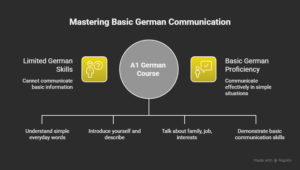
A1 is the first level on the CEFR scale and the start point of your German language journey. Here there is no point here, in fluency or understanding jargon. Instead, there is a desire to understand and use simple everyday words that can help you communicate basic information in an obvious way.
On the A level, you learn how to introduce yourself and how to describe your personality. You can call your name, your origination point, where you live. For instance “Ich heiße Sravan, ich komme aus Indien.”
You also learn to talk about your family, your job, your interests, the languages you speak, even about what you eat. The conversations are short, slow, and generally more about common topics which makes them easier to hear.
The most popular test at this level is the Goethe-Zertifikat A1 or Start Deutsch 1. Other testing standards include TELC and SD. These tests measure listening, reading, writing, and speaking as four of the most important skills. Passing the exam demonstrates you can answer simple questions, give short answers, and have simple conversations.
In Germany, many people take the A1 exam for visa purposes, family reunion, or for entry level employment. More importantly, A1 provides a solid foundation for entry into A2 and above. It’s not about perfection—it’s about confidence building and communicating important information effectively.
Can You Really Reach A1 in Just 6 Months?
1: How do you say "Good Morning" in German?
Many people have passed the Goethe A1 level faster than they hope. On forums like Reddit, you’ll find students who passed the exam within two months of signing up for Duolingo and speaking regularly. Others live for four or six months, working full time and studying in the evening. In reality, six months is a long time for a motivated beginner. It is a test of foundational skills not advanced grammar at the A1 level. Expect to learn about 650 to 800 common words, use simple present tense, some simple questions, and a few clear sentences. There is no need for witty past tenses or sophisticated grammar at this point.
Consistency, not talent. On most days even 45-60 minutes of practice is enough to make incremental progress.
Language learning can only grow over time. The words become more familiar to the brain, the sentences feel more natural, and you learn to be more attentive as your ears begin to adjust to German rhythms. Small daily efforts quickly build confidence.
The difference between successful learners and strugglers is habit. The passers-by practice German practice like brushing their teeth, and they do it without even talking about it. Motivation dips are normal, of course. Every learner will wonder why “the” is in German three different words. That frustration is part of the process. The difference is pushing through those moments, rather than stopping.
A1 is possible if you are consistent, speak regularly, and review what you learn. Keep things simple, be patient with yourself and trust the process. You got this.
Free German A1 Mock Tests – Powered by AI!
Test your skills on our interactive platform. Get instant feedback from our AI to help you communicate better and track your progress. Start your free German mock test now.
Test Your German A1 for FreeWhat the A1 Level Really Feels Like

On the A1 level you’re learning language you can actually speak from day one. It’s not about knowing complicated rules, it’s about sounding perfect. It’s about finding useful phrases to speak in your own situations, and that little rush of confidence when something works out.
You start with the everyday: hello and goodbye in various contexts, introduce yourself, simple questions, and you respond naturally. You count money at the bakery, you order food, or you describe how you do things everyday. Messages like “Ich stehe um sieben Uhr auf” become more familiar than terrifying. You learn to say what you like, “Ich mag Fußball”, without thinking too much about grammar.
The grammar at this point is easy and manageable. You read the present tense and a few important verbs such as sein (to be), haben (to have), essen (to eat), and wohnen (to live). You begin understanding articles and simple negation like “Ich habe kein Auto.” The goal isn’t perfection but clarity and confidence.
Vocabulary is connected to everyday life. The topics often include family, food, hobbies, time, numbers, and common places in town. Because the themes are well known, new words tend to stick.
The importance of pronunciation is large. The smallest sounds matter. If your “ich” is the English “ick,” people may not understand you. Getting comfortable with these details early helps to make speaking easier later.
Your learning has personality built in. You may even see why Germans say “Mahlzeit” around lunchtime or how greetings vary according to the day.
The best thing about A1? It is big enough to say the small victory. And those first victories keep you fueled to keep pushing.
The Four Skills the Exam Tests
All of these tests check that you can actually use German in real life through listening, reading, writing, speaking, they all link.
- Listening You listen to short everyday clips (someone giving directions, a phone call, a store announcement) and you answer simple questions about who, what, where, when.
- Reading Short text, like text messages, signs, ads or notes: You find information (times, prices, names).
- Writing Fill out the forms, write a short postcard or email (30-50 words), describe a picture, concentrate on well-written sentences and correct basics (capital nouns!).
- Speaking Usually with a different candidate: introduce yourself, ask your own questions, play (ordering food, asking the way). They like you to be understandable, polite, and trying, even when you fail.
Practice all four together so there is no surprise on test day.
Quick Look at the Exam Format
It is about 65–80 minutes long and it’s pretty straight forward once you get used to it.
- Listening 20 min 15 questions on 3 audio parts.
- Reading: 30 min, 15 tests on short texts.
- Writing: 20 min; 2–3 short tasks.
- Speaking: 15 min in pairs—self-intro, Q&A, simple role-play.
You must score 60/100 to pass. The test is the same across the globe, so most of the stress is avoided by trying to perform official model tests.
Your 6-Month Roadmap (Realistic & Flexible)

This plan builds gently so you don’t burn out. Adjust if life gets busy, but try to stay consistent.
Month 1: Get Comfortable with Sounds & Basics
Learn the letters of the alphabet (ä, ö, ü, ß), nail the sounds of hard and soft (“ch” in a rolled form, rolled r), and learn survival phrases— greetings, numbers 1–20, days, “Ich heiße …”, “Wo ist…?” Label things at home, listen to slow music, sing everything out loud. Goal: greet people, share basic facts, but not freezing.
Month 2: Grammar Foundations + Word Building
Take off der/die/das, ein/eine, present tense verbs, simple questions/negatives. Build vocab in themes (family, colors, food, clothes). Daily write down and say short sentences (“Meine Mutter wohnt in…”, “Ich esse gerne Reis”). Use flash cards + mini-stories. Goal: Write the basic sentences easily.
Month 3: Start Talking & String Sentences Together
Focus on full sentences, verb order (verb second), describing routines/hobbies. Talk every day—narrate your morning, play shopping, write notes. If possible, find a language partner. The goal: Have 2–3 minute chats with fewer pauses.
Month 4: Train Your Ear & Eyes
Read real beginner texts (menus, emails, signs); listen slow podcasts/songs/dialogues. Replay, shadow speakers, note new phrases. Object: to be able to enjoy simple authentic content without panic.
Month 5: Test Yourself & Fix Gaps
Be able to take weekly full-time practice exams. Review mistakes and correct weak topics (articles, verbs, pronunciation). Goal: Increase stamina and confidence while in battle.
Month 6: Polish & Get Mentally Ready
More mocks, more speaking practice, review key phrases/grammar. Work on slow breathing and positive thinking. Goal: walk in prepared and excited.
Free German A1 Mock Tests – Powered by AI!
Test your skills on our interactive platform. Get instant feedback from our AI to help you communicate better and track your progress. Start your free German mock test now.
Test Your German A1 for FreeSimple 1-Hour Daily Routine That Actually Works
Keep it sustainable:
- 20 min vocab: review old + learn 10–15 new in sentences (flashcards/apps).
- 20 min grammar: one rule + exercises + write your own examples.
- 20 min listening/speaking: play audio, repeat aloud, answer questions, describe what you heard.
Short, focused, every day > long cramming sessions.
Resources That Real Learners Swear By
Apps
Duolingo (fun, habit-forming), Babbel (great for conversations + pronunciation feedback), Memrise (spaced repetition for vocab).
Videos
Easy German (real interviews with subtitles—feels like hanging out with friends), Deutsch für Euch (clear explanations), Nicos Weg (story-based, addictive).
Books & Practice
Netzwerk A1 or Menschen A1 (textbook + audio), Goethe-Institut free model tests, Hueber Fit fürs Zertifikat A1 (exam-focused drills).
Mistakes I’ve Seen People Make (Don’t Do These)
- Memorizing lists without speaking → words vanish fast; use them in sentences/talks.
- Avoiding speaking practice → reading feels good but speaking stays scary—talk daily, even to yourself.
- Studying only when motivated → inconsistency kills progress; make it a non-negotiable habit.
Exam Day – Little Things That Help
- Pace yourself—don’t get stuck; mark and return.
- In speaking: breathe, smile, speak clearly, don’t rush. Examiners want to understand you—they’re not trying to trick you.
Learn German language in your own language! Get free Demo Classes Here!
Wrapping Up
Six months left in the A1 is definitely a good goal, and can be a wonderful reward and really life changing. In fact, language learning isn’t about learning words or grammar rules. You’re teaching your brain to think differently, you’re providing confidence, and you develop a skill that allows you to connect with others and cultures. It may not be the easiest road, but six months of hard work can get you there.
It is not a fast ride, but one of them. Days will come when the rules of grammar don’t seem to make sense or those jarring articles. it doesn’t work. You may read the lesson twice and be confused. That’s normal. It has happened to every student. It is not to escape frustration, it is to get through it. These hard times are usually a sign that your brain is expanding and adapting.
Then there are the breakthroughs. Then you will hear a sentence that you never thought about. You’ll know words in a video or speak freely in a small conversation. The wins are going to make you laugh like a fool. They remind you that your work is paying off.
Start small. Think a little bit. Spend the first 20 minutes learning greetings and sounds. Stay in your sessions, it’s never long, it’s always constant. Set up simple. Be kind to yourself during breaks, not quit. Progress is about persistence, not perfection.
Soon you will see yourself back and know how far you have come. No words. You’re opening up an entire new world of opportunities, experiences and confidence. Go for it.
Free German A1 Mock Tests – Powered by AI!
Test your skills on our interactive platform. Get instant feedback from our AI to help you communicate better and track your progress. Start your free German mock test now.
Test Your German A1 for FreeFrequently Asked Questions
Is It Really Possible to Pass the Goethe A1 Exam in Just Six Months If I Work a Full-Time Job?
The short answer is yes, and thousands of successful learners have done precisely that. However, the longer, more honest answer requires unpacking what “possible” actually means in the context of your life, your current responsibilities, and your relationship with language learning. When we look at real data from language learners on platforms like Reddit’s r/German, Duolingo forums, and feedback from Goethe-Institut course participants, a clear pattern emerges: six months is not only possible—it is actually the average timeline for a motivated adult learner with moderate consistency. Some people sprint through A1 in eight weeks of intensive daily practice. Others stretch it to nine or ten months because life intervenes. But six months represents a sweet spot: long enough to absorb the material without rushing, yet short enough to maintain momentum and avoid the dreaded plateau of boredom.
The key variable is not how many hours you have in a day but what you do with the hours you have. A full-time job does not prevent language acquisition; it merely requires that you study with intention rather than hoping osmosis will occur. If you commute by public transport, those thirty minutes twice a day can become listening comprehension sessions. If you have a lunch break, fifteen minutes of flashcards is fifteen minutes of progress. If you cook dinner, narrating your actions in German—”Ich schneide die Zwiebel, ich koche das Wasser”—turns mundane tasks into language labs. The myth that you need silent, undisturbed four-hour study blocks is precisely that: a myth. In fact, research in second language acquisition consistently demonstrates that spaced repetition and distributed practice—short sessions spread across many days—are significantly more effective for long-term retention than marathon cramming sessions.
What matters far more than available time is what linguist Stephen Krashen calls “comprehensible input” combined with what psychologist Anders Ericsson terms “deliberate practice.” You cannot simply listen to German radio in the background while answering work emails and expect fluency to manifest. You must actively engage: repeating phrases, writing down words you do not recognize, forming your own sentences, and—crucially—speaking aloud. Many full-time professionals succeed at A1 precisely because their time constraints force them to study efficiently. They do not have the luxury of passively “studying” for three hours while simultaneously scrolling social media. They have twenty focused minutes, and they use every second. That focused twenty minutes is worth more than two distracted hours.
There is also the psychological dimension to consider. Learners who work full time often bring valuable skills to their language journey: discipline, time management, and the ability to prioritize. You already know how to show up consistently because your job demands it. You already understand that results require effort because your career has taught you that lesson. These are not small advantages. The learner who must carve out time from a busy schedule often values that time more deeply than the learner who has unlimited hours to waste. Scarcity creates intentionality.
That said, honesty about your current circumstances is essential. If you work sixty-hour weeks, care for young children, or are navigating a major life transition, six months may feel rushed—and that is perfectly acceptable. The Goethe A1 certificate does not expire. Taking eight or nine months to reach a solid, confident A1 is still an extraordinary achievement. The goal is not speed; the goal is proficiency. Six months is a realistic target for most working adults, but it is not a deadline that defines your worth as a learner. What defines your success is showing up, again and again, until one day you realize you no longer need to translate “Ich heiße” before you say it.
What Specific Vocabulary and Grammar Topics Must I Master for the A1 Exam?
The Goethe A1 examination is not an open-ended test of everything German. It is a tightly defined, predictable assessment of foundational language skills, and understanding its precise boundaries is the difference between studying efficiently and drowning in unnecessary detail. When examiners design A1 tests, they are not attempting to trick you with obscure vocabulary or advanced grammatical constructions. They are verifying that you possess approximately 650 to 800 words of active vocabulary and can navigate the simplest communicative situations. Knowing exactly what falls within that scope transforms the exam from an intimidating unknown into a manageable checklist.
Vocabulary at the A1 level is relentlessly practical and tied to immediately useful life situations. You must be able to introduce yourself and others, stating your name, age, country of origin, languages spoken, profession, and where you live. You must discuss your family—immediate relatives such as Mutter, Vater, Bruder, Schwester—and describe them with basic adjectives like groß, klein, jung, alt. You need numbers: cardinal numbers for prices and quantities, ordinal numbers for dates and birthdays. You need time expressions: days of the week, months, seasons, and how to tell time both formally and informally. Food and drink vocabulary appears regularly because ordering in restaurants and shopping at markets are classic A1 scenarios. You should know common foods (Brot, Käse, Apfel, Wasser), meals (Frühstück, Mittagessen, Abendessen), and basic restaurant interactions. Directions and locations are tested consistently: understanding and giving simple directions (geradeaus, links, rechts), naming places in town (Bahnhof, Supermarkt, Apotheke), and describing where things are using prepositions like in, auf, unter, neben. Hobbies and daily routines anchor the speaking section, so vocabulary related to Freizeit, Sport, Fernsehen, Lesen, and typical daily activities (aufstehen, frühstücken, arbeiten, schlafen) is non-negotiable.
Grammar at A1 is similarly bounded. You absolutely must master the present tense of regular verbs, which follow predictable patterns, and the essential irregular verbs that appear in virtually every conversation: sein, haben, werden, essen, nehmen, sprechen, schlafen. Modal verbs—können, müssen, wollen, dürfen—appear frequently because they allow you to express ability, necessity, desire, and permission, all fundamental communicative functions. You must understand the nominative and accusative cases at a functional level. This does not mean memorizing declension tables until you recite them in your sleep. It means knowing that der becomes den for masculine nouns in the accusative, and that this change matters when you say “Ich habe einen Bruder” rather than “Ich habe ein Bruder.” You must grasp basic sentence structure: verb second position in main clauses, verb final position in subordinate clauses introduced by dass, weil, wenn. You need negation with nicht and kein, understanding the distinction between negating verbs and negating nouns. Personal pronouns in nominative and accusative, possessive articles (mein, dein, sein, ihr), and basic prepositions with their required cases complete the core grammatical inventory.
What is not required at A1 is equally important to recognize. You do not need the dative or genitive cases. You do not need the simple past tense (Imperfekt/Präteritum) except for the verbs sein and haben, and even there, many textbooks delay it until A2. You do not need passive voice, subjunctive mood (Konjunktiv II), relative clauses, or any compound tenses beyond the present perfect (Perfekt), which is introduced but not rigorously tested. You do not need sophisticated connectors or academic vocabulary. The exam is testing your ability to survive, not to impress. When learners fail, it is rarely because they did not know enough German. More often, it is because they tried to know too much and neglected the solid, repeated practice of the fundamentals. Mastering the limited domain of A1 completely is far more effective than skimming the surface of B1 material you cannot yet use.
How Should I Divide My Study Time Across Listening, Reading, Writing, and Speaking?
The most common mistake beginners make is studying German as if it were a dead language—something to be analyzed on paper rather than lived in the mouth and ear. They spend hours highlighting grammar rules, completing workbook exercises, and memorizing vocabulary lists, yet they freeze when a native speaker asks them a simple question. This happens because language is not a collection of knowledge; it is a collection of skills, and skills are developed only through deliberate, repeated performance. To pass the A1 exam, you must train all four modalities—listening, reading, writing, speaking—in deliberate proportion, and that proportion changes as you progress through your six-month journey.
In the first month, your allocation should be heavily weighted toward listening and pronunciation. This is the period when your brain is learning to recognize German sounds, distinguish between similar vowels, and process speech at natural speeds. Spend forty percent of your study time on listening: short dialogues, slow German podcasts, the audio component of your textbook, even children’s songs. Another thirty percent should go to reading, but reading aloud. The physical act of speaking German, even haltingly and incorrectly, wires your neural pathways differently than silent reading. Twenty percent can be dedicated to building initial vocabulary through flashcards or apps, and only ten percent to explicit grammar study. This imbalance is intentional. You cannot apply grammar rules to sentences you cannot hear or pronounce.
By months three and four, the distribution should shift toward production. You have accumulated enough vocabulary and pattern recognition to begin generating your own sentences. Now, allocate equal time—twenty-five percent each—to listening, reading, writing, and speaking. The speaking component becomes critical at this stage. If you do not have access to a language partner or tutor, you must create speaking opportunities: narrate your day, describe photographs, record yourself answering practice questions and listen back for errors. Writing moves beyond copying to composition: short paragraphs about your weekend, simple emails to imaginary friends, descriptions of your family members. Reading should progress from isolated words to connected texts: A1-level readers, simple news websites like Nachrichtenleicht, even Instagram captions from German influencers. Listening should include more varied accents and slightly faster speech, preparing you for the unpredictability of exam audio.
The final six to eight weeks before your exam require a specific kind of integrated practice. You should be taking full-length mock tests weekly, under timed conditions, to build stamina and identify weak areas. During this period, your study distribution should mirror the exam’s weight: approximately twenty-five percent on each section, with additional time allocated to your weakest skill. Many learners discover that speaking remains their greatest challenge, not because they lack vocabulary but because they lack confidence. If this is you, shift more time to speaking practice. If reading comprehension consistently trips you up, spend extra sessions working through model texts. The key insight is that skill development is not linear. You do not “finish” listening and then “start” speaking. You spiral through all four skills continuously, each reinforcing the others. Words you learn through reading become words you recognize in listening. Sentences you write become sentence patterns you can adapt in conversation. The integrated brain learns faster than the compartmentalized one.
Which Resources and Textbooks Are Most Effective for Self-Study A1 Preparation?
Navigating the overwhelming landscape of German learning resources is itself a skill that many beginners underestimate. There are dozens of textbooks, hundreds of apps, and thousands of YouTube channels all claiming to be the fastest path to fluency. The truth is that no single resource is sufficient, and the learners who succeed are those who strategically combine complementary tools that address different aspects of language acquisition. For self-study A1 preparation, the most effective approach is to select one comprehensive textbook as your structural backbone, supplement with targeted apps for vocabulary and listening, and use authentic media to bridge the gap between classroom German and real-world German.
The textbook you choose matters less than how you use it, but certain books have proven particularly effective for independent learners. Netzwerk A1, published by Klett, is widely considered the gold standard for Goethe exam preparation because its exercises and vocabulary align almost perfectly with test requirements. The textbook includes access to audio files and online exercises, and many self-learners appreciate its clear progression and abundant practice opportunities. Menschen A1, also from Hueber, takes a slightly different approach with more visual elements and shorter, more varied activities. Some learners find Menschen more engaging; others prefer Netzwerk’s methodical structure. If possible, preview both and choose the one whose presentation style resonates with you. A third excellent option is Begegnungen A1, which many learners describe as “no-nonsense”—fewer illustrations, more concentrated practice, ideal for serious adult learners who want efficient preparation.
For vocabulary acquisition, spaced repetition systems are non-negotiable. Anki remains the most powerful tool because it gives you complete control over your decks and forces active recall rather than passive recognition. You can download pre-made A1 decks or create your own from words you encounter in your textbook. The key is consistency: ten to fifteen minutes of Anki daily is vastly more effective than an hour once weekly. For learners who prefer gamification, Duolingo can build vocabulary habits, but it must be supplemented with explicit grammar instruction and speaking practice. Babbel offers more structured conversations and pronunciation feedback, making it a better bridge between vocabulary and real communication. Memrise, particularly its community-created courses aligned with specific textbooks, provides excellent reinforcement.
Listening resources deserve special attention because the Goethe A1 listening section is often the most intimidating for self-learners. Easy German on YouTube is perhaps the single most valuable free resource for A1 listeners. Their street interviews, subtitled in both German and English, expose you to natural speech patterns, regional accents, and authentic vocabulary. The slower versions of their videos are perfect for beginners. Nicos Weg, Deutsche Welle’s free interactive video course, functions almost as a full textbook replacement with its integrated grammar explanations and exercises. Coffee Break German and Slow German podcasts offer manageable listening practice for commuters and walkers. For those who enjoy music, searching Spotify for “Deutsch lernen mit Liedern” reveals playlists of simplified pop songs with clear vocals.
Finally, you absolutely must use official Goethe-Institut practice materials. The Goethe website offers free model tests that replicate the exam format exactly. Becoming familiar with the timing, question types, and difficulty level is not optional preparation—it is essential calibration. Many learners also purchase Fit fürs Goethe-Zertifikat A1 from Hueber, which provides focused exam preparation with tips and strategies. The cost is minimal compared to the confidence it builds. Remember that resources are tools, not solutions. A library of excellent textbooks is worthless if you do not open them daily. A single well-used workbook, completed page by page, can carry you to success.
How Do I Stay Motivated and Consistent When I Feel Discouraged or Overwhelmed?
Motivation is not a personality trait that some possess and others lack. It is an emotional state that fluctuates naturally, predictably, and universally among language learners. The difference between those who reach A1 in six months and those who abandon the attempt after six weeks is not that the successful learners never felt discouraged. It is that they developed strategies to continue studying even when motivation had evaporated. Understanding this distinction is perhaps the most important meta-skill you can cultivate because it inoculates you against the inevitable moments when der, die, and das feel like a personal attack and every listening exercise sounds like static.
The first strategy is to separate your identity from your daily performance. On days when you cannot remember the plural of Apfel or you confuse heißen and heizen, you are not a bad language learner. You are a normal human brain attempting to rewire itself, and rewiring is messy. Progress in language acquisition is not linear; it resembles a staircase with long plateaus punctuated by sudden leaps. Many learners abandon their studies during plateaus because they perceive no improvement, not realizing that beneath the surface, their brains are consolidating patterns and preparing for the next ascent. When you feel stuck, remind yourself that the plateau is not failure—it is integration.
The second strategy is to honor your resistance without being controlled by it. If you planned a forty-five minute study session but feel profound reluctance, negotiate with yourself. Commit to ten minutes and grant yourself permission to stop afterward. More often than not, the act of beginning dissolves the resistance, and you will continue beyond the initial compromise. If you genuinely cannot focus after ten minutes, stop. Forcing yourself through an hour of resentful, distracted study is less productive than twenty minutes of engaged, intentional practice. Consistency over time matters more than intensity in any single session.
The third strategy is to diversify your activities so that studying does not become synonymous with drudgery. If you have spent three days drilling grammar exercises and your brain is rebelling, switch entirely to listening to German music and attempting to sing along. If flashcards feel like torture, read a simple German children’s book and focus on understanding the story rather than memorizing vocabulary. If formal study is impossible because you are exhausted from work, watch ten minutes of Easy German without any expectation of active learning. Passive exposure is still exposure. The goal is to maintain contact with the language, in any form, every single day.
The fourth strategy is to connect your daily efforts to your deeper reasons for learning German. These reasons must be specific and emotionally resonant to sustain you through difficulty. “I want to pass A1” is a goal, but it is not a motivation. “I want to pass A1 so I can speak with my Oma in her native language before she gets older” is a motivation. “I want to pass A1 because I am moving to Berlin next year and I refuse to be the expat who cannot order coffee” is a motivation. Write your reason on a sticky note and place it where you study. When you question why you are spending precious hours on grammar, read that note.
The final strategy is to cultivate community, even if you are physically studying alone. Join the r/German subreddit, participate in the Daily Chat Thread, celebrate other learners’ successes, and share your own small victories. Find a tandem partner on HelloTalk or Tandem, not only for language practice but for the human connection that reminds you German is not an abstract system—it is how millions of people live their lives. Isolation amplifies discouragement; connection dilutes it. You are not alone in this struggle, and witnessing others navigate the same challenges makes your own path feel more navigable.
What Is the Goethe A1 Exam Format, and How Can I Avoid Surprises on Test Day?
The Goethe-Zertifikat A1: Start Deutsch 1 is a meticulously standardized examination administered at Goethe-Institut locations worldwide, and its predictability is your greatest strategic advantage. This is not an exam designed to surprise or confuse candidates. It is designed to reliably measure whether you can function at a basic communicative level in German-speaking environments. When you understand exactly what each section requires, how it is scored, and what examiners are looking for, the test transforms from an intimidating interrogation into a familiar routine that you have practiced dozens of times.
The examination consists of four distinct modules: Hören (listening), Lesen (reading), Schreiben (writing), and Sprechen (speaking). The total testing time is approximately 65 to 80 minutes, not including administrative instructions and breaks. Listening comprises approximately 20 minutes and contains 15 questions distributed across three audio texts. The first text is typically a short public announcement or voicemail message. The second is a conversation between two people discussing everyday topics. The third may be multiple brief dialogues or announcements. Each audio segment is played twice, and you mark your answers on a separate answer sheet. Critical strategy: use the first listening to understand the gist and the second to confirm details. Do not panic if you miss an answer—the audio repeats, and your brain often processes information on the second pass that eluded you initially.
Reading comprehension is 30 minutes long and also contains 15 questions across three to four texts. These texts are authentically simple: classified ads, signs, emails, event listings, short newspaper notices. You will match headlines to texts, answer multiple-choice questions, and complete true/false tasks. The vocabulary is strictly controlled to A1 level. If you encounter an unfamiliar word, context almost always reveals the meaning. The most common mistake in Lesen is overthinking. Learners see a text and assume it must be more complex than it appears. Trust your preparation. The correct answer is usually the most direct and obvious one.
Writing is 20 minutes and requires two or three short texts. The first task is often a form: you provide personal information such as name, address, nationality, language skills. Accuracy matters here—capitalize German nouns, include the ß where required, spell street names correctly. The second task is typically a short email or postcard of 30 to 50 words. You might thank someone for a gift, describe your weekend plans, or invite a friend to an event. Examiners evaluate whether your text is comprehensible and appropriate to the situation. They do not expect literary prose. Simple sentences, correct verb placement, and polite phrasing will earn full points. Write what you know you can write correctly; this is not the moment for experimental grammar.
Speaking is the shortest module at approximately 15 minutes, but it carries the most psychological weight because it is interactive. You will be paired with another candidate, and the examination proceeds in three parts. First, you introduce yourself: name, age, country, languages, profession, hobbies. This script should be memorized and rehearsed until it flows naturally. Second, you ask and answer questions about everyday topics. You might receive a card with a word like “Essen” or “Wohnen” and must formulate questions for your partner while responding to theirs. Third, a brief role-play: ordering food, making an appointment, asking for directions. The examiners are not evaluating your accent or penalizing minor errors. They are evaluating whether you can communicate the necessary information. Smile, maintain eye contact, and speak clearly. If you do not understand a question, “Bitte?” or “Können Sie das wiederholen?” is acceptable and demonstrates communicative competence.
Preparation for test day extends beyond content review. Visit your test center beforehand if possible so the location is familiar. Prepare your identification documents according to Goethe’s specifications. Pack your bag the night before. Arrive early enough that rushing does not elevate your stress. During the exam, monitor the clock without obsessing over it. If a question stumps you, mark it and return later if time permits. The candidates who succeed at A1 are rarely the ones who know the most German. They are the ones who remain calm, trust their preparation, and treat the exam as what it is: a threshold, not a judgment.
How Important Is Pronunciation and Accent at the A1 Level?
Pronunciation occupies a paradoxical position in beginner German. It is simultaneously one of the most neglected skills and one of the most consequential for both exam success and real-world communication. Learners often assume that pronunciation will naturally improve as vocabulary expands, or that accent is a cosmetic concern best addressed at higher levels. Both assumptions are dangerously incorrect. Pronunciation is foundational, not ornamental, and habits established at A1 become increasingly resistant to change as your brain solidifies its neural pathways for German sounds.
The Goethe A1 examination does not require native-like pronunciation. Examiners are professionals who evaluate hundreds of candidates from dozens of language backgrounds; they are accustomed to hearing German spoken with French, Turkish, English, Arabic, and Asian accents. You will not be penalized for sounding foreign. You will be penalized if your pronunciation impedes comprehensibility. This is the critical distinction. When an examiner cannot understand whether you said “ich” or “nicht,” whether you meant “Hund” or “Hunde,” whether you are ordering one beer or two, your message fails regardless of your grammatical accuracy. Pronunciation errors that cause confusion directly impact your speaking score.
The specific challenges for English speakers learning German are well documented and predictable. The ich-Laut—the soft /ç/ sound in words like ich, Milch, Mädchen—does not exist in English, and beginners often substitute the familiar English “ick” or “ish.” This is not merely aesthetic; “ick” is a Berlin dialect variation that is comprehensible in context, but “ish” can be confused with “isch” as in Tisch, creating ambiguity. The German r, whether uvular or rolled, differs significantly from the English retroflex r. The vowel distinctions between long and short sounds (Staat versus Stadt, Beet versus Bett) carry semantic weight. The glottal stop at word beginnings (be-achten versus beachten) changes meaning. Aspirated plosives—p, t, k—are more forcefully aspirated in German than English, affecting word recognition. These differences are not trivial. They are the acoustic cues that German speakers use to distinguish one word from another.
The solution is not to spend months in phonetic training before learning vocabulary. The solution is to integrate pronunciation practice into your daily study from day one, using three specific techniques that research supports. First, shadowing: listen to a short audio segment, pause after each phrase, and repeat immediately while attempting to match the speaker’s intonation and rhythm exactly. Do not simply read the transcript aloud from your own internal model; your internal model is wrong. Imitate the audio. Second, recording: use your smartphone to record yourself reading German sentences, then compare your recording to a native speaker’s version. The gap between what you think you sound like and what you actually sound like is often substantial, and hearing that gap is the first step toward closing it. Third, minimal pair training: practice distinguishing and producing sounds that differ by a single phonetic feature, such as “können” versus “Kennen,” “Hütte” versus “Hüte,” “wieder” versus “wider.” Your brain must learn that these differences matter.
For A1 specifically, prioritize the sounds that appear in the most frequent vocabulary. Ich, nicht, and Buch cover the ich- and ach-Laut variations. R sounds in words like Bruder, Mutter, and Lehrer appear constantly. Vowel length distinctions affect core verbs: gibt, gibt, gab. Consonant clusters at word beginnings (Pfennig, Schwester, Zug) require practice because English speakers tend to insert epenthetic vowels. Do not aim for perfection in your first month. Aim for awareness and gradual approximation. Each time you correctly produce the ich sound in “ich heiße,” you strengthen a motor pattern. Each time you fail to correct it, you strengthen the wrong pattern. Progress is cumulative, and the trajectory is determined by your daily habits, not your innate talent for mimicry.
Can I Pass A1 Using Only Free Resources, or Do I Need Paid Courses and Tutors?
The democratization of language learning resources over the past decade has fundamentally altered what is possible for self-directed learners. Twenty years ago, motivated beginners without access to formal instruction faced significant barriers: textbooks were expensive, audio materials required physical media, and interaction with native speakers demanded travel or expensive phone calls. Today, an ambitious learner with internet access can assemble a complete A1 curriculum from free materials that surpasses what many paid programs offered in the 1990s. The question is not whether free resources exist—they abound—but whether you possess the self-regulation and strategic awareness to deploy them effectively.
The most comprehensive free resource for A1 German is Deutsche Welle’s Nicos Weg. This interactive video course spans A1 through B1, includes hundreds of instructional videos, interactive exercises, vocabulary training, and downloadable transcripts. It is not a supplement; it is a complete curriculum created by Germany’s public international broadcaster with pedagogical rigor. Thousands of learners have passed Goethe examinations using Nicos Weg as their primary instructional method. Similarly, the Easy German YouTube channel offers authentic street interviews with bilingual subtitles, gradually training your ear for natural speech. Their podcast version allows offline listening practice during commutes. Anki, the spaced repetition flashcard system, is free on Android and desktop (iOS requires a paid app, but the web version is accessible). The Goethe-Institut’s own website provides free model tests and sample exercises that are essential for exam preparation. The Annotated Research collection on r/German links to hundreds of grammar explanations, vocabulary lists, and listening resources.
However, “free” is not synonymous with “costless.” Using free resources effectively requires skills that paid instruction often provides as a service: structure, accountability, feedback, and motivation. When you purchase a course at the Goethe-Institut, you are not only paying for content; you are paying for a syllabus that sequences topics in pedagogically sound order, a teacher who answers your specific questions, deadlines that prevent procrastination, and peers who normalize the struggle. These are substantial benefits, and for many learners, they justify the significant expense. The question you must answer honestly is what kind of learner you are.
If you have previous experience learning languages independently, if you are comfortable identifying your own knowledge gaps, if you can maintain consistent study without external deadlines, and if you have sufficient time to curate your own curriculum, free resources can absolutely carry you to A1 success. You must be willing to treat Nicos Weg as your textbook, completing each lesson sequentially rather than hopping randomly between resources. You must seek out speaking practice—HelloTalk and Tandem are free—and overcome the discomfort of conversing with strangers. You must record yourself and self-correct without a teacher to identify your errors. This is demanding but achievable.
If, however, you know from past experience that you struggle with self-directed learning, if you feel overwhelmed by the abundance of free options, if you need someone to tell you exactly what to do each week, consider allocating at least a modest budget for structured support. This does not necessarily require enrolling in an expensive Goethe course. It could mean purchasing a used copy of Netzwerk A1 with answer keys, allowing you to check your own work. It could mean booking five sessions with an italki tutor spaced throughout your six months, specifically to assess your speaking progress and correct persistent pronunciation errors. It could mean joining a low-cost conversation group. The optimal approach for most learners is hybrid: free resources for daily input and practice, paid support for the specific moments when you need expert guidance. Neither path is superior; they are simply different routes to the same destination, and the right choice depends entirely on your learning style and circumstances.
What Happens If I Fail the Exam? Can I Retake It, and How Should I Adjust My Approach?
The fear of failure prevents more language progress than any grammatical concept ever invented. Learners invest so much emotional energy in the possibility of not passing that they cannot fully invest in the process of learning. This fear is understandable: examination fees are not trivial, the stakes may include visa requirements or employment opportunities, and admitting that you need more time can feel like admitting inadequacy. Yet paradoxically, the learners who succeed are often those who have made peace with the possibility of failure and developed contingency plans that transform setback into strategic information.
First, the practical facts: you can absolutely retake the Goethe A1 examination. There is no limit on attempts, no waiting period between attempts, and no permanent record of unsuccessful attempts. When you eventually pass and receive your certificate, that document does not indicate how many tries preceded it. Employers and immigration authorities see only the passing certificate. The only consequence of failure is the financial cost of the exam fee and the psychological disappointment. Both are real, but neither is insurmountable. Many successful German speakers failed their first attempt at various levels and now speak fluently. Failure at A1 is not predictive of your ultimate ceiling in the language; it is merely feedback about your preparation.
If you do not pass, the first and most important step is to obtain your score report and analyze it dispassionately. The Goethe examination provides subscores for each module, revealing precisely where your performance fell short. Did you score adequately on Lesen and Hören but collapse in Sprechen? This suggests test-day anxiety or insufficient speaking practice rather than fundamental knowledge deficits. Did you narrowly miss the passing threshold in all sections? This indicates that your knowledge is present but not yet automatic; you need more time for retrieval speed to catch up to recognition. Did you fail Schreiben catastrophically while performing well elsewhere? You may have misunderstood the task requirements or made systematic errors in basic sentence structure. Each pattern of results dictates a different remedial strategy.
For candidates who fail due to anxiety or test-day conditions, the solution is not more vocabulary. It is desensitization: more mock examinations under timed conditions, preferably in an unfamiliar environment to simulate test-day stress. If your local library has quiet study rooms, reserve one and complete practice exams there. If you can visit the test center beforehand to visualize the experience, do so. For candidates who fail due to insufficient knowledge, extend your timeline by two to three months and continue studying. A1 is not a race. Arriving at B1 in ten months with solid foundations is superior to rushing an inadequate A1 in six months and struggling through A2 because you never automated the basics. For candidates who fail due to specific skill deficits—most commonly speaking—invest in targeted practice. This is the moment to book five italki sessions, join a conversation group, or ask a German-speaking colleague to practice with you weekly.
Finally, cultivate perspective that feels almost impossible when you are in the midst of disappointment but becomes clearer with distance. Language learning is measured in years, not months. A six-week delay in obtaining your A1 certificate will not determine your life trajectory. The Germans have a wonderful word for this attitude: Gelassenheit. It translates imperfectly as serenity, composure, or equanimity in the face of uncertainty. The Gelassenheit approach to exam failure is not denial or toxic positivity. It is acceptance: this attempt did not succeed, I have learned what I need to improve, and I will try again. The language will still be there. The exam will still be offered. Your capacity to learn has not diminished. You have merely discovered the gaps in your preparation, and discovery is the precondition for mastery.
What Does Life After A1 Look Like, and How Do I Continue to A2 and Beyond?
Passing the Goethe A1 examination is a genuine achievement, and you should celebrate it fully before immediately pivoting to the next goal. You have demonstrated to yourself and to an accredited institution that you can function in basic German. You can introduce yourself, navigate simple transactions, understand slow speech on familiar topics, and write short messages. This is not “nothing.” This is the foundation upon which all future proficiency is built. Yet A1 is simultaneously the end of the beginning and the beginning of the middle. The distance between A1 and B2—the level required for university study or most professional positions—is substantial, and understanding that landscape prevents discouragement when progress inevitably slows.

The transition from A1 to A2 is less about learning entirely new concepts and more about deepening and expanding what you already know. Where A1 introduced the present tense, A2 adds the present perfect and simple past for common verbs. Where A1 introduced nominative and accusative, A2 introduces dative case and two-way prepositions. Where A1 limited you to main clauses, A2 introduces subordinate clauses with weil, dass, wenn, and ob. Your vocabulary target expands from approximately 650 words to approximately 1300 words. The difficulty increase from A1 to A2 is noticeable but manageable; the difficulty increase from A2 to B1 is where many learners experience their first serious plateau. Knowing this in advance allows you to pace your effort and expectations appropriately.
Your study strategies should evolve as your proficiency increases. At A1, you could rely heavily on your native language for explanations and translations. At A2, begin transitioning to monolingual resources: German-German dictionaries, grammar explanations in simple German, learners’ news sites like Nachrichtenleicht. This shift is uncomfortable initially, but it forces your brain to stop translating and start thinking in German. Your listening practice should move from slowed, pedagogical speech to authentic speech at natural speed. You will not understand everything, and you are not supposed to. The goal is increased tolerance for ambiguity and improved ability to infer meaning from context. Your speaking practice should move beyond scripted introductions to spontaneous conversation about your opinions, experiences, and plans. You will make more errors at A2 than you did at A1 because you are attempting more complex expression. This is progress, not regression.
The temptation after A1 is to relax your study habits, believing that you have “learned German” sufficiently to coast. This is the most common cause of the A2-to-B1 plateau. Learners reduce their daily practice from forty-five minutes to fifteen minutes, replace structured study with passive listening, and wonder why they cannot advance. Maintaining the habits that carried you through A1 is essential, even as you adjust the specific activities. The learner who spends forty-five minutes daily on German at A1 and continues that investment at A2 will reach B1 within another six to eight months. The learner who reduces investment to twenty minutes irregularly may spend a year at A2 without substantial progress. Consistency remains the single strongest predictor of success.
Finally, cultivate intrinsic motivation that transcends certificates and external validation. The learners who achieve advanced proficiency are not those who love taking tests. They are those who fall in love with the language itself: the rhythm of a well-constructed sentence, the satisfaction of understanding a joke in German, the intimacy of reading a novel in its original language, the connection of speaking with colleagues and neighbors in their mother tongue. A1 opens the door, but what lies beyond is not merely more difficult grammar and longer vocabulary lists. What lies beyond is access. Access to one of Europe’s richest literary traditions. Access to a central voice in philosophy, science, and art. Access to the daily lives of over one hundred million native speakers. You began this journey for reasons that mattered to you. Those reasons will continue to matter, and the language will continue to reward your effort, long after you have tucked your A1 certificate into a drawer and forgotten it is there.