Table of Contents
You should aim for B1 German language competency if you wish to study, work, or live in a German-speaking country. Fluency is essential to show that you are aware of current events, tell stories, express your thoughts, and transcend conventional language.
Many students wonder if they can pass German B1 in six months. Success requires persistence, experience, and hard work. After mastering grammar and vocabulary, practice reading, writing, speaking, and listening.
To get your B1 certification quickly, this article gives a six-month program, a daily study routine, and critical preparation material. Whether you are learning German with a group or alone, this method can help you focus and relax.
Learn German language in your own language! Get free Demo Classes Here!
Importance of the German B1 level
For learners, reaching German B1 means being able to use the language independently in daily life. Even with certain errors, you can have normal discussions, understand simple documents, and express yourself clearly.
Study programs, jobs, and visa applications in Germany, Austria, and Switzerland commonly require the B1 certificate. Many institutions and employers consider it proof of professional or academic communication skills.
B1 allows you to speak German confidently beyond official requirements. You may easily travel, meet friends, and participate in daily life—from shopping to banking to watching local news. German feels natural at this point.
Is cracking B1 in 6 months realistic?
1: How do you say "Good Morning" in German?
It is undoubtedly possible crack the German B1 level in a span of six months if one has a well-defined plan and persists in their efforts. It is possible for the majority of students to achieve a grade of B1 within the allotted period if they devote one and a half to two hours per day to studying and improving their skills in speaking, vocabulary, and grammar.
Your success, on the other hand, is contingent on a few essential factors, which are as follows:
- It is beneficial to have a strong command of the German language at the level of A1–A2 when beginning to learn the language.
- When compared to less regular and longer study schedules, maintaining a regular study schedule is preferable.
- Listening to podcasts, viewing videos on YouTube, and making use of language exchange applications are all examples of practice activities that could potentially assist you in learning a language more quickly.
- Motivating: If you have a positive attitude and have a clear objective in mind, the road will be much simpler for you.
The ability to become comfortable with German in everyday life is within reach for those who commit themselves to learning and build excellent study habits. This is in addition to the ability to pass the B1 exam. Six months is more than enough time to deal with the situation given the circumstances.
Free German A1 Mock Tests – Powered by AI!
Test your skills on our interactive platform. Get instant feedback from our AI to help you communicate better and track your progress. Start your free German mock test now.
Test Your German A1 for FreeUnderstanding the German B1 Level
According to the CEFRL, a German speaker at level B1 may use the language independently. This level of proficiency should allow you to handle most situations, whether you’re traveling abroad or living in a German-speaking country.
Many institutions, such as Goethe-Institut, TELC, and ÖSD, offer the B1 test. This test assesses your knowledge in four key areas.
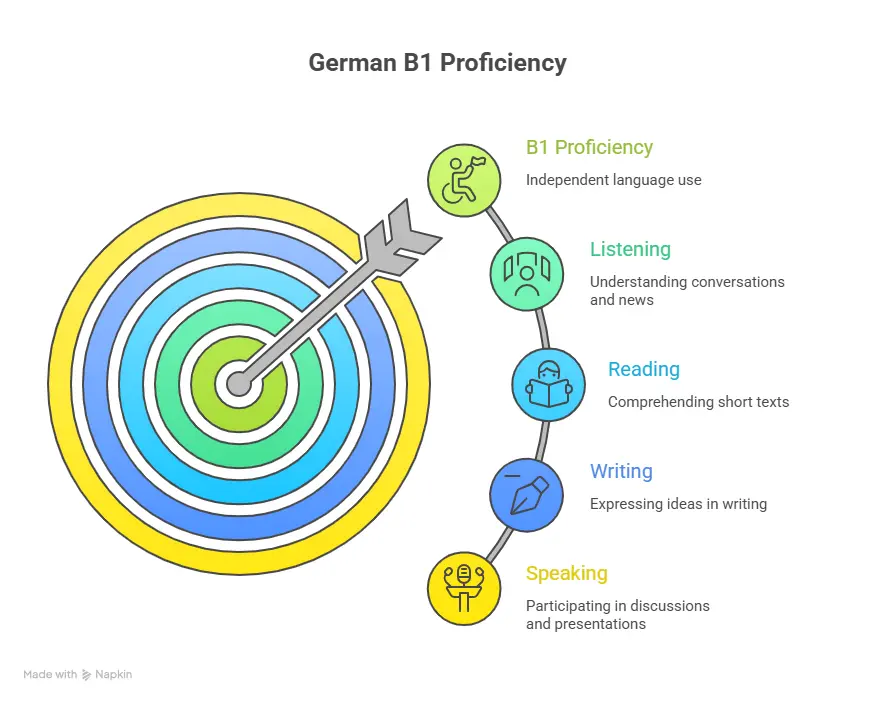
Listening: the ability to understand common conversation, brief news, and basic directions.
Reading: You must understand the main ideas of short stories, ads, and PSAs before reading. Reading is communication.
Writing: Writing is expressing oneself in writing, whether in an official or personal letter or by summarizing one’s experiences. This notion covers several writing activities.
Speaking: Speech includes having a discussion, expressing a viewpoint, and giving brief presentations on topics that are becoming more popular.
What B1 Proficiency Means?
B1 proficiency means you can use German independently in everyday contexts. You can understand basic concepts in discussions, news items, and simple literature. Discussing your career, schoolwork, or interests is also possible. You can communicate your opinions, summarise your experiences, and produce succinct, well-formatted articles or letters. You can efficiently converse and solve most difficulties if you live, study, or travel in a German-speaking country. Although you may make a few little mistakes, this is true.
What you should be able to do at B1 is:
- Having a clear understanding of the essential points of clear speech on issues that are familiar to you.
- Deal with issues that are prevalent in German-speaking travel and business circumstances.
- Create uncomplicated and interconnected content on subjects that are of genuine interest to you.
- Provide a brief explanation of your thoughts or plans, as well as a description of your experiences, dreams, and hopes.
B1 Proficiency Expectations
German B1 learners must communicate and understand the language independently in everyday contexts. You should be able to discuss work, school, interests, opinions, and experiences or plans in simple words.
Clear speaking, concise news reports, and daily materials like letters and articles convey the important points. You should write concise, well-structured emails, essays, and messages.
Despite occasional errors, B1 proficiency allows you to live, study, and socialise confidently in German-speaking countries.
Free German A1 Mock Tests – Powered by AI!
Test your skills on our interactive platform. Get instant feedback from our AI to help you communicate better and track your progress. Start your free German mock test now.
Test Your German A1 for Free6-Month German B1 Study Roadmap
Month 1: A2 Revision & Grammar Strengthening
-
Revise all A2 grammar topics such as cases, verb conjugations, sentence structure, and basic tenses.
-
Review common vocabulary from everyday situations.
-
Focus on building a strong foundation for more advanced B1 topics.
Month 2: Vocabulary Expansion & Sentence Structure
- Review A2 grammar cases, verb conjugations, sentence structure, and basic tenses.
- Brush up on ordinary vocabulary.
- Build a solid foundation for advanced B1 topics.
Month 3: Reading & Listening Mastery
- Every day, learn 20–30 verbs, adjectives, and helpful phrases.
- Use new vocabulary to form whole sentences.
- Start small daily German journals to practice grammar and sentence structure.
Month 4: Writing Formats & Speaking Fluency
- For the purpose of practice, it is a good idea to compose various letters, emails, articles, and messages on topics that are common.
- There are a variety of activities that can assist you in enhancing your fluency in speaking. Some of these activities include role-playing, expressing perspectives, and storytelling experiences.
- You can evaluate the areas in which you could enhance your pronunciation and sentence structure by recording yourself speaking on video and then analyzing the results. This is the most effective method.
Month 5: Mock Tests & Error Correction
- The use of timed practice tests is a fantastic concept when it comes to gaining an understanding of the format of the B1 examination.
- Focus your attention on areas that require development, such as grammar, vocabulary, or public speaking, and carefully examine any errors that you discover on a comprehensive level.
- There is a terrific technique to increase your verbal competency so that you can use it in your day-to-day life, and that is by participating in language exchange sessions that are conducted online.
Month 6: Exam-Focused Practice & Confidence Building
- You should make it a habit to regularly practice for full-length mock tests in order to improve both your speed and your accuracy.
- Carry out an analysis of the following well-known B1 subjects: technology, culture, travel, and the ecological system.
- Instead of focusing on perfection, you should focus on clarity and flow in order to enhance your self-assurance when it comes to speaking and writing.
Learn German language in your own language! Get free Demo Classes Here!
Daily Study Routine (1.5–2 Hours Plan) That Actually Works
The establishment of a daily routine that is well-organized is essential in order to ensure the continuity of a positive movement. If you devote even one and a half to two hours of study time each day, it is feasible to pass the B1 examination within a period of just six months. This is the minimum amount of time that is required.
1. Vocabulary and Grammar (for 20 to 30minutes)
- Using flashcards or software like Anki to assist you in gaining your new vocabulary will help you acquire twenty to thirty new phrases on a daily basis. This is a significant amount of new vocabulary.
- You are going to go over some of the most fundamental principles of grammar in this section. These topics include those that pertain to the use of connectors, cases, tenses, and passive voice.
- The composition of some sample phrases is required in order for you to demonstrate the newfound knowledge of syntax and vocabulary that you have acquired.
2. Practise in listening for another half an hour
- You have the choice of engaging in activities such as listening to podcasts, watching movies on YouTube, or engaging in any other activity that is available in slow German (for instance, Slow German or DW Deutsch Lernen).
- The primary themes, the keywords, and the context should receive the majority of your attention. You should focus on these three aspects.
- You can improve your comprehension and overall memory of the information that you take in by summarizing or repeating what you hear. This will help you remember more of the material. This approach is especially efficient in its execution.
3. Speaking and writing (for 30 to 40 minutes)
- It is possible for you to discuss your day, share your thoughts, or even rehearse role plays out loud while you are speaking. It is important to videotape yourself so that you can notice any errors.
- Compose small articles, compose emails, or write entries in your journal. Writing encompasses all writing. It is essential to create accurate sentence patterns and make use of connectors in your writing.
- Writing should come first, followed by speaking out loud; this is an efficient strategy to reinforce learning. Speaking out loud should come after writing.
4. A brief review (10 minutes) or revision
- In order to complete the rapid review, you should review any new vocabulary, grammar points, or mistakes that you have made.
- By strengthening weak areas on a daily basis, you can assist prevent forgetting something.
Key Grammar & Skill Areas to Focus On
1. Nebensätze (Subordinate Clauses)
-
Learn how to form sentences using weil, dass, obwohl, wenn, etc.
-
Example: Ich gehe nach Hause, weil ich müde bin.
2. Konnektoren (Connectors)
-
Use linking words to connect ideas smoothly: deshalb, trotzdem, außerdem, daher.
-
Example: Es regnet, deshalb bleibe ich zu Hause.
3. Passive Voice
-
Understand and practice werden + Partizip II to form passive sentences.
-
Example: Das Buch wird gelesen.
4. Past Tenses
-
Focus on Perfekt (for spoken German) and Präteritum (for reading/writing).
-
Example: Ich habe gestern Fußball gespielt. / Er ging ins Kino.
5. Opinion-Based Speaking
-
Practice expressing your opinions using phrases like: Ich denke, dass…, Meiner Meinung nach…
-
Learn to agree or disagree politely: Da stimme ich zu / Ich sehe das anders.
Common Mistakes to Avoid
During your preparation for the German B1 exam, some behaviors can slow down your progress from time to time. It is important to be aware of these typical errors:
1. Ignoring the Need for Writing Lessons
- There are a lot of students who concentrate on listening and speaking.
- Grammar, vocabulary, and sentence structure can all be strengthened through the ability to write. Inattention to it can result in a lower score in the exam.
2. The process of translating from English
- The use of direct translation frequently results in sentences that are not natural and spelling mistakes.
- You should make an effort to think in German and employ German sentence patterns rather than English building blocks.
3. Limited opportunities to give speeches
- It is not sufficient to limit yourself to only repeating phrases or speaking in your head.
- Language proficiency, pronunciation, and self-assurance can all be improved via consistent practice with friends, instructors, or language partners.
- You will be able to perform more confidently in all four skills — listening, reading, writing, and speaking — if you avoid making these blunders, which will both make your preparation more effective.
Exam Preparation Tips
To do well on the German B1 test, test-takers need to feel prepared and sure of their skills, not just memorize words and phrases. Always keep these things in mind:
1. How to Use Your Time Well
- Practice making sure you finish each part in the time allowed.
- You should make good use of your time and not spend too much on any one question.
- Planning is important before you start writing. Put pen to paper. Give yourself a few minutes to write it again.
2. A Complete Plan for Speaking Tests
- Don’t worry about making small mistakes; what counts is that you are fluent, not that you are perfect.
- I think that… and “My opinion after…” are both ways to say what you think.
- Doing role plays and short talks will help you get ready for common questions.
- Use words like “also,” “na ja,” “ich glaube,” etc. to sound natural.
Manage your time well and plan ahead before you speak to get the best grade possible on the test.
Key Takeaways
Pass German B1 in six months with consistency and effective learning. Learn grammar, listening, speaking, and writing for 1.5–2 hours a day. German conversation improves with the use of Nicos Weg, podcasts, and Deutsche Welle. Writing, speaking, and more will improve with weekly practice exams. Avoid English translation and focus on spontaneous German conversation.
- Spend 1.5–2 hours studying daily.
- Boost vocabulary, syntax, and relationships.
- Daily German practice.
- Write brief journals.
- Deutsche Welle, Nicos Way.
- Weekly practise exams may enhance confidence.
- Focus on genuine expressiveness over translation.
Conclusion
Free German A1 Mock Tests – Powered by AI!
Test your skills on our interactive platform. Get instant feedback from our AI to help you communicate better and track your progress. Start your free German mock test now.
Test Your German A1 for FreeFrequently Asked Questions
What are the main skills tested in B1?
The B1 exam tests listening, reading, writing, and speaking skills, with a focus on everyday communication and opinion expression.
Can I self-study for B1 or do I need a class?
Both are possible. Self-study with structured materials, online resources, and speaking practice works well, but classes or tutors can provide guidance and feedback.
Do I need to speak perfect German to pass B1?
No. Fluency and clear communication matter more than perfection. Small mistakes are acceptable if you can convey your ideas effectively.
How can I improve speaking for B1?
Practice daily with language partners, tutors, or recordings, and focus on expressing opinions, describing experiences, and using natural connectors.
How much vocabulary do I need for B1?
Aim to learn around 2,000–2,500 words, including everyday expressions, verbs, adjectives, and connectors.
What topics are common in B1 exams?
Topics include daily life, travel, work, hobbies, environment, culture, technology, and social issues.
How can I build confidence for the exam?
Take mock tests, practice speaking daily, and simulate exam conditions. Regular practice reduces stress and improves performance.