

Table of Contents
Key Takeaways:
- Follow a clear 6-month roadmap from A1 to B1 with monthly milestones.
- Study 1–2 hours daily, balancing vocabulary, grammar, listening, and speaking.
- Start speaking from Day 1 and focus on pronunciation clarity.
- Use immersive learning and spaced repetition for faster retention.
- Take regular mock tests and improve time management.
- Stay consistent, disciplined, and focused on steady progress.
Learning a new language feels exciting and challenging. Many students dream to Crack German in 6 months. It sounds difficult at first. But with the right plan, it is possible. German opens doors to global careers. It helps in studying abroad. It improves job opportunities in Europe. The key is daily consistent practice.
You do not need special talent. You need discipline and smart strategy. Small daily efforts create big results. Clear goals make learning faster. Structured planning reduces confusion. Practice speaking from the beginning. Avoid waiting for perfection. Focus on steady improvement every day. Six months can truly transform your skills.
Start learning German today to fast-track your career in Germany!

Introduction
Imagine landing your dream job in Germany—perhaps in IT, healthcare, or engineering—but hitting a wall because of the language barrier. With over 1.5 lakh Indians moving to Germany yearly for opportunities, mastering German (up to B2 level) opens doors to visas, high-paying roles (₹20-50 LPA equivalent), and a fresh start. This blog shares a proven 6-month plan to go from zero to fluent, no fluff.
Why This Journey Matters
- Builds international career opportunities
- Supports higher education in Germany
- Improves confidence in communication
- Expands global networking possibilities
- Enhances cognitive and memory skills
- Opens migration and visa advantages
- Strengthens professional resume value
- Encourages cultural awareness and adaptability
What Makes Success Possible
- Clear six-month structured roadmap
- Daily consistent study routine
- Active speaking from early stage
- Regular mock test practice
- Continuous vocabulary revision
- Listening to authentic German content
- Learning from mistakes regularly
- Staying motivated throughout the journey
With clarity and commitment, German becomes achievable. The process demands patience and discipline. Structured effort transforms difficulty into progress. Six months can create strong language foundations. Consistency remains the ultimate key to success.
Why German is in High Demand
1: How do you say "Good Morning" in German?
German continues to gain global importance. Many students choose it for growth. Professionals learn it for career expansion. Employers value multilingual candidates highly. German strengthens international communication skills. It improves access to European markets. It supports long-term global mobility. Demand rises every year steadily.
-
Strong European Economy
Key economic strengths include:
-
- Advanced manufacturing sector
- Automotive production leadership
- Machinery and industrial equipment
- Strong export-driven economy
- Global trade partnerships
- High product quality standards
- Innovation and research focus
- Government research funding
- Industry-academia collaboration
- Advanced manufacturing sector
-
Education Opportunities
Benefits for students include:
-
- Low tuition fees
- Public university advantages
- Reduced financial burden
- International recognition
- Globally valued degrees
- Strong academic credibility
- Industry exposure
- Internship opportunities
- Practical learning environment
- Low tuition fees
-
Career Advantages
German language improves job prospects significantly. Many multinational companies operate in Germany. German firms expand across continents. Language skills increase employability. Employers prefer culturally adaptable candidates.
Major industries demanding German skills:
| Industry | Demand Reason | Career Scope |
|---|---|---|
| Engineering | Strong industrial base | Technical roles |
| Information Tech | Growing digital economy | Software careers |
| Healthcare | Aging population needs | Medical professionals |
| Automotive | Global brand presence | Design and production |
| Research | Innovation investment | Academic positions |
-
Business and Trade Growth
Business advantages include:
-
- Direct communication with partners
- Better negotiation clarity
- Stronger business relationships
- Market expansion opportunities
- Access to European clients
- Increased trade possibilities
- Professional credibility
- Competitive resume advantage
- Higher salary potential
- Direct communication with partners
-
Cultural and Global Influence
Reasons for cultural importance:
-
- Rich intellectual heritage
- Influential philosophers
- Classical literature legacy
- Scientific contributions
- Nobel Prize achievements
- Research advancements
- Cultural exchange growth
- International collaborations
- Global academic partnerships
- Rich intellectual heritage
German demand continues increasing steadily. Economic stability drives language interest. Education and careers strengthen its relevance. Business expansion supports global necessity. Cultural value adds further importance. Learning German creates long-term global opportunities.
|
German A2 Exercises – Download Free PDF |
||
Free German A1 Mock Tests – Powered by AI!
Test your skills on our interactive platform. Get instant feedback from our AI to help you communicate better and track your progress. Start your free German mock test now.
Test Your German A1 for FreeIs Cracking German in 6 Months Realistic?
Many learners ask this common question. The answer depends on expectations clearly. Six months is a focused timeframe. It demands structured and disciplined learning. Casual learning will not give results. Daily effort makes progress visible. Clear goals make success achievable. Consistency matters more than intelligence. Smart planning saves valuable time.
Six months can build strong foundations. It can prepare for language exams. Six months can improve daily communication ability. It cannot create native fluency quickly. Real fluency requires longer exposure. However, functional proficiency is realistic. Commitment decides final outcomes.
Factors That Make It Realistic
Certain conditions improve success probability.
- Daily study discipline
- Minimum one hour practice
- No long learning gaps
- Structured curriculum
- Level-wise progression
- Regular assessment
- Active speaking practice
- Conversation sessions weekly
- Self-recording practice
- Continuous revision
- Weekly recap sessions
- Vocabulary reinforcement
Without these elements, progress slows. With them, six months works well.
Start learning German today to fast-track your career in Germany!
6-Month German Learning Roadmap
A structured roadmap ensures steady progress. Each month builds clear competencies. Consistency remains the central requirement. Daily practice prevents knowledge gaps. Small goals maintain strong motivation. Each stage prepares the next level. Gradual complexity reduces confusion. Discipline transforms effort into measurable results.
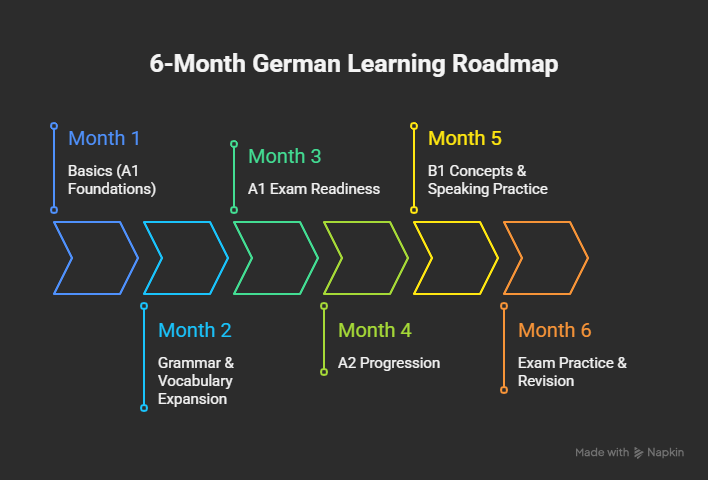
Month 1: Basics (A1 Foundations)
The first month builds core foundations. Pronunciation must receive early attention. Correct sounds prevent future mistakes. Alphabet mastery improves reading confidence. Articles require careful memorization practice. Sentence formation begins simply.
Focus areas include:
- Alphabet and pronunciation
- Vowel sounds practice
- Umlaut sound recognition
- Basic greetings
- Formal introductions
- Informal conversations
- Articles understanding
- Der usage
- Die usage
- Das usage
- Present tense verbs
- Regular verbs
- Common irregular verbs
- Numbers and dates
- Counting practice
- Calendar vocabulary
Monthly Outcome
| Skill Area | Target Achievement |
|---|---|
| Reading | Simple sentences |
| Writing | Basic introductions |
| Listening | Short dialogues |
| Speaking | Self introduction |
Month one builds confidence gradually. Accuracy matters more than speed.
Month 2: Grammar & Vocabulary Expansion
Grammar depth increases this month. Vocabulary range expands consistently. Sentence structure becomes more organized. Listening duration increases slightly. Writing becomes more structured.
Focus areas include:
- Sentence structure
- Verb second position rule
- Question formation
- Modal verbs
- Können usage
- Müssen usage
- Wollen usage
- Prepositions
- Time expressions
- Location phrases
- Vocabulary expansion
- Daily life topics
- Workplace terms
- Simple paragraph writing
- Routine description
- Personal interests
Vocabulary Growth Plan
| Week | Words Target | Topic Focus |
|---|---|---|
| 1 | 150 | Daily routine |
| 2 | 150 | Family topics |
| 3 | 200 | Work life |
| 4 | 200 | Travel context |
Regular revision strengthens memory retention. Practice exercises reinforce grammar clarity.
Month 3: A1 Exam Readiness
This month focuses on exam familiarity. Format understanding reduces exam anxiety. Structured practice improves performance speed. Time awareness becomes important.
Focus areas include:
- Reading practice
- Notice interpretation
- Short email comprehension
- Writing tasks
- Informal email format
- Filling application forms
- Listening practice
- Short announcements
- Telephone conversations
- Speaking preparation
- Picture description
- Question response practice
Weekly Exam Practice Structure
| Component | Practice Frequency |
|---|---|
| Reading | Twice weekly |
| Writing | Twice weekly |
| Listening | Three times weekly |
| Speaking | Daily short practice |
Mock tests simulate real conditions. Error analysis guides improvement. Confidence builds through repetition.
Month 4: A2 Progression
Difficulty level increases gradually. Communication becomes more functional. Past tense usage becomes essential. Listening length increases moderately. Writing becomes descriptive.
Focus areas include:
- Past tense Perfekt
- Regular verb forms
- Irregular verb forms
- Comparisons
- Adjective comparisons
- Superlative structures
- Complex sentences
- Weil usage
- Dass usage
- Topic-based speaking
- Travel experience
- Workplace discussion
Skill Development Targets
| Skill Area | New Expectation |
|---|---|
| Reading | Short articles |
| Writing | 80-word texts |
| Listening | Longer dialogues |
| Speaking | Experience sharing |
Consistent speaking reduces hesitation gradually. Grammar accuracy improves sentence flow.
Month 5: B1 Concepts & Speaking Practice
This stage demands higher discipline. Communication becomes more analytical. Opinion expression gains importance. Listening includes structured discussions. Writing requires logical organization.
Focus areas include:
- Opinion-based speaking
- Agreeing politely
- Disagreeing respectfully
- Connectors
- Obwohl usage
- Trotzdem usage
- Deshalb usage
- Formal writing
- Complaint letters
- Application letters
- Advanced listening
- Interviews
- Radio discussions
Weekly Speaking Plan
- Daily topic presentation
- Two-minute speech
- Self-evaluation recording
- Partner conversation
- Debate simulation
- Opinion exchange
- Vocabulary reinforcement
- Synonym learning
- Context usage
Skill Progress Table
| Area | B1 Expectation |
|---|---|
| Reading | Opinion texts |
| Writing | Structured essays |
| Listening | Detailed conversations |
| Speaking | Argument presentation |
Confidence increases with repetition. Structured thinking improves clarity.
Month 6: Exam Practice & Revision
The final month focuses on polishing. Accuracy becomes priority. Speed improves gradually. Revision strengthens weak areas.
Focus areas include:
- Full mock tests
- Complete timing simulation
- Immediate evaluation
- Grammar revision
- Case review
- Verb tense recap
- Vocabulary revision
- Topic-based grouping
- Collocation practice
- Speaking refinement
- Pronunciation correction
- Fluency enhancement
Weekly Revision Structure
| Week | Focus Area |
|---|---|
| 1 | Grammar recap |
| 2 | Listening drills |
| 3 | Writing improvement |
| 4 | Full mock practice |
Daily revision prevents knowledge loss. Mock exams improve endurance. Feedback corrects persistent errors.
Roadmap Summary
Each month serves specific purpose. Foundation builds structural confidence. Expansion increases language range. Exam preparation strengthens strategy. Progression deepens communication ability. Advanced practice builds independence. Revision ensures final readiness.
Six months require commitment and patience. Structured effort produces measurable results. Clear milestones maintain motivation. Consistent revision prevents forgetting. Speaking practice ensures practical confidence. A disciplined roadmap transforms goals into achievement.
Start learning German today to fast-track your career in Germany!
Daily Study Routine (1–2 Hours Plan)
A short daily routine ensures steady progress. Long study hours are unnecessary. Consistency matters more than duration. One to two hours work well. Focused sessions improve retention significantly. Balanced practice builds all language skills. Each section needs proper attention daily. Structured timing prevents mental fatigue.
Suggested 2-Hour Structure
| Activity | Time Allocation |
|---|---|
| Vocabulary | 25 minutes |
| Grammar | 30 minutes |
| Listening & Speaking | 30 minutes |
| Revision | 15 minutes |
| Buffer Practice | 20 minutes |
Short breaks maintain concentration levels. Avoid multitasking during study time.
Vocabulary
Vocabulary builds communication confidence. Words form the base of sentences. Daily learning strengthens active recall. Small targets prevent overload.
Focus on structured word learning.
- Learn 15–20 new words
- Topic-based grouping
- Practical daily usage
- Write example sentences
- Simple sentence construction
- Personal context usage
- Use flashcards
- Physical cards
- Digital apps
- Revise previous words
- Quick recall testing
- Self-quiz practice
Vocabulary Strategy Table
| Step | Method Used |
|---|---|
| Learning | Topic grouping |
| Practice | Sentence writing |
| Reinforcement | Flashcards |
| Recall | Self testing |
Avoid memorizing random word lists. Connect words with daily experiences.
Grammar
Grammar gives structure to language. Clear rules prevent sentence errors. Daily practice improves accuracy gradually. Focus on one concept daily.
Grammar routine should include:
- Concept study
- Rule explanation
- Usage examples
- Written exercises
- Fill-in-the-blanks
- Sentence transformation
- Error correction
- Identify mistakes
- Rewrite correctly
- Practical application
- Short paragraph writing
- Spoken sentence formation
Grammar Practice Plan
| Activity | Duration |
|---|---|
| Rule study | 10 mins |
| Exercises | 10 mins |
| Writing practice | 5 mins |
| Error review | 5 mins |
Understanding matters more than memorization. Apply grammar in speaking immediately.
Listening & Speaking
Listening improves pronunciation awareness. Speaking builds fluency and confidence. Both skills require daily exposure. Passive listening gives limited benefit. Active practice creates improvement.
Listening activities include:
- Short audio clips
- Daily conversation topics
- Slow-speed recordings
- Repetition practice
- Shadowing technique
- Pronunciation correction
- Note key words
- Identify main ideas
- Write short summaries
Speaking practice should include:
- Five-minute topic talk
- Daily routine
- Personal opinion
- Recording yourself
- Playback review
- Error identification
- Conversation simulation
- Question-answer format
- Role-play practice
Listening & Speaking Plan
| Skill | Activity Type |
|---|---|
| Listening | Audio practice |
| Listening | Shadow repetition |
| Speaking | Topic discussion |
| Speaking | Self recording |
Daily speaking removes hesitation slowly. Pronunciation improves with repetition.
Revision
Revision strengthens long-term memory. Skipping revision reduces retention. Daily recap prevents forgetting. Short review sessions are effective.
Revision routine should include:
- Review vocabulary list
- Quick recall testing
- Weak word marking
- Revisit grammar notes
- Key rule summary
- Example revision
- Correct previous mistakes
- Error notebook review
- Rewrite incorrect sentences
Revision Checklist
| Focus Area | Action Step |
|---|---|
| Vocabulary | Rapid recall test |
| Grammar | Rule summary |
| Mistakes | Error correction |
End each session with reflection. Identify one improvement area daily. Structured repetition ensures steady development. Consistency transforms short study hours into real progress.
Free German A1 Mock Tests – Powered by AI!
Test your skills on our interactive platform. Get instant feedback from our AI to help you communicate better and track your progress. Start your free German mock test now.
Test Your German A1 for FreeBest Learning Methods for Faster Results
Learning speed depends on method choice. Smart techniques reduce wasted effort. Passive study slows overall progress. Active engagement improves retention significantly. Consistency multiplies learning efficiency. Structured habits build long-term memory. The right approach saves valuable time. Three methods deliver faster improvement consistently.
Immersive Learning
Immersion surrounds you with the language. Exposure increases natural understanding gradually. The brain adapts through repetition. Context improves word retention. Daily interaction strengthens familiarity.
Immersion does not require travel. Small environmental changes create impact.
Practical Immersion Techniques
- Change device language settings
- Phone interface
- Social media apps
- Watch simple videos
- Subtitled content
- Slow speech channels
- Listen to daily audio
- Short podcasts
- Music with lyrics
- Label household objects
- Furniture names
- Kitchen vocabulary
Immersion Impact Table
| Activity | Benefit Gained |
|---|---|
| Device language change | Daily passive exposure |
| Video watching | Listening improvement |
| Music listening | Pronunciation awareness |
| Object labeling | Visual memory support |
Immersion builds familiarity without pressure. It reduces translation dependency gradually. Understanding becomes more automatic daily.
Speaking from Day 1
Many learners delay speaking practice. Fear slows confidence growth. Early speaking reduces hesitation. Mistakes become learning tools. Confidence grows through repetition.
Speaking should begin immediately. Perfect grammar is unnecessary initially. Clarity matters more than accuracy.
Early Speaking Strategies
- Introduce yourself daily
- Name and background
- Simple personal details
- Describe surroundings
- Room description
- Daily routine
- Ask basic questions
- Time inquiries
- Simple preferences
- Record short speeches
- One-minute talks
- Playback review
Speaking Growth Table
| Practice Type | Skill Improved |
|---|---|
| Self introduction | Basic fluency |
| Daily description | Sentence formation |
| Question practice | Interaction ability |
| Self recording | Pronunciation clarity |
Speaking early trains spontaneous thinking. Hesitation reduces over time. Fluency improves with daily repetition.
Spaced Repetition
Memory fades without revision. Spaced repetition prevents forgetting. Review intervals strengthen recall ability. Scientific research supports this method. Consistent review improves long-term retention.
Spaced repetition uses timed revision cycles. Words are reviewed at intervals. Each revision strengthens neural pathways.
Basic Spaced Repetition Plan
- Day 1
- Learn new vocabulary
- Day 2
- Quick recall practice
- Day 4
- Short revision test
- Day 7
- Active usage practice
- Day 14
- Comprehensive review
Spaced Repetition Table
| Interval | Action Taken |
|---|---|
| Day 1 | Initial learning |
| Day 2 | Recall practice |
| Day 4 | Reinforcement |
| Day 7 | Application usage |
| Day 14 | Memory testing |
Flashcards support this method effectively. Digital apps automate revision cycles. Writing strengthens memory further.
Spaced repetition reduces last-minute stress. It ensures consistent vocabulary growth. Grammar rules remain fresh longer.
Combining the Three Methods
These methods work best together. Immersion increases natural exposure. Early speaking builds communication confidence. Spaced repetition secures memory retention.
Balanced implementation improves speed significantly. Passive study becomes active learning. Regular practice produces visible results. Smart methods shorten the learning curve. Consistency turns strategy into success.
Common Mistakes to Avoid
Learning becomes faster with awareness. Many learners repeat similar mistakes. These errors slow visible progress. Avoiding them saves valuable time. Smart correction improves learning efficiency. Balanced practice builds real confidence. Understanding mistakes prevents frustration later. Three common errors deserve special attention.
Over-Focusing on Grammar
Grammar is important for structure. However, excess focus creates imbalance. Many learners study rules endlessly. They delay practical application unnecessarily. This reduces communication confidence.
Grammar without usage limits fluency. Memorizing rules does not ensure speaking ability. Language grows through active use.
Signs of Over-Focusing
- Reading only grammar books
- Ignoring listening practice
- Avoiding conversation attempts
- Completing endless exercises
- No real sentence creation
- No speaking integration
- Fear of making mistakes
- Waiting for perfection
- Hesitating during conversation
Balanced Grammar Approach
| Correct Approach | Why It Helps |
|---|---|
| Learn one rule daily | Prevents overload |
| Apply in sentences | Builds real usage |
| Use in conversation | Improves fluency |
| Review weekly | Strengthens retention |
Grammar should support communication. It should not block expression. Imperfect speaking still builds progress.
|
Goethe 2026 Exam Dates: Multiple Test Centers |
|
| Trivandrum Goethe Exam Dates | Kochi Goethe Exam Dates |
| Chennai Goethe Exam Dates | Coimbatore Goethe Exam Dates |
Ignoring Pronunciation
Pronunciation shapes first impressions strongly. Poor pronunciation reduces clarity. Mispronounced words cause misunderstanding. Early correction prevents future difficulty.
Many learners focus only on vocabulary. They ignore sound accuracy completely. This creates communication barriers later.
Common Pronunciation Mistakes
- Skipping vowel clarity
- Mixing similar sounds
- Ignoring long vowels
- Avoiding sound repetition
- No shadow practice
- No audio imitation
- Reading silently always
- Rarely speaking aloud
- No self-recording
Effective Pronunciation Practice
| Practice Method | Improvement Area |
|---|---|
| Listening carefully | Sound recognition |
| Shadow repetition | Accent clarity |
| Recording yourself | Error awareness |
| Speaking slowly | Sound accuracy |
Pronunciation improves with daily repetition. Early attention saves future correction effort. Clear speech increases listener understanding.
Lack of Speaking Practice
Many learners understand the language well. However, they hesitate while speaking. Passive knowledge differs from active ability. Speaking requires separate practice.
Silence prevents fluency growth. Confidence develops through regular attempts. Mistakes guide improvement gradually.
Reasons for Avoiding Speaking
- Fear of embarrassment
- Worry about grammar errors
- Concern about accent
- Overthinking responses
- Searching perfect words
- Delayed answers
- Limited conversation exposure
- No practice partner
- No daily speaking routine
Building Speaking Habit
- Five-minute daily talk
- Choose simple topics
- Speak without script
- Mirror practice
- Observe expressions
- Improve clarity
- Question-answer drills
- Simulate conversations
- Practice quick responses
- Weekly longer speaking session
- Structured discussion
- Opinion sharing
Speaking Progress Table
| Habit Formed | Result Achieved |
|---|---|
| Daily short talks | Reduced hesitation |
| Self recording | Better pronunciation |
| Conversation drills | Faster thinking |
| Weekly practice | Improved confidence |
Speaking transforms knowledge into skill. Practice removes mental barriers slowly. Fluency grows through consistent repetition.
Exam Preparation Tips
Exams require structured preparation. Strategy matters more than memorization. Understanding format reduces anxiety significantly. Balanced skill practice improves overall performance. Preparation should remain consistent daily. Smart techniques increase scoring potential. Each section needs focused attention. Clear planning ensures confident performance.
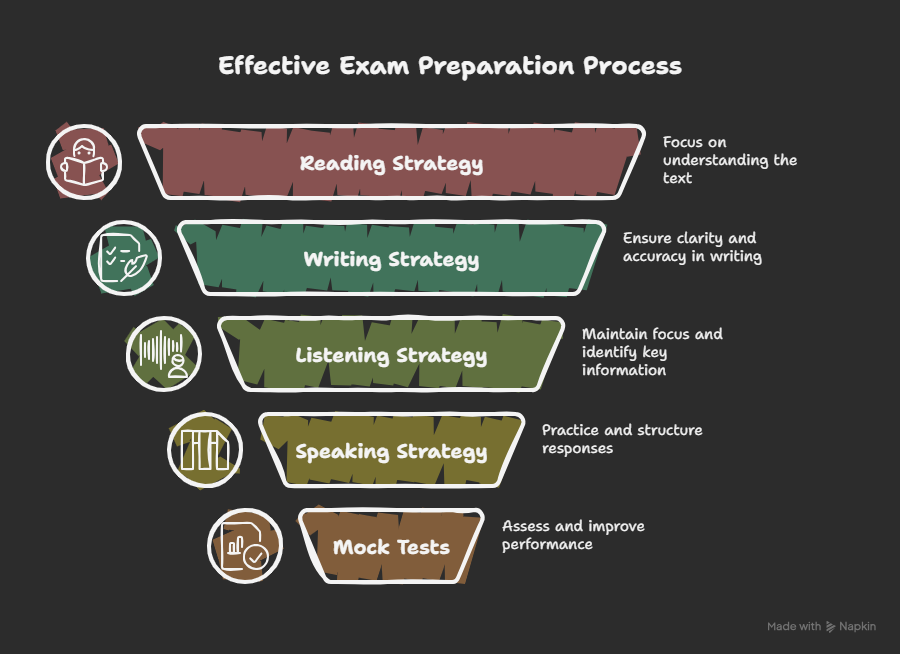
Reading Strategy
Reading tests measure comprehension accuracy. Speed and understanding must balance. Avoid translating every single word. Focus on overall meaning first.
Effective Reading Approach
- Read questions before passage
- Identify keywords
- Predict possible answers
- Skim the text quickly
- Understand main idea
- Note important sections
- Scan for specific details
- Dates and numbers
- Names and locations
- Avoid overthinking answers
- Trust first understanding
- Eliminate wrong options
Reading Practice Plan
| Step | Purpose Achieved |
|---|---|
| Question preview | Direction clarity |
| Skimming | Main idea capture |
| Scanning | Detail identification |
| Answer review | Error reduction |
Regular timed practice improves reading speed. Vocabulary familiarity strengthens comprehension accuracy.
Writing Strategy
Writing tests structure and clarity. Simple sentences score better often. Clear organization improves readability. Follow required format carefully.
Writing Improvement Steps
- Understand task instructions clearly
- Word limit awareness
- Topic understanding
- Plan before writing
- Note key points
- Organize paragraph flow
- Use simple sentence structure
- Avoid complex constructions
- Maintain clarity
- Review before submission
- Check grammar errors
- Correct spelling mistakes
Writing Structure Table
| Section | Focus Area |
|---|---|
| Introduction | Clear topic mention |
| Body | Logical explanation |
| Conclusion | Short closing line |
| Review | Grammar correction |
Practice improves writing speed gradually. Clear structure reduces confusion.
Listening Strategy
Listening demands focused attention. Audio plays limited times. Missing details creates stress. Calm concentration improves accuracy.
Listening Practice Techniques
- Read questions first
- Identify keywords
- Predict information type
- Listen for main idea
- Do not panic
- Ignore unknown words
- Note important details
- Numbers and names
- Locations and dates
- Stay attentive throughout
- Avoid mental distraction
- Maintain steady focus
Listening Preparation Plan
| Practice Method | Skill Developed |
|---|---|
| Short audio drills | Detail recognition |
| Repeated listening | Sound clarity |
| Note-taking practice | Quick information capture |
| Timed exercises | Speed control |
Frequent listening builds confidence gradually. Exposure improves understanding naturally.
Speaking Strategy
Speaking tests clarity and confidence. Fluency matters more than perfection. Structured answers create strong impression. Calm delivery increases confidence.
Speaking Preparation Steps
- Practice common topics
- Daily life themes
- Opinion-based questions
- Use simple connectors
- For logical flow
- For clear structure
- Maintain steady pace
- Avoid rushing
- Pause naturally
- Maintain eye contact
- Show confidence
- Stay composed
Speaking Skill Table
| Focus Area | Improvement Benefit |
|---|---|
| Topic practice | Idea clarity |
| Connector usage | Structured answers |
| Pace control | Clear delivery |
| Confidence building | Better impression |
Regular speaking practice reduces nervousness. Confidence grows with repetition.
Mock Tests & Time Management
Mock tests simulate real conditions. They reveal performance gaps clearly. Timed practice improves speed control. Repeated testing builds endurance.
Mock Test Benefits
- Identify weak sections
- Targeted improvement
- Focused revision
- Improve time allocation
- Balanced section timing
- Avoid last-minute rush
- Build exam stamina
- Maintain concentration
- Reduce anxiety
Time Management Plan
| Section | Suggested Focus Time |
|---|---|
| Reading | Controlled pacing |
| Writing | Planned drafting |
| Listening | Full attention |
| Speaking | Calm structured response |
Practice under real timing conditions. Avoid spending excess time initially. Track performance after each test. Improve gradually through analysis.
Smart preparation increases success probability. Strategy turns effort into results. Consistent practice builds strong exam confidence.
Final Advice
Language learning needs patience and steady discipline. Daily effort matters more than short bursts of intensity. Small, consistent improvements build lasting progress and real confidence. Set clear weekly goals and track your growth regularly. Celebrate small wins and learn from mistakes without fear. Stay organized with structured notes, regular revision, and balanced practice of all skills.
Protect a positive mindset and avoid negative self-talk. Stay patient during slow phases and trust your consistent effort. Create a distraction-free routine with fixed study hours. Limit unnecessary screen time and remain connected with the language daily through listening, reading, and speaking. Remember your purpose and visualize success often. Commitment, consistency, and practice gradually turn goals into achievement.
Free German A1 Mock Tests – Powered by AI!
Test your skills on our interactive platform. Get instant feedback from our AI to help you communicate better and track your progress. Start your free German mock test now.
Test Your German A1 for FreeFrequently Asked Questions
Is it really possible to learn German in six months?
Yes, it is possible to reach a strong beginner or lower intermediate level within six months if you study consistently and follow a structured plan. The key factor is daily practice rather than occasional long study sessions. With one to two focused hours every day, learners can comfortably complete foundational levels like A1 and A2, and even approach B1 with dedication. However, becoming completely fluent like a native speaker usually requires more time and immersion. Success depends on discipline, regular speaking practice, and continuous revision.
How many hours should I study German daily?
Ideally, one to two hours of focused study every day is sufficient for steady progress. These hours should include vocabulary, grammar, listening, speaking, and revision. Studying for long hours without focus is less effective than short, structured sessions. Consistency matters more than intensity. A balanced routine ensures all language skills improve together.
Which level can I realistically achieve in six months?
Most learners can comfortably achieve A2 level within six months with consistent effort. Reaching B1 is also possible if study intensity remains high and speaking practice is regular. The exact level depends on your learning speed and daily commitment. Learners who actively practice conversation often progress faster. Clear milestones help measure realistic progress.
Should I focus more on grammar or speaking?
Both grammar and speaking are important, but balance is essential. Grammar provides structure, while speaking builds confidence and fluency. Over-focusing only on grammar can slow communication skills. At the same time, ignoring grammar completely may create accuracy issues. A combined approach ensures steady and practical improvement.
How can I improve my German speaking skills quickly?
Start speaking from the first week, even if your sentences are simple. Practice daily self-introductions and short topic discussions. Record yourself and listen for pronunciation errors. Try conversation simulations and question-answer practice. Regular speaking reduces hesitation and builds natural confidence over time.
Is self-study enough to crack German exams?
Self-study can be effective if you use reliable resources and follow a structured plan. However, guidance from a mentor or language partner can accelerate improvement. Mock tests and feedback are very important for exam preparation. Regular self-assessment helps identify weak areas. Discipline and consistency determine the success of self-study.
How important is pronunciation in German learning?
Pronunciation plays a major role in clear communication. Even with correct grammar, unclear pronunciation can cause misunderstandings. Early practice prevents long-term mistakes. Listening carefully and repeating audio helps improve accuracy. Good pronunciation increases confidence during speaking exams.
What is the best way to remember German vocabulary?
Spaced repetition is one of the most effective techniques. Reviewing words at planned intervals improves long-term retention. Using flashcards and writing example sentences helps reinforce memory. Learning vocabulary by topic also improves understanding. Daily revision prevents forgetting previously learned words.
How should I prepare for German language exams?
Understand the exam format clearly before preparation. Practice reading, writing, listening, and speaking separately. Take full-length mock tests under timed conditions. Analyze mistakes and correct them immediately. Consistent practice reduces exam anxiety and improves time management.
What should I do if I feel stuck during learning?
Feeling stuck is normal during language learning. Take a short break but avoid long gaps. Change your learning method to make it interesting. Practice more speaking to rebuild confidence. Consistent small efforts will help you move forward again.