Table of Contents
While it might be scary and discourageing, the thought of searching through job listings late at night can be very enticing. You come across positions that were able to match your skills in Berlin startups or Munich engineering firms and for a moment you think you would make a life in Germany. And the reality begins to bite. Someone says you need years of experience. A forum post lays out that freshmen never pass. Doubt builds before you even apply. This hesitation is common, but it’s also based on half truths, rather than how the system really works.
The EU Blue Card was conceived as a means to attract professional skilled workers, rather than a barrier to them. Norms in Germany don’t have an unrealistic checklist of experience. What matters most is your qualifications, a legitimate job offer, and whether the salary is fair to the role and to the industry standards. Even early-career workers, provided their degree is recognized and a minimum wage is paid, can qualify in many fields, particularly engineering, healthcare and research. Experience helps, but not as a gatekeeper.
In IT the picture becomes even more flexible. In Germany, IT professionals can apply for an EU Blue Card without having a degree if they have good practical skills and relevant work experience. This is because the country values what you can do, not just what is written on a certificate. This offers a real path for developers, system administrators and tech specialists that many do not.
What makes your chances really strong is preparation. Find the jobs that are relevant to you, make sure your qualifications are visible, know what the salary is for your profession and present your profile as truthful as possible. Many applicants get approved because they are good, but not because they are perfect. By understanding how the EU Blue Card really works, you can move from late-night doubt to informed action—and decide with confidence whether Germany is the right next step for you.
Learn German from the best mentors in the field! Join the Entri online course!
Intro: Myth vs Reality
So many people get held back by myths that just don’t hold up anymore. One of the biggest is that you need five, ten, or even more years of solid work history to qualify for the EU Blue Card. You hear it in WhatsApp groups, on Reddit threads, or from someone who tried years ago and gave up. The truth feels different when you look at how things actually work today. German authorities care most about whether you have a recognized university degree that lines up with the job and whether the salary offer hits the current threshold. Experience helps prove you’re capable, but it’s rarely a hard requirement on its own.
Take someone who just finished a computer science degree in India or Nigeria. They get an offer from a growing tech team in Hamburg paying above the minimum. Because the studies match the coding and problem-solving the job needs, officials often approve without asking for years on the resume. The same openness applies in other areas. Another myth floating around says experience only counts if you earned it back home—yet work from anywhere in the world gets considered as long as you can show solid proof like contracts or references. That’s why thousands keep succeeding each year.
The majority of the Blue Cards granted to all members of the European Union were issued by Germany and over 56,000 new EU Blue Cards were issued in 2024. What’s more striking is how many people actually live and work in Germany as part of this scheme, which has now reached over 100,000. These numbers are not an accident. These are not temporary hiring patterns, but are structurally driven by a long-term structural need in the German economy. Germany is not trying to experiment with skilled migration but is actively reliant on it.
And in critical sectors like engineering, software, healthcare and science, the country is still short of capacity. Ageing populations, declining birth rates, and rapid digital transformation have created gaps that cannot be filled domestically. Germany needs qualified outside EU professionals to keep industries and public services running. A European Blue Card is one of the most viable ways to fill this void, and has given skilled workers a legally-expedited and efficient entry and exit.
The system has become more flexible and accessible over time. Salary thresholds have been modified, qualification systems have improved and rules for demand-driven jobs have been simplified. These changes are signs of change in mindset. The Blue Card is not only for elites or niche gentry. It is now being tailored more and more to well-meaning mid-level professionals who have clear criteria and are capable of contributing immediately.
When you remove old fears about complexity or exclusivity, the EU Blue Card begins to look far more realistic. Engineers, developers, doctors and researchers find it a decided and feasible next step rather than an unknown vision. Germany’s approach shows that skilled migration is not simply welcome—it is necessary.
Is Work Experience Mandatory?
1: How do you say "Good Morning" in German?
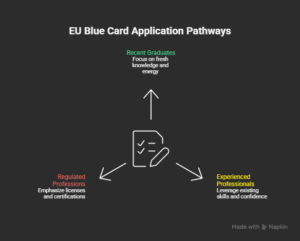 Straight up: no, work experience is not mandatory for everyone applying for an EU Blue Card. The foundation is a university degree that Germany recognizes as equivalent to one from a local school, plus a job offer that matches what you studied and pays at least the required amount. As of 2026, that gross annual salary sits at €50,700 for most jobs, but it drops to €45,934.20 in shortage fields like IT, engineering, or healthcare—or even for people who graduated in the last three years. The job usually needs to last at least six months, and the Federal Employment Agency sometimes has to give a quick okay, but the rules don’t demand a long list of past positions.
This setup opens the door especially wide for people just starting out. Companies love hiring recent graduates because they come with fresh knowledge, quick learning, and energy that fits fast-moving teams. Official numbers show a good chunk of approvals go to folks who wrapped up their studies recently, often in entry-level roles that still meet the lower salary bar. On the flip side, if you already have a few solid years behind you, that history usually pushes your salary higher and makes employers feel more confident, which speeds things along.
But even without that track record, a well-matched degree and offer can carry the application. In regulated jobs like medicine, extra licenses come into play no matter what, but for most professions the spotlight stays on education and relevance instead of forcing everyone to rack up years first. Put your energy into finding a fitting role and negotiating fair pay, and experience becomes a nice bonus rather than a roadblock.
|
German A2 Exercises – Download Free PDF |
||
Free German A1 Mock Tests – Powered by AI!
Test your skills on our interactive platform. Get instant feedback from our AI to help you communicate better and track your progress. Start your free German mock test now.
Test Your German A1 for FreeDegree + Job Relevance Explained
Your degree sits at the heart of the whole process. German officials need to see it as comparable to a German qualification—check that quickly in the ANABIN database, where an “H+” rating means you’re good to go. After recognition, the real test is showing how what you studied prepares you for the actual work in the job description. They look closely because no one wants to bring someone in who needs years of retraining.
You make your case stronger by attaching things like course lists, transcripts, or even project summaries from university that highlight the overlap. An electrical engineering grad applying to work on solar panel systems has an easy story to tell; the same person applying to manage financial portfolios might get more questions. When the link feels natural, everything moves faster. Recent graduates often have an edge here—their knowledge stays current, and many employers specifically look for that. A large portion of approvals involve people who finished school in the last few years. If ANABIN isn’t enough and you need official equivalence, the Central Office for Foreign Education can handle it for a small fee, though starting early saves headaches. Nail the degree-job match, and suddenly the EU Blue Card feels much closer than it seemed at first.
Fresh Graduates vs Experienced Professionals
New graduates and people with years on the job both have clear ways forward, just with slightly different advantages. If you’re fresh out of university—especially within the last three years—you qualify for the lower salary threshold of €45,934.20 across the board, even outside shortage fields. That opens doors to entry-level spots in startups, labs, or bigger companies that value new ideas and modern training. Many get hired because teams want someone who brings up-to-date tools and approaches without old habits baked in.
Folks further along in their careers bring a different kind of strength. Past successes help justify salaries well above the minimum, and hiring managers see lower risk when someone already knows how to deliver in similar roles. Three, five, or more years often lead to mid-level or senior positions with better pay and quicker decisions. Yet the rules never force graduates aside to favor veterans—the balance keeps both groups welcome.
Everyone gets the same perks: up to four years on the initial permit, family can join, and permanent residency becomes realistic after a reasonable time of work and integration. Graduates build everything from scratch, learning the culture and networks along the way; experienced applicants use their history to land stronger terms right away. Wherever you stand today, matching your background to a solid offer puts you in a strong position to become one of the many EU Blue Card holders thriving in Germany.
|
Goethe 2026 Exam Dates: Multiple Test Centers |
|
| Trivandrum Goethe Exam Dates | Kochi Goethe Exam Dates |
| Chennai Goethe Exam Dates | Coimbatore Goethe Exam Dates |
Sector-Wise Experience Expectations
Every industry has its own flavor when it comes to experience because Germany’s needs vary so much. Shortage areas give more breathing room, while others lean harder on proof you’re ready to contribute.
IT Professionals
IT feels like one of the friendliest sectors right now. Demand for developers, data people, cybersecurity experts, and cloud specialists stays sky-high, so rules bend to bring talent in fast. A relevant degree helps a lot, but recent grads land roles all the time because companies need fresh coders who know current frameworks. The lower €45,934.20 threshold applies, and places like Berlin or Frankfurt keep hiring internationally.
If you have a couple of years—or even three to five—building apps, managing systems, or working with AI, approvals usually come quicker and offers get better. Portfolios, code samples, or boss recommendations add real weight. And there’s even a special path without any degree at all, which we’ll cover soon. Shortages push flexibility here, so IT remains a strong bet whether you’re starting out or switching lanes.
Engineers
Engineering demands solid foundations, but both newcomers and pros find spots. Mechanical, civil, electrical, and related fields often qualify as shortage areas, dropping the salary requirement and easing entry. Graduates with strong coursework in design, materials, or simulation jump into automotive, renewable energy, or construction projects, especially when their studies line up closely.
People with several years under their belt move into specialized or leadership roles that pay well above minimums. Showing past projects, certifications, or results helps prove you’re the right fit. Germany’s economy runs on engineering talent, so steady openings keep the door open for everyone prepared to show relevance.
Healthcare Workers
Healthcare moves slower because safety comes first—doctors, nurses, and therapists need qualification recognition plus language tests and sometimes bridging courses. Experience carries more weight here since hands-on patient work builds trust. New grads often start with extra training in Germany, while those with three or more years in clinics or hospitals see smoother paths.
Shortages in nursing and some specialties help lower thresholds in places, and approvals rise when you demonstrate real bedside or diagnostic skills. Solid B1 or B2 German pairs with that experience to make a big difference. It takes patience, but dedicated people fill critical gaps every year.
Researchers
The demanding nature of the research professional profession relies on superior academic credentials, with a master’s or PhD being a more important baseline than a competitive advantage. Unlike other firms, experience expectations for junior researchers, doctoral candidates and postdoctoral positions are relatively less stringent.
At these levels institutions want to know more about your time, your knowledge of your area, your ability to design experiments, and your ability to think critically than they do about how long you have worked. It facilitates research for young professionals who are interested in basic principles but may lack substantial industry experience.
University, laboratory, and research institutes also recruit on a global scale. Most hiring is done through grant, contract or fellowship funding, and is based on pre-defined compensation and compliance measures. Because the funding has already been secured, candidates are assessed for fit, research relevance, and skill alignment rather than negotiation or prior compensation history. This transnational, project based model allows researchers to move across countries and institutions without the obstacles of traditional jobs.
New PhD students are a key component of this ecosystem. They often apply the most up-to-date theories, methodologies, and technical approaches directly from their doctorate. They are exposed to modern software and new work that allows them to be on the cutting edge of projects. Such freshness is a value that researchers share, especially in fast-paced fields where the relevance of staying current is more important than time spent doing the job.
At the top, but, expectations change. Researchers with good publications history, successful grant applications, patents or leadership experience on teams and projects are more likely to become the principal investigator or lead investigator. Key distinguishing factors here are demonstrated output and impact.
Free German A1 Mock Tests – Powered by AI!
Test your skills on our interactive platform. Get instant feedback from our AI to help you communicate better and track your progress. Start your free German mock test now.
Test Your German A1 for FreeWhen Experience Replaces a Degree
Sometimes experience truly stands in for a formal degree, though this happens mostly in one area. IT leads the pack because the talent shortage forces flexibility. German rules let certain IT professionals qualify without university if they prove university-level skills through work alone.
You need at least three years of relevant IT experience in the past seven years, and that work must have been essential for roles similar to the German job. The offer still needs to last six months minimum and pay at least €45,934.20 in 2026. Self-taught coders, bootcamp grads, and long-time practitioners use this path successfully. Other fields stick closer to degrees, but IT shows how Germany adjusts when demand gets urgent.
Special IT Rule (Without Formal Degree)
The IT exception adds a new degree requirement to inform and communication technology professionals, providing a more practical pathway for specialists who began their career outside of college. Instead, the state emphasizes verified and relevant work experience and a practical job offer that meets labor-market requirements.
In order to qualify applicants must receive a firm job offer of at least six months and at or above the required minimum wage for the shortage occupation. This is a not-for-profit offering that represents a strong economic value in itself, and confirms an employer’s willingness to hire based on skill rather than on academic credentials. On completion of this requirement, applicants must have at least three years of university level IT work experience in the last seven years.
What matters is not just time served but relevance and depth. This experience must be clear to reflect the job offered and must have been a key requirement for similar positions. Officials then evaluate the applicant for professional experience that would compare to that of a degree holder. The evaluation is evidence-based, meaning it may include a detailed job description, employer references, documentation of project work, certifications, and concrete technical achievements.
This is a rule because IT has real labor shortages. Most of the companies struggle to fill positions efficiently through traditional hiring processes, and governments have altered immigration processes to fit the needs of the tech industry. So many skilled professionals could move in and out of work without graduate school.
Candidate should combine this route with basic German language skills and extremely organized documentation for best results. Clear, standardized paperwork and well-structured evidence will increase the chance for approval and reduce processing time.
How Experience Is Verified
All documents are reviewed by officials to ensure fairness and transparency. The application process usually begins with a job contract or offer letter. This document should outline your role, responsibilities, salary, start date, and why you were selected for this position. A properly executed contract, with company logo on official letterhead and signed signatures provides confidence and confirmation to officials that the offer is genuine.
Payslips from your recent or previous employment provide a helpful support. They can help you prove that you actually worked in the positions you claim and how long you spent in those positions. A balanced and accurate paylip that clearly shows your title, employer information and the employment period will give you an edge over the competition. Payslips that are not received, or are not present, can also lead to follow-up questions or delays.
Your professional background can be best represented in letters containing experience from previous employers. These letters are often filled with a description of your job title, key tasks, accomplishments and sometimes even a few observations about your performance. In fact, writing a well written experience letter can help cement your application as credible. If the documents are not in the right language, certified translations are requested, as non-official translations may not be accepted.
Purity and accuracy are also key throughout the process. Even small errors or contradictions between documents can raise red flags and slow approval. LinkedIn profiles or recommendation letters may help you prove your case, but they don’t replace official papers. Keep all documents up to date on your visa or permit application and this helps speed up processing, which typically takes a few weeks or a few months depending on the country and jurisdiction involved.
Learn German from the best mentors in the field! Join the Entri online course!
Conclusion
The idea that only highly experienced professionals are eligible for the EU Blue Card does not hold up today. It is need and relevance that is the foundation of Germany’s system, not old checklists. If you hold a recognized qualification, have an offer that matches your talents, and a wage above current levels, the door is pretty much open, whether you’re a recent graduate, a mid-level professional, or an experienced specialist.
Experience alone does not differentiate successful applicants from never applying but clarity and preparation. Most of the fear of the process is removed once you know how degrees are measured, how experience counts and how different sectors operate. Germany is not testing your perfection, it is testing whether you can contribute meaningfully.
Skilled migration is not a side policy anymore, but a structural necessity of the German economy. That’s what the EU Blue Card is. When you substitute myths for facts, trepidation for planning, the route becomes practical and attainable. If Germany matches your professional goals, the next step is not waiting for “more experience” but a decision.
Expert Tips
Set yourself up right with these real-world moves. Check Make it in Germany regularly for the latest salary numbers and shortage lists—they update every year. Rewrite your CV to spotlight projects and results with numbers where you can; it stands out.
Connect with people already there—LinkedIn groups, expat forums, or industry events often lead to referrals. Push for salary that comfortably clears the threshold, especially in hot fields. Start German classes even at A1 or A2; it shows seriousness and helps life after arrival.
Collect documents early—budget for translations, recognition fees, maybe even advice from an immigration lawyer if your case has twists. If something gets denied, you usually have a month to appeal. Keep track of your application online and follow up politely. Stay patient but proactive; the people who succeed treat this like a project with clear steps. You’ve got the skills—now line up the pieces, and Germany can become your next chapter as an EU Blue Card holder.
Free German A1 Mock Tests – Powered by AI!
Test your skills on our interactive platform. Get instant feedback from our AI to help you communicate better and track your progress. Start your free German mock test now.
Test Your German A1 for FreeFrequently Asked Questions
I am a fresh graduate with no work experience. Is the EU Blue Card a realistic option for me, or should I wait several years?
Absolutely, it is a realistic and common option. The core misconception about the EU Blue Card is that it’s exclusively for seasoned veterans. In reality, the German legislator designed specific provisions to attract young talent directly from universities. Your primary qualification is a recognized university degree that is relevant to the job offer you secure.
The critical lever for you is the special salary threshold for recent graduates. As of 2026, while the standard threshold is €50,700, there is a reduced threshold of €45,934.20. This lower threshold applies to all occupations—not just shortage fields—if you have obtained your recognized university degree within the last three years. This rule is a deliberate incentive for German companies to hire international graduates early in their careers, bringing in fresh knowledge and modern methodologies.
Therefore, your path is clear: focus on securing a job offer in your field of study that meets this lower salary requirement. In sectors like software development, engineering, scientific research, and certain business roles, entry-level positions in German cities frequently meet or exceed this figure. Your “experience” is your up-to-date academic knowledge. The immigration authorities will examine the relevance of your degree to the job description. A Computer Science graduate applying for a junior developer role, or a Mechanical Engineering graduate applying for a CAD designer position, presents a compelling, straightforward case.
Waiting years solely to accumulate experience for the Blue Card is often a strategic error. You lose access to the favorable graduate threshold and delay your entry into the German job market, where early integration and language acquisition are invaluable. Your profile is highly attractive to many German employers, especially startups and innovative Mittelstand (medium-sized) companies who value current academic training and adaptability. Prepare a strong application highlighting your thesis, academic projects, and technical skills that directly align with the job. The EU Blue Card is not your future possibility; it is your present opportunity.
How exactly do German authorities verify my "relevant work experience," and what documents constitute solid proof?
Verification is a meticulous, document-driven process. Authorities rely on official, verifiable paperwork to assess the legitimacy and relevance of your claimed experience. Anecdotes or unverified online profiles are insufficient. The burden of proof is on you to present a clear, consistent, and paper-backed career narrative.
The cornerstone document is your employment contract or binding job offer from the German employer. This must detail your position, responsibilities, start date, duration (at least 6 months), and crucially, the gross annual salary, confirming it meets the required threshold.
To prove your past experience, a layered approach is best:
-
Experience Letters/Certificates of Employment (Arbeitszeugnis style): Ideally from each previous employer, on company letterhead, signed and dated. These should state your exact job title, precise period of employment (month/year to month/year), and a detailed description of your core duties and projects. German authorities favor documents that resemble the German Arbeitszeugnis, which typically includes role descriptions.
-
Pay Slips and Bank Statements: Original pay slips from your past roles are powerful evidence. They corroborate the employment periods stated in your experience letters and prove the professional nature of the engagement. Bank statements showing regular salary deposits can serve as supporting evidence if pay slips are lost.
-
Social Security/ Tax Documentation: Documents from your home country’s pension, social security, or tax authority that officially record your periods of employment are considered highly credible, as they are state-verified.
-
Supplementary Evidence: Project portfolios, publication lists (for researchers), professional certifications, or reference letters from supervisors can add depth, but they support the core official documents; they do not replace them.
All documents not in German or English must be translated by a sworn, certified translator. Inconsistencies (e.g., mismatched dates between your CV and a contract) can trigger requests for clarification or cause delays. The message is: start collecting these documents early, ensure they are accurate and comprehensive, and present them in a well-organized, chronological dossier.
For the IT sector "experience over degree" rule, what qualifies as "three years of comparable professional experience"?
This rule (§19c AufenthG) is a significant pathway for non-graduate IT talent, but “comparable professional experience” is interpreted strictly. It doesn’t mean three years of casual coding or IT support. It requires proving that your experience is equivalent to the knowledge and skills gained from a German university degree in an IT field.
The “three years in the last seven” is the temporal frame. The experience must be professional, meaning it was your primary, paid occupation. Freelance or self-employed experience can qualify but requires even more rigorous proof (e.g., long-term client contracts, invoices, tax records).
Authorities and the Federal Employment Agency (BA) assess comparability by examining:
-
Complexity & Autonomy: Did your work involve solving complex problems, designing systems, developing software architectures, or managing significant IT projects? Routine maintenance or basic help-desk tasks are less likely to be deemed “comparable.”
-
Relevance to the German Job Offer: Your past experience must logically prepare you for the specific IT position offered in Germany. A job as a DevOps engineer requires proof of past experience in DevOps, automation, and cloud platforms.
-
Documentation: You must provide exhaustive proof: detailed reference letters describing projects and technologies used, employment contracts, pay slips, and a compelling portfolio (GitHub repositories, project descriptions). Certifications from major tech vendors (AWS, Microsoft, Cisco) can bolster your case by providing standardized, recognized benchmarks of your skills.
The German employer plays a key role. In their job offer and supporting statement, they must justify why they are hiring you based on your experience rather than a formal degree, explaining how your proven skills meet their needs. This pathway acknowledges that in the rapidly evolving IT world, proven capability can be as valuable as formal education. Your application must tell a convincing story of professional growth, technical depth, and direct relevance to the German labor market’s needs.
Does work experience from any country in the world count equally, or is experience from certain regions valued more?
Legally and formally, work experience from any country is valid and counted equally for the EU Blue Card application. The German immigration law does not hierarchize experience based on geography. What matters is the verifiability, relevance, and professional quality of the experience, not where it was acquired.
An experienced software engineer from Kenya, India, Brazil, or Ukraine with strong documentation has the same formal standing as one from Canada or Japan. The authorities assess the substance of your career, not its location.
However, in practice, two indirect factors can come into play:
-
Ease of Verification: Experience from countries with robust, transparent record-keeping systems (where official tax documents, standardized employment letters, and easily verifiable company registries are the norm) can sometimes be processed with slightly less administrative scrutiny. Conversely, experience from regions where document formats are less formal or fraud is a higher concern might lead to more detailed questioning or requests for additional proof. This is not discrimination, but a procedural reality of risk assessment. The solution is impeccable, well-translated, and notarized documentation.
-
Market Familiarity & “Brand” Recognition: A hiring manager at a German company might unconsciously favor experience from companies or universities they recognize. Working for a multinational tech giant or a well-known local champion in your field can make it easier for the employer—and subsequently the authorities—to gauge the level and rigor of your experience. This is a perception issue, not a legal one.
Your strategy should be to transcend geography through quality. Focus on documenting your achievements, the scale of projects, technologies used, and responsibilities held. Obtain reference letters that detail your role in internationally understandable terms. Ultimately, if you can prove via concrete evidence that you have been a high-performing professional in your field, your experience will be valued, full stop.
I have 10+ years of experience but no formal university degree. Apart from the IT exception, is there any hope for an EU Blue Card?
For non-IT professions, the absence of a recognized university degree is a significant, and usually insurmountable, legal barrier to the standard EU Blue Card. The degree is a non-negotiable cornerstone of the Blue Card directive as implemented in German law.
However, all hope is not lost. Germany offers other potent immigration pathways tailored precisely for experienced professionals without degrees. You should pivot your focus to the Chancenkarte (Opportunity Card) and the Skilled Worker Immigration Act.
-
Chancenkarte (Points-Based System): This is your most direct route. You earn points for criteria like language skills (German/English), professional experience, age, connection to Germany, and a recognized vocational qualification (which is different from an academic degree). Substantial experience (5+ years) in a regulated profession earns high points. If you reach the required points threshold, you receive a one-year visa to search for a job in Germany. Once you find a job commensurate with your skills, you switch to a standard work residence permit.
-
Skilled Worker Visa (with Vocational Training): If you have completed a state-recognized, comparable vocational training (e.g., as a master craftsman, technician, or in a formal apprenticeship program) that lasted at least two years, and you have a job offer in that field, you qualify directly for a work visa. Your decade of experience then serves to strengthen this application.
-
Work Visa for Experienced Professionals: In certain in-demand fields, even without formal training, if you can demonstrate several years (usually 5-7) of highly relevant professional experience that is recognized as equivalent to a German vocational qualification, you may be eligible. This requires a meticulous individual case assessment by the Federal Employment Agency (ZA).
Your 10+ years of experience is a tremendous asset, not a waste. It opens the door wide to these alternative routes. The key is to abandon the “Blue Card or bust” mindset and strategically target the immigration channel designed for your profile: the experienced professional with proven, non-academic expertise.
In highly regulated professions like medicine or law, how does work experience interplay with the mandatory state approval (Anerkennung)?
In regulated professions (reglementierte Berufe), the process is a two-stage hurdle: 1. Professional Recognition (Anerkennung), 2. Immigration Permission (Blue Card/Work Visa). Experience is deeply intertwined with the first, often more challenging, stage.
For doctors, the state recognition of your medical degree and license is mandatory. Here, experience is not a “nice-to-have” but a potential compensatory mechanism. If your medical training is deemed to have significant differences from the German curriculum, you may be required to complete adaptation measures (Anpassungsmaßnahmen), such as knowledge tests or supervised practice periods (Berufserfahrung unter Aufsicht). In this context, proven, documented clinical experience in your home country can sometimes reduce the scope or duration of these adaptation requirements. It demonstrates practical competence.
For lawyers wishing to practice German law, the path is exceptionally narrow and typically requires passing the German state exams. Experience in international law firms or with home-country law may be valued by employers hiring for specialist consultative roles, but it does not bypass the bar admission requirements.
For engineers in certain fields (like structural safety) or healthcare professions like physiotherapists, the recognition body (e.g., the respective Chamber) will assess both your degree and your professional experience. Years of responsible work can be crucial in convincing them of the equivalence of your overall qualification package.
The critical sequence is: First, you initiate the recognition procedure with the competent German authority (e.g., the respective Landesamt or Chamber). You submit your degree, transcripts, and proof of experience. Only once you have a positive or provisional recognition decision (stating any compensatory measures needed) can you effectively apply for a Blue Card. The job offer must be for the regulated profession, and the salary threshold applies. Thus, in these fields, experience is a key piece of evidence in the recognition dossier, helping to bridge gaps between education systems and proving your readiness to practice under German standards.
Does unpaid work, internships, or freelance project work count towards the required experience years?
The short answer is: It’s complicated and often insufficient for core requirements, but it can be valuable supporting evidence.
For the central experience requirements—such as proving “comparable professional experience” for the IT rule or for general strength of application—German authorities primarily seek full-time, paid, professional employment. This is because such employment implies a certain level of responsibility, skill, and integration into a professional structure that meets German standards.
-
Unpaid Work/Internships: Typically, these are not counted towards the calculation of years for formal thresholds. They are considered part of an educational or training phase, not comparable professional experience. However, a prestigious or highly technical internship can be mentioned in your CV and discussed in an interview to show early exposure to the field.
-
Freelance Work: This is a grey area with a higher burden of proof. For it to be considered, you must prove it was substantial, sustained professional activity, not occasional gigs. You would need to provide: long-term contracts with clients, continuous invoice records, bank statements showing regular income from this work, and tax documents declaring this freelance income. For the IT exception, successful freelance developers with a clear portfolio and such documentation have been approved. However, the path is more scrutinized than for traditional employment.
-
Doctoral Research (PhD Candidates): This is a special case. While often funded through stipends (not a salary), it is universally regarded as highly qualified professional experience, especially for research and academic roles. It should be prominently featured.
While these types of experience may not check the formal “X years” box in a rigid sense, they are far from worthless. Document them thoroughly. They help build a holistic picture of your dedication, skill progression, and continuous engagement with your profession. They can be decisive in a job interview and can support your case to immigration officials as evidence of your practical capabilities and deep-seated interest in the field.
I have a mix of experience in different but related fields. How do I prove the "relevance" to a specific German job offer?
This is a common scenario for career pivoters or those in interdisciplinary roles. The key is to become a strategic narrator of your own career, constructing a coherent story that links your past to the German future.
Step 1: Deconstruct the German Job Description. List the core required skills: both hard (e.g., Python, CAD design, clinical procedures) and soft (project management, cross-functional teamwork, client consulting).
Step 2: Audit Your Diverse Experience. Go through each past role not by its job title, but by the skills and projects you executed. Did you manage budgets? Lead a team? Develop a client database? Implement a new quality control process?
Step 3: Create a Relevance Map. In your application documents, explicitly connect the dots.
-
Tailored CV: Don’t use a generic CV. Structure the bullet points under each past position to highlight the tasks and achievements most relevant to the German job. If the German job needs “data analysis,” ensure a bullet point from your marketing role describes how you “analyzed campaign performance data using SQL and Excel to drive a 15% increase in ROI.”
-
Motivation Letter/Cover Letter: This is your narrative canvas. Write a paragraph that says: “While my official title at Company X was ‘Product Support Specialist,’ the role heavily involved troubleshooting our IoT platform, which required deep understanding of network protocols and Python scripting—skills directly applicable to the IoT Developer position you are offering.”
-
Project Portfolio/Annex: For technical fields, a separate document listing projects, the technologies used, and your specific contribution can visually demonstrate relevance across different job titles.
Step 4: Secure Supportive References. If possible, ask former supervisors for reference letters that can speak to the specific, transferable skills needed for the new role.
The immigration case worker is not a mind-reader. You must actively demonstrate that your heterogeneous experience forms a unique, valuable, and directly applicable skill set for the specific job in Germany. Show them the thread that runs through your career and leads to this offer.
If my application is rejected due to "insufficient relevant experience," what are my concrete options to appeal or reapply?
A rejection is a setback, not an end. First, carefully analyze the official rejection letter (Ablehnungsbescheid). It is legally required to state the precise reasons. “Insufficient relevant experience” is a starting point, but you need to understand the specific gap they perceived.
Your immediate options:
-
File a Formal Objection (Widerspruch): You typically have one month from receipt of the letter to file a written objection. This is not an emotional appeal but a legal procedural step. In it, you must address the specific reason cited. You can:
-
Contest the Interpretation: Argue that your experience is relevant, providing additional, clearer documentation you may have omitted initially (e.g., a more detailed reference letter, a project report).
-
Provide New Evidence: If you have gained more experience since applying, you can submit proof. If you have a new, more detailed statement from your future German employer explaining why your experience is perfect for the role, include it.
-
Request a Re-evaluation.
-
-
Reapply with a Strengthened Dossier: Sometimes, it’s more efficient to start a fresh application, especially if the objection period has passed. Use the rejection as feedback to rebuild:
-
Get a More Detailed Job Description: Work with your German employer to revise the Stellenbeschreibung (job description) to more explicitly mirror the skills demonstrated in your past experience.
-
Bridge the Gap with a “Preparatory” Role: If the gap is clear (e.g., they wanted 3 years of specific SAP module experience and you have 1), consider if you can find a related role in Germany under a different permit (e.g., a regular work visa for a slightly different job), gain the missing experience locally for 1-2 years, and then apply for the Blue Card.
-
Seek Professional Advice: Consult an immigration lawyer (Fachanwalt für Ausländer- und Asylrecht). They can assess the rejection’s merits and suggest the best legal or strategic course.
-
Persistence is key. Many successful applicants faced an initial hurdle. Treat the process as a dialogue: they asked a question (via the rejection), and you must now provide a better, more documented answer.
Beyond the legal minimums, how does additional experience tangibly benefit my EU Blue Card application and my career in Germany?
Surpassing the minimum experience requirements transforms your application from a technical compliance exercise into a compelling, fast-tracked case with significant long-term career advantages.
For the Application Process:
-
Faster Approval: Applications with candidates holding 5+ years of experience, especially with well-known companies, often face less scrutiny. The case worker sees a lower “risk” profile, leading to quicker decisions.
-
Stronger Negotiation Power: Your experience directly translates into a higher salary. Exceeding the threshold by a wide margin (e.g., earning €65,000 against a €50,700 minimum) makes your application ironclad and can sometimes simplify the labor market test (prioritization check) with the Federal Employment Agency.
-
Easier Job Search: You are competing for mid-to-senior level positions where there is often less competition from the domestic EU workforce. German employers actively seek experienced professionals to fill leadership and specialist gaps, making them more willing to handle the sponsorship process.
For Your Career in Germany:
-
Higher Starting Position & Salary: You enter the market not as a junior, but at a level commensurate with your global experience. This sets a higher baseline for all future salary increases and promotions within the German system.
-
Accelerated Path to Permanent Residency (Niederlassungserlaubnis): With a standard Blue Card, PR is possible after 33 months with basic German (A1), or just 21 months if you demonstrate German language skills at level B1. Your experience helps you secure the stable, well-paid employment needed to fulfill this requirement swiftly.
-
Professional Credibility & Network: Entering with a proven track record grants you immediate professional credibility. It’s easier to build a network with peers and superiors when you are seen as a fellow experienced professional, not a trainee. This can lead to better projects, mentoring opportunities, and faster integration into the German business culture.
In essence, while experience might not be a strict legal necessity for many, it is the ultimate career capital. It turbocharges your immigration pathway and lays the foundation for a more successful, senior, and financially rewarding long-term career in Germany.