Table of Contents
Germany keeps facing a real shortage of skilled people in lots of important fields right now, and honestly, that opens up some pretty exciting doors for anyone with the right background who dreams of working there. The EU Blue Card really stands out because it’s one of the quickest and most straightforward ways to get a work visa in Germany. It lets qualified professionals pack up, move over relatively fast, and jump straight into a job that actually uses what they’ve studied or worked on for years. Companies created this visa to attract talent in fields where they struggle to find skilled professionals—such as technology, healthcare, engineering, and natural sciences—where new job openings appear constantly.
The salary part feels doable for a lot of skilled folks. Right now in 2026, the standard gross annual salary you need is at least €50,700 for most jobs. But if the role falls into a shortage occupation, that number drops to €45,934.20, and you just need approval from the Federal Employment Agency to make it work. The same lower threshold applies if you finished your degree or equivalent qualification in the last three years—no matter the field—which is great news for recent graduates starting out.
They update them every year according to the pension insurance ceiling, so they keep pace with the economy. Add that to Germany’s strong economy, the way people actually get to enjoy their time off work, those long vacation allowances, and good medical care, and you have a package that feels like a real treat.
Think about being in Berlin and its creative energy, Munich and its mix of tradition and technology, Frankfurt as a financial centre, or Hamburg by the water, places that are alive, with great public transport, parks, culture, and a life appropriate for singles, couples, or families. The EU Blue Card is even better than other visa options because its process is much quicker—less waiting times, simpler rules for bringing your spouse (who can usually start working right away) and easy access to schools for kids. Software development, data roles, doctors and nurses, engineers that work on cars, or green energy, those are the fields that demand the greatest amount of jobs, because they give you stability and an opportunity to grow, and lots of people move up very quickly in big international teams.
This guide tells you everything you need to know about finding a job, how to apply in time, and what to do if someone comes knocking you down so you can skip it. It builds on actions from past experience so you can see yourself succeeding and be motivated to do so. Keep it going and you’ll see what it means to turn interest into a plan.
Learn German from the best mentors in the field! Join the Entri online course!
Eligibility Overview
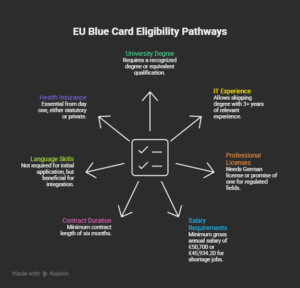 To get the EU Blue Card, the first big piece is having a university degree or something equivalent that German authorities see as matching one of their own higher education qualifications. If you have a bachelor’s or master’s from a recognized school, you’re usually in good shape, but foreign degrees need checking.
The easiest way is to use the anabin database which tells you if your school and program count as similar or equivalent. If it doesn’t, you can get a statement from the Central Office for Foreign Education to confirm it. In some fields, such as IT, you can skip the degree if you have at least three years of solid, relevant experience that demonstrates university-level skills and the job offer directly relates to that work.
The regulations—such as a doctor, teacher, lawyer, or some engineers—have additional requirements: you either have the German license for practice or the government gives you a letter that they’ll grant it after you arrive. This makes sure everything is safe and professional. Even the best-known higher-level paths, such as master craftsman credentialing, can count if they reach that level. Getting this recognized early relieves a great deal of stress later and makes your whole case stronger.
The part of salary everyone watches most is probably the one. If you are working in the regular sector, your contract must provide at least €50,700 gross per year, about half of the annual pension assessment limit, and is adjusted annually. It falls to €45,934.20 for shortage jobs but only if approved by the Federal Employment Agency (they make sure it truly closes a gap and does not harm local workers). Newcomers also receive the same €45,934.20 threshold regardless of the discipline, if their degree is less than three years old, and an agency approval is still in effect.
The contract itself needs to run for at least six months, and only your fixed base salary counts toward the number—bonuses or extras usually don’t help reach it. Talking openly about the visa during salary talks often gets employers to meet or beat the minimum, especially when they really want your skills. When the lower threshold is in play, that agency approval becomes part of the visa steps, keeping things fair.
Language rules are fairly relaxed when you first apply. You don’t need German to get an EU Blue Card, so many international companies—especially in tech, research, universities, and large global firms—operate entirely in English. That said, some jobs really need German because you’ll talk to clients, work closely in teams, or deal with regulations, and that’s more common outside big cities or in regulated roles. Down the road, if you want permanent residency, you’ll usually need A1 German after 27 months or B1 to speed it up to 21 months.
Starting with some basic German before you go—maybe through an app, online lessons, or evening classes—helps you settle in faster and opens more doors over time. A lot of people arrive, work mostly in English at first, and pick up the language naturally while living there, which keeps things manageable without blocking the move.
You also need health insurance lined up from day one—usually statutory coverage starts with the job, but a short-term private travel policy that meets Schengen rules can bridge any gap. No heavy criminal checks beyond normal declarations, and things like your age or where you’re from don’t block you if the main requirements fit. Germany’s system welcomes skilled people from around the world and supports their families by allowing spouses to work without extra paperwork, making the move easier. When you match the role’s qualifications, meet the salary expectations, fit the job’s expertise requirements, and cover essential needs, Germany’s job market offers you real opportunities.
|
German A2 Exercises – Download Free PDF |
||
Step-by-Step Job Search Process
1: How do you say "Good Morning" in German?
Start your search for jobs, German employers are actively seeking international talent. Especially in Germany, LinkedIn is a vital part of the hiring process, especially among skilled workers. Having a strong profile is much more important than volume. Specify clearly your education, positions, core skills, and most importantly, tangible outcomes. Follow the companies you want to know, connect with recruiters in your area, and contribute by pointing out what’s been posted about industry news. Most German firms post openings directly on LinkedIn and follow-up increases your exposure to hiring managers and recruiters.
For international visitors, the Make it in Germany website is one of the most reliable sources. It’s an official government platform for new workers who are coming to work in Germany. It also presents detailed, up-to-date information on visas, work permits, verification of qualifications, and steps toward relocation along with carefully-curated job listings.
The site also provides links to trusted job portals and advisory firms, helping users understand both the job market and the legal process. Then you should apply direct to the job pages of the firm. Large German employers like Siemens, SAP, BMW, Deutsche Bank, Bosch and many others regularly post detailed job descriptions on their websites. These listings often include a description of the team, ongoing projects, skills needed, and/or relocation or visa assistance. Using official job listings can also increase your odds, since employers fill many of these roles without ever posting them on job sites. Use German job portals like StepStone, Indeed Germany and Xing. These websites allow you to search precisely by city, industry, level of experience, and contract type to find the jobs that are actually in your profile. Targeted work saves time and results in better quality applications.
Networking matters a lot—join virtual industry events, webinars, or expat groups focused on Germany life. Focusing on shortage areas naturally gets better results: tech jobs explode in Berlin’s startup world, healthcare stays steady in hospitals everywhere, engineering ties into cars and renewables. Keep searching consistently around your strengths, and connections start appearing.
Your CV needs to feel German: short (one or two pages), straight to the facts, reverse-chronological order. List dates, titles, main duties, and results you can measure—like “cut processing time 30% for a team of eight.” Clean layout, simple fonts, keywords from the job ad to beat the filters. Photos are optional now. Explain any gaps honestly. This no-fluff style matches what recruiters expect and helps you stand out positively. Recruiters often skip long, wordy resumes from other countries, so keeping your resume concise pays off fast.
The cover letter (Anschreiben) adds your personality. Format it properly: your address, date, theirs, greeting, opening that says why this job/company excites you, body linking your background to their needs (show you’ve researched them), polite close asking for a talk, and sign-off. One page max, courteous but direct. Tailor every one—generic letters go straight to the trash. Samples online give the skeleton, but your own words make it real.
Apply online mostly—follow portal instructions exactly, use PDF, track everything in a simple spreadsheet. After two weeks quiet, a polite follow-up email reminds them nicely. Prep hard for video interviews: good setup, professional look, practice answers showing why Germany, why them, and that you get punctuality and clear talk.
Interviews can have multiple rounds—technical tests for skilled jobs, questions about teamwork or challenges. Ask smart things about projects or growth to show you’re serious. Getting through usually means an offer soon.
|
Goethe 2026 Exam Dates: Multiple Test Centers |
|
| Trivandrum Goethe Exam Dates | Kochi Goethe Exam Dates |
| Chennai Goethe Exam Dates | Coimbatore Goethe Exam Dates |
Free German A1 Mock Tests – Powered by AI!
Test your skills on our interactive platform. Get instant feedback from our AI to help you communicate better and track your progress. Start your free German mock test now.
Test Your German A1 for FreeGetting a Blue Card-Eligible Job Offer
The offer should hit the salary sweet spot to be considered. That implies a gross annual salary of at least €50,700 for normal positions. For the needy or newly graduated, this threshold is less than €45,934.20. These are non-concurrent benchmarks, so check them out before going forward. Also, note that authorities typically only consider the base salary. Bonuses, allowances and other extras are rarely counted toward meeting the minimum.
It is important to discuss visa requirements early in the process. This is not a weakness, it is a step in the right direction. Many employers will change terms or provide support if they truly value a candidate. Transparency early enables the employers to properly structure the offer and to avoid delay or rejection later in the process.
Officials will check the job title, duties, and responsibilities closely to see if they match your qualifications. The position has to show you are using your professional skills and education. Defining your background with the job description can be a red flag, even when the wage is appropriate. The employment contract should be for a period of at least six months, have standard probation and notice periods, and include a clear starting date. Anything obtuse or vague can slow approval down or incite further questions.
Many employers provide relocation bonuses to ease the process for international workers. The benefits are designed to alleviate the stress of moving to another country and living in an unfamiliar environment. Most commonly used relocation services consist of temporary or long-term housing assistance, reimbursement of costs of relocation such as flight and shipping, and settlement allowance to offset the initial living expenses. Some employers even offer language instruction to help employees adapt quicker to work and the day. These benefits do not impact visa availability or approval, but they do provide additional protection for those who are just getting started and can not afford to leave. It’s always tough to start a new job, and with help you can focus on your job more than logistically.
In addition to the relocation benefits, relocating could show how invested an employer is in your long-term success. Structured support firms tend to understand the challenges faced by international hires and strive to promote a positive transition period. This can improve the quality of employment, productivity, and overall health. Small gestures such as registration, bank opening, or other basic assistance can be extremely helpful in a foreign country like Germany, where the paperwork can seem overwhelming at first.
Before submitting an offer of employment, the employment contract must be thoroughly read. Read through each clause line by line, checking for wages, hours, notice periods, probation terms and references to relocation support. If any part of this is unclear or unclear, don’t hesitate to ask for clarification. If you want to avoid misunderstandings, you can ask a German employment contract specialist, a legal advisor or a professional.
Learn German from the best mentors in the field! Join the Entri online course!
Common Mistakes to Avoid
Many skilled professionals underestimate the danger that small errors can bring to their chances while applying for a German EU Blue Card. Incorrectly, degree recognition is often delayed. If your qualification isn’t listed in Anabin or if it’s unclear, your application can sit still before it even starts. Salary minimums are another silent deal-breaker. Even strong profiles are rejected because an offer is too low on threshold. Generic CVs and cover letters can also be against you, because hiring managers will find them in minutes and do not move forward. If you rely only on English, you may limit yourself—especially in foreign countries—and when you rush through contracts, you often miss clauses that affect job security, probation, or benefits.
Practical details matter as much as the job itself. Many applicants neglect to provide health insurance proofs as early as possible, which creates unnecessary delays in registration and visa processing. Another costly mistake is to ignore networking. There are many jobs in Germany that are fillable via referrals or internal recommendations, long before they appear on job portals. To ignore this secret market, you prevent yourself from discovering high quality opportunities that never make it to public listings.
If done correctly, the EU Blue Card pathway is great. Germany offers competitive wages, strong worker protections, and a lifestyle that balances job growth with personal well-being. It is a system, predictable, but only to those who follow the rules and are prepared. That means understanding eligibility, tailoring applications, negotiating offers with awareness and avoiding traps that crank people up.
Germany really needs professionals, and it works when you get there strategically. With the right preparation, persistence and attention to detail, you can build a rewarding career in the heart of Europe – and it happens every day for those who do it right.
Conclusion
The demand for skilled professionals in Germany is not a short-term phenomenon, it’s a structural reality. The EU Blue Card is there because the country needs qualified people, and it is one of the most direct, fastest and most reliable ways to turn international work into a long-term career in Europe. Once your qualifications are established, your job offer is made up of terms of salary, and your application is carefully prepared, the system works in your favor.
What distinguishes successful candidates from frustrated applicants is preparation. Understanding degree recognition early, targeted hiring, budgeting according to visa regulations, and staying away from mistakes with paperwork can save you months of waiting. Language skills are not necessary initially, but they help you expand your options, ease your daily life and help permanent settlement.
If the idea of working in Germany is more than that, and you truly want to make it happen, then move on. Start with the right job search strategy, write a German-ready CV, and make investments in learning German alongside your career goals. The EU Blue Card, if done properly, is not just a visa; it’s a gateway to professional development, stability and quality of life in one of Europe’s strongest economies.
Free German A1 Mock Tests – Powered by AI!
Test your skills on our interactive platform. Get instant feedback from our AI to help you communicate better and track your progress. Start your free German mock test now.
Test Your German A1 for FreeFrequently Asked Questions
What exactly is the EU Blue Card, and why is it considered a superior option compared to a standard German work visa?
The EU Blue Card is a special residence permit designed specifically to attract highly qualified non-EU nationals to work in Germany (and the EU). Its superiority lies in its streamlined process and enhanced benefits. While a standard work visa requires a priority check by the Federal Employment Agency to ensure no EU candidate is available, the Blue Card waives this for shortage occupations and roles meeting the higher salary threshold, drastically speeding up approval. Furthermore, it offers a accelerated path to permanent residency (21-33 months instead of 5 years), more straightforward family reunification rights allowing spouses to work without restrictions, and greater mobility within the EU after 18 months. It’s a purpose-built fast-track for talent in high-demand fields.
I have a foreign university degree. How can I be absolutely sure it will be recognized for the EU Blue Card application?
Recognition is a critical first step. The official resource is the anabin database maintained by the German Rectors’ Conference. You must verify two things: that your university is listed as “H+” (recognized) and that your degree is evaluated as “comparable” to a German degree. If your institution or degree isn’t listed or status is unclear, you must apply for a Statement of Comparability from the Central Office for Foreign Education (ZAB). This process can take months, so initiating it early is paramount. For IT professionals without a formal degree, an alternative pathway exists: at least three years of documented, relevant professional experience deemed equivalent to a university education, coupled with a job offer matching that experience.
The salary thresholds are confusing. How do I know if my job offer qualifies for the lower €45,934.20 threshold or requires the standard €50,700?
The distinction is vital. The standard threshold (€50,700 for 2026) applies to all professions not classified as shortage occupations. The reduced threshold (€45,934.20) applies in two specific cases: 1) The job is on the official “shortage occupation” list (primarily STEM, healthcare, and certain academic fields), and the Federal Employment Agency grants approval for your specific role. 2) Or, you are a recent graduate—having obtained your recognized degree within the last three years—regardless of the field. In both reduced-threshold scenarios, the agency’s approval is mandatory and forms part of your visa application, ensuring the role genuinely addresses a skills gap.
Do I need to speak German fluently to apply for and receive an EU Blue Card?
No, not for the initial application. There is no formal German language requirement to obtain the EU Blue Card. Many multinational corporations, tech startups, and research institutions operate in English. However, your long-term integration and career flexibility benefit immensely from learning German. For permanent residency, language proficiency becomes mandatory: you’ll need level A1 after 27 months, or B1 to reduce the waiting period to 21 months. Moreover, for jobs involving client interaction, public sector work, or roles outside major cities, German is often a practical necessity from the start. Beginning lessons before you move demonstrates commitment and eases daily life.
Can my spouse or partner join me in Germany, and what are their work rights?
Yes, one of the most attractive features of the EU Blue Card is the favorable family reunification rules. Your spouse or registered partner can join you immediately. They will apply for a family reunion residence permit, which is typically granted swiftly. Crucially, they are entitled to work in Germany without any restrictions from day one—they do not need a separate work visa, and their employment is not tied to your specific job or employer. This is a significant advantage over other visa types and removes a major barrier for relocating families, allowing both partners to build their careers.
What is the step-by-step process from job search to actually moving to Germany?
The structured pathway is as follows: First, secure degree recognition via anabin or a ZAB statement. Concurrently, conduct a targeted job search using LinkedIn, the official Make it in Germany portal, company career pages, and German job boards like StepStone. Once you receive a qualified job offer meeting salary and content criteria, your employer may assist with the pre-approval from the Federal Employment Agency if needed. Then, apply for the EU Blue Card visa at the German embassy/consulate in your home country, submitting your contract, recognized degree, passport, and health insurance proof. After entry, you register your address (Anmeldung) in Germany, and then convert your visa into the full EU Blue Card resident permit at the local Foreigners’ Office (Ausländerbehörde).
What are the most common pitfalls or reasons for rejection in the EU Blue Card application process?
The most frequent pitfalls are: 1) Incomplete or unverified degree recognition—submitting an application without the anabin confirmation or ZAB statement halts everything. 2) Salary miscalculation—offers that don’t meet the precise gross annual threshold (counting only fixed base salary) are rejected. 3) Generic application materials—a CV not tailored to the German format or a non-specific cover letter (Anschreiben) fails to impress employers. 4) Underestimating processing times—not starting the degree check or visa appointment months in advance leads to stressful delays. 5) Lack of valid health insurance—you must prove coverage from the moment you land, often requiring a travel policy to bridge the gap before statutory insurance begins.
How does the EU Blue Card facilitate the path to permanent residency (settlement permit) and eventual citizenship?
The Blue Card provides the fastest route to permanent residency (Niederlassungserlaubnis). The standard requirement is 33 months of Blue Card employment with mandatory pension contributions. However, if you demonstrate German language proficiency at level B1, this period is reduced to just 21 months. This is a fraction of the standard 5-year requirement for other permits. After obtaining permanent residency, you can eventually apply for German citizenship, typically after 8 years of total residence (which can be reduced to 6-7 years with exceptional integration). The Blue Card essentially front-loads the integration benefits, rewarding skilled migrants who commit to Germany.
I work in IT without a formal degree but have extensive experience. How do I prove my qualifications are "equivalent" for the Blue Card?
The German immigration law (§ 18b AufenthG) allows for professional experience to substitute for a university degree in the IT sector. You must provide comprehensive documentation proving at least three years of relevant, professional IT work experience. This includes detailed references from past employers outlining your roles, responsibilities, technologies used, and projects. This portfolio must convincingly demonstrate that your knowledge and skills are at a university level. Crucially, your German job offer must be directly related to this proven field of experience. The final decision on equivalence rests with the immigration authorities, so presenting a strong, well-documented case is essential.
Beyond the visa, what are the realistic challenges and quality-of-life benefits I should expect when moving to Germany for work?
Challenges include navigating bureaucracy (registration, tax ID, residency permits), which requires patience and meticulous paperwork. Finding housing, especially in competitive cities like Munich, Hamburg, or Berlin, can be difficult and time-consuming. While many workplaces are English-friendly, daily life (government offices, contracts, local services) often operates in German. Cultural adjustment to direct communication styles and specific social norms is also common.
Benefits are substantial: Strong job security and worker protections under German law, excellent work-life balance with legally mandated minimum 20 days vacation (often 25-30+), robust public healthcare, and efficient infrastructure (public transport, cycling paths). You gain access to a central European location for travel, a high standard of living, and in fields with skill shortages, significant career growth potential within a stable, innovative economy.